Meeting Modern User Expectations in WordPress
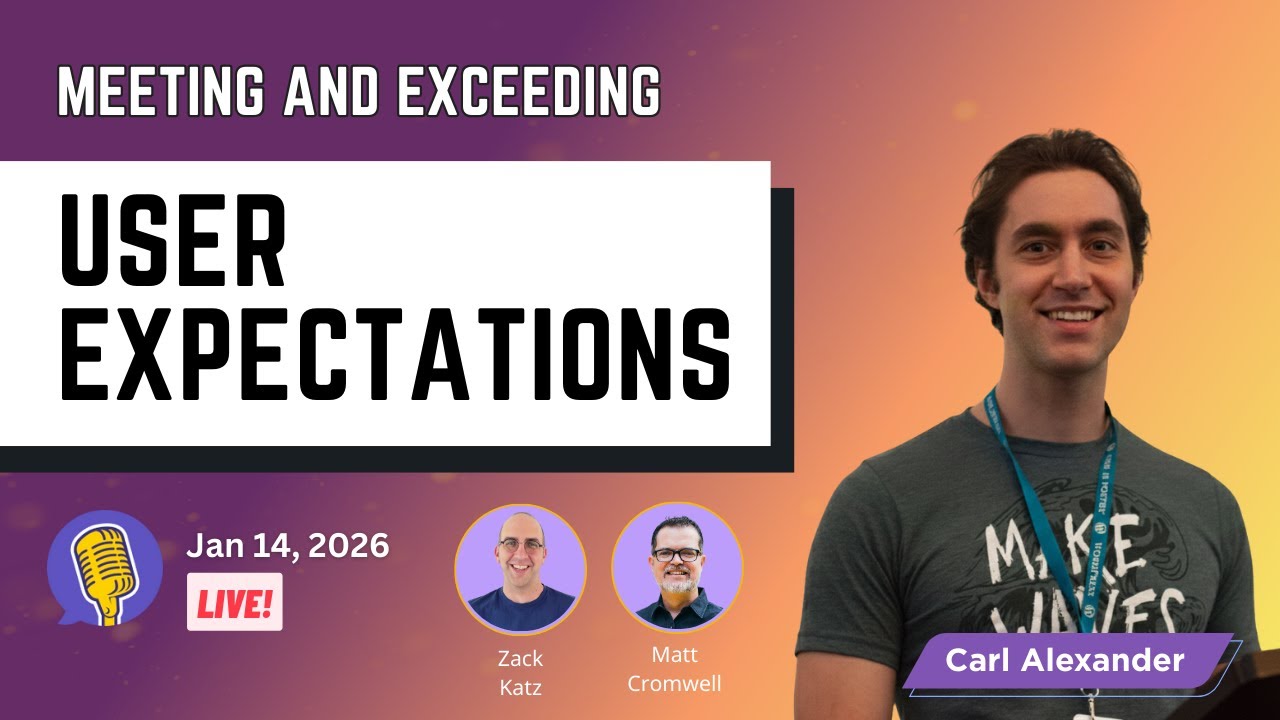
Hey everybody. If you've been in the WordPress space for a while, uh you know that so much of the product experience that people experience is filling out a bunch of settings like going through a form, clicking this, clicking that, and often not even knowing what's going to happen on the other end of it. Uh that's the way it has been in WordPress for a really long time. Things have been
changing quite a lot. Things are getting a lot more visual oriented. Uh but the thing is user expectations are quickly outpacing the way that we're able to get there. Today we're going to talk all about user expectations and how to meet and exceed them in the WordPress space. This is WP product talk. The place where every week we bring you insights, product marketing, business management
and growth, customer experience, product development, and more. It's your go-to podcast for WordPress product owners by WordPress product owners. And now enjoy the show. Hey everybody, I am Matt Cromwell uh from WP Product Talk >> and I'm Zach Katz from Gravity Kit
>> and uh we today are talking about user experiences. We're having a weird fun little formatting issue with our slide deck here. This is fascinating. I've never seen this happen before. So, while Matt is figuring that out, uh, I want to thank Fremius for being our exclusive growth partner on the road to 10,000 subscribers. That's that's our goal, uh, to get 10,000 YouTube subscribers. Fremius, haven't heard of it? Well, you should because they help software makers grow, monetize, and succeed. Fremius is
a merchant of record platform, and what that means is they handle everything surrounding selling software. Checkout, payments, subscriptions, licensings, updates, everything you need to know. global tax compliance even so you can focus on building amazing products. So check out Fremius. Huge thanks for sponsoring uh WP product talk. >> Awesome. Awesome. Thanks, Zach. And for today's subject of talking about user experiences um and amazing user experiences, we are bringing on two
folks. longtime friend of mine, Carl Alexander is here and a new friend, CEO of BuiltWith, Paul Carter as well. Hey folks, thanks for being here. >> Hey Matt. Hey, Zach. >> Yeah, thanks for coming on. Uh, so Carl Ven Paul, please tell everybody a little bit about yourself. >> Oh my goodness. Uh, I don't know where to start, but uh, longtime WordPress developer, freelancer,
uh, love basically building crazy things, which is what I'm doing with Emir. I'm working on Emir, which is bringing serverless technology to WordPress, uh, and the PHP space. Um, that I think that's a good short explanation. >> Cool. >> Uh, so my name's Paul Carter. I've been in the web hosting and SAS space for last couple of decades. Uh most recently uh myself and my two co-founders Justin Mazy and Josh Priddle were at A2. Uh and
after leaving there after the sale recently uh we founded uh Builtfast uh which is sort of a modern web hosting company focused on uh best experience uh for WordPress folks as well as other hosting traditional hosting. So this is appropriate for us. >> Awesome. Love having you both here. If you are watching right now on YouTube, then uh feel free to use that comment section and ask your questions. Um any and all questions about embarrassing
stories about Carl, I can answer. Um I cannot answer those questions about Paul, but um you know, we'll see how things go. >> Paul is much more respectable than Carl. >> I don't know. Zach and I could probably have a couple word camp days. >> Yeah. >> Yeah. Maybe today we get to create those embarrassing stories. Paul maybe. So >> I mean there's one of them right behind me. So there just like there's countless countless stories. >> Yes. So first up um we I want to talk a
little bit about just the problem that we're trying to address right now. Uh this whole idea that we want to create amazing uh product experiences, user experiences, but customer expectations are racing and getting higher and higher. Um what I'd love to hear a little bit about what is your zeitgeist about this situation at the moment. Paul, I'd love to hear your take. Um talk talk a little bit about what you're seeing in the space and uh what this
problem is exactly. >> Yeah, I think well I think one you know you guys probably hear it all the time but AI alone is is accelerating everything so fast. Um, it gives us the tooling to be able to meet expectations quicker through rapid prototyping or trying new things and even building faster, throwing away stuff and and keeping stuff that is is great. Um, but in terms of, you know, like our process and things that we've worked on, uh, you know, trying to get as close to the customer or the partner while you're
having those conversations, literally making them in putting them in the room or having the conversation with them on a weekly basis, um, and really watching them go through it. I think those things combined with the speed that we're seeing right now are probably the the best way I've seen in the current uh environment to get the best sort of user experience uh out of whatever we're building. And that's what we're trying to do. And it's hard, right? You know, it's hard to get feedback. It's hard to get people in the in the room to have the conversation. Uh but the tooling
allows us to move very very quickly. So I think that's what we've been focused on recently. >> Yeah. Yeah. I love it. Um Carl, what's your take? Are you facing the same thing? I mean, Yamir is a very different product. Um, not very customerf facing overall, but like what's your take on this situation? >> I mean, so you've known me a long time. And Zach too, like Zach, a funny story, Zach, so the domain's like emirapp.com and Zach was like so frustrated I didn't
have emir.app that he bought it for me and transferred it to me. >> I got so I got so mad. >> So mad. so mad about it. I still I still might use it. Uh >> you're still not using it? Oh my god. >> No, I'm still not using it. Uh but so I've been I've been talking about this tech I started working on this in 2019 to give you an idea. Right. So I've been I've been talking about this and working in Canada this year and Cloudfest USA. I started I'm preparing for a rebrand and I've been changing a bit about talking
about customer expectation and the view on this technology or the the interest has gone through the roof basically like both times I could not finish my talk in time because I was getting so many questions either it went over or I got I had to stop it. Um, so it it really speaks to the moment where I think the customer expectations around hosting and
like uptime like from a developer from developers to customers, nobody wants to hear about their site going down for any reason whatsoever like like it doesn't matter. And that's why like platforms like uh Shopify and Wix and Squarespace have a huge like foothold on that because when you're on that platform you never go down, right? Like executives talk about like sassification of software but not sacification in
terms of like the pricing model sassification in terms of expectation. When you pay for a SAS like it never goes down. Can you imagine if you if a SAS was as down as a WordPress site like their turn rate would be like 20 30%. Like it's impossible, right? So I'm seeing it even in tech talks. So it's crazy. >> Yeah. I was thinking about a little bit in terms of the kind of evolution of the way that we do work on computers and whatnot. Um I you know for the longest
time if you were going to accomplish anything on your computer it was going to be with a locally hosted application. You got to download the thing and install it and then it's running on your machine. And in that environment of course it's like it's always going to you know more or less it's always going to work. It's it's on your machine. It you pull it up and it doesn't matter whether you have the internet or not. Um it's going to work. But now so much of the work that we do and accomplish
actually is on the web um and physically requires the internet in so many different ways. Uh and folks's expectations though have stayed the same. They're still expecting to have a desktop like feel and a desktop like stability even though they're depending 100% on gigabytes of data going through there all the time. I think of like a platform like Figma. I could never never comprehend something like Figma existing
uh for me uh like six seven years ago actually it did launch I think six seven years ago at this point 10 years ago let's say um uh you know doing Adobe Illustrator and whatnot was the only way to get that kind of work done and now you can do all of that in the browser it's insane um so that and they're expecting more and more th those types of experiences I think I don't know Zach what's it what's it make you think about right now. >> Well, uh, in terms of 10 years ago, Gravity Kit's 11 years old, turning 12
this year. Uh, and that's a long time, right? And the difference between the customer expectations then and now, um, it's it's it's exponentially people are, I think, frustrated by the level of customization that's required to get something done. And so, Gravity Kit has a lot of settings, a lot of configuration. You drag and drop fields, you configure the field layouts. It's it's like a little page builder for Gravity Forms data. And people just want solutions and they also want powerful
applications at the same time. And Gravity Kit can do that, but it still requires way too much customization. And so internally at Gravity Kit, we're talking a lot about how to provide solutions rather than how to provide explainers for how to build those solutions. Like we want to make it easier for people to get from I've bought and installed your plugin to I am done. And reducing that is really I think the goal of should be the goal of all product owners at the at the moment because we are under threat from AI and
under threat from Shopify and Wix and Squarespace who provide uh simpler even if it's not as thorough uh implementations. Yeah, I I think similar to what Zach was just saying, like even in the hosting space, you know, if you look at 10 years ago, you could literally just keep throwing hardware at something to keep it keep it up and running. And even now with everyone being online, you know, the distributed model or trying to keep things online uh and responsive has
become a real challenge even just for large e-commerce websites. I think to what Carl was saying, you'd never expect Shopify to be down for some extended period of time or Matt was mentioning Figma, any of the tools that we use, but certainly as a user, my website or my my application online being down or not accessible or not scalable has just left the the mindset of people like that just isn't acceptable anymore. And I think that's where we're seeing a lot of the shift. And then you have folks like Carl
who spent all of his time for the last five six years just focusing on how to keep the website up and scalable indefinitely. And I think that's where we see a lot of the benefit from subject subject matter experts um who are deeply trying to understand that problem whether it's like Zach's team trying to make it really simple one button one button push to get something up and running easy or or Carl with you know how do I make it just uh simple to keep the site scalable. Yeah, I mean I'm seeing it like just you
know when I gave the talk at CloudFest like I had these young JavaScript developers in the back and I have a slide that says like I wanted the Versell experience and you should have seen their heads not like I think their heads were going to fall off their you know their shoulders like like developers don't want to hear about this stuff like nobody wants everybody has this expectation that you deploy code and then it just stays there it scales. It does what it needs to do. And also like even for me for Emir, I try to keep
it simple like you know it's still a developer product but I use a lot of what I call like progressive complexity like in configuration. So I start with easy configurations that that apply to everything and then you can kind of drill down and and customize it more granularly if you want to. But um yeah, so um but that's like really important basically to have this kind of simple experience and that's what devs want and
that's part of the Verscell experience right because the Verscell when we talk about the Verscell experience for those who don't know Verscell is the company that runs that built Nex.js which is a very popular uh JavaScript framework and they basically make it super simple to host a Nex.js JS application like you connect your GitHub repo, it deploys it and that's it. You're done. >> That's it. Yeah. >> And you're done, right? Um there's no questions of like how much RAM you have, how many CPUs you need. Like nobody
wants to hear about this. Like nobody nobody nobody wants to hear about it. Like they want it the same thing as as for regular products. Developers want simple experiences. Like I'm an old boomer who started like basically managing servers when he was like 15, but nobody's growing up managing servers anymore. Like you know, nobody wants to SSH in and like tinker with stuff. Like they just wanted to just grow and scale. And like Paul was saying, like I've been
working on that for like a long time, but the message just really started hitting this year because I think there's been a critical kind of point in user expectations that's been hit this year, like an inflection point where this stuff just matters now. >> Absolutely. I think the other aspect um that is really significant when it comes to um plugins and themes and whatnot um is just also that the UI of whatever you're interacting with should explain itself intuitively. Uh folks really are
tired of being like, "Okay, I'm going to go and work on this one thing in this one screen, and then in order for me to have success, I need to go over to a whole another screen and do something else over there, and then I need to go and check out, make sure that it actually works on the front end the way I'm expecting it to. Uh I mean, this has been that in so many ways is the WordPress way for a really long time. Not only just that you do something in the admin and then you have to go and make sure it still looks okay. Uh but
sometimes you have to do it across multiple different screens before anything is is actually working real uh correctly. Um but uh I don't know exactly the best way to describe uh the path forward under those circumstances but I can say clearly that the users are more and more expecting that whatever they're going to get done is going to be done in a in a very uh intuitive and visualoriented way and not only should be up and functioning all the time it
also should actually uh make sense to them visually immediately. Does that resonate with you, Zach, as well? >> Yeah, it does. Um, one of the things that that Carl was saying and Paul was about uptime expectations, and I thought that was really funny that one of the other things that's come in and and I think this applies in other ways to the plug-in space. While we while expectations have increased in surrounding uptime, the understanding that when Cloudflare is down or Amazon is down, it's okay. It's not your fault.
that that shift and the like the public understanding that everything is so hyperconnected um has really evolved um at least what I saw as the reaction to the downtime that Cloudflare and and and Amazon had. Um in terms of the questions about like configuration, I do think Matt that the trend is toward hyper simplicity. Uh but part of the problem there is that uh we get down to like the AI chatbot like the
the single prompt box as the simplest thing that people could do. Yet that is just like a a facade for unlimited complexity. And so the goal is like Carl was saying progressive enhancement and progressive disclosure for as you master one thing we can present you with the next level of of of skill. And there's a great book called making oh it's over there making your users awesome. Um I think it's the the main title is badass making your users awesome. It's all
about this where it's like your job as a plug-in owner as a product owner is to guide your users to expert toward expertise uh progressively. So it's not like okay you're going to go from being afraid of heights to bungee jumping. It's you're going to ease into this uh process of learning this tool and becoming masterful in it. >> Paul, I'd love to hear um some uh examples or if you have things top of mind. It looked like you had something
on top of mind already. So, >> I did. Yeah. Like you brought up a great experience. Sorry, I apologize. Go ahead. >> No, no, no, no. It's all you. I was going to say you brought up a great experience like um one of the things that we got to do when we relaunched Builtfast was to rethink about how a control panel would work. We're all sort of very familiar with the the primary control panels are out there. They're very task focused like let me let me find the button that does the thing I want it to do and then I'm going to do that thing in here and then I got to go over here to this other button to do that thing. Um, and it's it's powerful
because you have a lot of features, but the workflow uh can be really difficult on users. And sometimes that's similar even in WordPress if I'm trying to do multiple steps and I want to do multiple things inside of there. And so, um, one of the things our product team, you know, we're working with Carl on a new product called Vector that that takes his product and and makes it usable. And one of the things that our product team can do is actually use AI to develop quick UX. um uh not just even wireframes, but usable functional
separate apps or internal uh pages or flows. And it's much easier for us to go through. There used to be a pretty high bar to say like, "All right, I'm going to throw a designer at this. I'm going to throw a UI person at this. I'm going to then have it coded up and try it." And now, like within a day or maybe two, you can have five, six, seven working prototypes and flows. You can put those in front of users. You can put those in front of your teams and get feedback and
go what feels the most intuitive. How does and and even real time now where if you're even if you're willing to do some vibe vibe coding, you can put a user in there, have them walk through it, and then say, "Oh, he he ran into a a cold sack here. Let me make a quick change. Now, walk through it again. Oh, that didn't happen again." Um, so I think when we're talking about the expectations again, the speed and the the level of expectation like Zach's like it's all interconnected, everything should stay up and you know, uh, whatever. Uh, but it's very high bar. At
the same time, we now have tooling that allows us to get much much closer to say the Figma experience or the Shopify experience or whatever, even for small businesses or or you know, hosting companies or whoever. One of the things we've done at Gravity Kit over the years is we really focused on having great text documentation and some good onboarding videos, but those videos show how to create a simple application uh that are complex but not
really complex. And one of the things we just were talking about in team in a team call was we need to show from start to finish all the nitty-gritty. uh so to to expose to ourselves uh how much complexity there is so we can simplify the process and we can also demonstrate to users what the current experience is. We need to simplify that uh so much the use of any short codes is a kind of uh failure state that should be represented
by a user interface uh or like a an AI prompt like there there should not be uh as many places in our plugins or our settings for misunderstanding for uh errors to be introduced for like it's easy to fail all across WordPress by clicking a button and that's unacceptable. And I do think that when you can just say to GPT uh you know that's not working fix it. That's where the user experience has been shifting so much so
rapidly like why is Google so bad? Why can't I just ask it a question and get an answer like chat GPT? Like that same question people are asking across WordPress. Why am I having to do all this stuff and how can it be simpler and like how can I get out of this as soon as possible and just get what I want done? And for us like that is a process. I don't think there's a single answer. I think it's every episode of WP product talk where we talk about onboarding, we
talk about marketing, we talk about like uh user accessibility, we talk about like all the all the different aspects of running a business are going to be coming into play here as people expect more and better from from their web experience. >> 100%. 100%. Carl. >> Yeah, I mean AI is changing a lot. Like I can't I mean Google has good AI
answers now, but I one of the I mean I use it some like but uh I'm a big Gemini stand actually. So I was just like >> I'm a big Gemini stand. Their AI if I see an AI answer something instantly I assume it's wrong. I mean, but the AI stuff is hard. Like I talk a lot about I mean, we're talking product, but on the marketing side, it's it's decimating >> everything. Um, like, you know, I,
>> you know, I didn't do that much content marketing and I'm like, I don't feel I missed out, you know, like it's like because it I don't know if it matters. Like I feel like having the community and stuff like that matters for products and stuff like for user expectations. they want to talk with somebody if they, you know, if AI can't solve it, they want to talk with someone. Uh, you know, like I think support's as important as ever. Uh, things like that. But yeah, it's like it's really hard. Like you can
solve so much that way. >> Let's talk about that a little bit because and Matt, I'd love to hear your thoughts on this. Like one of the things we're considering is as AI is taking more and more support responses, maybe we bring on some phone support or we bring in like a tier 2, tier three one- on-one like Zoom calls. Like how are uh how is is that how is AI shifting the customer expectation of support?
>> Yeah, I'm sure Paul has some good thoughts on this too. I mean, the whole aspect of how AI can benefit um the customer support environment, I think is something we've talked about on the show quite a bit. Um and I do think I do think that AI is is a good way to provide solutions to customers faster, faster than an agent can. And if you're not trying to make sure that your AI is providing solutions to your customers
faster, you're you're in the wrong business. like you you have to do that. Um, but I love the the note that you brought in there too, Zach, in the sense that like sometimes folks don't care that your bot can give them faster answers. They just want to talk to a human. Like there is this aspect in which it doesn't they don't actually want a fast resolution. They want to feel heard and that's just never going to go away.
So bringing in an intentional like white glove feeling of like you know our bots can help you so you should use them as much as you can but if you really need somebody to kind of counsel you through your hosting problem we have some folks available to you. I think that's a nice hybrid approach for sure but especially in the hosting environment where essentially they own the whole environment AI can go to town. um like if you have like a simple thing like uh
for example a an SSL certificate just gets borked on renewal in one way or another the hosting environment you know it's just like AI should be able to be like oh yeah let me renew that for you right now you don't need to have a person to like interrogate you for five minutes over live chat to figure out whether or not it's an SSL certificate or not yeah it's an SSL certificate renew something like right now like it That's not hard. That's not rocket science anymore. Um, and it doesn't
require a person. And the person who does that kind of support, they don't enjoy that kind of support. They're just like, "Oh my gosh, here's like the three dozen um SSL renewal thing that I've had to do this week." Um, that's not a enjoyable uh work environment to have. Um, so I I find support technicians are excited by AI that solves the dumb support um and are really motivated uh to help people at a higher level. So that that hybrid thing I think is ideal.
Anyway, I don't want to steal all of the insights that Paul has in the hosting environment and AI and support, but the that's been my experiences too. So >> yeah, I couldn't agree more. I think you know it's a it's a stepped process, right? which is that if you build a product well at first by meeting those expectations, you just generally have less uh support coming in. But I've also seen now that AI is out there, you see some people clumsily trying to cram AI as the frontline agent. And that just it's like calling a a 1-800 number for
support when you desperately need it. If you're calling the 1-800 number, most people now have probably done some level of due diligence or it's not obvious that it's it needs to be they can be fixed uh easily. And so the last thing you want to do is put them through 15 variations of like press two for so and so. And same thing on AI chat. Now what I do think and this is where I think uh you're 100% right is um similarly to developers who are using AI. If you put um a tool like AI in someone who doesn't
know how to code in their hands, they might get some stuff done, but really putting AI into to a subject matter experts hands, a developer that understands, you turn them into a ninja or a you know whatever a monster in terms of producing. It's the same thing for for um I think our agents, right? So you have fewer level two, level three agents versus these level one agents. Um, and by default, you're bringing up an account. It immediately does the scanning. It can uh parse the
information. It can pull out the relevant information. So, the agent doesn't have to spend 10 minutes reading a response or talking to the customer up front. It can automatically do a lot of that pre pre-work. Um, and then you get to do the the thing that it really, like you were saying, Matt, that humans really enjoy doing, which is I just want to help. I want to solve this problem for you without frustrating you or frustrating me doing the menial tasks. And I think that's where if you can get it right, the AI does a phenomenal job of of coming alongside uh support people
>> 100%. I'll I'll add one more thing that I I also do think the hosting environments, SAS applications, they have the benefit that they own all the code um and can control that environment um basically 100%. WordPress plugins and themes are distributed. it's a lot harder, but there's a lot of really smart folks doing a lot of things to try to bring the support experience into the WordPress admin. And as we build out our MCP for WordPress and the core AI team is building more uh AI into WordPress
core itself, I think that's going to empower plugins to have a lot better access to the environment that the customer lives in uh and to be able to provide a lot better support in that environment. That's one thing we were doing at StellarWP is putting the support into the WordPress envir environment with the benefit of AI being able to provide a lot more context than what the user is saying purely in a little chatbot. Um I I think that that's
also the future for uh WordPress products because it's been our Achilles heel for too long. We just we we can't see their environment. We don't know everything about it and the customer doesn't know how to explain what's going on in their environment. uh they often don't even know where their system info is in order to provide it to you. Um so having all those things at your fingertips um is is something that's going to become more and more common, more and more normal for WordPress plugins, too, I think, going forward.
>> Yeah, I mean, oh my god, I have so many thoughts. First, I want to shout out to Zach, my co-host, for for saying like I think I agree with him. Legendary human support I think is critical. I think that's why I want to >> writes wholeheartedly believe that all the way to stand out is to provide legendary human support as fast as AI can without the AI fluff. >> Yeah. I mean I also believe in like this idea of community and people helping each other out and like having things
escalate uh like keeping that human stuff. One thing I was thinking about and I had kind of a kind of terrorizing thought about as you were talking Matt is what if we get the the chatbot problem that we have with this the admin notifications? What if every plugin has a freaking chatbot in the in the admin? >> Like >> Yeah. I mean cross my mind till till you were
talking. I'm like yeah but now like That's where it's headed already. That's what I'm saying. That's what we That's what That's what I was physically implementing at Stellar before I took off. >> The command pallet is really going to be the interface that everybody needs to implement otherwise it's going to be a mess. >> Yeah, they almost need a unified chat solution that the plugins hook into basically. And then but to me that's like a disastrous scenario because again like that's part of the part of the
challenges with the user experience like is is this disjointedness >> of of everything you know every and that doesn't make for a good user expect experience or user expectations right like it's just it doesn't and >> that's been an Achilles Hill of the admin for a long time like people have been pushing really hard to have like a kind of unified design language and whatnot, but it but you know can you you
know how are you gonna fight all the chat bots the chat bubbles on on your admin? There's going to be like a whole row you know whole row at the bottom of chat bubbles and it's just like which one do you click on? Like it's >> I mean I think that's going to be a huge problem. Uh I was just hearing you thought and I was like oh my god that's like terrible. Like for me, I just think I really like there's this um email marketing software. It's one guy, but he's like so talented. It's called
Bento. Uh and he's building like a chatbot thing, but he still has a very active like he has a Discord and stuff, but like the idea is like the chat should definitely the AI chat should be basically about getting things done too. Like it's it's I like so so much of it is about like answering questions, but I I I view the chatbot should be more as a yes, you can ask questions about what why things aren't working, but I think the power of
the chatbot is to get you to do things, right? We talked about like, oh, it sucks that you have to go through three windows, three different windows to get something done, but the chatbot doesn't care. Like, it knows which settings to go toggle. It just does it and then it's like, "Oh, it's done." and then you can just go back to the home screen. Like it's about customer empowerment, not >> so is that that is that a current expectation of of modern WordPress users though? Like is >> I think that's where it's going.
>> That's where it's going. Yeah, I I agree. I I I'm actually really curious, Paul, your take because I for me coming from uh the experience of like trying to get support into a plug-in environment, working at a hosting company, uh my kind of like hail Mary was that I want hosting companies to own this problem because the bottom line is that you all do in uh control that environment a ton more than the plugins do. And often,
unfortunately, sometimes uh the customer is going to reach out to the hosting company for support and the hosting company is like, "Oh, that's a plug-in. That's not our problem." Uh, and that just ends up being also a terrible experience. You you know exactly where I'm going, Paul. I'd love to hear your thoughts. >> Yeah, I I agree. Look, the worst thing for a customer is to say the the agency says that's a hosting problem, the hosting company says that's an agency problem, and then the customer is left to go like, "I don't I don't know where to go now." So that's the worst case
scenario. And um a lot of times the let's go back to the support um the the superb support piece which is no one wants to take responsibility. The the agency doesn't want to mess up something in the the uh the environment and the hosting company doesn't want to screw something up in the plug-in and be responsible for fixing it. And I think again this is where real-time triaging using AI tools um in in hand with anme means that they can go like oh I've pin it could run a bunch of tests it could do a bunch of stuff and and pull back a
lot of data that would have not been available. Um, you know, it's interesting. Carla has been working on some logging stuff for us and just having access to that real-time stream of data um will make us be able to troubleshoot problems on the platform infinitely faster, right? And ultimately we can apply um AI or other types of things that will either proactively or dynamically give us like, oh, this has been seen before. This is probably your solution. Um, and how how can you get to a self-healing environment is is a
different different thing. Um I you know the struggle I think that we're going to see is that you know Zach asked is this the expectation of a modern WordPress user? I think the answer is that we're losing some of the people off of WordPress because they go, "Oh, my friend's using Shopify or my friend's using this other Wix, Weebly, whatever the other thing is." And I never have that problem, >> right? They have the full control of it. And so they go, you know, WordPress was
uh and is hugely powerful and hugely dynamic, but if you can't meet the user where they're at, they will find another solution. And I think that's where we've been struggling a little bit honestly um in those areas. And so is it an expectation? Yes, Zach. I think it is an expectation. I don't think that they um I don't think that they think it's going to get solved fast. And that's why we're losing some of those users off to other platforms right now. >> Yeah. >> Yeah. What do you think, Matt? >> I I'm going to do another little tiny
spicy poke at the hosting guy. Um um I think and part of the reason why we have that dilemma where it's like oh I'm on Wix, I'm on Squarespace, it's all roses over here and WordPress is all like, oh man, things are broken. It's because of the at the end of the day kind of like the false promises that the managed WordPress hosting environment promised uh that and if you're going to be on managed WordPress, you're going to pay a little bit more and that's because
we're going to manage your WordPress for you so you don't have those problems. But the truth is, manage WordPress has just become basically like more or less updating your plugins maybe at the best, you know, um or yeah, will let you know if there's a new PHP version that you can upgrade to. Uh it's not at all what it was ever intended to be in the first place. Again, just poking at the hosting guy. Not to turn on my brethren, but I would say that I would agree 100%. And I think one of the things you see in the
hosting space right now is this race to the bottom where plans are $1.99 a month or a managed WP is $4.99 a month. And um and realistically at scale you're not going to be able to provide the level of support that a quote unquote managed environment will be able to provide. Right? When you say managed um you're talking about somebody helping you do. I mean, maybe it's automated in some way, but you're expecting that somebody can help you when you run into a problem. Um, and so I've worked in other other
hosting companies over the years and been through a number of them. And what ends up happening is that you lose customers off to price and they they care less and less about the actual service until the service becomes so bad that they go, I it doesn't matter how cheap you sell me this product, I'm going to go spend it somewhere else. And then now you have that's why you have third you have some dedicated host who are $35 to $50 a month for a website that is you know three pages five pages
on a hosting thing. It's not it's not about the need of the requirements or the resources of the the site. It's about about the fact that they want to pick up a phone and get someone on there that knows what they're doing when something doesn't work. And so I think we're in this uh you know not uh they're in this pushpull like where you can't sell something that cheap. uh it's a marketing ploy to say it's managed when it's not really managed but the end user doesn't really know that right but as a host if you're not being competitive and offering competitive pricing uh on
similar products as everyone sort of moves down to the bottom then it becomes really difficult until someone has a real problem and they're like oh no uh you mean my $1.99 a month managed hosting doesn't come with somebody who's going to help me fix my plug-in problem oh >> now now maybe I should be looking for something that actually does support that. So, um yeah, you can poke at it. I think it's I think it's a f a very valid criticism. Um but I think it's a a mix, right? Because again, there's infinite number of plugins and for me to train my
staff or or our team to understand every theme, every plugin th those that are using modern building tools, those are not using modern tools, the updated security patches, it gets really difficult. Um, and I think that's where AI could help us scale quickly on those areas and not use up a bunch of resources, make it more expensive. >> Yeah, love it. >> So, one of the issues I think we're facing is redefining who WordPress is for. Uh, and that that's happening by
self- sorting like you were talking about, Paul, that it's not for everybody and it's never should have been for everybody. like uh the people who should have had a static site all along, they should have a static site. That shouldn't be what WordPress is for. If it's just a markdown file that they can edit, uh the proverbial markdown file, um I wouldn't use WordPress today if I didn't build on WordPress. I just wouldn't. I would write in Markdown and I would have a a you know, GitHub pages
site. Like that's all I need for my personal blog. That's what I would use, right? So that's a like if we're not for blogging and if we're not for um you know small sites like brochure sites maybe like who is WordPress for? I think that question is going to come into focus um as AI progresses as well. But I think right now the answer for meeting modern WordPress user experiences as product owners is Elementor.
I think we have to better integrate with Elementor and page builders like Divvy, Elementor, BeaverBuilder. Like we've got to address those users because those are the users who expect things to work in a certain way that is consistent throughout Elementor. There is consistency outside of Elementor. It's just WordPress and it's the wild west out there. >> Can I can I just respond real quick to what Zach says? I 100% agree what you're saying, but now the AI is available because before the the markdown file was
sort of seemed too technical, even though it's just text file, it seemed too technical to users. Now I can use my chat GBT or my cloud or Gemini or whatever and I can just tell it like just add this to this page. >> It doesn't even need to know. Yeah, the user doesn't need to know. >> Nope. And so now I can use AI to just update those pages and put things on there quickly, >> which is also a great hope for WordPress in that like the WordPress MCP will allow chat DPT will be the WordPress interface where people just say like write a new blog post for me about XYZ and it it will automatically publish and
like uh or schedule it or whatever. I do think that >> that the interface to WordPress has expanded uh even though the complexity remains. >> Yeah. Was that a bit of where you were headed to, Paul? >> Say again. >> Is that a bit of where you were headed to? >> Yeah, a little bit. I you know, I think um I think as a host, we want to provide as close to what Shopify or or Wix or
Weebly is pro, but for WordPress folks, right? And we can only sol we can only solve one part of that equation. I think this is why the the Carl, you know, the Amir and the Builtfast partnership on this new product we're putting out, it makes sense. You know, he deeply understands the the scaling part of it. We deeply understand the product and the user and the support side of it, but at the end of the day, what we're trying to accomplish is making WordPress that sort of click button uh and scalable, right? Because again, we're on the hosting
side, so less on the theme and plugin, but there's the same kind of thing where do you have I mean, Carl can talk. Carl, you should tell the story about the worm guy because it's the best story ever, but like uh you know, normal users don't need or want to know about the hosting infrastructure either. They don't even less so than how to update their page. They care less about the infrastructure side of things. So we have the same problem on the hosting side. Um trying to provide that same like infinitely scalable but still you know easily
approachable environment. Worm guy, let's go. Okay. Worm story. Yeah. So that was at work camp and um basically somebody came up to me and he was talking about this WooCommerce site about this this farmer who sells believe it or not $100,000 worth of worms per month. >> Per month. >> Worms. >> It's a lot of worms. But his site goes
down all the time. You know, well, not all the time, but they the the person managing the site struggles sometimes to keep it up. and he's like, "I'm just a simple worm farmer. Like, I should sell my worms and I can't, you know, and and this isn't a dig on like, oh, they should go to use Shopify because Shopify has limitations. Shopify is doesn't let you spell what worms here is okay, but there's like gray market stuff and
>> you probably Yeah, there's some probably international trade bans on worms. I don't even like to think about worms." Yeah. >> Yeah. Exactly. Yeah. So, but there's a reason why I think WooCommerce has a bright future because it's like a there's not a lot of alternatives to Shopify if you can't sell on Shopify for some reason. But it doesn't change that. Again, it goes back to this expectation of like why can I why can't I do this thing? And every marketing executives
knows it. Every every person knows it. Like I've talked with marketing executives from all the big hosting companies. Like they know it. They don't want to they the last thing they want is somebody to go on Reddit and say like don't use WooCommerce. Don't use this because like it just falls over the minute I have like my lightning in a bottle moment, right? Like I make it to the front page of Reddit and it's like you know that that's like their lightning in a bottle and then their site goes down and they don't even know why and they're
like what's going on? like, oh, CPU's disc. What? Like, what is going on, you know? And uh it's just >> Yeah. >> To me, it's >> Tell us how you got the worm guys website running. Paul, uh Paul and Carl, did you guys get it going? >> No, no, no. It's not I know who hosts it, but it's just uh and he's brilliant, but it's it's just the story is so good because it it talks to this user expectation thing. >> Yeah. where it's like, and the thing is
is it's the same thing with developers now. They're like, what's a PHP worker? Why do I need to care about how many workers I have? Like, >> what is this? Like, >> yeah, >> it's all gone. Like, it's not like, >> yeah, >> I think that's a transition from like the nerd culture. We've won. The nerds have won. Congratulations. Uh but we also need to know that now that we're mass like we're in charge of the culture uh nobody cares about what we actually are talking about.
>> But also it's layers of abstractions, right? >> Yeah. So we need to abstract it away. We don't need to explain how the TV gets streamed like through your your Apple TV or your Roku or whatever or like built into the TV itself. We don't explain the bit rate. They just want the program to run. Right. >> Correct. Exactly. They just want to they want to deploy and have it run >> and that's kind of anti antithetical to how WordPress is set up. So how do we as individual product owners
>> how do we make this better for for for product uh for our customers? >> I I think it has you we need to find and this is something we're focused on. So small plug for us is we want to work with agencies and theme and plug-in developers to create more of a unified experience between the hosting environment and the product whether it's a productized uh you know WordPress as a SAS solution or if it's just hey we want this to just work well on our product on our on our platform. Um, that's that is
the thing we think we're doing slightly differently. And so I think that's that is the way forward regardless it's with us or any hosting like developers and and theme designers have to get closer to the environment and the environment folks have to get closer to the development work that's being done. Um, so that we're all working on that same example which is it should just be push button, right? Boom. I deploy it and it just works and the product works and it's easy to use. Um, but and this is
why I'm a big fan of like again when we work with Carl, he's a subject matter expert on scalability in in the AWS environment. My team doesn't have to think about that. Our team has to think about how we do all the other things that we do as a host, but we don't have to think about the scalability. Working with people who are subject matter experts is the key to us being able to overcome these things versus just being in a silo or Matt, you and I throwing uh fruit at each other like it's the hosters's problem. No, it's not. it's the other guy's problem. If we can figure out how to honestly work together
in that environment and build solutions around that, um I think that's how we we overcome it and meet those expectations for customers. Now, >> 100% 100%. I love it. I mean, the idea that uh any of us could have gotten to a spot at which we can provide a unified experience for our customers was always a pipe dream unless hosts actually get that vision. uh it really like none of it works at all unless the hosts are in first uh in the in the
>> in case the WordPress community will have their their pitchforks out for that host because they're providing too good an experience that's not WordPress. I mean, if you're if if I it's an interesting um aspect that we didn't talk about at all so far, but like if you're talking about like hosting WAS like WordPress as a service offerings on Builtfast, that's a whole separate episode that we're going to have to bring you back for probably. >> Yeah. Um, >> yeah, the product we're building is
called I'm going to do that pitch, but it it's built on the fact that Carl can his his technology can scale infinitely and then we can work really closely to provide that experience and other hosts can do it. >> It's not it's not, you know, like we we have the ability to scale, but that regardless if you're putting this on a box in the cloud on something else, it's the the host has to want to work on on making the experience better with the developer, the plugin or whatever. 100%. Cool. Cool. Well, uh, this has been
great. Um, really lively. I mean, I'm gonna have a conversation with Carl Alexander on. It's always going to be lively. Always. Um, thank God for the worm guy. Oh my gosh. Um, >> save the show. >> Let's do best advice. Uh we're going to go around uh the circle here and the question is what is your best advice for advising a product owner uh on how to provide excellent user experiences? Uh
Carl, you're up first. >> Oh my goodness. I mean, I don't know if I should I'm an expert on that, but I really believe like what Zach said, like I think what's kept me going over the years is just having the human touch, right? Like it's just like being in being responsive like like um there's a guy recently like uh Justin Walsh he writes a thing but he was talking about service in general in the west there's
like this whether you go to a hotel or a restaurant like the bar now is like so low like nobody just shows up and gives you good service anymore like answering an email on time like just anything. So I was just like I just think that's like a user expectation thing and the bar is still low. So if you can clear that like that's how I've gotten some customers is just by being there and answering questions you know.
>> Yeah that's awesome. I live in Germany so I resonate with that uh criticism probably a little bit more than the rest of you honestly. Um Zach what about you? What's your best advice? Well, uh, as I mentioned, I think the finding out what page builders your users are using and make sure to support them. That's one of our focuses for Gravity Kit in 2026. Um, I also have Zoom calls and my I make myself available for people to schedule consultation calls with me and I love to
see them using their own website and I cringe every time I see a what other things they have running and how horrible it is and b how horrible anything is that like our software isn't perfect and it's so good to see our customers using it in order to expose that. So, make sure you're staying in touch with your customers in that way. And like Carl was saying about uh support, um, one of the best things for user experience, if somebody requests a feature years ago and you implement it,
email them, no matter how long ago it was, they will be so surprised and thrilled. The the little moments of delight, uh, is is where it's at in terms of >> I absolutely love that advice. Yeah. >> Absolutely love it. >> Yeah. >> So, those are those are quick three. How about uh how about you, Matt? >> Yeah. Oh, we'll save you best for last. Um, I'm gonna say that um user great user experiences are born out of company culture. You all have to actually
believe in great user experiences. Uh, individually, each department, it can't just be a marketing responsibility, can't just be a CX responsibility, can't just be a development responsibility. Everybody has to believe in um great customer experiences and be looking for those opportunities all the time. Um and not in terms of like well is this great marketing or is this a great support experience. You have to think about the whole entire uh experience across the whole uh customer uh journey. Um and
that only happens if if that's part of everything you think about as as a team. Um, so that's that's my best advice. Think about it holistically from all the angles. Paul, you're up. >> Yeah, I'd say mine's two points. The the first one being if you're a product manager or someone building like reach out to subject matter experts in the area. I've I've never I've never been turned down. If I reach out to somebody, I say like, I'm really struggling with this issue and I and I know you're
already solving it or you solved it in a real smart way. Explain to me that. I've literally never had somebody not. So I think product owners, product managers rarely leverage outside experience. Um maybe it's because they want it to feel like it's coming from them. I guess that's it. Um but I would say le leverage that. And then I would say get really really comfortable with the technology that's available today because rapid prototyping real life creation of a tool even if it's outside of the tool you're building if you can replicate what you're trying to build
through UX you know AIUX and U AI actual building of those apps um putting customers through real world experience tells you so many more times faster where they're going to run into a culde-sac or dead end and um you just you know you're going to shave weeks and months months and sometimes sometimes years off of your development time if you can do do that with your users. One of the cool things that we've been doing recently and it's it was really validating because it ended up creating something exactly like we had already
designed through a lot of iteration was explaining what our one of our apps one of our plugins does and then uh in detail and then saying to the to AI look you know research all the other tools that might do this come up with a synthesized spec for how this might work create a mockup based on that uh with the different screens that are required for the for the configuration and came up with it pretty much exactly what we had designed. Uh so like that's a great way to validate what you're doing. Uh
>> yeah, >> that's cool. That's a cool idea. >> All right, folks. Well, this has been great. Carl and Paul, thanks so much for being here. Tell everybody where uh we can find you online. >> I'll go first. Uh I'm starting to go on the X a bit more, so Twick Press on there. Otherwise, uh, LinkedIn or post status or my own emir discord. Uh, I'm I'm all around the interwebs. Uh,
>> and how do you spell amir, Carl? >> Why am I r >> How about you? >> Uh, you find me on LinkedIn, uh, primarily. That's also where our main site is for stuff. Uh, and, uh, reach out to us that way. Okay. And then builtfast.com uh is our website and check it out and uh reach out to us if you have any questions. paulbillfast.com if you want to reach me directly. >> Love it.
>> And if you're enjoying our shows uh please do us a favor and hit that subscribe button on YouTube. It's totally free and it does a great service to the show. So please uh we're trying to get to 10,000 likes and you can be one of those. Please uh like and subscribe. And special thanks again to Fremius for being a WP product talk uh sponsor. >> And next week folks, we have a special friend of mine on the show who is now one of the team leads for the core AI team at Automatic. Uh Jason Adams. He's going to join us to talk about the
WordPress plugins and themes and how they can leverage the work that the core AI team is doing right now already u and uh all the things they're doing to bring MCP and AI and the abilities API into WordPress core and what plug-in uh owners can do with those things. Uh we'll talk all about those stuff and I think it's going to be really practical uh really useful. So mark your calendars for next week. And uh everybody have a good one and we will see you next time., Meeting Modern User Expectations in WordPress, YouTube, 01kf10tt607gnxy61f20vfwmpy.