Multiple Ways of Knowing

## Metadata
- Author: [[Change Elemental]]
- Full Title: Multiple Ways of Knowing
- Category: #articles
- Document Note: # Title: Ways of Knowing: Experiential, Presentational, Propositional, and Practical Knowing
---
tags: #WaysOfKnowing #ExperientialKnowing #PresentationalKnowing #PropositionalKnowing #PracticalKnowing
Author: Peter Reason
Source: Excerpt from the article "Ways of Knowing: Experiential, Presentational, Propositional, and Practical Knowing"
Reference: Not applicable (Excerpt from the article)
Date created: 2024-01-21T14:30
---
## Table of Contents:
1. Experiential Knowing
2. Presentational Knowing
3. Propositional Knowing
4. Practical Knowing
5. The Interconnection of Ways of Knowing
6. U.S. Dominant Culture and Its Preference
7. The Importance of Honoring Experiential and Presentational Knowing
8. The Significance of Poetry
9. Conclusion
### References:
None
## Index Creation:
- Experiential Knowing
- Presentational Knowing
- Propositional Knowing
- Practical Knowing
- U.S. Dominant Culture
- Poetry
## 📝 Summary:
Peter Reason discusses four distinct ways of knowing: Experiential Knowing, Presentational Knowing, Propositional Knowing, and Practical Knowing. These ways of knowing are interconnected and provide a holistic understanding of the world. While U.S. dominant culture often values Propositional and Practical Knowing, Reason emphasizes the importance of honoring Experiential and Presentational Knowing as well. He highlights the significance of poetry in shaping our understanding and actions.
## 📖 Main Content:
Peter Reason's article delves into the four ways of knowing and their significance in our lives:
### Experiential Knowing:
- This is where our values and beliefs reside, shaped by our experiences and engagement with the world.
### Presentational Knowing:
- Involves creating and sharing stories, metaphors, art, and more to make meaning of experiences and share them with others.
### Propositional Knowing:
- Concerns intellectual knowledge where conclusions, theories, and ideas are formed. Logic models and theories of change belong here.
### Practical Knowing:
- Relates to knowing what to do and how to do things. It guides transformative actions aligned with experience.
### The Interconnection of Ways of Knowing:
- These ways of knowing are interconnected, with Practical Knowing ideally building from Experiential Knowing. They are cyclical and valid on their own.
### U.S. Dominant Culture and Its Preference:
- U.S. culture often values Propositional and Practical Knowing, emphasizing data, theory, and action. However, this can lead to a disconnect between values, experiences, and actions.
### The Importance of Honoring Experiential and Presentational Knowing:
- Reason argues that Experiential and Presentational Knowing, the emotional and artistic aspects, are valuable and essential to theories and action plans, particularly for enacting justice values and culture change.
### The Significance of Poetry:
- Poetry is portrayed as vital and necessary, helping to give name to the nameless and shaping our hopes and dreams. It is a powerful tool for expressing experiences and emotions.
## 🗒️ Notes:
- Experiential Knowing is where values and beliefs reside.
- Shaped by experiences and engagement with the world.
- Presentational Knowing involves creating and sharing stories, metaphors, and art.
- It helps make meaning of experiences and share them with others.
- Propositional Knowing is intellectual knowledge.
- It includes forming conclusions, theories, and ideas.
- Practical Knowing guides actions and practices.
- It aligns with experiences and leads to transformation.
- These ways of knowing are interconnected and cyclical.
- U.S. culture values Propositional and Practical Knowing.
- There's often a disconnect between values, experiences, and actions.
- Experiential and Presentational Knowing are essential for enacting justice values and culture change.
- Poetry is a vital means of expression and shaping hopes and dreams.
## 📖 References:
None
## 🗣️ Paraphrase:
1. Original Paragraph: "Knowing will be more valid–richer, deeper, more true to life and more useful–if these four ways of knowing are congruent with each other: if our knowing is grounded in our experience, expressed through our art, understood through theories which make sense to us, and expressed in worthwhile action in our lives."
- Paraphrase: Valid knowledge is enhanced when the four ways of knowing align: grounded in experience, expressed through art, understood through relatable theories, and manifested in meaningful actions.
2. Original Paragraph: "Poetry is not a luxury. It is a vital necessity of our existence. It forms the quality of the light within which we predicate our hopes and dreams toward survival and change, first made into language, then into idea, then into more tangible action."
- Paraphrase: Poetry isn't a mere indulgence; it's an essential part of our existence, shaping the essence of our aspirations and change. It starts as language, transforms into ideas, and drives tangible actions.
## 🧪 Hypotheses:
1. Hypothesis: Exploring the impact of honoring Experiential and Presentational Knowing alongside Propositional and Practical Knowing can lead to more holistic and effective approaches in education and decision-making.
2. Hypothesis: Investigating the role of poetry in expressing and influencing societal values and cultural change can reveal its potential as a tool for promoting empathy and understanding.
### 📊 Methodology:
1. Methodology: Conduct qualitative research involving individuals who prioritize Experiential and Presentational Knowing in their decision-making processes. Analyze the outcomes to understand how it influences their actions and outcomes.
2. Methodology: Analyze a diverse range of poems and their societal impact, considering historical and contemporary contexts. Gather data on how poetry has contributed to shaping cultural values and promoting change.
### 💡 Implications:
1. Implications: Emphasizing Experiential and Presentational Knowing in education and decision-making may lead to more well-rounded individuals capable of aligning values with actions.
2. Implications: Recognizing poetry's importance in society can encourage the integration of creative expression into various fields, potentially fostering empathy and promoting cultural understanding.
### 🔮 Future Research:
1. Future Research: Further investigate the role of Experiential and Presentational Knowing in diverse cultural contexts to identify potential variations in their impact on decision-making.
2. Future Research: Explore how poetry can be incorporated into educational curricula to enhance creativity, emotional intelligence, and empathy among students.
### ❓ Implications:
1. Implications: Prioritizing Experiential and Presentational Knowing alongside Propositional and Practical Knowing can bridge the gap between values, experiences, and actions, fostering more authentic decision-making.
2. Implications: Recognizing the significance of poetry as a tool for expressing experiences and influencing change can lead to a deeper appreciation of its role in shaping society.
### ✅ Logical Validity:
The author presents a logical argument for the importance of balancing Experiential, Presentational, Propositional, and Practical Knowing. The logical coherence is evident, and there are no apparent logical fallacies. The tone of voice is informative and reflective.
## Conclusion:
Peter Reason's exploration of the four ways of knowing highlights the importance of a holistic approach to understanding the world. By recognizing the value of Experiential and Presentational Knowing
- Summary: There are four ways of knowing: experiential, presentational, propositional, and practical, which together create a richer understanding of life. While dominant culture often values propositional and practical knowing, it's important to also honor experiential and presentational knowing, as they connect our values and experiences to our actions. Poetry and art play a vital role in expressing our hopes and dreams, making them essential for meaningful change.
- URL: https://changeelemental.org/resources/ways-of-knowing/

> Knowing will be more valid–richer, deeper, more true to life and more useful–if these four ways of knowing are congruent with each other: if our knowing is grounded in our experience, expressed through our art, understood through theories which make sense to us, and expressed in worthwhile action in our lives.
>
> Peter Reason
##### Experiential Knowing
We have experiences through resonance or empathetic engagement with the world. This is where our values and beliefs live; they shape these experiences as well as how we will make meaning of them in presentational knowing.
##### Presentational Knowing
We create and share stories, metaphors, patterns in space and time (e.g., movement, art, music, poetry, etc.) that can make meaning of experience and share experience with others that leads to group meaning-making.
##### Propositional Knowing
We know “about” something. We draw conclusions and form themes, theories and ideas. This is intellectual knowing and where logic models and theories of change live.
##### Practical Knowing
We know what to do and how to do things. We know how to engage in action or practice that is transformative and aligned with experience.
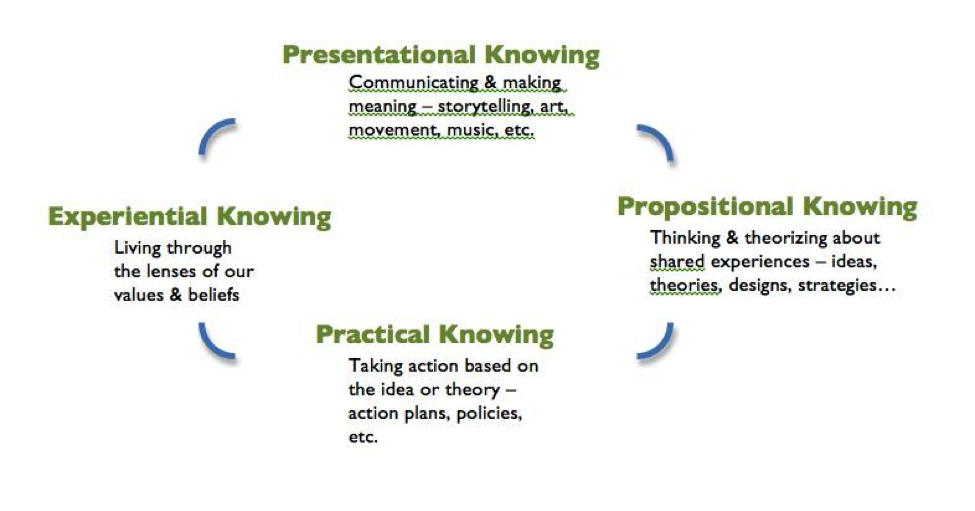
The ways of knowing are pyramid-like in that our practical knowing ideally builds from experiential knowing. They are cyclical in that we often move through them repeatedly. They are separate entities in that they are each valid, meaningful and interconnected ways of knowing on their own. And, finally, we can be in more that one place at one time.
U.S. dominant culture prizes propositional and practical knowing – that is using arguments, data, theory propositions, etc. to represent reality. We hire for it, fund based on it, structure for it, measure it – indeed we craft and evaluate our lives, our health and our institutions on it. Expertise is often defined by possessing deep propositional (intellectual) knowledge without considering full knowledge across multiple ways of knowing. However if we stay only in theory and action (i.e., the propositional and practical ways of knowing), there is little or no connection between our values, our experiences, our shared understandings, our cultures, and our actions. We must honor the experiential and the presentational ways of knowing – the emotional and the artistic. We must hold them as valuable information essential to both our theories and our action plans to enact justice values and culture change.
> Poetry is not a luxury. It is a vital necessity of our existence. It forms the quality of the light within which we predicate our hopes and dreams toward survival and change, first made into language, then into idea, then into more tangible action.
>
>
> Poetry is the way we help give name to the nameless so it can be thought. The farthest external horizons of our hopes and fears are cobbled by our poems, carved from the rock experiences of our daily lives.
>
>
> If what we need to dream, to move our spirits most deeply and directly toward and through promise, is a luxury, then we have given up the core–the fountain–of our power….
>
> Audre Lorde
Banner photo credit: Alison Lin
##### Leave a Reply
Your email address will not be published. Required fields are marked \*
Comment \* <div \_="@=597,dis=none"><div \_="@=598,dis=none"></div></div>
Name \*
Email \*
Website
For security, use of Google's reCAPTCHA service is required which is subject to the Google [Privacy Policy](https://policies.google.com/privacy) and [Terms of Use](https://policies.google.com/terms)., Multiple Ways of Knowing, Change Elemental, 01hkt43wxfxffqxkb00qxpzy8d.