My Most POWERFUL Study Trick (Any Subject)
## Metadata
- Author: [[YouTube]]
- Full Title: My Most POWERFUL Study Trick (Any Subject)
- Category: #articles
- Document Note: ---
tags: [study-techniques, learning-strategies, order-control]
author: Justin Sung
source: YouTube
reference: https://www.youtube.com/watch?v=UY2GO1ML-Bo
date created: 2024-12-19 10:15
---
# 🏷️ Title: My Most POWERFUL Study Trick (Any Subject)
## 🧰 Action Inbox
- [H1] Implement order control technique — skip difficult concepts on first pass #study-technique
- [H2] Create three-column system — source material, skip list, notes #organization
- [H3] Practice identifying rote memorization cues — feeling of brute force repetition #metacognition
## 🧭 Table of Contents
- [📝 Summary](#-summary)
- [📖 Main Content](#-main-content)
- [🗒️ Notes](#️-notes)
- [📚 References](#-references)
- [🗣️ Paraphrase](#️-paraphrase)
- [📰 Newsletter](#-newsletter)
- [✅ Action Items](#-action-items)
- [🧪 Hypotheses](#-hypotheses)
- [📊 Methodology](#-methodology)
- [❓ Questions](#-questions)
- [🔮 Future Research](#-future-research)
- [💡 Implications](#-implications)
- [🧠 Learning Styles Assessment](#-learning-styles-assessment)
- [📊 Accessibility Assessment](#-accessibility-assessment)
- [🌍 DEIB Assessment](#-deib-assessment)
- [✅ Logical Validity](#-logical-validity)
- [🛡️ DARVO Analysis](#-darvo-analysis)
- [🎯 Conclusion](#-conclusion)
### 🔗 References
- [Original Video](https://www.youtube.com/watch?v=UY2GO1ML-Bo)
- [Justin Sung's Discord Community](Discord link mentioned but not provided)
## 📝 Summary
- Dr. Justin Sung presents "order control" as the most powerful study technique for any subject
- The strategy involves reordering information consumption based on current understanding level rather than following textbook sequence
- Students skip difficult concepts initially, build foundational knowledge first, then return to previously difficult material
- This approach optimizes working memory usage and prevents framing/anchoring bias from incorrect initial learning
- Bottom line: Control the order you learn information to match your current knowledge level, dramatically improving time efficiency
## 📖 Main Content
The core argument is that traditional linear studying (following textbook order) is inefficient because it forces students to learn advanced concepts before they have sufficient foundational knowledge. This creates cognitive overload and leads to rote memorization rather than true understanding.
The "order control" technique works by recognizing that within any learning material, some information requires more prior knowledge than others. By identifying what you can easily understand versus what requires "brute force" memorization, you can optimize the learning sequence.
The three-column system (source material, skip list, active notes) allows systematic tracking of what to postpone. Multiple passes through the material build increasingly sophisticated understanding as prior knowledge accumulates.
This challenges the assumption that curriculum designers have optimally sequenced information for all learners. Individual differences in prior knowledge mean personalized sequencing is more effective than one-size-fits-all approaches.
## 🗒️ Notes
#### ⏱️ [00:00](https://www.youtube.com/watch?v=UY2GO1ML-Bo?t=0) — [H1] The efficiency definition and learning complexity
- Key idea: Studying efficiency means time to reach required knowledge mastery level for your specific goals
- Evidence: "What I'm actually talking about is the time it takes to reach the level of knowledge mastery we need for the goal"
#### ⏱️ [02:30](https://www.youtube.com/watch?v=UY2GO1ML-Bo?t=150) — [H2] The PhD thesis thought experiment
- Key idea: Starting with overly advanced material is obviously inefficient and counterintuitive
- Evidence: "We're going to find ourselves three PhD thesis and we're going to read these first...does it make sense to do it this way?"
#### ⏱️ [04:15](https://www.youtube.com/watch?v=UY2GO1ML-Bo?t=255) — [H2] Why advanced-first doesn't work
- Key idea: Lack of foundational knowledge makes advanced concepts impossible to process efficiently
- Evidence: "We lack the foundational knowledge to make sense of it and because we're not able to make sense of it it's going to be harder"
#### ⏱️ [05:00](https://www.youtube.com/watch?v=UY2GO1ML-Bo?t=300) — [H1] Same problem exists within single textbook pages
- Key idea: Even within one page or chapter, some sentences require more prior knowledge than others
- Evidence: "Even within that single paragraph that first sentence...might be something that you read and you're like oh yeah that makes sense...sentence number four that's something that I struggled to process"
#### ⏱️ [06:45](https://www.youtube.com/watch?v=UY2GO1ML-Bo?t=405) — [H2] The Year 9A to Year 9Z analogy
- Key idea: Learning material has implicit difficulty levels that aren't explicitly organized for optimal learning
- Evidence: "Imagine we divided it like this...year 9 is split into multiple different levels...year nine a then year nine b year nine c"
#### ⏱️ [08:30](https://www.youtube.com/watch?v=UY2GO1ML-Bo?t=510) — [H1] Textbook authors don't know your specific prior knowledge
- Key idea: Curriculum designers can't optimize for individual learner's existing knowledge and cognitive patterns
- Evidence: "This author of the textbook even your teacher they don't know everything that you know they don't know the intricate nature of how your brain works"
#### ⏱️ [09:15](https://www.youtube.com/watch?v=UY2GO1ML-Bo?t=555) — [H1] The three-column order control system
- Key idea: Systematically skip difficult concepts and track them for later review when you have more foundation
- Evidence: "Three different sets of notes one is the source material...two is kind of this sheet of things that we are skipping...three is the notes that we are making"
#### ⏱️ [10:45](https://www.youtube.com/watch?v=UY2GO1ML-Bo?t=645) — [H2] Recognizing the rote memorization cue
- Key idea: When you feel compelled to use brute force repetition, that signals insufficient prior knowledge
- Evidence: "When you feel like the only way for you to make sense of it is just to repeat it in your head again and again...that's a sign that your brain doesn't know what to think about it"
#### ⏱️ [12:00](https://www.youtube.com/watch?v=UY2GO1ML-Bo?t=720) — [H2] Multiple passes build cumulative understanding
- Key idea: Each sweep through material reveals more accessible concepts as prior knowledge accumulates
- Evidence: "Each time we sweep through this we have more and more prior knowledge we're actually going to end up covering the same amount of material"
#### ⏱️ [13:30](https://www.youtube.com/watch?v=UY2GO1ML-Bo?t=810) — [H2] Working memory and framing constraints
- Key idea: Limited working memory capacity makes order crucial for long-term retention and organization
- Evidence: "Our working memory capacity is very short...we've only got really seconds to work with that information and try to put into our long-term memory"
#### ⏱️ [14:45](https://www.youtube.com/watch?v=UY2GO1ML-Bo?t=885) — [H3] Framing and anchoring bias effects
- Key idea: Initial learning sequence creates cognitive biases that make relearning more difficult
- Evidence: "Framing bias...influences the way that we actually think about it...anchoring bias...the first time we learn information...influences the way in which we understand things"
#### ⏱️ [16:00](https://www.youtube.com/watch?v=UY2GO1ML-Bo?t=960) — [H3] When to resort to flashcards and rote memorization
- Key idea: Only truly isolated information should require brute force memorization techniques
- Evidence: "That is the stuff that you want to put into your flash cards...because it probably means that that piece of information is a little bit more isolated"
#### ⏱️ [17:00](https://www.youtube.com/watch?v=UY2GO1ML-Bo?t=1020) — [H1] Universal applicability across subjects
- Key idea: Order control works for any subject from biology to coding to languages
- Evidence: "It's applicable for really any topic...chemistry...physics languages even coding"
#### ⏱️ [18:00](https://www.youtube.com/watch?v=UY2GO1ML-Bo?t=1080) — [H1] Why this might be the single most important technique
- Key idea: Even with poor other study habits, order control provides significant improvement with minimal habit change
- Evidence: "If you had only one thing that you could change I think this would be the one because it's easy-ish to pull off...it doesn't require you to change a lot of your other habits"
## 📚 References
- [Justin Sung YouTube Channel](https://www.youtube.com/channel/UCLAEsXjYcPMwVoMVtCz_mzQ)
- [Learning course mentioned](Course website referenced but not provided)
- [Discord community](Link referenced but not provided)
## 🗣️ Paraphrase
- Instead of forcing yourself through difficult material linearly, identify what you can easily understand first and build from there
- Create a systematic approach to track what you're skipping so you can return to it when you have better foundation
- Recognize when you're using rote memorization as a cue that you need more background knowledge before tackling that concept
## 📰 Newsletter
**Game-Changing Study Technique: Take Control of Learning Order**
Tired of hitting walls when studying complex material? Dr. Justin Sung's "order control" technique could transform how you learn any subject.
The core insight: textbooks aren't optimized for your specific knowledge gaps. Instead of forcing yourself through difficult concepts linearly, identify what makes sense now and postpone what requires brute-force memorization.
**The System:**
- Create three columns: source material, skip list, current notes
- Skip anything requiring repetitive memorization
- Make multiple passes as prior knowledge builds
- Reserve flashcards only for truly isolated facts
This works because your working memory has seconds to process new information effectively. Learning concepts in the wrong order creates cognitive biases that make later mastery harder.
**Practical Benefit:** Students report dramatic time savings and deeper understanding across subjects from biology to coding.
**Try This:** Next time you study, pay attention to when you feel like you need to "just memorize" something. That's your cue to skip it temporarily and return when you have more foundation.
Resources: [Learn WordPress](https://learn.wordpress.org/), [Developer Docs](https://developer.wordpress.org/), [WP-CLI](https://wp-cli.org/)
## ✅ Action Items
#### DevRel
- Developer education: Create learning paths that implement order control for documentation
- Developer experience: Design API documentation with explicit prerequisite knowledge markers
- Developer marketing: Develop content series that build foundational knowledge before advanced topics
#### Community
- Contributors: Design onboarding that identifies knowledge gaps before assigning complex issues
- Maintainers: Structure project documentation with clear knowledge prerequisites
- Sponsors: Provide educational resources that build understanding incrementally
#### WordPress
- Core: Organize contributor documentation by prerequisite knowledge rather than alphabetically
- Training: Redesign learning paths to identify and skip concepts requiring excessive prior knowledge
- Documentation: Add prerequisite knowledge indicators to DevHub articles
- Support: Create troubleshooting guides that build foundational understanding first
## 🧪 Hypotheses
- Students using order control will complete learning objectives 30-50% faster than linear approaches
- Retention rates will be higher when concepts are learned in optimal knowledge-building sequence
- Metacognitive awareness of "rote memorization cues" improves learning efficiency across subjects
- Multiple-pass learning creates stronger knowledge networks than single comprehensive passes
### 📊 Methodology
- Randomized controlled trial comparing order control vs. linear study approaches with time-to-mastery metrics
- Longitudinal study tracking retention rates 1 week, 1 month, and 3 months post-learning
- Qualitative analysis of student metacognitive awareness before and after order control training
### ❓ Questions
- How can educational technology automatically identify optimal learning sequences for individual students?
- What specific cognitive markers best predict when a concept requires too much prior knowledge?
- How does order control effectiveness vary across different subject domains and learning objectives?
### 🔮 Future Research
- Adaptive learning systems that dynamically reorder content based on individual comprehension patterns
- Integration with spaced repetition algorithms to optimize both order and timing
- Cross-cultural validation of order control effectiveness across different educational systems
### 💡 Implications
- Practice: Requires significant shift from linear curriculum design to adaptive, prerequisite-aware approaches
- Policy: Educational standards may need restructuring to support individualized learning sequences
- Education: Teacher training must include techniques for identifying optimal learning orders for different students
- Technology: Learning management systems need prerequisite tracking and adaptive sequencing capabilities
### 🧠 Learning Styles Assessment
Reading level estimate: 10th Grade (Flesch-Kincaid)
#### 👀 Visual learners
- Present: Clear three-column system visualization, Year 9A-Z analogy diagram
- Improve: Flowchart showing decision process for skip vs. learn, knowledge network diagrams
#### 🔊 Aural learners
- Present: 18-minute video explanation with clear verbal examples
- Improve: Audio summary focusing on key decision points and implementation steps
#### 🗣️ Verbal learners
- Present: Rich analogies (PhD thesis, Year 9 levels), clear definitions of efficiency
- Improve: Glossary of key terms, comparison table of linear vs. order control approaches
#### 🧩 Kinesthetic learners
- Present: Concrete three-column implementation system, actionable skip/learn decisions
- Improve: Practice worksheets for identifying prerequisite knowledge gaps, hands-on exercises
#### 🧠 Logical learners
- Present: Clear cause-and-effect reasoning about working memory limitations and bias effects
- Improve: Decision tree for when to skip concepts, metrics for measuring learning efficiency
#### 🧑🤝🧑 Social learners
- Present: References to Discord community and peer learning experiences
- Improve: Study group guides for implementing order control collaboratively
#### 🧘♀️ Solitary learners
- Present: Self-directed technique requiring individual metacognitive awareness
- Improve: Self-assessment rubrics for identifying personal knowledge gaps, reflection prompts
#### 🌿 Naturalistic learners
- Present: Organic approach to learning that follows natural knowledge-building patterns
- Improve: Analogies to natural systems and growth patterns in knowledge development
### 📊 Accessibility Assessment
#### Screen reader semantics
- Present: Clear headings and logical structure in video description
- Improve: Detailed alt text for any visual diagrams, structured transcript with clear sections
#### Keyboard navigation
- Present: Standard YouTube video controls accessible via keyboard
- Improve: Chapter markers for easy navigation to specific concepts
#### Contrast and readability
- Present: High contrast video with clear visual presentation
- Improve: Closed captions with high contrast styling, transcript with proper formatting
#### Text resizing and reflow
- Present: YouTube's built-in accessibility features
- Improve: Separate accessible transcript that reflows properly
#### Media and captions
- Present: Full transcript available
- Improve: Time-synchronized captions with speaker identification
#### Forms and interactions
- Present: Simple video interface with clear controls
- Improve: Interactive version allowing users to practice the technique
### 🌍 DEIB Assessment
#### Cultural breadth
- Present: Universal learning principles applicable across educational systems
- Improve: Examples from different cultural contexts beyond Western academic system
#### Inclusive language
- Present: Gender-neutral examples, accessible technical language
- Improve: Acknowledgment that different educational backgrounds may affect technique implementation
#### Neurodiversity support
- Present: Structured approach that accommodates different cognitive processing styles
- Improve: Explicit discussion of how technique benefits different neurodivergent learning patterns
#### Representation
- Present: Focus on universal cognitive principles rather than specific demographics
- Improve: Diverse examples showing technique working across different identity groups
#### Psychological safety
- Present: Non-judgmental approach that validates difficulty with complex material
- Improve: Explicit reassurance that skipping concepts is strategic, not failure
### ✅ Logical Validity
#### Strong reasoning
- Deductive strength: Clear logical progression from working memory limitations
- Document Tags: [[study]] [[organization]] [[metacognition]]
- Summary: My Most POWERFUL Study Trick (Any Subject)
- URL: https://www.youtube.com/watch?v=UY2GO1ML-Bo
People are always asking me, "Justin, whatis the best way of studying? What's likeyour top studying tip?" Most of the time,that question doesn’t really make sensebecause learning is a very complicatedthing, and so it’s not really possible toanswer that. But it does make me think:you know, like, what is the biggestmost important thing to increase yourstudying efficiency? What would make thebiggest difference? There are so manypossible contenders, but I’m going tosay that this may be the thing. If youdid nothing else but just this, it could
possibly be the thing that makes thebiggest difference. For those of you thatare new, I’m Dr. Justin Sung. I’m a formermedical doctor and a full-time learningcoach. I am really excited about thisparticular topic because I think this isgoing to help a lot of people. Let’s takean example topic. For example, let’s saywe’re studying biology, okay? Andthis could be any topic, okay? Literally,any topic. And let’s say that you want tolearn Year 9 biology, okay? Year9 and biology.
So in order to learn Year 9 biology, whatisthe mostAn efficientway to learn it, there’s something that Ireally need to clear up here. When Isay the word efficient, what I’m actuallytalking about is the time it takesto reachthe level of knowledge mastery we needfor the goal. So, for example, if you’reonly getting tested on retrieving simplefacts and memorizing definitions,then that’s a very low level ofknowledge mastery. How long does it taketo get to that level compared to, let’ssay, that we’re getting tested on
discussing a network of ideas and theinfluence that these ideas have on eachother, or advanced applications. If you’rea senior in high school oruniversity or beyond, you’re going to betested at these higher levels. So, again,how long does it take to get to thesehigher levels? Some people will look atonly how long it takes to hold on tothe information, or they won’t even thinkabout efficiency at all. But it’simportant that we look at both — both theeffectiveness in terms of how muchknowledge mastery we can get and thenalso the time efficiency in terms of howlong it takes to get there.
Obviously, you know doing passive flashcards just again and again and again, itmight be okay for the low level,but it's a very inefficient way ofgetting to the higher levels. And so thetime efficiency of that isterribly low. But let's assume thatwe're trying to get to a reasonablyhigh level of knowledge mastery here.What is the most efficient way for us toget to that level with something likeENI and biology? I want you to thinkabout that for a little bit. I want youto think about the ideas that you mighthave, and I'm going to tell you what I thinkis a good idea, and it's probably not thesame thing as what you're thinking.
Here's a suggestion: what we're going todo is, in order to get to Year 9 biology,we're going to start from something moreadvanced than union biology, and we'regoing to work our way down. What we'regoing to do insteadis we're going to find ourselvesthreePhDtheses. Okay, PhD thesestimes three, and we're going to find threeof these.And we're going to read these.
Gonna try to completely understand it asmuch as we can. In understanding it,we're going to be able to figure out whatthe core principles are within this PhD,and then we'll be able to track our wayback to,you know, maybe like a, you know, just auniversity level,and then we'll be able to track our wayback to just the high school level.Then we'll be able to bring it all theway back down to a Year Nine level.And because we worked from this reallyadvanced version first, and we spent allof that time to learn that to a goodlevel, when we come down to the Year Ninestuff,we should have a very solidunderstanding of it. So when we readthrough a Year Nine textbook, for example,it should be pretty easy. Does it makesense to do it this way? Hopefully,if you were listening to me talk aboutthis,you would thinkthat does not make any sense.
And you're right;it doesn't make any sense. This is the point.We know intuitively that if you were totake someone that doesn't even know YearIn biology, if we were to give them threePhD theses, it would take so long tounderstand them. This person willprobably never get to the point wherethey actually fully understand even onethesis, let alone three. In terms of thetime efficiency of doing this thingwhere we're, you know, tracking down allthe way from a PhD level down to a unitedvalley, that's not time efficientwhatsoever. We instinctively realize thatwhen we start with information that istoo advanced for us, it's not efficient.
We lack the foundational knowledge tomake sense of it, and because we're notable to make sense of it, it's going tobe harder. So, for example, if someone hasa master's in biology and then they reada PhD thesis, you would expect they willhave an easier time understanding itbecause they have a lot morefoundational knowledge. Here’s thething — here’s the realstrategy that I'm talking about.This was just an exercise to get you torealize that this doesn’t make sense. Weare doing the exact same thing on asmaller scale when we study. See,when you open up a Year 9biology textbook, or again, whatever
The subject you're studying, not all theinformation in it is the same. You couldhave a single page and on that page youmay have, let's say,three different paragraphs. Right? Evenwithin that single paragraph,that first sentence, sentence number one,might be something that you read andyou're like, "Oh yeah, that makes sense."Sentence number two you might read thatand think, "Hmm, this idea is a littleshaky." When we move to paragraph numbertwo, we may say sentence number three,"That makes sense," but then sentencenumber four, that's something that Istruggled to process and make sense of.
Information, the foundational knowledge,to process it. And even in a single page,in a single chapter of a textbook, evenwithin the category of Year 9 biology,there are still some pieces ofinformation that are more advanced, andthen there are some pieces ofinformation that are less advanced. Iwant you to imagine that instead ofdividing it into Year 9 biology and thenYear 10 biology, Year 11 biology, so on,and so forth, imagine we divided it likethis: you go into Year 9, but Year 9 issplit into multiple different levels.
Let's say that there are year nine A, year nine B, year nine C, year nine D, andeach level is a little bit more advancedand more challenging than the next. Solet's say that there is all the waythrough to year nine A from year nine toyear nine Z, and year nine Z is themost advanced stuff that you can learnwithin the year nine level. If we saidwe're going to start with year nine Z andthen movebackwards from year nine Z to yearnine A, that doesn't makesense. It's the same reason it doesn'tmake sense starting at a PhD level.
It's not going to be as dramatic, but itis still probably going to be slower.We're going to struggle more than weneed to, and we're going to feel like itjust takes us a long time to wrap ourheads around some of these ideas. But ifyou started at A and worked to Z, youwould be building the foundationalknowledge along the way. So when you didget to Z, it would actually make sense.
It's not split up that way; no, no,curriculum is splitting it that way foryou. However, it doesn't change the factthat the objective reality is that someinformation is more advanced and requiresDifferent types of prior knowledge, andhere's the thing: if someone were towrite a textbook knowing exactly whatyou know, they know all the priorknowledge that you have inside yourbrain, and they would create a textbookjust for you, they would arrange it inthe order in which you need to learn itto make the most sense of the next thingthat follows. They wouldn’t put a conceptearlier on that you’re going to reallystruggle to understand because youactually needed to understand the nextthing first, right? That order doesn’tmake sense.
But this author of thetextbook, even your teacher, they don’tknow everything that you know. They don’tknow the intricate nature of how yourbrain works, and even small differencescan have significant effects. It’s up tous as learners to take responsibility, andwe take responsibility by reordering theway in which we study. We are going tochange the order in which we consumeinformation, and this is the one thingthat I think if you started to takecontrol of, almost regardless of everyother study technique that you’re using,you would find benefit.
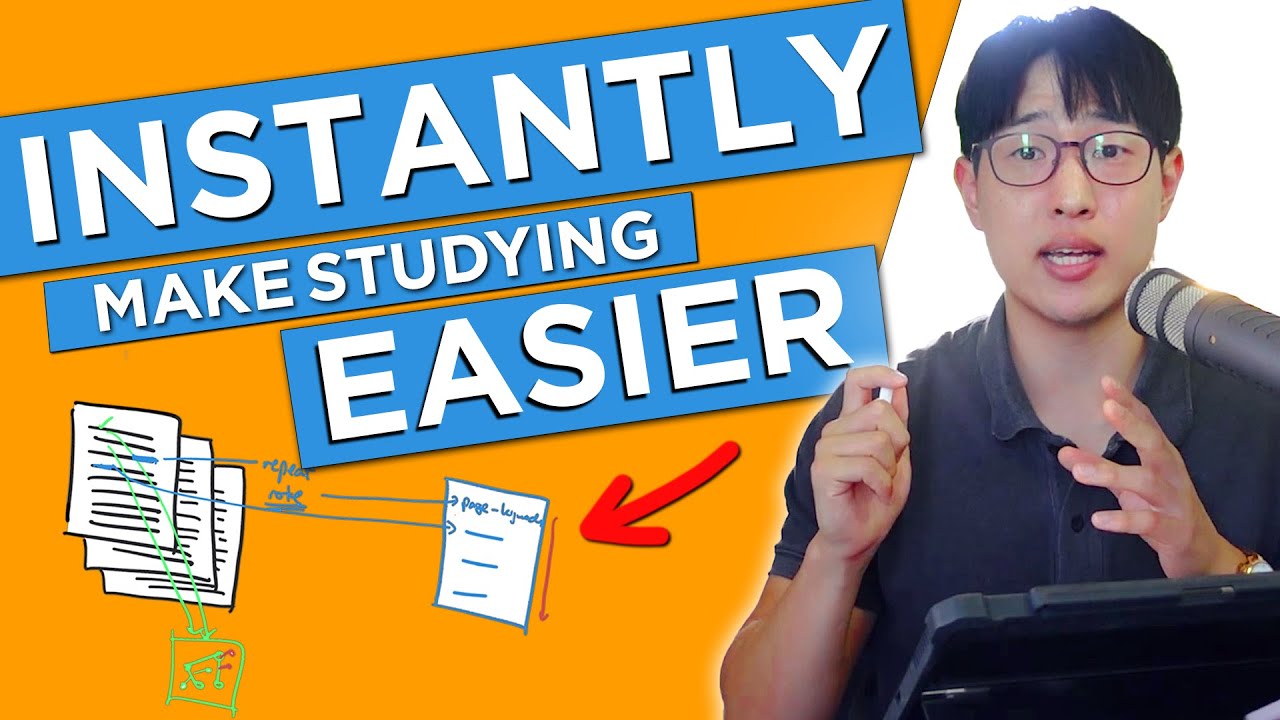
Absolutely trash. You're still not going tobe ultra amazing, but it will bebetter than where you were before. Here'show we do this: we take the textbook orthe lecture slides or whatever we'relearning from, and the first thing we'regoing to do is go through thematerial and just learn it. But anythingthat takes longer than one or twominutes for you to wrap your head around,you're going to take note of, and you'regoing to skip it. Okay? So we've gotessentially sort of like three differentsets of notes. One is the source materialthat we're learning from, two is this sheet of things that we areskipping, and then three is the notesthat we are making as we are studying.
Now, I'm not going to go into how towrite your notes. I'm not going to gointo any other techniques involved inthis. I talk about that in other videos; Italk about that in my course. It's reallyquite complicated to go through theentire system, but I'm just focusing onthis particular strategy. So any othertechniques that you're comfortable withusing, any of the other techniques thatyou'll learn in my course, you can applythis. You can stack it together.
You're in my course; you probably alreadyknow this concept anyway, but you cancombine it with whatever you're alreadyusing. Okay, we're going through thisinformation. We're going through andwe're saying, "Okay, I understand that;that makes sense to me. I get that." Wecan, you know, shunt that across into ournotes that we're creating.
Then we're saying, "Hmm, thisparticular part, though, this sentencehere, I can't really understand; itseems a little bit random. It seems alittle irrelevant. I don't really see howthat works. I feel like I need to reallystart just rote learning and memorizing;that's the cue. When you feel likethe only way for you to make sense of itis just to repeat it in your headagain and again and just try to smash itin and encode it through brute force.
That's a sign that your brain doesn'tknow what to think about it. It's justsaying, "I don't know why it's relevant. Idon't know where it fits. I'm havingdifficulty coding it." Man, you can'tjust repeatedly smash it in and justassume that it's gonna stay there; it's not.That's not how learning works.
Your brain is telling you that itDoesn't make sense; it's kind of like ifyou were to take that PhD thesis you'dread it and you'd think, "I have no ideawhat this means." But if you know you'regetting tested on it, you're probablyjust going to try to learn the thingline by line. That's the cue when youfeel like, "Hmm, this piece of informationI feel like I'm starting to just repeat.
I'm trying to just rote learn thisthrough just repetitive memorization.
What you're going to do is you're gonnastop that. You're gonna cut that off andyou'll just make a note of that. Okay, youcan write the page that it's on and youcan write a couple of key words about whatthe concept was just to keep track ofwhat it was that you skipped. But you'rejust gonna move on. You're just gonnamove on to the next thing. You mightsay, "Okay, well this part also I don’treally understand," and you'regonna skip that too. You're gonna endup skipping heaps of information. You'regonna be skippingconstantly, and that's okay because thepurpose is to go through this text andpick out the things that make sense.
Already, the things that are easy for usto make sense of and what that's goingWhat we need to do is, over time, when we continue tolook through this, we are slowly going tobuild up a stronger and stronger networkof prior knowledge. Then,when we go backthrough the notes and look at the thingsthat we skipped, when we go back throughthem, now we have more prior knowledge.
Right? We know now more than we did 20 or30 minutes ago. So,you'll find that from this list thereare maybe a few things that initiallyyou couldn't wrap your head around, butnow when you read it, you think, "Oh, thatdoes make sense because that's relatedto this thing, and that thing, and thisthing." Or, "Oh, of course it has to be thisway because otherwise that wouldn'thappen." But the thing is, unless you knewwhat that was, you wouldn't know why thisis relevant. What we're doing here is weare reordering the way in which we aregoing to consume information. So, whatevermakes sense, we absorb; whatever doesn'tmake sense, we leave it till later, upuntil a point where it will make sensefor us. And we'll go through this once,and we're not going to be able to pickout absolutely everything from here.We'll see that, hey, we can add a few more.
Things onto this, our notes start gettinga little bit more and more detailed.But we still may have lots and lots of things that we have left. Onceyou've done that, go through it again.Start from the top: what did you miss?Again, and now you'll see that there'seven more things that you're able topick up, because each time we sweepthrough this, we have more and more priorknowledge. We're actually going to end upcovering the same amount of material.
It's going to be the same amount ofdetail; it's going to be a lot more timeefficient because something that wouldnormally have taken us 20 or 30 minutesto memorize through repetitions, throughmaybe flash cards, over the course of aweek, we may not need to do that at all.We could potentially just skip thatentire step, and we may be able to learnit in just 15 or 20 seconds.The reason that it's important to do it in thisorder rather than just copying it alllinearly from start to finish and thentrying to process it afterwards isbecause of the fact that our workingmemory capacity is very short. Ourworking memory is only seconds long, andif you're interested, check out my video.
On how memory works, issues withspace retrieval—when you takeinformation and it’s sitting in yourworking memory capacity, because we’veonly got really seconds to work withthat information and try to put it into ourlong-term memory. If we don’t frame it ina way that makes it really wellorganized to begin with, you’re going toend up forgetting that anyway. And thenwhen you try to put it back in, we arenow going to be hit with somethingcalled framing bias, which is that theway that the information is framed andis presented to us influences the waythat we actually think about it. We’realso going to be influenced byanother thing called anchoring bias,
which is that the first time we learninformation—the first time we’re exposedto something—that also influences theway in which we understand things aswell. So for example, if we learnsomething in a certain way the firsttime around, in a certain order, thatorder starts influencing the way that westart thinking about that afterwards. Soit’s actually harder to make sense of itlater because we have to then relearnthe thing that we forgot, which is alsoIt's frustrating and pretty demotivating, butit is also cognitively more difficultbecause we’re sort of working againstwhat our brain did to begin with.
We have this tangled thing we have tountangle first. It would have beenbetter just to not have it tangled tobegin with. This is the thing: whatwe're trying to do here is we'reoptimizing the system. We're saying theseare the areas where we're wasting time,and we’re removing those time-wasteparts and replacing them withstrategies and techniques that actuallywork more efficiently. Instead, now youwill get to a point where you’re goingthrough this list, and you may havecertain pieces of information that eventhough you’ve gone through this maybetwo or three times, you stilldon’t know how to make sense of it. And
that is the stuff that you want to putinto your flashcards, or you want tojust rote memorize because it probablymeans that that piece of information isa little bit more isolated and you’regoing to have to resort to justmemorizing that through repetition. Buthopefully, there’s a lot less of thistype of information than there normallyWould have been. I know I’ve usedbiology in this initial example, but likeI said before, it’s applicable for reallyany topic. You could be using this forchemistry; you could be using this forphysics, languages, even coding.
If you jump ontomy Discord, the links below in thedescription, you can see that there arethousands of people on the Discord whoare using this technique andother techniques as well. But they’reusing this, right? This is something thatI teach in my courses called ordercontrol, and you’ve probably heard metalk about it in my other videos as well. Ifyou’ve seen my other videos, there arethousands of people that use thistechnique for a huge range of subjects,and it’s very, very effective. People thatdon’t use it will start noticingthat they tend to have very similarissues. They struggle with trying toprocess information; they find it reallydifficult to retain things, and theyfind that they’re spending a really longtime just reading and rereading things,trying to just understand it. The issueis that they are making themselvesunderstand something that they’re in noIn order to start understanding, what they need to do first is gain more priorknowledge beforehand to makethat easier. This thing, this thingthat I call order control, I think,and it’s a close one because there are so manyother techniques that are just asgood, but maybe not as good. This is thething that I think if people starteddoing, even if your note-taking techniqueis terrible, even if your pre-studytechnique is terrible, even if yourrevision strategy is terrible, if youhave no interleaving, if you have no, youknow, sense of time management, if youprocrastinate like crazy, if all of these
things are working against you, if youhad only one thing that you could change,I think this would be the one becauseit’s easy-ish to pull off, and there’smore advanced versions that are moredifficult to do, but at least the onethat I’ve taught you right now is prettyeasy to do. It’s straightforward and prettyeffective. It doesn’t require you tochange a lot of your other habits. Theonly thing is just getting used to thefact that you’re not covering things ina linear order and tuning in more towhere your brain is telling you that youYou should go and move away from just theconcept of repetitive memorization. Ihope you enjoyed this video. I hope youreally learned something from this. Itruly think that this can be a gamechanger. So leave a comment down below ifyou've used a technique like this, ifyou've figured out somethingvery similar on your own and you'realready using something like this, or ifyou're not, give it a go. Come back tothis video and just leave a commentabout how you feel about it. And if youare interested in learning some of theother techniques that I've got to teach,then I've got a course where I gothrough all of this stuff from start tofinish. You can check that out in thedescription below as well. If you'reinterested to learn more about thecourse, you can either check out thewebsite or you can just talk to studentsthat are literally going through thecourse right now by joining the Discord.
There are lots of public channels thatyou can look through and see what it'sall about. Thanks for listening; I'llcatch you on the next one.[Music]You., My Most POWERFUL Study Trick (Any Subject), YouTube, 01ka88r6sygtq34qr5px8aekkf.