My Strategy To Consume Information Effectively
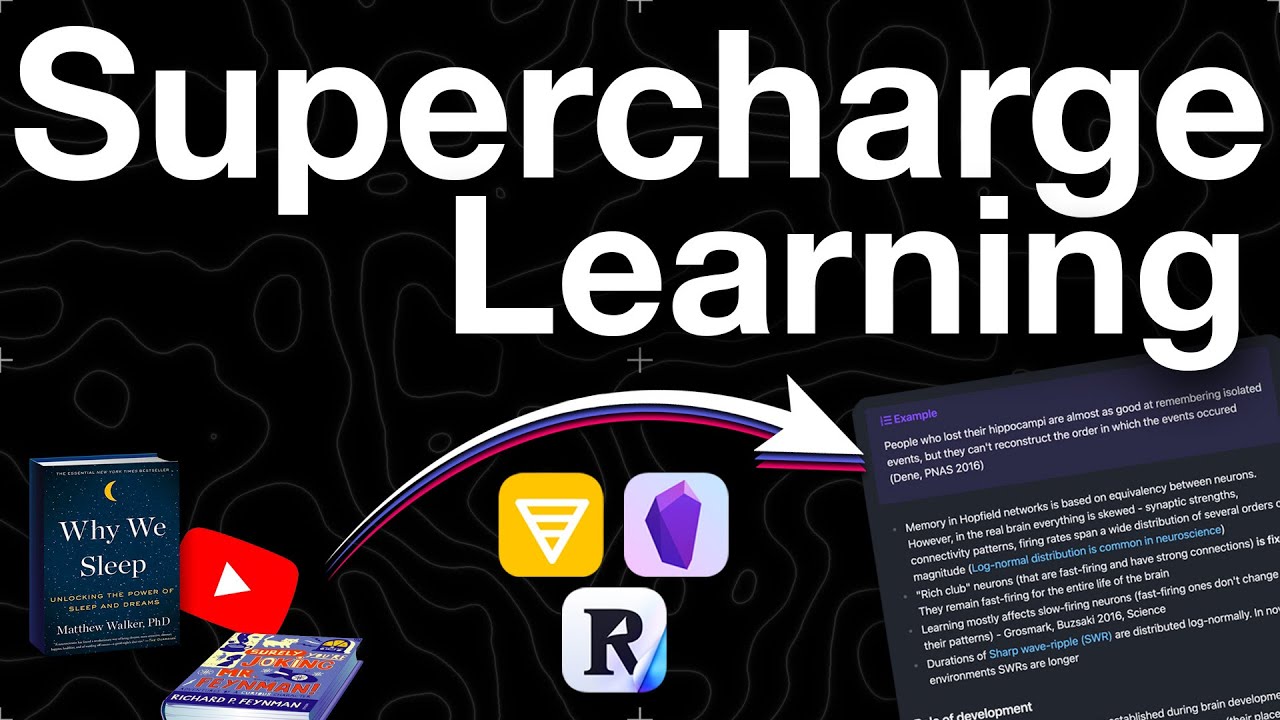
## Metadata
- Author: [[YouTube]]
- Full Title: My Strategy To Consume Information Effectively
- Category: #articles
- Document Note: ---
tags: [learning_strategies, information_consumption, note_taking]
author: Artem Kirsanov
source: YouTube
reference: https://www.youtube.com/watch?v=OZ7LEB44B3E
date created: 2024-12-19 15:30
---
# 🏷️ Title: My Strategy To Consume Information Effectively
## 🧰 Action Inbox
- [H1] Read summaries before committing to full books — evaluate content relevance #reading
- [H2] Use AI-generated summaries for YouTube lectures — research efficiency #learning
- [H3] Refactor highlights into atomic notes in Zettelkasten — knowledge management #notes
## 🧭 Table of Contents
- [📝 Summary](#-summary)
- [📖 Main Content](#-main-content)
- [🗒️ Notes](#️-notes)
- [📚 References](#-references)
- [🗣️ Paraphrase](#️-paraphrase)
- [📰 Newsletter](#-newsletter)
- [✅ Action Items](#-action-items)
- [🧪 Hypotheses](#-hypotheses)
- [📊 Methodology](#-methodology)
- [❓ Questions](#-questions)
- [🔮 Future Research](#-future-research)
- [💡 Implications](#-implications)
- [🧠 Learning Styles Assessment](#-learning-styles-assessment)
- [📊 Accessibility Assessment](#-accessibility-assessment)
- [🌍 DEIB Assessment](#-deib-assessment)
- [✅ Logical Validity](#-logical-validity)
- [🛡️ DARVO Analysis](#-darvo-analysis)
- [🎯 Conclusion](#-conclusion)
### 🔗 References
- [Shortform Platform](https://shortform.com)
- [Building a Second Brain by Tiago Forte](https://www.amazon.com/Building-Second-Brain-Organize-Potential/dp/1982167386)
## 📝 Summary
- Artem Kirsanov presents a strategy for effective information consumption focused on quality over quantity
- The core approach involves starting with summaries and adding details layer by layer
- Uses tools like Shortform for book summaries and AI extensions for video/article summaries
- Integrates with Obsidian and Zettelkasten note-taking methodology for knowledge management
- Emphasizes the importance of filtering content before investing time in full consumption
## 📖 Main Content
The video challenges the common "read a book a week" mentality, arguing that what you read and how you read it matters more than quantity. Kirsanov demonstrates a systematic approach using book summaries as a filtering mechanism, combined with AI-powered tools for processing various content types. The strategy integrates with personal knowledge management systems like Obsidian to create lasting value from consumed information.
## 🗒️ Notes
#### ⏱️ [00:00](https://www.youtube.com/watch?v=OZ7LEB44B3E?t=0) — [H1] Question the "Book a Week" Standard
- Key idea: Quantity of books consumed is not the right metric to optimize for
- Evidence: "What has always puzzled me is who the hell came up with this standard"
#### ⏱️ [01:30](https://www.youtube.com/watch?v=OZ7LEB44B3E?t=90) — [H1] Core Philosophy: Layer-by-Layer Learning
- Key idea: Start with summaries and gradually add details
- Evidence: "The key to effective reading is to start with the summary of the core ideas and then gradually add details layer by layer"
#### ⏱️ [02:15](https://www.youtube.com/watch?v=OZ7LEB44B3E?t=135) — [H2] The Scale Problem with Books
- Key idea: Filtering is essential given the overwhelming number of available books
- Evidence: "Google says it's about 150 million titles and let's be honest only a tiny proportion of them would be actually interesting and relevant to you"
#### ⏱️ [03:00](https://www.youtube.com/watch?v=OZ7LEB44B3E?t=180) — [H2] Books as High Investment, High Reward
- Key idea: Books require significant time investment but offer concentrated knowledge
- Evidence: "It takes about 2 weeks to read a single book from cover to cover but in return you get several years worth of author's experience and research"
#### ⏱️ [04:20](https://www.youtube.com/watch?v=OZ7LEB44B3E?t=260) — [H2] Summaries Prime Your Brain
- Key idea: Reading summaries first improves comprehension of the full content
- Evidence: "Having this overview in mind kind of primes your brain to the incoming information and helps you stay focused while reading"
#### ⏱️ [06:30](https://www.youtube.com/watch?v=OZ7LEB44B3E?t=390) — [H1] Shortform Platform Features
- Key idea: Shortform provides detailed, augmented book summaries with expert commentary
- Evidence: "Content augmentation... blocks of text tagged as short form note... information which was inserted by the author of the guide as relevant"
#### ⏱️ [09:45](https://www.youtube.com/watch?v=OZ7LEB44B3E?t=585) — [H2] Obsidian Integration Workflow
- Key idea: Highlights from summaries sync automatically to Obsidian via Readwise
- Evidence: "These highlights can be automatically linked to my obsidian Vault via a readwise API"
#### ⏱️ [11:20](https://www.youtube.com/watch?v=OZ7LEB44B3E?t=680) — [H3] Decision Point Example: Building a Second Brain
- Key idea: Summaries help decide whether to continue with full book
- Evidence: "About halfway through the summary I realized that the book is not quite what I expected"
#### ⏱️ [12:45](https://www.youtube.com/watch?v=OZ7LEB44B3E?t=765) — [H2] Zettelkasten Refactoring Process
- Key idea: Transform highlights into atomic notes linked in a knowledge network
- Evidence: "Individual ideas are stored as atomic notes in one folder and linked together"
#### ⏱️ [15:30](https://www.youtube.com/watch?v=OZ7LEB44B3E?t=930) — [H1] AI Extension for Any Content
- Key idea: Shortform browser extension creates summaries for articles and YouTube videos
- Evidence: "Just open any page you would like to get a summary of... press the short form extension icon and voila"
#### ⏱️ [17:00](https://www.youtube.com/watch?v=OZ7LEB44B3E?t=1020) — [H2] YouTube Lectures as AAA Sources
- Key idea: Academic YouTube content is Accessible, Aggregate, and Accurate
- Evidence: "They are accessible because the speaker usually explains the topic in a much simpler way... aggregate because unlike a paper which dives very deeply into tackling an isolated problem"
#### ⏱️ [19:15](https://www.youtube.com/watch?v=OZ7LEB44B3E?t=1155) — [H3] Video Note-Taking Process
- Key idea: Watch with Obsidian open, pause to rephrase key points
- Evidence: "Whenever I hear new information that is worth writing down I watch a bit further until the speaker finishes the point then pause the video"
#### ⏱️ [20:30](https://www.youtube.com/watch?v=OZ7LEB44B3E?t=1230) — [H3] Linking to Existing Knowledge
- Key idea: Connect new information to existing atomic notes rather than duplicating
- Evidence: "Instead of rewriting the same information again I simply insert a link to the corresponding idea note"
#### ⏱️ [21:45](https://www.youtube.com/watch?v=OZ7LEB44B3E?t=1305) — [H3] AI Tool Limitations
- Key idea: Speech recognition errors can affect summary quality
- Evidence: "Because it is based on the video transcript... the AI summary can often confuse uncommon words like specific terms or people's names"
## 📚 References
- [Shortform Platform](https://shortform.com)
- [Obsidian Knowledge Management](https://obsidian.md)
- [Readwise Integration](https://readwise.io)
- [Zettelkasten Method](https://zettelkasten.de)
## 🗣️ Paraphrase
- Instead of rushing through many books, focus on strategic selection and deep processing of fewer, more relevant sources
- Use summaries as a filtering mechanism before investing time in full content, allowing your brain to better organize and retain information
- Integrate modern tools like AI summarization with proven knowledge management techniques like Zettelkasten to create lasting value from information consumption
## 📰 Newsletter
**Transform Your Learning Strategy: Quality Over Quantity**
Tired of the "read a book a week" pressure? Content creator Artem Kirsanov shares a smarter approach: start with summaries, filter strategically, and build knowledge layer by layer.
His method combines AI-powered summarization tools with proven note-taking systems like Zettelkasten. The result? Better retention, clearer thinking, and more actionable insights from less content.
**Key takeaway:** Your learning system should filter first, then deepen—not just consume more.
**Try this week:** Before starting your next book, read a summary first. Notice how it changes your reading experience.
Resources: [Shortform](https://shortform.com), [Obsidian](https://obsidian.md), [Readwise](https://readwise.io)
## ✅ Action Items
#### DevRel
- Developer advocacy: Create content demonstrating layer-by-layer learning for technical documentation
- Education: Design workshops on effective technical information consumption strategies
- Developer experience: Build summary features into documentation platforms
#### Community
- Contributors: Develop templates for creating effective content summaries
- Maintainers: Implement AI-powered summarization for long-form project documentation
- Ecosystem: Create cross-project knowledge sharing protocols
#### WordPress
- Documentation: Add executive summaries to lengthy developer guides
- Training: Integrate summarization techniques into lesson planning
- Community: Provide note-taking templates for WordCamp sessions
## 🧪 Hypotheses
- Reading summaries before full content improves comprehension and retention rates
- AI-generated summaries can effectively filter content worth deeper engagement
- Layer-by-layer information processing reduces cognitive overload compared to linear reading
- Integration of multiple information sources through note-linking creates stronger knowledge networks
### 📊 Methodology
- A/B testing reading comprehension with and without preliminary summaries
- Tracking time-to-value metrics for different information consumption strategies
- Measuring knowledge retention through spaced repetition testing of atomic notes
### ❓ Questions
- How does summary-first reading affect long-term knowledge retention compared to traditional linear reading?
- What percentage of books/content can be effectively filtered out using summary-based evaluation?
- How does the quality of AI-generated summaries compare to human-created ones for technical content?
### 🔮 Future Research
- Development of domain-specific AI summarization models for technical documentation
- Integration patterns between AI tools and personal knowledge management systems
- Effectiveness metrics for different note-taking and knowledge connection methodologies
### 💡 Implications
- Practice: Shifts focus from consumption volume to strategic curation and deep processing
- Education: Suggests redesigning curricula around layered information architecture
- Technology: Indicates market need for intelligent content filtering and summarization tools
- Productivity: Challenges time management strategies based on completion rates rather than comprehension quality
### 🧠 Learning Styles Assessment
Reading level estimate: 10th Grade (Flesch-Kincaid)
#### 👀 Visual learners
- Present: Obsidian interface screenshots, workflow diagrams
- Improve: Add flowcharts showing the summary-to-atomic-notes process
#### 🔊 Aural learners
- Present: Full video with clear narration and examples
- Improve: Provide podcast-format audio summary of key concepts
#### 🗣️ Verbal learners
- Present: Clear definitions of terms like "atomic notes" and "Zettelkasten"
- Improve: Add more analogies comparing information processing to familiar activities
#### 🧩 Kinesthetic learners
- Present: Step-by-step demonstration of the Obsidian workflow
- Improve: Create downloadable templates and checklists for implementing the method
#### 🧠 Logical learners
- Present: Clear cause-and-effect reasoning for why summaries improve comprehension
- Improve: Add metrics and data on time saved through filtering
#### 🧑🤝🧑 Social learners
- Present: Community sharing through video comments and discussions
- Improve: Create study groups for implementing the methodology together
#### 🧘♀️ Solitary learners
- Present: Individual note-taking system designed for personal knowledge building
- Improve: Add reflection prompts for evaluating personal learning progress
#### 🌿 Naturalistic learners
- Present: Organic connection-making between ideas in the Zettelkasten system
- Improve: Draw parallels to how knowledge networks form in nature
### 📊 Accessibility Assessment
#### Screen reader semantics
- Present: YouTube auto-captions and clear heading structure in description
- Improve: Provide detailed alt text for interface screenshots
#### Keyboard navigation
- Present: Standard YouTube player controls
- Improve: Ensure linked resources are keyboard accessible
#### Contrast and readability
- Present: High contrast in Obsidian interface demonstrations
- Improve: Verify all text overlays meet minimum contrast requirements
#### Media and captions
- Present: Auto-generated captions available
- Improve: Provide manually reviewed captions and transcript download
### 🌍 DEIB Assessment
#### Cultural breadth
- Present: Focuses on widely accessible tools and methods
- Improve: Include examples from diverse academic and professional contexts
#### Inclusive language
- Present: Uses accessible technical language with explanations
- Improve: Avoid idioms like "shot in the dark" that may not translate culturally
#### Neurodiversity support
- Present: Well-structured presentation with clear sections
- Improve: Add content warnings for information overload discussions
#### Representation
- Present: Single presenter limits diverse representation
- Improve: Include examples from multiple learning contexts and backgrounds
### ✅ Logical Validity
#### Strong reasoning
- Deductive strength: Logical progression from information overload problem to layered solution
- Inductive strength: Uses personal experience examples to support general principles
- Causal reasoning: Clear cause-effect between summaries and improved comprehension
#### Fallacies
- Appeal to authority: Relies heavily on personal experience without citing research on reading comprehension
- False dichotomy: Presents quantity vs. quality as mutually exclusive when balanced approaches exist
#### Tone of voice
- Overall tone: Enthusiastic and helpful, with occasional casual language ("who the hell") that maintains engagement
### 🛡️ DARVO Analysis
- Deny: No denial patterns present
- Attack: No attacks on alternative approaches, respectfully questions common practices
- Reverse victim/offender: Not applicable to this educational content
- Emotional cues and rhetoric: Uses positive framing and personal anecdotes rather than manipulative tactics
## 🎯 Conclusion
Kirsanov's approach offers a practical alternative to quantity-focused learning by emphasizing strategic filtering and layered information processing. The integration of AI tools with established knowledge management practices provides a scalable framework for handling information overload while maintaining deep comprehension and long-term retention.
## 🧱 Refactor Appendix
### 📚 Literature Split Pad
Purpose: Stage CEE units that become Literature notes.
Split level: H3
### [H1] Summaries improve reading comprehension through cognitive priming
> [!quote] [My Strategy To Consume Information Effectively](https://www.youtube.com/watch?v=OZ7LEB44B3E) by [[Artem Kirsanov]] via [[YouTube]]. Published 2024. Accessed 2024-12-19.
> "Having this overview in mind kind of primes your brain to the incoming information and helps you stay focused while reading"
Cognitive priming effect of pre-reading summaries on information processing and retention.
[view highlight](https://www.youtube.com/watch?v=OZ7LEB44B3E?t=260) #learning #cognition #articleseed ID:rw_001
### [H2] AI tools enable scalable content summarization
> [!quote] [My Strategy To Consume Information Effectively](https://www.youtube.com/watch?v=OZ7LEB44B3E)
> "Just open any page you would like to get a summary of... press the short
- Document Tags: [[notes]] [[reading]] [[learning]] [[cognition]]
- Summary: My Strategy To Consume Information Effectively
- URL: https://www.youtube.com/watch?v=OZ7LEB44B3E
OK, here's an interesting experiment for you.Try typing "reading a book a week" into YouTube's search bar.You'll probably see something like this a lot.What has always puzzled me is, who the hell came up with this standard?No, seriously, is the quantity of books per unit time the right metric to optimize for?I believe that what you read and how you read it are much more important.In this video, I will show you my approach for optimizing those two things,particularly how to discover and evaluatewhat books are worth pursuingand how to read them and take notes effectivelyin order to ensure that the time investment pays off.In the second part of the video,I will also show you a way to apply this strategyto any article or even YouTube lectures.If you're interested, stay tuned.
If I were to summarize the point of the video in one sentence, it's this:The key to effective readingis to start with the summary of the core ideasand then gradually add details layer by layer.All right, let's unpack what this means a little bit.Previously, I used to think that the only use of book summarieswas to save me from getting an F in middle school.You know how when you are assigned to read something,but since you had better things to do,you instead just Google the brief summary of the bookwhile the teacher is handing out the quiz?Well, it turns out that summaries of books,especially non-fiction ones,can be an amazing tool for more effective reading,and that is for several reasons.
Do you know how many books in total humanity has written?Well, me neither.But Google says it's about 150 million titles.Let's be honest, only a tiny proportion of them would beactually interesting and relevant to you.So it seems like picking a worthy one is like a shot in the dark.
Additionally, books are a high investment, high rewardtype of information source.It takes about two weeks to read a single book from cover to cover.But in return,you get several years' worth of author's experience and research.Now that's pretty powerful.
This is why we need to be extra pickyabout the next book to invest our time and effort into.One great way to filter all this information overloadis to actually read the book summarybefore deciding whether it's worth committing to reading the whole thing.This helps to make sure that you don't waste valuable time and cognitive efforton something that would later turn out to be not what you expected.
When you're reading fantasy novels or detective novels,knowing the content in advance takes all the fun out of it.But with non-fiction books, it's actually the other way around.Checking out the summary before diving into the content itselfcan be super helpful in boosting your understanding.
Summaries give you a quick rundown of the main ideas,arguments, and the overall structure of the book.Having this overview in mindkind of primes your brain to the incoming information,and helps you stay focused while reading,making it easier to grasp complex ideas.
And follow the author's reasoning.Plus, it sets you with specific questions and objectiveswhich keep your brain engaged and thinking criticallythroughout the reading journey.For example, suppose in the very beginning,the author provides a very detailed personal anecdote.If you are unfamiliar with the rough outline of the book,it might seem out of the blue, and you may lose interest.However, if you've read the summary beforehand,you can relate this storyto the crucial ideas coming up further in the book,which makes you much more engaged with the content.
It is also a great idea to read the summary kind of side by side while reading the book,if you decide that it's worth investing in the full version.This helps you to keep track of where you are in the book's schema,and it's especially helpful when taking notes,but I'll get to that.Finally, the summary can be very usefuleven after you read the entire book.For example, suppose at some pointyou'd like to include or reference ideas from the book in your own work,be it a blog post, essay, or just a personal note.
Skimming through the summary will help you recall the contentand evoke similar chains of thought and insights you had during reading.Also, seeing the whole book laid out like thismakes it much easier to link ideas together.Now that I hopefully convinced you that book summaries are something to consider,let me tell you what I believe is the best place to find themand how exactly it integrates into my workflow.In my opinion, the go-to place for book summariesIs the platform called Shortform.
Now they are sponsoring this video, but don't let this fact put you off.Personally, I have been using Shortform for almost two years nowand I genuinely often recommend it to the people I meet.So, rest assured that everything in this videois my unbiased opinion about the product that I love.In fact, they have no idea what I'm about to say in this video.OK, so for starters,Shortform summaries, or book guides in their terminology,are much more detailed and holisticthan what I've seen on other platforms like Blinkist, for example.Every single book in their librarycontains a one-page summary,which is like a 10 to 15 minute readcontaining the book's key ideas.
Judging by my personal experience,in most cases, this is more than enough.These one-page summaries are super rich in informationand are organized extremely well.No, seriously, I take my hat off to the team of writers who produce them,because it takes a lot of hard workto flesh out the entire book like this and lay out the ideasin such a streamlined fashion.
If you want to go deeper, some books,not all of them, usually the more popular ones,have the full guide featurewhich is an even more detailedchapter-by-chapter breakdown of the content.The number one,my absolute favorite feature that makes Shortform uniqueThis is what I like to call content augmentation.
Essentially, throughout the summary,which outlines the book's key ideas and takeaways,you can see blocks of text tagged as short form notes.This is information that is not a part of the original bookbut was inserted by the author of the guide as relevant.And because the Shortform writers clearly know what they are doing,these notes, sprinkled throughout,don't overshadow the summary itself.Instead, they make a nice addition and truly augment the book's content.
For example, such notes often providebackground information on what the author is talking about,different perspectives,and even the drawbacks of the original point of view,backed up by relevant literature.So the name 'book guide' is well deserved.You're not merely reading the dry summary.It's like you're having a conversation with the personwho not only read the book thoroughly,but also knows background information,interesting facts, supporting works, and other perspectives related to it.
Now to the library.You can find books from almost every field,from science and health to business and finance.In terms of the sheer number of books,I'd say it's one of the Shortform's weaker sides.Not every book is available on the platform,which is not surprising given the amount of effortit takes to create a book guide.So you might find that only one of everyn books you're interested inHas a short form guide, where *n* really depends on how peculiar and non-mainstream your interests are.
But on the bright side,new books are being added weekly,and I think as the platform grows and scales up,this rate can likely increase in the future.
To show you Shortform in action,let me take you on a tour and actually show you how I use itin combination with Obsidian to read books effectively.So whenever a new book falls onto my radar,the first thing I do is checkwhether there is a Shortform summary.If there is, I begin to go through it and highlight important points.
These highlights can be automatically linkedto my Obsidian vault via a Readwise API.As you can see inside the reference notes folder,there is a sub-folder called Readwise,which is the home for all the contentgenerated and synced via Readwise.
For example, not too long ago,I began to read the summary ofand make its highlights.As soon as I made the first highlight, it was synced,and Readwise created a corresponding note inside my Obsidian vault.
Notice that the author field says Shortform rather than Tiago Forteto point out that it's about the summary of the book and not the book itself.In this case, about halfway through the summary,I realized that the book is not quite what I expected,so I usually just add a little message to myselfto know what exactly happened to reading the book.
And keep the note inside the Readwise folderfor potential future reference.In case I decide to read the full book,this process goes one step further.For instance, take the bookwhich is about how circadian rhythms affect things likecognitive abilities, focus, and moodand how we can harness the biological clocksto be most productive and intentional with our time.I recently discovered it on Shortformand after reading the summary,I decided to read the full book for more details,especially on chapters that resonate with me.
I’m currently reading it with Apple Books,usually on my iPad or iPhone,and as I read, I highlight and occasionally add brief notesright there in the Books app.These highlights are then automatically synced to Obsidian via Readwise.
Now there are two notes corresponding to the same book.This is because one of them was brought to Readwise via Shortformand contains highlights and notes that I made on this summary,while the other one was synced from Apple Booksand contains highlights and notes from the full book itself.
But these highlights are usually not the end goal.If you watched some of my previous videos,you may know that I follow a Zettelkasten note-taking philosophy,where individual ideas are stored as atomic notes in one folder and linked together.This is why once I feel that my highlights reach the critical mass, so to speak,I start to refactor the notes,rewrite information in my own words,Create new idea notes and link them to existing ones.
It can happen after I finish reading the entire bookor on a chapter-by-chapter basis.Here is an example of such a refactored book note.I recently finished reading Richard Feynman's autobiography titled " **Surely, you're joking, Mr. Feynman!** " It's a fascinating book, by the way.If you haven't checked it out, I highly recommend it.Even though it's an autobiography laid down in the form of stories,there are some interesting lessons and ideas interspersed in the narrative,such as the importance of teaching,embracing the natural curiosity and drive for learning.
I've scribbled down a few notes while reading it myself,but the amazing summary by Shortformreally helped me gain an overview and isolate important points.Here is a more extreme example of turning the book into atomic ideas. This is what my note on Scott Young's *Ultra Learning* looks like. It initially started with highlights as well,then I rewrote the information in my own wordsand because the book was so good,I actually turned the majority of what I wrote down into individual ideasas separate markdown files in my Zettelkasten network.
So now, the resulting reference note just contains links to the corresponding idea notes.Shortform guides are really amazing when it comes to books,but there are only so many of thembecause it takes a lot of man-hours to put them together.So would it be possible to leverage the recent advancementsin the development of large language modelsto create similar summaries of arbitrary content?Well, this is precisely what Shortform has done.
Now, I'm usually quite skeptical about the swarm of different AI agent apps out there,but I think the new Shortform browser extensionis one of the few that actually makes senseand that has a lot of potential.Plus, it's very simple to use.You don't need to think about the prompt,no need to set up an OpenAI API key,just open any page you would like to get a summary of,be it an article or a YouTube video.
Press the Shortform extension icon, and voila!I've been playing around with it for a few weeks nowand I can confidently say that it integrates nicely with how I consume information.Particularly game changing for me was its ability to summarize any YouTube video.
You see, when I research information for my own video scriptsor just learn for the sake of curiosity,apart from reading a ton of papers,I also watch recordings of lectures and conference talks,and YouTube has a surprisingly rich library of those.
I found that such recordings can be amazing sources of information that are what I call **AAA** , they are accessible because the speaker usually explains the topic in a much simpler waycompared to the source paper,accounting for the audience with diverse backgrounds.
Aggregate, because unlike a paper which dives very deeplyinto tackling an isolated problem,talks very often contain results of many consecutive paperstied together into a larger story.
So you get an overview of the last *n* years of the speaker's research in just one hour. Finally, they are accurate,since the talks are usually given directly by the authors.
So you have a unique chance to acquire some first-hand knowledgewithout a risk of misinformation.This makes lecture recordings an invaluable source of information,but there are a lot of them.So we face similar problems as with books,though be it on a smaller scale.
So just like with books,skimming through the summary of the lecturehelps you identify whether it's something you actually want to watch,because sometimes it's not clear from the titlewhat the speaker is going to talk about.
Now previously I used to just scrub the YouTube play-headthrough the video to get a rough outline of the talk.Now this scrubbing, which has a visual component,can be augmented with an AI-generated summary.
Also, it's much easier to take and refine notes,which I do a lot while watching the talks.Remember what made the Shortform book guide special?This augmentation gives you a bigger picture,well, props to the developers,these AI-generated summariesnot only give you a condensed version of the information,but they also contain this context,which is an overview of the subject matter and related background information,like the research directions of the speakeror the current problems in the field.
There are also links to further readingsand often paragraphs about counter-arguments and limitationsof what's talked about in the video itself.So, nowadays,If, by scrubbing through the YouTube video& skimming through the summary,I think that this particular lecture is worth the time investment,I begin watching it with my Obsidian open next to the browser,with a reference note corresponding to the talk.
Whenever I hear new information that is worth writing down,I watch a bit further until the speaker finishes the point,then pause the video,rephrase the key information in my own words,and consult with a Shortform summaryto check how the AI decided to phrase this.Finally, I write it down in Obsidian,usually following a bullet list format,though sometimes, I like to add the Admonition boxes just to spice things up.
Crucially, because I've been using the Zettelkasten note-taking system for more than two years now,a lot of the ideas mentioned in various talksturn out to be already present in my Obsidian vault as atomic notes.In this case,instead of rewriting the same information again,I simply insert a link to the corresponding idea note.Sometimes, if the lecture just adds some new details to the existing idea,I would go and modify the idea note itself,and try to write a small summarizing paragraph in the reference noteon my own, like a take-home message.
Finally, it's worth pointing out some of the limitations of this tool.First of all, because it is based on the video transcript,which, in turn, is generated via YouTube speech recognition,the AI summary can often confuse uncommon wordslike specific terms or people's names.Take this example here.
A wonderful lecture by Timothy Lillicrapon the biological plausibility of backpropagation,which, by the way, contains spoilers to my next video.The summary mentions that the speaker is Timothy A. Little,and sometimes, especially in the beginning of the summary,it may include unnecessary informationlike this sentence here that the author has been interested in this topic for a long time.
Twice!But really, that’s just nitpicking.If you just keep in mind that this is an AI tool after all,which means it may contain its own quirks,it’s no big deal.Again, on a high level, it performs surprisingly well.
Just for fun, I actually ran it on a few of my own videos, and it did a pretty good job.It actually found some super relevant readings.Well, I hope this video was helpful.If you want to try Shortform for yourself,there is my referral link down in the video description below,which will get you 5 days of unlimited accessand a 20% discount on the annual membership.
If you enjoyed this video, press the like button,share it with your friends & colleagues& subscribe to the channel if you haven’t already.Stay tuned for more interesting topics coming up.Goodbye and thank you for the interest in knowledge.
(Subtitles by Crimson Ghoul), My Strategy To Consume Information Effectively, YouTube, 01ka8jx4chkt1qh9ds3qq08yxr.