My university note-taking | Zettelkasten & more
## Metadata
- Author: [[YouTube]]
- Full Title: My university note-taking | Zettelkasten & more
- Category: #articles
- Document Note: ---
tags: [note-taking, zettelkasten, learning-methods]
author: Artem Kirsanov
source: YouTube
reference: https://www.youtube.com/watch?v=OmbJPHd6ETI
date created: 2024-12-28 21:35
---
# 🏷️ Title: My university note-taking | Zettelkasten & more
## 🧰 Action Inbox
- [H1] Question conventional note-taking effectiveness — analyze current classroom habits #learning
- [H2] Implement three-layer note system — fleeting, embedded, zettelkasten #methodology
- [H3] Create atomic flashcards for memorization — focus on spaced repetition #retention
## 🧭 Table of Contents
- [📝 Summary](#-summary)
- [📖 Main Content](#-main-content)
- [🗒️ Notes](#️-notes)
- [📚 References](#-references)
- [🗣️ Paraphrase](#️-paraphrase)
- [📰 Newsletter](#-newsletter)
- [✅ Action Items](#-action-items)
- [🧪 Hypotheses](#-hypotheses)
- [📊 Methodology](#-methodology)
- [❓ Questions](#-questions)
- [🔮 Future Research](#-future-research)
- [💡 Implications](#-implications)
- [🧠 Learning Styles Assessment](#-learning-styles-assessment)
- [📊 Accessibility Assessment](#-accessibility-assessment)
- [🌍 DEIB Assessment](#-deib-assessment)
- [✅ Logical Validity](#-logical-validity)
- [🛡️ DARVO Analysis](#-darvo-analysis)
- [🎯 Conclusion](#-conclusion)
### 🔗 References
- [Brilliant educational platform](https://brilliant.org)
- [Anki flashcard software](https://apps.ankiweb.net)
## 📝 Summary
- A computational neuroscience student critiques conventional university note-taking practices where students frantically transcribe lectures word-for-word
- Traditional note-taking creates information redundancy, disperses attention, and paradoxically reduces memory retention
- A three-layer system is proposed: fleeting notes for capture, embedded notes for memorization, and zettelkasten for creative connections
- The approach emphasizes intentional note-taking based on purpose rather than reflexive transcription
- Students should focus attention on listening and understanding rather than creating redundant copies of available information
## 📖 Main Content
The video challenges the widespread practice of verbatim lecture transcription, arguing it's counterproductive in the digital age. The author observes students anxiously copying everything professors say, creating what he calls "redundant sources of the same information" when textbooks, syllabi, and online resources already exist.
Two main defenses of conventional note-taking are debunked: 1) Writing aids memorization - research suggests external storage actually reduces memory retention, and 2) Classes provide unique information - this was true 50 years ago but no longer applies when information is instantly accessible online.
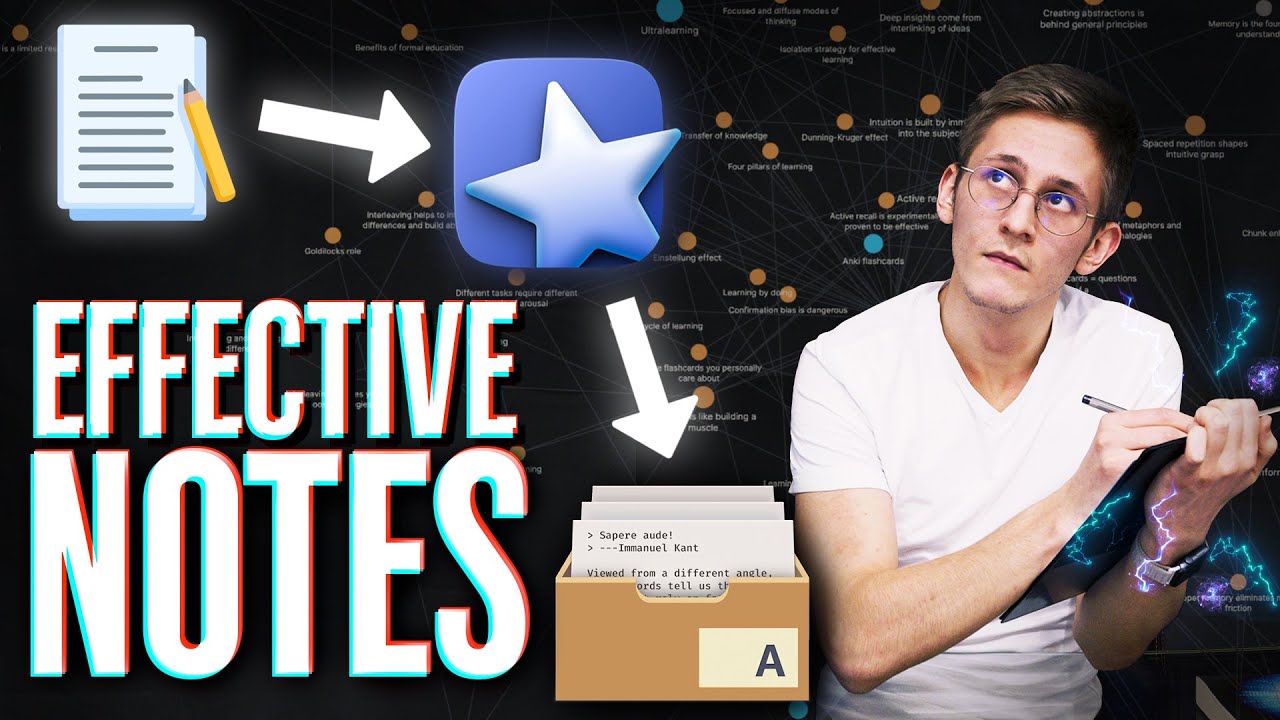
The proposed alternative uses three distinct note types: fleeting notes for quick capture throughout the day, embedded notes (flashcards) for systematic memorization through spaced repetition, and zettelkasten notes for building creative connections between ideas across subjects.
## 🗒️ Notes
#### ⏱️ [00:00](https://www.youtube.com/watch?v=OmbJPHd6ETI?t=0) — [H1] Conventional note-taking critique
- Key idea: Students reflexively transcribe lectures word-for-word without considering effectiveness
- Evidence: "As soon as the professor opens his mouth everyone around me start to anxiously write something down"
#### ⏱️ [01:45](https://www.youtube.com/watch?v=OmbJPHd6ETI?t=105) — [H2] Purpose determines method
- Key idea: Different notes serve different purposes and workflows should match goals
- Evidence: "You should be very clear with yourself about this purpose because this will determine the type of note-taking workflow"
#### ⏱️ [02:30](https://www.youtube.com/watch?v=OmbJPHd6ETI?t=150) — [H3] Writing doesn't equal learning
- Key idea: Students falsely believe transcription embeds information in memory
- Evidence: "Students think that writing something down is equivalent to embedding this information in their brain but that is simply not the case"
#### ⏱️ [03:15](https://www.youtube.com/watch?v=OmbJPHd6ETI?t=195) — [H2] Attention dispersion problem
- Key idea: Note-taking splits focus and causes information loss during lectures
- Evidence: "As you focus on writing your attention becomes dispersed but the stream of information doesn't stop so some words go in one ear and out the other"
#### ⏱️ [04:00](https://www.youtube.com/watch?v=OmbJPHd6ETI?t=240) — [H3] External storage paradox
- Key idea: Detailed notes reduce memory retention compared to not writing anything
- Evidence: "Your brain removes the memory after it ensures that it has been successfully offloaded onto the external storage"
#### ⏱️ [04:30](https://www.youtube.com/watch?v=OmbJPHd6ETI?t=270) — [H2] Information accessibility revolution
- Key idea: Internet access makes lecture transcription redundant unlike 50 years ago
- Evidence: "Everything the syllabus the typed notes countless textbooks video explainers online websites are all available for free at your fingertips"
#### ⏱️ [05:45](https://www.youtube.com/watch?v=OmbJPHd6ETI?t=345) — [H3] Intentional note-taking example
- Key idea: Use single keywords as retrieval cues rather than detailed transcription
- Evidence: "I'm not going to write a single word other than just mechanism... that one single word is enough because all i need is the key"
#### ⏱️ [07:00](https://www.youtube.com/watch?v=OmbJPHd6ETI?t=420) — [H1] Three-layer note system introduction
- Key idea: Fleeting, embedded, and zettelkasten notes serve distinct functions
- Evidence: "I have three different layers of note-taking and every single one of them serves a specific goal"
#### ⏱️ [07:30](https://www.youtube.com/watch?v=OmbJPHd6ETI?t=450) — [H2] Fleeting notes definition
- Key idea: Quick capture throughout the day using any available medium
- Evidence: "Brief nodes that you take throughout the day and their main goal is to reliably capture the information"
#### ⏱️ [08:15](https://www.youtube.com/watch?v=OmbJPHd6ETI?t=495) — [H2] Embedded notes for memorization
- Key idea: Flashcard-based system for long-term memory through spaced repetition
- Evidence: "Their main job is to embed information into my long-term memory... laid out in the form of flashcards"
#### ⏱️ [09:30](https://www.youtube.com/watch?v=OmbJPHd6ETI?t=570) — [H3] Flashcard creation process
- Key idea: Create questions from remembered content, then verify against sources
- Evidence: "After i'm done processing the information... i will create flashcards in the form of questions and answers from the things i remember"
#### ⏱️ [10:45](https://www.youtube.com/watch?v=OmbJPHd6ETI?t=645) — [H2] Zettelkasten for creative thinking
- Key idea: Individual atomic ideas with interconnections promote creativity
- Evidence: "Zettle casting helps to collect valuable ideas and to promote creative thinking"
#### ⏱️ [11:30](https://www.youtube.com/watch?v=OmbJPHd6ETI?t=690) — [H3] Zettelkasten principles for students
- Key idea: Follow atomic/interconnected structure, avoid copying textbooks
- Evidence: "Remember to follow the principles of atomic and interconnected nodes... do not copy the contents of the textbook"
#### ⏱️ [12:15](https://www.youtube.com/watch?v=OmbJPHd6ETI?t=735) — [H3] Passion-driven knowledge work
- Key idea: Only include material you're genuinely interested in exploring
- Evidence: "Only write things down you're passionate about working with your second brain should not feel like a chore"
## 📚 References
- [Brilliant - Interactive STEM Learning](https://brilliant.org)
- [Anki Flashcard Software](https://apps.ankiweb.net)
- [Previous Zettelkasten Video](https://www.youtube.com/channel/UCdxPlZ8XbTDCC8yQGxmBAhw)
## 🗣️ Paraphrase
- Conventional lecture transcription wastes mental energy and reduces comprehension by splitting attention between listening and writing
- Modern information accessibility makes detailed note-taking redundant since all content exists online in better formats
- A layered approach using quick capture, systematic memorization, and creative connection-building serves learning more effectively
## 📰 Newsletter
**Rethinking University Note-Taking: From Transcription to Strategic Learning**
A computational neuroscience student shares why frantically copying lectures might be sabotaging your learning. Instead of creating redundant information copies, try this three-layer approach: fleeting notes for quick capture, flashcards for memorization, and zettelkasten for creative connections.
The key insight? In our information-rich world, focus on understanding and strategic cues rather than comprehensive transcription. Your attention is better spent listening deeply than writing frantically.
**Practical Next Steps:**
- Question your current note-taking habits and purposes
- Try single-keyword cues instead of full transcription
- Implement spaced repetition for memorization
Resources: [Anki for Flashcards](https://apps.ankiweb.net/), [Obsidian for Zettelkasten](https://obsidian.md/), [Roam Research](https://roamresearch.com/)
## ✅ Action Items
#### DevRel
- Developer advocacy: Create content about effective documentation practices for technical learning
- Education: Workshop on note-taking methods for developer bootcamps and computer science students
- Developer experience: Design documentation that supports different learning approaches (reference vs tutorial)
#### Community
- Contributors: Develop onboarding materials that avoid information redundancy
- Ecosystem: Share knowledge management best practices across technical communities
#### WordPress
- Training: Apply three-layer approach to WordPress learning paths - quick reference, practice exercises, conceptual connections
- Documentation: Structure content to support focused attention rather than comprehensive copying
- Community: Share effective learning strategies at WordCamps and meetups
## 🧪 Hypotheses
- Students who focus on listening rather than transcription achieve better comprehension scores
- Spaced repetition flashcards outperform traditional notes for factual retention in STEM subjects
- Zettelkasten note-taking increases creative problem-solving compared to subject-siloed notes
- Attention-splitting during lectures correlates with information gaps and reduced understanding
### 📊 Methodology
- Randomized controlled trial comparing transcription vs listening-focused students
- Longitudinal study tracking flashcard users vs traditional note-takers over semester
- Creative output analysis of zettelkasten vs conventional note systems
### ❓ Questions
- How does information redundancy affect long-term learning outcomes across different subjects?
- What is the optimal ratio of listening time to strategic note-taking during lectures?
- How can educators design lectures to support focused attention rather than frantic transcription?
### 🔮 Future Research
- Neuroscience studies on attention allocation during simultaneous listening and writing tasks
- Comparative effectiveness of different spaced repetition algorithms for academic content
- Impact of zettelkasten methodology on interdisciplinary thinking and innovation
### 💡 Implications
- Practice: Shift from comprehensive note-taking to strategic information capture and processing
- Education: Lecture design should consider cognitive load and attention management
- Technology: Note-taking applications should support different purposes rather than mimicking paper notebooks
- Policy: Academic institutions might reconsider emphasis on note-taking as learning indicator
### 🧠 Learning Styles Assessment
Reading level estimate: 11th grade (accessible to university students)
#### 👀 Visual learners
- Present: Clear three-layer system visualization, examples of different note types
- Improve: Add flowcharts showing decision process for when to take notes
#### 🔊 Aural learners
- Present: Full video with clear narration and examples
- Improve: Audio-only version for podcast consumption
#### 🗣️ Verbal learners
- Present: Clear definitions, analogies (brain as external storage), concrete examples
- Improve: More storytelling around learning transformations
#### 🧩 Kinesthetic learners
- Present: Practical examples with biochemistry, step-by-step flashcard creation
- Improve: Interactive exercises for implementing each note type
#### 🧠 Logical learners
- Present: Clear reasoning against conventional methods, systematic three-layer approach
- Improve: Decision tree for note-taking choices, effectiveness metrics
#### 🧑🤝🧑 Social learners
- Present: University classroom context, shared learning challenges
- Improve: Study group applications, collaborative zettelkasten examples
#### 🧘♀️ Solitary learners
- Present: Individual reflection on note-taking habits, personal system development
- Improve: Self-assessment checklist for note-taking effectiveness
#### 🌿 Naturalistic learners
- Present: Information ecosystem metaphors, natural learning patterns
- Improve: Connections to information flows in biological systems
### 📊 Accessibility Assessment
#### Screen reader semantics
- Present: Video has clear audio narration throughout
- Improve: Detailed transcript with heading structure, alt text for any visual examples
#### Keyboard navigation
- Present: Standard YouTube controls accessible
- Improve: Timestamped navigation for key concepts
#### Contrast and readability
- Present: High contrast text in video, clear audio
- Improve: Ensure any text overlays meet 4.5:1 contrast ratio
#### Media and captions
- Present: Full audio narration
- Improve: Accurate captions with speaker identification, downloadable transcript
### 🌍 DEIB Assessment
#### Cultural breadth
- Present: Universal academic challenges across educational systems
- Improve: Examples from different university cultures, non-Western learning traditions
#### Inclusive language
- Present: Gender-neutral examples, avoids educational jargon
- Improve: Acknowledge different educational backgrounds and access levels
#### Neurodiversity support
- Present: Structured approach accommodates different processing styles
- Improve: Explicit discussion of how method helps ADHD or other attention differences
#### Representation
- Present: STEM field representation, individual learning focus
- Improve: Examples across disciplines, acknowledgment of different learning challenges
### ✅ Logical Validity
#### Strong reasoning
- Deductive strength: Clear premises about attention and redundancy leading to logical conclusions
- Inductive strength: Personal experience generalized to broader student population
- Causal reasoning: Links between note-taking practices and learning outcomes well-established
#### Fallacies
- Hasty generalization: Personal experience in neuroscience may not apply to all fields - acknowledged with subject-dependent examples
- False dichotomy: Presents alternative without fully acknowledging hybrid approaches - partially addressed with "sometimes it's good to jot down notes"
#### Tone of voice
- Overall tone: Confident but helpful, uses personal experience to build credibility without being preachy
### 🛡️ DARVO Analysis
- Deny: No denial patterns present
- Attack: No attacks on conventional note-takers, respectful criticism of methods not people
- Reverse victim/offender: Not applicable to educational content
- Emotional cues and rhetoric: Positive, encouraging tone focused on improvement rather than criticism
## 🎯 Conclusion
The video effectively challenges conventional note-taking by proposing a purpose-driven three-layer system that aligns with modern information accessibility. The key insight is shifting from reflexive transcription to strategic attention management, using fleeting notes for capture, embedded notes for memorization, and zettelkasten for creative connections. This approach recognizes that in our information-rich environment, the skill lies not in copying but in processing and connecting ideas meaningfully.
## 🧱 Refactor Appendix
### 📚 Literature Split Pad
### [H1] Conventional note-taking disperses attention and reduces comprehension
> [!quote] [My university note-taking | Zettelkasten & more](https://www.youtube.com/watch?v=OmbJPHd6ETI) by [[Artem Kirsanov]] via [[YouTube]]. Published 2024. Accesse
- Document Tags: [[learning]] [[retention]] [[methodology]]
- Summary: My university note-taking | Zettelkasten & more
- URL: https://www.youtube.com/watch?v=OmbJPHd6ETI
during my very first day at theuniversity i come to the lecture and isee bizarre phenomena as soon as theprofessor opens his mouth everyonearound me start to anxiously writesomething downcopying word for word what he says andwrites on the blackboard and i just sitthere in disbelief thinking to myselfwhy i'd like to argue that suchconventional note-taking is extremelyineffective i will talk about why idon't do it and how instead you canchannel this time and energy into a more
valuable approach which supports deepunderstanding in the long term and yeswe will talk about how zero casting fitsin this framework if you're ready buckleup[Music]this video is sponsored by brilliant aneducational platform for self-pacedinteractive learning it's a well-knownfact that solving lots of problems is
the absolute best way to gain intuitiveunderstanding especially in subjectswith high level of abstraction such asmath or computer science brilliantallows you to do just that it provideshands-on lessons containing clear andintuitive explanations of key ideaswhich are intertwined with interactivedemonstrations and exercises helping youto deepen the knowledge through activeengagement courses on brilliant cover agreat variety of topics in stem fields
from logic and scientific thinking todifferential equations and quantumcomputing for the past couple of weeksi've been carving out free time to learnsome concepts from pure mathematics as away to deepen my understanding of dataanalysis techniques we are applying inthe lab i'm currently taking the courseon group theory and i'm really enjoyingthe experience although certain problemscan initially feel quite challengingthis is what makes solving them sobeneficial in the first place plus everyproblem comes with a clear step-by-step
solution you can join millions of peoplelearning on brilliant and get startedfor free just by clicking this link andthe first 200 people to use it will alsoget a 20 off in the annual membershipmy name is autumn i'm a computationalneuroscience student and researcherhere we talk about the brain both thetheory of how it works under the hood aswell as practice of how to study andlearn more effectively if you'reinterested consider subscribing to thechannel not to miss anythingin this video we are talking about note
taking i'd like to begin by emphasizingthat different notes serve differentpurposes and you should be very clearwith yourself about this purpose becausethis will determine the type ofnote-taking workflow you should followand i think this is actually the keytakeaway of everything that will follownext that you should choose the righttool that matches your goalfor some reason students think thatwriting something down
is equivalent to embedding thisinformation in their brain but that issimply not the case it's actuallystriking how many people just blindlyfollow this routineof coming to a class and sitting downand desperately trying to write as muchstuff down as possible and then neverlook at those notes again or at leastskim through them the night before theexam and ever since high school i feltthat something is inherently wrong withthis approach i managed to pinpoint two
reasons that are used by the majority ofpeople to defend the classicconventional note-taking approach thepoint i hear most often is that writingstuff down helps to memorize and processthis information but in my experience ifound that very often it actually hasthe opposite effect you listen to aprofessor and everything makes perfectsense so you decide to write some of itdown as you focus on writing yourattention becomes dispersed but thestream of information doesn't stop so
some words go in one ear and out theotherwaitwhat the is he talking aboutyou inevitably miss some fraction of theinformation being delivered in thebackground it might not be a big dealbut every now and then you will miss alinking sentence or a crucial definitionin my experience it's much morebeneficial to fully devote yourattention primarily to listening andabsorbing the information there is also
a phenomenon that if you take detailednotes on somethingyou're actually less likely to rememberthat informationthan if you didn't write anything downone explanation is that your brainremoves the memory after it ensures thatit has been successfully offloaded ontothe external storage another point i seepeople make is that classes areinvaluable sources of unique informationnow this indeed was the case not toolong maybe just 50 years ago when access
to books was limited internet didn'texist whatsoever so going to classes andactually writing stuff down was the onlyway to ensure that this informationstays with you but this is not the caseanymoreeverything the syllabus the typed notescountless textbooks video explainersonline websites are all available forfree at your fingertips you can find anypiece of information within seconds ifyou know where to look for it in fact
nowadays we have more knowledge than wecan possibly process so why createadditional redundant sources of the sameinformation let me clarify something i'mnot saying that you should avoid usingyour pen or a keyboard like a fire nosometimes it's actually good to jot downsome notesbut the key thing is you have to beintentional about them and always askyourself whether you are creatingredundancy or not to give you a concreteexample suppose you are sitting in a
biochemistry class and the professortalks about glycolysis and then she getsto a particular enzyme likeglyceraldehyde 3-phosphate dehydrogenaseemphasizing that we will now explore itsmechanism and it's really important andwe will be asked about it on the examand as she's providing the explanationdrawing out the mechanism and talkingabout which amino acid residues do whati'm not going to write a single wordother than just mechanismwhy because i know that anytime i can
access a beautiful picture of thatmechanism on the web i don't need my ownpoorly drawn version of it right now i'drather just sit still and devote my fullattention to absorbing the explanationand not trying to desperately draw itout and understand what's going on atthe same timeand that one single word is enoughbecause all i need is the key for myselfthat this particular concept isimportant so i should probably look into
it when preparing for the exam and thereare other examples when briefly joltingdown notes is useful like when you hearabout relevant resources and the booksprofessor recommends this is alsosubject-dependent because in math andphysics very often you're expected tosolve problems which is kind of tough todo if you don't have anything to writeon i can go further but i think you getthe point when you write something downalways be mindful about what this pieceof information is doing there and what
goal it serves make an emphasis onincluding different cues and hooks foryourself which just point you to thedirection of relevant informationat this point you'll probably want toask me okay terrific but what the helldo you do that do you just sit aroundand listen to lectures all of the time ihave three different layers ofnote-taking and every single one of themserves a specific goal fleeting notesembedding notes and zettle cast andnotes let's discuss them in more detail
the first type of notes i take is thefleeting nodes i've already given you anexample of such a note when we talkedabout glycolysis it's basically thosebrief nodes that you take throughout theday and their main goal is to reliablycapture the information for example whenin the middle of the day you suddenlyget an awesome idea for a blog post oryou remember you wanted to research thatmath topic and because they serve asthis quick capture the main criteria isbeing closed at hand that's why
depending on the situation i will takethem in a notes application on my phonewrite something down on a piece of paperor a notability application on my ipadit really doesn't matter as long asrelevant ideas make their way into thestages of further processing scribblingsomething down when solving a problemcan also be considered a fleeting noteeven though most of the time it isthrown away because its main job isproviding the medium for practicing aparticular skill the art of problem
solvingi call them embeddedbecause their main job is to embedinformation into my long-term memory andthis is the type of notes i take mostoften relating to my university classesthey're usually laid out in the form offlashcards in software like anki oremnodeand here is the pipeline after i'm doneprocessing the information eitherlistening to a lecture or readingthrough a textbooki will create flashcards in the form of
questions and answers from the things iremember for example in the case ofglycolysis i would create flash cardslike what reaction is catalyzed by thejpdh enzyme what key amino acids work inthe active site of jpdh andschematically draw the destiny of aproton during jdph catalysis i then goto the source and revise my flashcardsto see if there are any mistakes or if
i've missed something important thecrucial step is regularly reviewing themthrough spaced repetitionin the previous videoi discussed this concept and the processof creating flashcards in more detail soright before the exam i have up to 300cards on a particular subject and that'sit i don't need any fancy handwritingwith colorful pens and whatnot becausethis information is readily available inthe textbook or on the internet instead
nodes serve purely as a tool to promotememorization and that's why they arecreated accordingly finally the nextstage of my note-taking which is a bitmore high level is zettle cast in notesthey are done in a different way andwith a different purpose in mind zettlecasting helps to collect valuable ideasand to promote creative thinking in caseyou are unfamiliar with the philosophyof zerocasting i recommend this videoright here where i discuss what it isand what benefits it can bring to the
table but basically it comes down towriting individual ideasand searching for interconnectionsbetween them because by definition ideasfrom every source are welcome in yoursecond brain they'll cast and can bejust as well used for the things youlearn in college however i'd like toemphasize a few things to keep in mindwhen doing so remember to follow theprinciples of atomic and interconnectednodes because it can be easy to slipinto turning your zeddle casting into
yet another conventional notebook withdivisions into subjects and hardly anybacklinks two do not copy the contentsof the textbookit's a place for your own personal ideanetwork so only write down things yousee fitstructure the nodes and buildinterconnections as you want three don'tinclude anything obvious and four onlywrite things down you're passionateaboutworking with your second brain shouldnot feel like a chore instead it's a
process that brings you the sense of joyand meaningin short if you already have azedelkasten system then treat yourlectures and classes as just anothersource of information just like youwould reading books and articles in yourfree timeand if you haven't tried zettlecasternote-taking yet give it a go it's anamazing tool for learning and creatingbecause when a particular concept is notisolated but rather embedded in thishuge network you are more likely toremember it and see the big picture
that's pretty much my entire note-takingworkflow in a nutshell that i use in myuniversity studies and in my researchhopefully some parts of it will resonatewith you if you like the video share itwith your friends press the like buttonand subscribe to the channel if youhaven't already stay tuned for moreinteresting stuff coming up goodbye andthanks for the interesting knowledge[Music]
you, My university note-taking | Zettelkasten & more, YouTube, 01ka83w8wq5daqnwrrgzhcvsr4.