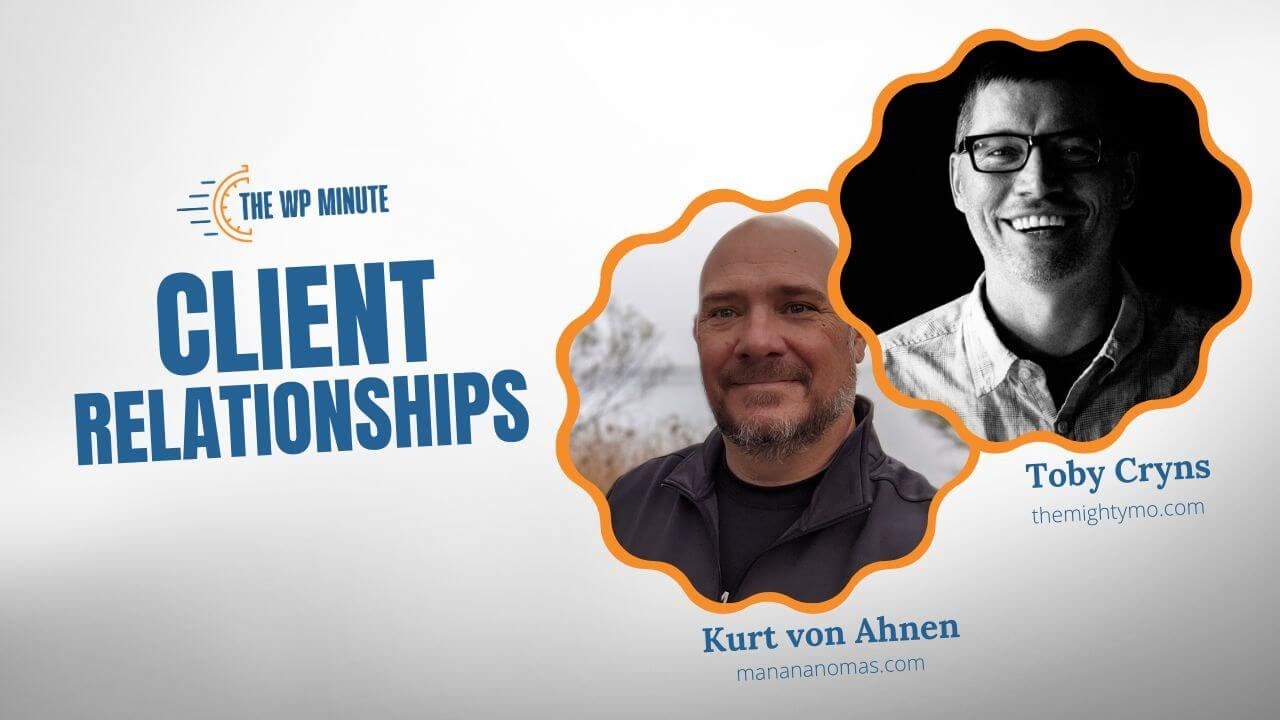
Navigating Client Relationships
## Metadata
- Author: [[WP Minute Podcasts]]
- Full Title: Navigating Client Relationships
- Category: #articles
- Document Note: ---
tags:
- #clientrelationships
- #agency
- #wordpress
Author: Toby Crimes and Kurt Vonan
Source: YouTube: Navigating Client Relationships
Reference: https://www.youtube.com/watch?v=DgkmVTQksCc
date created: 2025-07-21 13:45
---
# Title: Navigating Client Relationships: Handling Refunds and Communication Challenges in WordPress Agencies
## Table of Contents:
- 📝 [Summary](#-summary)
- 📖 [Main Content](#-main-content)
- 🗒️ [Notes](#-notes)
- 🗣️ [Paraphrase](#-paraphrase)
- 📰 [Newsletter](#-newsletter)
- ✅ [Action Items](#-action-items)
- 🧪 [Hypotheses](#-hypotheses)
- 📊 [Methodology](#-methodology)
- ❓ [Questions](#-questions)
- 🔮 [Future Research](#-future-research)
- 💡 [Implications](#-implications)
- 🧠 [Learning Styles Assessment](#-learning-styles-assessment)
- 📊 [Accessibility Assessment](#-accessibility-assessment)
- 🌍 [DEIB Assessment](#-deib-diversity-equity-inclusion-and-belonging-assessment)
- ✅ [Logical Validity](#-logical-validity)
- 🔍 [DARVO Analysis](#-darvo-analysis-prompt)
- 🔍 [SEO Evaluation](#-seo-evaluation)
- 🎯 [Conclusion](#-conclusion)
### References:
- Crimes, Toby, and Kurt Vonan. *Navigating Client Relationships*. YouTube video, https://www.youtube.com/watch?v=DgkmVTQksCc
## 📝 Summary:
This candid conversation between Toby Crimes and Kurt Vonan dives into the complexities WordPress agencies face when clients cancel projects mid-way and request refunds. They explore best practices for managing financial disputes, maintaining empathy in communication, setting clear boundaries, and balancing agency processes with client flexibility. The dialogue also addresses emotional challenges faced by agency owners, including fear of success, the struggle to raise rates, and maintaining mental wellness amid client conflicts. Finally, they consider the evolving role of AI in agency workflows and how it can support—but not replace—the human touch.
## 📖 Main Content:
The speakers tackle the problem of clients quitting projects midstream and demanding refunds, underscoring that time booked is time spent and that agencies must communicate this clearly upfront. Delaying emotional responses to difficult client emails is advocated as a form of self-care and professionalism. They emphasize empathy for clients' perspectives, suggesting understanding root causes of dissatisfaction—whether process missteps or changing needs—while standing firm on contractual agreements.
Managing an agency differs from freelancing due to team dependencies, requiring structured processes and sometimes tough conversations with clients to protect financial and operational stability. The difference between "clients" and "customers" is highlighted, with "customers" seen as having firmer boundaries, impacting service attitudes and policies.
The discussion shifts to the role of agency culture, wellness, and transparency in attracting and retaining good clients. They share personal stories about startup struggles, family pressures, and how success can appear sudden but is usually years in the making. Raising rates even incrementally is recommended to match increasing costs and value delivered.
The speakers discuss how AI tools like ZipWP can streamline some design tasks but still require human designers for polish and client-specific customization. They stress the ongoing importance of human judgment and personal relationships in client success.
Root cause analysis, listening carefully to client needs, and knowing when to "walk away" from untenable relationships are framed as vital leadership skills. The conversation closes on embracing discomfort as growth and preparing mentally for difficult client conversations.
### 🗒️ Notes
- [**Client Refunds and Mid-Project Cancellations**](https://www.youtube.com/watch?v=DgkmVTQksCc&t=5)
- Clients may request refunds despite significant agency time investment (e.g., 80% budget spent).
- Clear upfront communication about no/refund policies can set realistic expectations.
- Agencies may offer goodwill refunds but emphasize booked time is reserved and costly.
- [**Emotional and Leadership Management**](https://www.youtube.com/watch?v=DgkmVTQksCc&t=145)
- It's healthy to delay email responses during emotional distress.
- Leaders must balance empathy with firmness and avoid impulsive reactions.
- [**Understanding and Negotiation**](https://www.youtube.com/watch?v=DgkmVTQksCc&t=399)
- Effective conflict resolution starts with empathy and seeking the client’s perspective.
- Balancing agency processes with client preferences (e.g., portal vs. email communication) helps client comfort.
- [**Agency vs Freelance Dynamics**](https://www.youtube.com/watch?v=DgkmVTQksCc&t=522)
- Agencies need processes due to team coordination, unlike flexible freelancing.
- Avoiding difficult client conversations risks financial and operational harm.
- [**Client vs Customer Mentality**](https://www.youtube.com/watch?v=DgkmVTQksCc&t=756)
- "Clients" may feel entitled; "customers" have clearer boundaries.
- Adopting a customer mindset may improve agency-client relationships.
- [**What Defines a Good Client**](https://www.youtube.com/watch?v=DgkmVTQksCc&t=879)
- Presence of a champion on the client side driving the project.
- Good clients are engaged and trust the agency’s process.
- [**External Influences on Client Decisions**](https://www.youtube.com/watch?v=DgkmVTQksCc&t=1117)
- Marketing staff or external pressures can change project scope unexpectedly.
- Agencies must critically evaluate these shifts and manage expectations.
- [**Agency Culture and Wellness**](https://www.youtube.com/watch?v=DgkmVTQksCc&t=1228)
- Transparency, communication, and wellness focus contribute to client loyalty.
- Personal wellness practices support leadership resilience.
- [**AI in Agency Workflow**](https://www.youtube.com/watch?v=DgkmVTQksCc&t=1452)
- AI tools can accelerate design but require human refinement.
- Designers remain essential for client-specific customizations and quality assurance.
- [**Financial Realities of Entrepreneurship**](https://www.youtube.com/watch?v=DgkmVTQksCc&t=1564)
- Entrepreneurial success is often delayed and misunderstood by loved ones.
- Mental health and family dynamics impact agency leaders.
- [**Pricing and Value**](https://www.youtube.com/watch?v=DgkmVTQksCc&t=1772)
- Incremental rate increases (5%) are encouraged for sustainability.
- Clients pay for efficiency, quality, and trust, not just raw time.
- [**Choosing Battles and Boundaries**](https://www.youtube.com/watch?v=DgkmVTQksCc&t=1868)
- Agencies must decide which fights (refunds, scope creep) are worth pursuing.
- Knowing when to say no or walk away is critical.
- [**Communication Skills**](https://www.youtube.com/watch?v=DgkmVTQksCc&t=2071)
- Listening deeply and understanding client motivations improves outcomes.
- Clear, empathetic explanations about technology and process help align expectations.
## 🗣️ Paraphrase:
1. *Original:* "Clients often assume that changing their mind won’t have financial consequences, but as agencies, we reserve our time and take ourselves off the market. It’s important to communicate that booked time is spent, and refunds are limited accordingly."
*Paraphrased:* Many clients mistakenly believe that altering project plans comes without cost. However, agencies allocate specific time blocks that can’t be sold elsewhere, so it’s crucial to clarify upfront that paid-for time counts, limiting potential refunds.
2. *Original:* "The key to managing difficult client conversations is empathy first: understanding their point of view, then balancing that with firm, clear boundaries about what’s fair and what’s contractually owed."
*Paraphrased:* Handling tough discussions with clients hinges on first empathizing with their position, then confidently establishing fair expectations and sticking to contractual commitments.
## 📰 Newsletter:
🌟 **This Week in WordPress Agencies: Navigating Client Challenges & Embracing Change** 🌟
When clients change their minds mid-
- Summary: In this episode of The WP Minute+ Podcast, Toby and Kurt discuss the complexities of client relationships, particularly focusing on handling refunds, emotional intelligence in communication, and the importance of setting boundaries. They explore the dynamics of good versus bad clients, the impact of personal relationships on business, and the evolving landscape of pricing strategies in agency work. The conversation also touches on the integration of AI tools in agency processes and the fear of success that many entrepreneurs face. Ultimately, they emphasize the importance of empathy, direct communication, and the art of negotiation in maintaining healthy client relationships.
- URL: https://www.youtube.com/watch?v=DgkmVTQksCc
Hello. Welcome to another episode ofWhose WordPress Agency is This Anyway?I'm Toby Crimes. I'm here with thelegend, Kurt Vonan.Kurt, I had a question. I ran intosomething this week. I need yourhelp. I had a client quit midproject.I've already received all the moneyupfrontand they want a refund for some unknownpercentage. To add context here, weif we just bill ourflat hourly rate, we've already used up80% of the budget.Yeah. I get into this frequently.I shouldn't say frequently because thenit makes it sound like we have angrycustomers. That's not the point. Thepoint is, customers change their mindsand a lot of customers assume thatthere's no financialbacklash for changing their mind. Iput a lot into our proposals, and this is
a prepaid service. You've booked ourtime, and that time gets used quickly,and I'm very clear about it. So youcould say, "Hey, that's reallyunfortunate. But looking at the timebudgeted and the time spent on yourProject, you're about 80% spent, so Ican give you a 20% refund. Um, I thinkthat's fair. Uh, but I will tell you, Iknow of other agencies that have bakedinto their paperwork now where there'sno refund. You've booked our time. Youhave earmarked spaceon our calendar, and we have taken ourselvesoff the market for that time to serveyou. If you changed your mind, that's notour problem. And it sounds cold, butunfortunately,we see this with employment atthe corporate level. I mean, there'snot the same loyalty that thereused to be. And so we need toprotect ourselves.
Mhm. Here's the sad truth. I think wementioned this in the last episode. Inall my years as an agency, I've only hadone person actually contest a chargethrough Stripe.Stripe gave them their $3,000 back. Icontested it. I sent in tons of proof ofdelivery. Like, here is the backup fileof the entire website that's alreadycompletely done that the customer has.And Stripe was like, you haven'tdemonstratedproof of concept. Whatever.
Like, you haven't demonstrated, and Inever got the three grand back. Mhm.So, yeah, I don't know. It's a hardroad to—it's a hard road to go becausein the end, you're always open to loss.And to be frank, I would love to finishthe project. That's my ideal scenario.Like, uh, it's really a weird thing.
Um, it—maybe this morning as this happenedyesterday and this morning, um, I got anemail yesterday. I haven't respondedyet, but I was, um, thinking a coupleof things that—like,uh, I was trying to be thoughtful aboutit, and like, I was thinking likeand I thought it would be good for us toconverse about just, like, high level—likesomething happened yesterday at 3 p.m. Iopened my email and found this, and I wasalready having a bad day. Um, notbusiness-wise, but just like, I was justin a really bad mental state orwhatever.
And I was thinking, like, historically maybe I would have repliedto this email in that state. Yeah. No.And so, like, yeah. So, like, I've beentrying to do a lot of therapy this year,and I'm like, maybe I just won't respondtoday.
I could share that learning withthe listeners here; it's okay to notrespond in real time. Let's juststart there. Yeah, it's okay to stick apin in something. It really is, andpreferred in many cases. You know, I'vegot that leadership certification, and Ifeel like with that comes this addedresponsibility that I really can’t, Ican’t act in a natural way sometimesbecause everybody's watching to see howKurt's going to react, you know. Um, youknow, and I don't want to be those "do asI say, not as I do" people. So, I'vereally had to learn over time that it's
okay to stick a pin in something. Ifsomeone says something, and especiallyif they know, they knew when they sent theemail, they knew; this is crazy. I'm probably not going toget my money back, but I'm going to askanyway. And then you're thinking, youknow, you're thinking extremes; they'rethinking extremes, and in reality,there's something in the middle thatmakes sense. And I find using empathyworks a lot. Hey, I have no idea whatcircumstance caused you to change yourmind on this project. I hope it wasn'tbudget because we've already spent 80%.
Of yours. You know, if you absolutelyneed a refund and you need to close theproject, I can refund you 20%.Um, but, or refund you, not reimburse, Ican refund you 20%. But please recognizethat that would be a goodwill offer onour part and that you’re locked into theproject based on what we soldoriginally.
Made me think like, um, so there’s thisother question. Okay, how to have thatconversation—email, phone, you know.Um,I am—I'm a direct person and I thinkvocal tone says a lot more than print.And so I'm somebody that would very muchpick up the phone and make the call, youknow, direct to the person knowing it’sprobably going to go to voicemail. Theydon’t want to take my call, right? Um,They’re hoping they can be firm inemail, right? That’s a person that’slike—that’s like someonethat breaks up with somebody via textmessage. Mhm. Right. And so, um, you’vealready seen they’re taking the escapismroute. So me, I would prefer to bedirect. Get them on the phone and usekind of that vocal inflection andpausing in my words and own the space.
Between the words, stay calm and incontrol. I prefer that method. Tobe honest, I probably wouldn’t get on aZoom call. I didn’t realize this until Ibecame a corporate trainer and Irecorded one of the sessions I wasteaching, but apparently, I have nocontrol over what my eyes do when I’mtalking to someone that I think iscrazy. So, there I was teaching a class anda technician was asking a question, and Iwas like, and when I saw the video playback, I waslike, "Oh my gosh, how did that guy evenleave the room with any sense of pride?"So, I would hesitate to get on aZoom call for a conflict resolution. I’d rather doit on the phone.And there’s, like, um, I’ve read a book by Christopher Vossabout negotiating. There’s Getting toYes. It’s a famous one written a long timeago. It’s interesting howthose books really approach it. They’re looking forunderstanding. First of all, if I couldsum up step one, try tounderstand their perspective.
And I think like in this case right nowwith my current headspace, it's goingto be really hard for me to put myselfin a place where I can listen. Yeah.
You know, it's never the easy thingto say when you're talking with peersabout this stuff, but it's really timeto look at some root cause analysis,too, right? Like, where did thisactually start to fall apart?
Is the client really crazy or did we notanswer three emails? Did we not deliversomething on time? Did we not explainthe process properly? Did we, um, I pridemyself on having all these greatprocesses and then I realize if you overcomplicate the process. Like, I am so processdriven with my client portal. I thinkit's this great asset, but I've had acouple of clients go, "Can I just emailyou? I really don't feel comfortable inthis portal thing." And I'm thinking,"Are you stupid? Because the portaltells you what percentage of the work isdone, what task we're on, like all these
things." And they're like, "Yeah, I just wantto email you and ask you what's goingon." And I'm like,"All right, you know, and I want to holdto my process, but I alsoI don’t want to alienate the client,right? So, I’m trying to work this out, thiscrazy situation. And that’s the problem — theobstacle of being the leader of an agency. That’s thedifference between freelancing andrunning an agency. You know, if you’refreelancing, you can be flexible,willy-nilly, all over the place toplease whatever the next contract is.
But if you’re running an agency and youhave other team members, you want tohave a process and be process-driven. Soyeah, it’s a challenge, man.It’s a real challenge. It’s anotherthing that I have, and I’m sureothers do, too, where it’s like I’mreally averse to having difficultconversations. You know, like I justtry to avoid them. I don’t want them.And so like I know historically whenI’ve been put in this situation, I havehanded over all the keys like, "Ohyeah, yeah, here’s a full refund and I’lleven give you a 10% bonus ontop of that, you know." Um, and I reallywant to stand firm andbe fair, whatever’s fair.That’s kind of my approach. ButI used to try being super nice, too. AndI was the same. I would say, "Oh, I'msorry. I'm sorry that happened to you.
Let me do this. Let me do that.
And then I realized, you know what? Um,this was it. It's weird. It's like motorcyclegear. I'm a big motorcyclist. The peoplethat need the gear the most have theleast. And the people that need the gearthe least have the most. I've got$20,000 in riding jackets in the garage,and I don't even have a motorcycle outthere right now.
Um, it's the same when I was in that position.We were broke, man. Beans in a pot,holes in the kid's shoes, and somestartup customer would be like, "Oh, Ijust don't have the money." And I'd belike, "Well, it's okay. I'll float youfor the first six months or whatever."Why am I giving a loan to someone I barelyknow? It'speople make these assumptions that thisagency work is like free or that wedon't need the money or something.
And it's like, no, absolutely not. Um,and I would say over time I've grownmore callous.
So I've become more callous andI have more processes.
Nice. I'm still empathetic, but I'mstill running a business. And that's wereally have to wrap our heads aroundthat and take the responsibility and theleadership to it. And yeah, there areconversations you don't want to have,but the more you have them, the betteryou get at them. Yeah. And I think partof the tricky thing for me is like Ifeel like I really have the preparationfor the call. For me, it's not so muchnuts and bolts. It's like getting myselfin that firm and inquisitive headspace.Yeah, like pump myself upbut in a way that’s like, "So tell mewhat's going on, like what happened, youknow?" but also hold really firm towhatever I have on my end. You know, I'mFrasier Crane. I'mempathetic, but you got todrive the point. And I think what somany people miss iswhen I think about what we do as anagency, right? We have a startupplatform we do for people and it's
super affordable. And that'sbecause I've been doing this for over 20years and I go, "Oh, you want an LMS, aCRM, this, that? Okay, it’s going tobe these five tools in a WordPress freshYou wanted to install a startertemplate. Okay, which one of thesetemplates do you want? Well, you and Iboth know that’s maybe 30 minutes, butI don’t care. You spent thatmoney. That money is gone. That productis done and delivered. That’s it. And ifthree months later you can’t figure out howto make the website look and feel theway you wanted it to look on some DIYprogram, that’s not my fault. You know,you could invest 22 years and figure outhow to do this. Or you could take theother options we already offered. Youcould hire us, and we could put in yourcontent and we could build this thingout for you. But you’re not going tospend $2,000. You’re going to spend$6,000 or you’re going to spend $8,000.
But you not having a budget is not myconcern. My concern is what I can offerfor the value that’s provided. There’sthis, um, thing, uh, it’s the language weuse in our industry. Um,we call our customers clients and I’vealways felt likeGoogle calls their clients customers,and they’re hard-nosed about it. They targetpeople who have firm boundariesand generally call their clientsClients and customers, and I think like maybeit's the WordPress culture. Like, you know,maybe that's part of it, but likethis whole idea of like you're a clientor, you know, let's just say there'sa difference between client and customer.
Customers have very firm boundaries.Clients don't. Um, I think all that seepsin—that client mentality—servingclients. And you know, social workers, yeah,client's a power word that makes peoplefeel more important than they really arein the equation, right? And, andcustomer is just a generic version ofthat. It's, it's— I always view like acustomer as like in the masses, and theclient is like the next tier up, right?They're like the manager.
Yeah. And I think what I wonder is likeif we approached,you know, if I approached this situationmore like they're a customer—like I'mtarget—like being like, "Have you usedthe product? Have you opened thebox?" You know, like, "Oh, you did openthe box. Oh, they did do a bunch ofwork. Oh, you know, like my approachmight be a little different to theconversation. Yeah. Yeah. Well, but thenyou have to factor in who's trying toMake the return, right? Because mywife can return anything at any storewith no questions asked. And as soon asI walk in with something, it's like, hasit been open? Has it been worn? Was itworn on pavement? That's so true. I hada receipt. I had a tree. So, I bought atree from a very fancy tree seller intown here. And they have a guaranteelike if it ever dies, we will replaceit. I brought it home, planted it,and brought it back the next year because arabbit had eaten it around and it died.
And they said, "No, we don’t. If arabbit eats it, we don’t take it back."But then I was talking to my friendwho's a woman and a little older thanme, just really kind, and she's like,"No, I return stuff like that all thetime to that very store." And like, "Noquestions asked. I walk in, they say,"Here's your refund." No questionsasked. No questions asked.
So, if you ran your agency like Target ran their agency,imagine how many allies andinclusive people would be so angry atyou if, like, if a woman wanted arefund, I'd give it to her. If a manwanted a refund, I'd make him work forIt’s probably not policy; it’s probably just part of life in the United States.
Part of life in the United States. Well,I think that we are going to transition into the next thing, and that is, so you’re having this incident,right? Let’s talk about it now, and in reality, I know you’re going to make the call.It’s probably going to smooth over, and it’s going to be fine. Like, you’re probably overworking it, right?
Which is what we always do to ourselves. But how do you define a good client then?So what is a good client, right? So, um,I asked this of our, uh, I should plug the WP Minute group.There’s a Slack channel; I think you can buy access to it.Like, it’s great. If you’re an agency owner, you should totally join.I don’t know what Matt charges for it, but it’s worth it.Now that I’ve been in it, I would buy it.Are you paying for it, Kurt? No.
Well, you’ll be on blast right now, but definitely join it.And then you have all the access to Kurt, me, and other grander names from WordPress.
Community, we'll say. But we had aconversation about this very question inour WP Minute Slack. Um, and one ofthe great answers we got was, um, thequestion, I was just like, "What makes agood client?" And the gist of it was youneed one person who really wants it ontheir end, on the buyer's end. Yeah, andthey're like, and they have the authorityor whatever, the clout. Really, it'sabout clout and trust to really push itthrough. And, um, the gist of it is itdoesn't have to be a big company.There doesn't have to be acertain vertical. It's like, do you havethat person at that company that'sreally fighting for you? Um, and I wasthinking, like, we are wrappingup a project right now for, um, a customerwho needed a website redesign, and theadvocate at this company doesn'teven work for the company. They're thespouse of one of the people at the
company, and the spouse is apartner. So like the spouse co-owns thecompany. Um, but our main contactthere is she, she's doing the copywritingfor the website, but she's driving theproject on their end, you know? Yeah.I think like when we say, "What's aGood customer. And then you say, well,having someonethat's vested, right? Someone thatthat's really into it. And you got to beready for the bumps that come with that,too, right? So, two years ago, I workedon a website project that I was reallyproud of. It was helping launch newauthors out of Canada. And I love thefounders. They're great people. Theywere on my podcast. We get along reallywell. Um, and then they hired amarketing person. And the marketingperson's like, "I prefer Squarespace."And then I'm like, "The website's built.
The website's built. You have afunctioning CRM. You have these things.And like, "No, we're going to go withGoHighLevel and Squarespace." And I'mlike, "So, you're going to spend twiceas much moneyto have no ownership of anything." Andthey're like, "Well, that's what ourmarketing person wants to do." And weare really committed to using her.Mhm. Okay. And so, sometimes you have torecognize that sometimes stuff justleaves and it's not your fault atall.
Yeah. I just got an email, um,recently, I think it was yesterday, fromAn agency in town does not do the same work we do. They dodifferent marketing and lead generationtype of work, but they are like, "Wereally want you to build this site becausethey came to us and they are talking to someone. They don't knowexactly who this client is talking to,but they wanted to do something I had neverheard of. Some company I had never heardof, but basically it's a headless CRheadless website builder thing. Andin my head, I am thinking, "Yeah, that'sWordPress if you want it to be." Like,we don't have to overthink, but thereis something in their head, whoeverthis amorphous person is. It'sAI. AI,but someone is driving it to this point.
Somebody with some influence is drivingthis weird decision. And if Ihad to guess, that’s where theproject is going, you know, just based onthis little email I received.Let’s just put him on blastbecause he’s a nice guy, right? So DanNelson answered your question, and thenwhat’s interesting is I didn’t realizehe worked for Multi-Dots, and then Ilooked at the way he answered that.
The question and the way that he drives downlike size of the customer doesn’t matter.You know, he goes through these things,and then I don’t know if you recognizethis or not, but like I interviewed AnilGupta for a separate podcast, who is theowner of Multi-Dots. Then he islike a holistic organic guy into yoga, liketotally awesome dude. He has awellness blog and all these things. And Ithink if we’re going to be real, like youand I having a conversation and we say, well,what’s an idea of success or what’s anidea of someone that’s struggling, right?
Um, when you see someone that operatesindividually in that way and then theygrow a team, you can tell by Dan’sresponse; he’s kind of in alignment withthat ethos, right? Good things aregoing to come their way. You’re going tosee the growth. You’re going to see theclient loyalty. You’re going to seecustomers that behave. And I workreally, really hard to emulate some ofthat on my end. And I know that youdo too from talking to you so muchrecently. So I think in a lot ofrespects when we say what’s a goodcustomer, what’s a bad customer, Isometimes think it’s just the fruits.
Of what our agency builds based on ourown actions and behaviors.Yeah, because I think, in general, inthe world, you can actually have alot of control over how people interactwith you, just based on how you carryyourself. That's freaking unacceptable, man.
So, no, but it's that — that's somethingto really drive towards, you know, andI'm not trying to put out a commercialfor Anneil in any way. It's just whenyou see the size of his agency and yousee the clients and the customers thatthey work with, and you see what he doesoutside of running the agency, you beginto realize, like, you're building anecosystem of truth, respect,transparency, communication,wellness. He's really big on wellness,mental wellness, physical wellness, allthose things. And I think when all ofthat comes together,you can't help but attract the rightpeople. Mhm. I asked my friend — I have afriend who's, um,has lots of personal issues, like mentalhealth types of issues, like reallyserious things that are very medicatedand whatnot. Um, but I asked herRecently, I was like, "How do you come off as so calm all the time?"It seems, you know, if I look at you on paper, it's a different story.
And she was like, this is what she found useful.I think I could use this too in general. She was saying, meditation for her was like —the idea is that you don't need to meditate, but if you can find calmness in the storm,whatever's going on in your head — because it's usually in your head.
If you can just figure out how to do that, for her it's meditation.It could be stream of consciousness journaling, it could be yoga, it could be basketball — I don't know.But, I think there's something to that.I think mine is mountain biking and barbecue.If I'm manning the grill, especially with a beverage and just chilling on a nice day,everything else just falls to the wayside.
You know, even if there are problems or obstacles or distractions,you're able to, I don't know, put things in a clear alignment.
That's really important. And wediscussed that an episode or two ago,like with the mountain biking and thephysical activity. I heard afunny anecdote yesterday at my kid'ssoccer practice. But I'mnot joking. With an hour of soccerpractice, a bunch of six-year-olds, not asingle soccer ball was kicked. Like, I'mnot even joking. At one point,there were like three or four groups. One group's playingcats. They're pretending they'recats, doing this with the soccerball.
One kid was sitting on it like an egg.The gist of it was, though, I havea friend who's a parent there, and shewas like, "Yeah, it was just wildyesterday." So what she started doingwas she got out a shot glass, and she'slike, "Anytime my kid asks me forsomething today, I'm just going to takea shot of water." It was like she was justplaying a drinking gamewith water. It's a fun way tohandle it, you know? That's one wayto get your gallon in for the day. Yeah,exactly. So, I know that from anotherDiscussion about toolsandI hesitate to turn this podcast into atool review all the time. You know, I dothat on other shows, but I think youand I shared a little moment with ZipWP,right? And then we have a lot of peopletalking about WordPress AI right onWordPress.com.
And um, what are your thoughts, man? Doyou think that’s like a replacement fora low-level agency designer, or areyou still skeptical, like the jury’sstill out? I played with ZipWP over theweekend, and effectively it’s like buildinga website with a click and building aWordPress site with a click. That’s whatit is. Yeah. Um, and the only reason Iwas there is because I was having troublegetting my contract designer to do thework because she was busy or whatever. Um,and so we were having a real businessproblem just producing mockups for a
client website. Like they’re just like,"We need a redesign." And we couldn’teven get like the initial design,you know, like a wireframe. Like I wasjust like, "Gosh, there’s got to be abetter way." And I got to say, I wasI was really impressed to the point where I’mthinking in my head, "Our designer, if we do this,our designer is going to manage theZipWP."We still need a designer to do itand think about it, but it’s a different process.
I just saw it as a process change, not like a tool.It was just kind of like, okay, the problemwas that I couldn’t hire this designerbecause she was busy. Here’s apotential process that we could use.Yeah. So,a while ago, maybe two years ago,maybe a year and a half ago, I don’tknow, um, I was in Cadence, and Cadencehad an AI builder with their startertemplates, and I had used Cadence startertemplates for a while, right? And let’sbe clear, from an agency perspective,there is very much room for thatproduct. You’ve got startups, you’ve gotpeople without budget, and you’re like,"Here, I can give you an instance ofWordPress and give you aformatted five-page website that givesyou the opportunity to get a head
start."Page, right? And so, I'm very clear,it's a starter template. It's not SEOoptimized. It's none of this crud. It just gives you the format toknow where to put your pictures and yourheadlines and your paragraphs,and I'm very clear about it. So Ijust want to make sure that I am clearon the podcast. But I found cadence; Iwasn't generating applicable content. And thenI have an Astro Pro license and Ithought, well, you know what? I'm goingto jump in and do this one in Astra,it was for a friend of the family. Andso I went in, again, not a lot ofbudget, but it was like so, and so doesthis in this area. They run this kind ofcompany D. And I put in like 500 words.
And then I noticed it said 500 of 3,000.Like I could put a giantdescription in this AI tool, but Ididn't. I just put in the 500 words,whatever it was. And then I clickednext. And I said, "Pick some pictures."I said, "Oh,okay." So, I picked some royalty-freepictures. And I was able to pick thepictures that match the client inThis case, right? She likes brightcolors. She likes this. I know some things. So, click, click, click, clickclick, click, click. Import.
Pick your colors. Wow. Okay. She likespurple. Boom. And then it said, "Pickyour format or pick your template," andthat’s where all of the, like, if youwant this kind of content, these kinds ofpictures and this color, it would lookgood in these templates. And there are allthe templates, and you pick one, and thenyou go into the next screen. It sayschoose the font, choose your colors. Solike, do you want the links to be this?Do you want this to be that? And then, uh,publish.Bada boom, bada bing, website. And I thinklike what people get wrong about this, um,like in my view, designers could stillcharge a premium for this. They don’tneed to pay me. Like, we're saying like,let’s say they charge X amount, X dollars,just to deliver the design to me.
Let’s say this designer that I wastrying to contract with. I don’t care ifshe does it in ZipWP or some other AItool. I just need the design because I stilldon’t want to do it. Like, um, if sheunderstands, she has a good sense of whatWe need, you know, like I would love forher to be like, "This hourly thing isn'tworking. I can do it for this amount nowfor each design," and be like, "Great, youknow?" Well, and I think if we're really honestwith each other, 'cause Idon't want people to hear this and go,"Oh, Kurt says I can build this in 10seconds." Uh, that's not true because Iwill say the template, all the printedmaterial was like the headlines matchthe cause, the paragraphs kind of matchthe cause, but you got to go over allthe content. You got to change things.
You got to put in some local SEOkeywords. You got to move some thingsaround. And when I say move thingsaround, that's where the designer comesin. Where the designer goes, "You know,what? In this use case, we probably needa little more white space here. We needa spacer here. We're going totransfer this form out. We're going toput this form in. We're gonna connect itto this lead magnet. You know, there'sa difference between, uh, gettingoff the blank page and having a finishedproduct, right? But for a lot of ourstartup clients in our local community,they're coming at us with aWith a meager budget, I'm able to say, "Hey,for that budget, I can give you a heckof a head start. Here you go. Oh, and bythe way, I run the WordPress meetup oncea month. You can come to that, and we can
go over how to make these changes andall that stuff for free. You know, onthat dime. I don't even have toabuse you at the agency level. And Ithink that earns trust, and we end upgetting more referrals from it. Theproduct's great. Yes, and I thinkyou're right. I think for me, the ZipWPthing, it's similar to tools that I tried. Itried one called Reloom.io that Ithought was really good, but not at allWordPress. It was just to get toFigma. It was a way to go from a blank page toFigma really quick. Um, and I think thisis what people getwrong. I still think my designerneeds to invest aday in polishing these things, likeyou're saying. Um, it requires alltheir talents and energies to do that.
Um, but maybe it saves a dayor two of whatever would happenbeforehand, and this is wherewe're going. I mean, when Ithink of where we're going, this isSorry, the world's changing; AI's here.
Like, I'm not fighting it; youknow. I think that is a very workableuse of AI. Whereas I'm going to ask ChatGPTto make me a custom plugin, and Idon't know what code is. I think that isa completely ridiculous use of AI. Yeah.
But even, like, this is the thing. Even ifyou with all your experienceasked ChatGPT, it's still a hugeheadache for you. You'd still want topay someone to do that. Like, even if youknew it was ChatGPT, you'd be like, justbuild me the starter plugin. I'll payyou X amount for ChatGPT. I know you'regoing to do it there. That's fine. Like,yeah.
But you're responsible. Like, I, I, Idon't want to be responsible. I want topass that liability off to someone else.I want to say, you're responsibleto test it and make sure itworks and that it's free. Yeah. Mhm.
Yeah, I'm totally down with that.And then, so if we are having thisconversation and we're saying, what is that worth?That comes into thatwhole framework that we talked aboutearlier, right? And it's like, what's thevalue you're bringing to the clientIf the client tried to duplicate what Ijust did in ZipWP in 30 minutes, they’d spend three weeks on it. So, isit worth 500 bucks? It’s absolutelyworth 500 bucks. And just because youhave the … if a technician uses airtools with an air compressor to replaceyour water pump, does he get paid lessbecause you would do it with a ratchet?
Right. No, that’s not how it works.Right. Well, most of theprofessionals in the world have a setfee just to show up. Yes, I’m going tocome and do something that’s 200 minimumjust to come and look at yourbroken pipe. You know, in our space, Ithink that’s actually going to be whatdrives the value in the near future,because people are going to want thathuman face-to-face, Zoom-to-Zoom contactand know that they’re talking to a realperson with real ideas, as opposed tosome AI tool that’s saying, "Oh, you’reso brilliant. Absolutely. This will beeasy. We should do this." Right? Youneed a real person to bounce things offof. Yep. Talking about real people tobounce things off of. Yeah.
Let’s segue into this one. All right.So, Casey Allen, who’s a friend of mine,In Twin Cities, he's an advocate ofthe local startup community here anddoes a bunch for the community. Buthe posted something to LinkedIn thatwas really interesting, and he said,"If you’re a founder, your husband orwife is your largest investor. Whetherthey want to be or not, whether you wantthem to be or not, they are." And then Igot to thinking, because I think there'ssome weird disconnect betweenthe startup community and theagency owner community. We're really thesame in my view, you know, in many ways.
But so I was thinking about it, and Iwas like I would just tweak this alittle bit and say, if youown a small business or anybusiness and you’re married, your spouseliterally owns half of your business.So don’t pretend they don’t.Whether or not they’re actively participating is irrelevant;because if you got divorced, theyown half the business.
I struggle with this whole concept. Ireally do. And it’s so use casespecific, right? It’s like what scenario did you put yourself into?My... and I’ll just be reallyTransparent. I love my wife. I love mywife. I love my wife. But the whole timeI'm launching my agency, she's like,"So and so is hiring. Did you thinkabout applying there?
I would really like it if you had ajob." You know, uh, and then she wouldcome home from her job, you know, and belike, "What have you done all day?" Youknow, it's like, "I'mworking." Well, there's no money in theaccount. It'll come. I'm so insecure.
Harvest. Yeah.Funny when the harvest shows up. It'slike, uh, all of a sudden you're anovernight success and you're a hero,right? And, uh, I'm not beatingher up because I can't because she's mywife. But that's very common withpeople. Very common. Um, people that haveI have entrepreneur friends that said,"Oh, it won't be long now. People aregoing to start patting you on the backtalking about this overnight success ofyours." And sure enough, there's somepeople going, "Wow, this guy came out ofnowhere." And it's like, out of nowhere,I've been doing this for 22 years.
Yeah, I have an e-learningwebsite that I almost shut down lastLast August, I almost shut it down. Iwas like, "Well, it's failed. It's notmaking any money." And then I thought, Ialready paid for the hosting package.
It doesn't cost me anything; I'm just goingto leave it up and see what happens.Literally that month, I got a phone callfrom someone that wanted to do apartnership, looking at their numbersand what they're going to bring to mye-learning program. This tool thatI was going to turn off after five years ofmaking nothing is all of a suddenturning $60,000 a year. Mhm. And it'slike, so is that an overnight success?No, that’s five years of waiting it out.Yeah, yeah. You just don’t know. SoI was transparent. How is it for you? Um, I’ve had similarconversations with my wife where, um,really up until this year, this is thefirst year that I have—The Mighty Mohas paid for health insurance for our
family. Up until this year, I thinkshe's usually had a full-timejob. Um,I should say every time she's had afull-time job, her job has paidhealth insurance. And that was always asticking point for her. She’s like,“Huh, your company doesn't even payhealth insurance. Is it even a realcompany?” And like, also, I wasputting some percentage away for anSEP IRA every year. And that’s likejust money that nobody ever sees. It’slike for 40 years from now, maybe if we’realive, we’ll see it. Um, andin her brain, that doesn’t count.
No, that doesn’t count at all. Likeshe’s just like,“You’re not making enough money.” And I’mlike, honey, like,um, you can’t shop on Amazon with an IRA,buddy. And it’s tough too because Ireally, I mean, within reason, I candecide what to pay myself as long asthat money is in the bank account, butyou know there’s uncertainty aboutwhat’ll be in the bank account. So it’slike, it’s hard for somebody who’s alwaysworked like a W-2. It’s hard for them tounderstand, I think, like, thejust kind of the messiness of running a business.And I, and I think wehave to acknowledge it, whether weagree with it or not. We have to acknowledge there is acertain amount of resentment.
I've already told you, if I'm having anunproductive day and there's nothing onthe schedule, I'm going to go mountainbiking at two o'clock in the afternoon, andthen I'm going to come and I’m going towork into the evening. Right? And theysee that they’re like, "Youdon't even care, you just do whateveryou want to do." And then some forty thousanddollar month rolls along. Right? And now, nowyou're rolling in it. Right? Now you’remaking it rain, you know? Hey, let’s go out todinner this week. You know, and you’redoing crazy things. And you thinkthey should be happy. Like you wonder,how come you’re not happy? Ibrought in all this money. You should behappy. But instead, they’re resentful.
They’re like, "I slave away at a job Ihate, and you’re just here hanging aroundthe house, and all of a sudden moneyshows up." Yes, that’s okay. Don’tworry, we’ll be broke in three months. Ihave gotten so much slack over the yearsfrom my wife. Not good slack. Likereally, like you're sucking it up slack.
’Cause I would take a lot of naps in theafternoon. But like what she doesn’t seeis like today my workday started at six o'clock.
A.m. Yeah. And a lot of times I leavefor work at 5:00 a.m. But what she sees,you took a nap today.But no matter how much I try toshare the context, she just doesn’tclick. And I think that’s probably, Idon’t know how normal that is, but itseems reasonable; like a human would belike he’s napping while I’m working.
Yeah, I try to be empatheticand I try to understand the perspective.Um, but like we said in anepisode before, I’m so emotionallyunemployable at this stage that I wouldbe useless to go to a corporation nowbecause I’d be the kind of guy thatwould want keys to the building and I’dwork at 3 in the morning some days andI’d be gone at lunch other days, youknow, and that drives corporate crazy, right?Yeah. They don’tknow what to do. They don’t care howmuch money you’re making or howproductive you are. But if you’re nottowing the line andconforming to, you know, their ideals,they freak out.
And so it’s really difficult with spousesfrom that perspective.
The side of entrepreneurship that is, it'slike a taboo. A lot of people don't liketo talk about it, but it's the fear ofsuccess. You know, how many people startan agency making $500 websites and thenthey go, "Oh, I could probably charge$750, but how am I going to raise myrates? You know, I'll lose customers."And like, no, that’s a fear of success.
Like, if you have acquired someskill set and you have a niche to sellto, sell to them. Now, it’s $1,500a site. Now, it’s $5,000 a site. Now,it’s $10,000 a site. And theneventually, you get to be one of thesemulti-dots guys and you go, "You knowwhat? We can take a look at that for$173,000."And people have a hard time wrappingthemselves around what that looks like,feels like, smells like, especiallypeople that aren’t in our shoes. Becausethen they go, "Wait a minute." Yeah. CuzI’ll talk to a client, I go, "Man, thatwas a great phone call. That’s got somepretty good potential. That could be a$40,000 call." And you know, peopleoutside your brain space are like, "Thatguy's crazy. There's no way that's goingto manifest itself, right? And then whenIt does; you’re an overnight success andyou got lucky. Yeah.
This "what to charge" thing is really, Ithink there’s something to what you’resaying. Like, um, I gave a talk at WordCamp this year, and one of the bulletswas for freelancers, and oneof the bullets was like, just raise yourrates 5% tomorrow. Whatever you’recharging, I don’t care what you’recharging. Just raise whatever you’re, youknow, like if you’re afraid to raise them,just raise them 5% tomorrow. Like, um, whynot? Like, I don’t know, like you couldalways drop them again.
I guess, like, you know when you’redriving across the country, and I saythis to a lot of people and they thinkI’m nuts. You’re driving across thecountry, and I’m in Kansas now where gasis $2.40 a gallon. Then I drive toArizona, and it’s $3.40 a gallon, and then Icross the border into California, andit’s $5.50 a gallon. Do I stop buying gas?No, I pay whatever I need to pay. Like,that’s just the way that itis. And if customers want to race to thebottom and find a niece or a nephewthat’ll build a website for $50,then they’ve taken that on themselves.
That's their business decision. But ifsomebody wants a professional that'sgoing to treat them well, and youknow, give them the status along the wayand build on time and on budget, thenyou have to have a budget. And that that'swhy I have conversations. I think that'sit. If you want to,for people who are afraid to raise yourrates. Well, I think you justneed to get over it. Like you’re saying,Kurt, like myself included, like I’vekind of been stuck in this for a year, andit’s 18 years in the biz. I feel like Ifinally maybe increased my ratesconsiderably compared to the firsttime since like 2013, maybe. Yeah. Um,and think about everything else that’sgone up since 2013. Yeah. Right. Youknow, rent in San Jose in 2013 on athree-bedroom house was $4,500 and nowit’s like $8,600, right? And so,and then you’re thinking, well, I’mworking on the same money I made in2013.
Like, we have to put things in aperspective that makes sense to ourenvironment. Yep.So, how do you pick that fight?Yeah, and this is a great question. Um, II actually heard about this concept. It was in the context of apolitical conversation that washappening recently, and the question waslike,without getting into specifics, I’lllet anyone fill in any blanksthey want. It doesn’t matter becausethis happens all the time, but it’s like,are you picking the fights that areadvantageous to you? And so this couldbe a pricing fight. It could be, let’ssay my case today, like with thisclient, a customer who’s trying to gettheir money back after the work’sdone. I can even within that context, Ican choose which fights I want to pick.
You know, I can set my own boundariesfor what I think is fair game to fightover.
And I think, like historically, oneI’ve shied away from picking anyfight, and I’ve just folded over and letpeople run roughshod overthe business deal that we struck.And so I think, like, one, I wouldencourage everybody to some degreeto find some ground and holdthat ground, whatever that is for you.And it’s going to be uncomfortable.
It's going to take time and energy tofigure it out in the moment. Um, thegood news is you have help, though. Youcan talk to people who have beenthrough this a lot. Kurt, you know,you can find us on LinkedIn. You canfind a business coach and score. Um, youcan also read these books like theChris Voss book or the Getting to Yesbook. They have really thoughtfulways to approach these questions, likefind the ground. In Getting to Yes,it's always about what's the best.This is how they describe it: what's thebest alternative to negotiated agreement?At what point do you walk away?That's how they encourage you to thinkabout it, just at a high level. Um, what doyou think, Kurt?How do you...?
So, again, this is going to sound... this isgoing to sound trite, but I worked for areally good manager when I was atDucati, a really great dude. And he hada saying he would say all the time. Hewould say, "Train hard, fight easy." Andit wasn't... it's not his saying. He tookit from something else, right? He'sfrom the UK, so he took it fromSomething. Train hard, fight easy. Trainhard, fight easy. And I've really takenthat almost as a mantra. Like, if you areprepared, if you are plugged in, if youare aware of your surroundings, youknow, if you have some verbal dialogue,I call it verbal muscle memory. Um, Ihave certain phraseology that I use that
I consider my power words, and um, theyget me through most of what would beuncomfortable. And then go back to whatis uncomfortable. Well, uncomfortableis always the space that we find growthin. Like, we always grow when we'reuncomfortable. We don't grow when we'recomfortable. When we're comfortable,we're not doing much. So when we'reuncomfortable is where we find thesegrowth moments. And so what I try torecognize is, and it's a saying I saidall throughout the pandemic. I said wehave to find opportunities within theobstacles, right? And that's my way ofsaying we grow when we're uncomfortable.
So if we find an opportunity in theobstacle, even if it sucks, even if itsucks in the moment, train hard, fighteasy, do the battle, learn from it, andgrow from it. And I always come back towhat's the root cause analysis. WhereDid this go sideways in the first place,and how could I avoid it in the future?
I'm always trying to think in thoseterms. I think it's really led meover the course of the last half-decadeto come to a pretty good space rightnow. I'm pretty comfortable inhow I make decisions. But you touchedon something, and you said, "At whatpoint do we walk away?" You know, atwhat point do we turn away? I'verealized that my point to walk away ispretty quick anymore. I'm not astenacious as I used to be. If it'snot a good fit, if someone reallydoesn't want to be part of the mañanateam, you know what?Go ahead. If it's a case whereI've done half the project, I have noproblem saying, "Hey, let me downloadthis for you. I'll give you a zip file.You can take it to any other developerto have it finished. Obviously, we'renot your choice, right? But that doesn'tmean you get all your money back. Thatmeans you get what we didn't use.
Yeah.You already know this. We saidthis the other day. I thought this was one ofthe smartest things we said two episodesA while ago, it was when you lose a client or when you think you can’t afford to lose the client, andthen you retrospectively lookback on it. You absolutely didn’t needthat client. There was always somethingbetter right behind it. I also like youknow I’m in the process of selling ahouse still. Um, the buyerscame and asked for something I thought was ridiculous. Ijust said no. Yeah, no. Theycame back with, “Okay, okay, okay.”And I would, you know, my realtor hadthe conversation, but I told him, “Just share with them howmuch we’ve done and don’t focus on thisthing.” But you know, tell them no, butcouch it in this other thing. I thinksometimes the advantageous fightis to be like, “Look, we’rebusting our butts for you, andyou’ve pushed us too far on this.” You know, like, “Yeah.” Thishappens frequently, especially withreally big projects with dynamic tools.
Um, I am really skilled at Lifter LMS.And so I jump into these Lifter LMSbuilds, and before I do the builds, ITell them, "This is how the quizzingworks. This is how the reporting works.
This is how the member pathwayworks. This is" and I go through allthis with people just to make sure we'reclear. And they always go, "Okay, yeah,that's great. We can work with that.That's not the way our old system didit, but we can change and this will befine, and da da da. And then, six monthslater, you know, you're building andthen it's like I noticed in thereporting, it doesn't give me this datapoint. You know, I really need that, likewhoa, whoa, whoa, whoa, whoa. We went overall this. What data point can you notlive with? Right. Okay. So, you want tohave that custom developed and add thatto the ticket, and well, I didn't want tohave to pay for it. It should beincluded. Well, it's not included.
We went over all of this. We did afull needs assessment with you. Um, butthat's to your point. You have to knowwhen is it appropriate to say no andnot even enter the advantageousfight. Like it's not a fight. Like, yeah.A lot of times we, as agency owners, wego, "Oh, I got to battle this out." Youdon't have to battle anything out, right?
A lot of times, I just go, "It's not abattle." The answer is no. Yeah. Yeah.And a lot of times, just because someone asks for it, doesn’t meanthat they think it’s even important. No,they just want to ask.They want to get back on the teetertotter and be in some kind of positionof balance or power, and sometimes wejust have to say no. Like, that's that.A lot of people ask me to doreally weird things, like with LMS’s orwith membership sites. Well, I wantcertain members to do this and certainmembers to access that, and then I wantto be able to restrict this, and like
everyone wants a community plan untilyou load up a community plan. Then theywant to restrict everybody from it, andthen I have to go, "Well, whatplatform do you currently use or haveaccess to that does anything like that?”Right? Like, what makes you think youneed to have that? Do you need to havethat? And why do you want to re-engineerhow the internet works? And I thinkthere's like an art to this conversation;like, and it’s more about being under listening. People wantto feel heard.
Saying,you want this feature that doesn'texist anywhere else and you think it'sgoing to be easy. Um, and it's veryimportant. Yeah. Um, I think the art is kind of like just listening andmaking sure they feel heard. Um, yeah.And I always drive back to why: likewhat's the root cause? What made youthink that this was important? You know,and maybe it's something they heard at aTony Robbins seminar or something,right? Like it's always going to besomething wild. Yeah. And then you haveto go, okay, well, let's circle back tohow the internet works and let's have aconversation about why you wanted a community platform in thefirst place. You want to attract people,build a mail list, and have a marketingtool. So, if you restricted a ton, haveyou created something that is an openconversation? They'll be like, well, no,I guess not. Okay, let's leave it open.
Yeah.Um, on that note, this has been agreat conversation. Um,uh,Kurt and I are both available onLinkedIn. Um, anywhere else that, uh,Anywhere else you’d like to show, uh,today, Kurt? Well, I’m aneverything mñana. So, mñana on X, mñanaon Facebook, mñana.com for my business,and you are the Mighty Mo. Yep. TheMighty Mo. T H E M I G-H T Y M O.com.
There’s a battleship, a radio station,and now a brewery that all share theMighty Mo moniker. A little careful. Allright. And we’ve already got great notesto start out the next episode. So,folks, if you’re not alreadysubscribing, liking, sharing, all thosefun things, please do so. And we’llsee you next time., Navigating Client Relationships, WP Minute Podcasts, 01k0prmxwncxsqaj4e4m8f0rab.