Next.js on Pantheon Launch Party
🔗 **Source:** [Next.js on Pantheon Launch Party](https://www.youtube.com/watch?v=5m8L2z2NQXM)
Hi everybody and welcome to our LinkedIn live where We are celebrating the launch
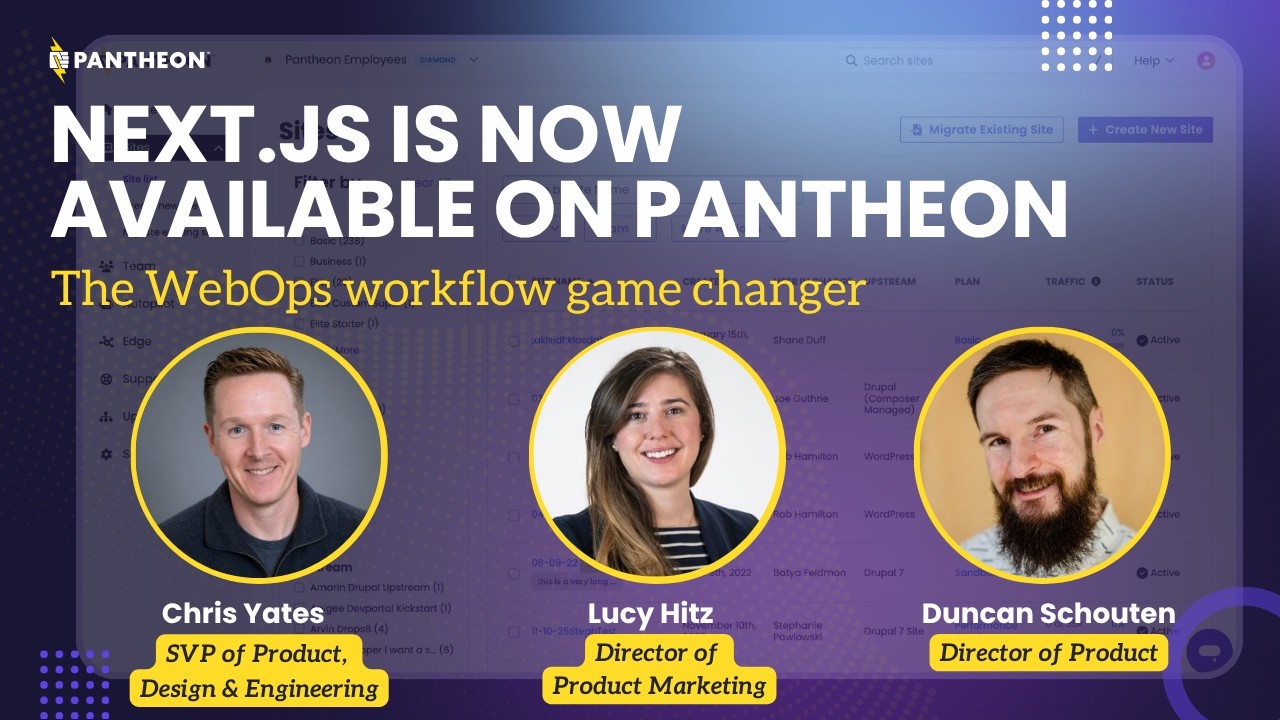
of Nex.js on on Pantheon which brings the power of React to a fully managed platform with edge optimized delivery built-in and zero infrastructure to babysit. I am Lucy Hitz. I'm the director of product marketing at Pantheon. And I'm joined here today by Chris Yates, our SVP of product design and engineering, and Duncan Scoutton, our director of product. This is really his baby. Um so I'm excited to let you um let you see it. Thanks for being here, guys.
>> Thank you, Lizzy. >> Um, so I think we're gonna show and and not tell and jump right into giving you all a peak behind the curtain and what this really looks like in practice on a real live site. So, we are going to live demo here. Pray to the demo gods for us. Um, and then we will have a little fireside chat where we'll talk about why we built this, what's coming next, what to expect, um, and all of that. All that good stuff. So Duncan, I'll I'll let you take it away. >> Ideally with minimal fires. We're trying
to keep the actual fire count down to no more than two. So hello everybody. I'm Duncan. Uh as Lucy said, I have been working on this very intensely for over a year now, which is rather distressing to say. I'm going to be walking you through a whole bunch of things that our Next.js system can do because while we say it is Nex.js, JS. What that actually means is a whole new platform that we're building on. This is the foundation of a
lot of what Pantheon is going to be building on top of over the next coming years. That doesn't mean our old platform is going away, but it means that we're building it and improving it. And you're going to see some of the features that we've applied to Nex.js JS as the first framework that we're supporting on the new platform that eventually, hopefully sooner than later, are going to make their way into the existing Pantheon platform that you know and love. So, I'm going to be walking you through creating a new site in
Nex.js. I'm going to be walking you through connecting that with Content Publisher, our CMS that we've built in-house that connects up with Google Docs and Microsoft Word. I'm going to be showing you some of the features that are inside the new functionality like much improved logging, uh, real good caching. Caching matters. I care a lot about caching. So, it's going to be great to show that off and just show you a bit of how this system works as
somebody that's familiar with Pantheon. So, as you can see here, this is like any other Pantheon dashboard that you are familiar with. You see your list of sites. You have WordPress. You have composer manage Drupal. Then you have NodeJS. What's that? What we're trying to do here is make it so that you've got one platform, one dashboard, one interface for managing all of your sites, WordPress, Drupal, Nex.js. We've heard
from customers time and again that having to manage multiple vendors is a real friction point and they would like to have one place where all of that work comes together and it can be managed on one surface. So that's what we've done with the new system. Likewise in terminus our command line tool it's the same functionality. You've got one interface for managing all of your front end and backend. And to be clear you can
run Nex.js JS sites that don't have a Drupal or WordPress backend on the system. You're not tied to that. But having them both in one place makes it a heck of a lot easier to avoid a lot of the pitfalls that come with managing one site on AWS, one site here, and one site there, and one site there. It's just one place really streamlines it. So, let's go through creating a site. If you're familiar with creating a site on Pantheon, this should be plenty familiar by design. So, we go into create new
site. We choose Nex.js alongside WordPress and Drupal. We're going to create a LinkedIn demo site. Choose the United States region. Continue. Here is a new thing for Pantheon. This connects up with your GitHub uh organization. So unlike the past where you handled all of your code management
inside Pantheon, this connects with your existing GitHub repos or you can create a new one. So I'm going to connect it up with our Pantheon systems. And by the way, for those that haven't heard this yet, you can now connect WordPress and Drupal sites from GitHub into Pantheon. I won't focus on that here, but as we've been building this system, we've been trying to, like I said, bring as much as we can into the existing experience, and that's one I'm
really happy with. So, you no longer have to go into the Pantheon dashboard to do all of your code management. So, I'm going to connect it up with Pantheon Systems. I'm going to create a new repository for the LinkedIn demo site. Here is where we can add our secrets. Another new thing for Pantheon, we as part of this work launched a secrets manager. So all of your API keys, personal access tokens, and anything
that you need to build your site, which is very common in Nex.js now has a real sleek, streamlined interface inside Pantheon dashboard and available through Terminus where you can add these things in. So I want to demo a little UX thing, just a tiny little UX thing that I was really happy to put in there. I'm going to copy some demo secrets and rather than having to manually write them in one by one, I can just paste them and they appear. And there we go.
You can also upload from yourv file of choice. But this is the fastest, smoothest, sleekst way to do that. At this point, I can continue and start making the site. I'm going to launch that. But using the power of television or LinkedIn or something, we're going to jump ahead and this is going to be the site that we're working with. This is the Pantheon web sessions on our uh marketing page. This site is connected
with content publisher which like I said is our connection with um Word, Microsoft Word and Google Docs. I'm going to take this and show you a couple of the things that happen inside the Pantheon dashboard. Now, the first and foremost is that we now have a variety of visibility on uh the builds that make up your site. So, any one of these builds, you can now go in and for
example, rebuild it. Let's say you've added secrets. When you add secrets, you have to reinitiate a new build. Well, now you can do that without pushing a blank commit, which was the way of the past. We also have build logs. So, these standard practice among companies like ours, but we've made them as cutting edge as we can. So, this is exactly what you would expect from a build log. Unlike the Pantheon of the past where this was harder to get, now it's just
built straight in there and you can see it while the build is happening. We also have runtime logs. runtime logs I'm very happy with. So this site whenever it is out in the world. If I go here, there's going to be one thing. There's always going to be one thing that glitches out during the live demo. So let's let that load now that I've acknowledged it. I've made my offering and now it's going to show it. So here
we have logs as of 11:00 a.m. Pacific time where I am. I'm going to reload this page. Go back over here. And you can see that the actual application is now pulling in the most recent logs. This is the way to determine when something goes wrong, why it went wrong. Fortunately, there's nothing I can show you about it going wrong, but you can see that it has all of the up-to-date information of what the site is doing at the runtime level. This is very very
handy and I use it a lot in my own sites. I also want to show you go back here. Every pull request that you make for the site comes along with a multid-dev. Multidevs are our preview environments for seeing the changes to your site before they go live. Every PR that you open now comes with a multid-dev associated with it alongside all the benefits of a multidev like a dedicated
preview environment to visit and really just the chance to collaborate with your team. Again, this is Nex.js for enterprise. You're not just working on one site with a very small team. You might have a big web team that all need to collaborate on one surface. So, we've taken Nex.js JS and brought it in line with Pantheon's enterprise readiness and these multi-devs for each PR. That's part of it.
Now I'm going to bring you into the content publisher side of things. So this is our web sessions page. This is built using content publisher and I want to publish a new piece of content. Let's do that. So here we have the Google Docs version. This is the show notes for a new page that we want to publish. I click into preview and publish. That
brings me here. You can see a live preview connected up with the next.js site in real time of the Google Docs and the corresponding page. We can make any edits that we want in here. Let's say I added an exclamation mark. Let's try reloading. Get that in there.
And there you go. You can see it. So, you get a confident preview of exactly what's going to happen. Now, I'm going to publish. I've made sure that our metadata is as we wanted. I'm going to publish. The content is published successfully. Perfect. Let's take a look at that in the live site.
There we are. The newest latest web session, Web Curious by Design with Omar Actar from user testing. Now I want to show you a little bit of
that roll back functionality that I mentioned earlier. So here we have the ply list. That's not right. That's not right. Somebody made a change. You put a put a typo in there. Let's fix that. When minutes count, this functionality of the roll back makes a big big big difference. So, we can just go find the most recent deployment, click roll back, roll back, and deploy. That's going to take about 30 seconds to do it rather
than triggering a new build and waiting for however long it's going to take. This is a way to get back to a known safe state quickly. This was a much requested feature during our beta period and the team pushed really hard to make sure that we got it into the general availability release. So that's going to do its thing. See if we have anything. And while that is happening, I'm going to show you the last bit that I wanted to demo, which is
our caching. We've put a lot of work into caching and in particular we put a lot of work into making it so that when you update content in the WordPress or Drupal site that is connected to Nex.js that shows up quickly on the front end. So here we have a demo site. Let me log myself back in. This is a very ugly page, but it does what it needs to do just to show you that this
content is coming from WordPress. It's connected to a WordPress site in the back end. Here you can see, let me just do a quick reload of this because this is critical. My new post here, my new post here, that is going to show you this number age zero. That means it's beginning to acrue in the cache. Our edge, Pantheon Edge has cached this and it's going to
accumulate time as we go. So we're now at age 17. That means the content is going to be served from the edge and not directly from the WordPress back end. Now I'm going to go into WordPress. I'm going to update that post. It's going to save. I'm going to go back here.
Reload. Riveting stuff. I know. My new post here now shows you an age of zero. And that means that the build has kicked off in the background that is updating only this content. The rest of the content on here is not being updated. This is what's called incremental static regeneration. The next JS feature that we're really happy to support now that that build is almost certainly finished. There we go.
And like before, it is now acrewing time age zero. And that change went live ASAP. We've got to close this loop. I have done the roll back now. It should have been rolled back and I reload this. And we're back at the playlist. So, I've shown you a bunch of
different things on here. I've shown you creating a new site. I've shown you our build and runtime logs. I've shown you the connection with content publisher. And I've shown you our caching system working on content that has been published from the WordPress site on the back end. and reloading the edge cache and clearing it. And all of this stuff is next to oh brain brain slip. All of this stuff is brand new to Pantheon. So, we've got things in here that I'm really excited
to be showing off and that we can bring into the rest of the platform hopefully before too long. So, I'm going to turn it back to Lucy to bring us into a little bit more conversational times. >> Thank you, Duncan. so many times. I wanted to throw some heart emojis out there, but we're not on a Zoom like we usually are all day together every day. Um, but I think my first question is really to you, Chris, and Duncan, please also chime in. But, you know, we are known for Drupal, for WordPress, um, for
our really strong infrastructure and, you know, really, uh, platform management. But why Next.js Next.js like why did we build this? Why did we decide to invest here? Why now? >> Yeah, that's a great question, Lucy. And and thanks for the the great demo. I think we uh we we must have done something right to uh appease the the demo gods. All that worked very well. Uh
and it's been a tremendous amount of of effort by the team and and it's a really awesome result. Why Nex.js? Uh I mean first for our you know existing customers and partners uh this is something that uh they have been expanding their uh you know their view uh from you know building applications strictly in WordPress and Drupal to injecting uh technologies like React and frameworks like Nex.js into their workflows. And Pantheon's value, as
Duncan said earlier, is really not just in, you know, the runtime of being able to run these things, but also the workflow, the collaboration, the tooling that makes all of these technologies really enterprise ready. So that's reason one. The other reason uh is that what we've seen over the last couple of years and es especially accelerating over the last few months is that uh JavaScript frameworks and nex next.js in particular and other react uh based
tools have become this kind of common language that uh is both incredibly accessible to humans. it is kind of the default uh kind of way people are learning to code that default uh for building new types of applications for the web and even for mobile. Uh but it's also a fantastic place for people to collaborate with AI tooling whether those are kind of generative tools that you interact with or agentic tools that are doing work on on our behalf. React
and Nex.js are a fantastic substrate for those tools to to work on. So we see this as an an important kind of bedrock to add to Pantheon's platform for you know reason three the future of you know what the web is and what you know Pantheon wants to deliver uh of which Nex.js is really a centerpiece. >> Thank you. Anything you want to add there Duncan?
I think it's important to underline what Chris said around JavaScript being where the web is is centralizing right now. There's uh there's some stats that were from the Stack Overflow developer survey 2025 that I reference in just about any call that I have about Nex.js. Over the 2025 survey, Nex.js is the framework of choice for I think it was 14% of the developer respondents. WordPress was somewhere around 4% and
Drupal was somewhere between 1 and 2%. This is where the web is going and more and more companies are hiring JavaScript native developers. PHP not always so much. So we have to work where our customers are. And we're seeing more and more of our customers take interest in Nex.js and JavaScript frameworks generally. And to kind of pull back the curtain a little bit more, Nex.js is the framework that we are
officially supporting on the new platform. But that's not all that it can do. So it actually supports any NodeJS framework. It just doesn't come with the Pantheon support of that. So we can't help you if the application that you're building goes a little bit off the rails. We'll try, but we're only officially supporting Nex.js. but it's the foundation for expanding into more of these JavaScript frameworks as time goes on and the market needs. So really this
is like us recalibrating for where the web is going and setting us up for a whole lot of our next chapter. Mhm. >> And do you see um you know a world where especially for our existing customers who are you know really like like strong and skilled in Drupal and in WordPress and have a lot of belief there where there's a lot of experimentation to be done you know while they keep their sites running in you know ways that they
always have. Mhm. >> Yeah. >> I think that it is a natural extension of Drupal and WordPress. There's a lot of things that Nex.js can do, particularly around the caching side of things, that a PHP backend just doesn't support quite as well. So, it's there's a very straight path now. Some years ago, not so much. But now, there's a very straight path between I have a WordPress backend, I have a Drupal backend, and I have a Nex.js front end.
it's easy to add on that Nex.js front end on top of it and gain all of the benefits that come along with it like some of the things that I demonstrated a couple minutes ago. So, it's a natural extension of what our existing customers are already doing and it gives more benefits than WordPress or Drupal can offer out of the box. So, we're seeing a lot of our customers take interest in keeping their existing fleet of sites,
>> but bringing the front end of them into this new JavaScript world. So, it's a it's a pretty natural extension of what we already offer. So when we think about that spectrum of kind of maybe experimentation then to scaling across 20 sites across a whole portfolio. Um and you've touched on this a little bit but I'd love you to get both either of you both of you to get as specific as as you want to or can. What is the one
kind of unsexy problem that that Pantheon solves for for Next.js JS developers um or folks experimenting with it that they don't realize they have until until it's too late. >> One word, governance. Other hosts are really quite amazing at running one site at a time. You've got one site that is connected to one repo and
there's a very clear path to how to update one and the other one changes. It's dead simple. But a lot of our customers have more than one site that are all drawing from the same source, the same code base. Higher ed institutions, for example, they're going to have one template that maps across many, many, many different um faculty sites, for example. And it's really important that when you change the parent site that all of the downstream
sites can be changed. This is really freaking hard whenever you have the concept of one repo, one site, and no governance across the whole collection of them. So with Pantheon, we offer something called upstreams. I wanted to demo it today, but just didn't have the time for that. But you can take that parent repo, make a change, and then a pull request is opened on all of the downstream sites. That is something that we really want to hone in on. And that's
a pain that a lot of people that are more used to having that one-to-one relationship. There's no way around that >> unless you're using something like upstreams. >> So governance is the one that comes to mind for me. Anything on your side, Chris? >> I I mean there's other unsexy things like, you know, procurement and compliance and security. um even if you only have one site that's operating in this kind of decoupled model uh whether you're you have a next front end with a
WordPress backend or you want a you know purely kind of server uh a decoupled uh you know headless backend that means going to multiple vendors it means having multiple procurement processes it means having multiple bills it means having multiple pathways that you have to work through in order to do the development uh different development customs, uh, you know, different bills, all of those things are separate. Uh, the idea with that that we're working
with here is to bring that all together onto one centralized platform uh to be able to only have to go through one procurement process, one security review, one uh, you know, development workflow uh, for all of your sites, whether they are JavaScript or PHP driven. So I I think that's actually incredibly important for, you know, getting to the point of teams just doing the work. Uh there's a lot of things that have to go into getting to that starting point. Uh and we want to make that as easy as possible.
>> Thank you. Yeah, that's great. I also wanted to mention I don't not sure I did it earlier, but if anyone watching has a question, please please throw it in the comments and we'll definitely definitely get to it. Um, so tell me, you know, when we were prepping for this LinkedIn live, um, Duncan said to me, "Hey, we should probably mention all of the stuff that we built for this next.js release that's going to benefit our entire platform so that people know about it." Um, what are those? What What is that
stuff? Um, and and why does it matter? Why does it matter to our customers, Duncan? Well, I showed off some of that while I was doing the the core demo. Things like runtime logs, they're so straightforward, but as a company that um didn't have them, I mean, that's not a great look. So, we fixed it. We heard what the market needs and we fixed it. There's things that are in the even deeper back end that let a
site on the new system scale much better. we have autoscaling at the deeper platform level. That means that when you have traffic spikes, the system just accommodates that. If it's going into a lower period, the system is going to be using fewer resources. There's also things like uh well the connection with GitHub and GitHub is only one part of our planned broader integration with external platforms. So
we started with GitHub. We wanted to get GitHub right. We're going to expand it to supporting GitLab and Bitbucket and potentially some others as time goes on. That's not just for Nex.js sites. That's for all of the sites on Pantheon. We want to make it so that Pantheon fits into the the team's existing development workflows rather than forcing the development workflows on our terms. So, these are some things that uh have been brought in there. Other stuff like the pull request, the
multi-dev per pull request. I'm actually really happy with that one because teams aren't necessarily going to want to go to the Pantheon dashboard or Terminus and spin up a multid-dev and then connect a branch to it. You're working in GitHub. You create a PR in GitHub and you can see that right away. I'm trying to think what else is really worth highlighting, but those are some of the things that jump out at me. And all of this is going to be brought into the
Drupal and WordPress side of things. We just want to get Nex.js right first. >> And by the way, if you have a request or idea for an integration, also please put that put that in the comments as well. We have a question here. What platform services I think you you you basically touched on this, but just to underline it. What platform services are available in Nex.js sites i.e. database, file system, caching.
The short answer is right now to use a database or file system or deeper caching on that level, you have to go through WordPress or Drupal. One of the things that's on our road map is to bring in freestanding database support for Nex.js sites. But right now, if you want to use that part of the system, you do have to go through WordPress or Drupal. Which leads me to my next question. Oh
wait, we have another question in the in the in the comments. Is it built on top of open next? >> So right now we are not using open next. We have uh the short answer is we don't have a need for it right now. It's built using Nex.js vanilla and there's no need in what we've currently built for the adapter layer that open next offers. We are uh now working with Versell and Cloudflare and Google and others in the open next ecosystem to make sure that
we're all building on a shared foundation. So while we are not supporting Open Next directly, we have a clear line of sight to anything that's happening in that world. And if and when we need to build a Pantheon Nex.js JS build adapter. We've got a very clear path to um working with the people who can make that in line with everything else that's out there. I hope that clarifies things. >> Yeah. And if it didn't, please, you know, ask a follow-up and we'll we'll clarify. And I guess that brings me to
our final question. Um and this will be to Chris and then Duncan definitely fill in fill in the blanks. Um what's next for Nex.js on Pantheon? Yeah, I mean to echo what what Duncan said, um you know, we we want to offer more of the kind of the primitives that support building uh unique applications in Nex.js, uh like databases and file systems. Uh we've got great support for caching
right out of the box, uh with our integration with our GCDN. Um but you know, there are there there's more work to be done. Uh so Chris I responded to you in LinkedIn but uh anybody with with uh input would love to uh you know get your feedback uh especially at uh roadmap.nathan.io uh where you can submit uh ideas and feedback uh directly to our product team. In terms of what comes beyond that, uh, you know, like I said earlier,
we're making some big investments into how we go really deeper into the way that teams build on the web and addressing more of the web team. So, we've served technologists really well uh, for more than 16 years at Pantheon and we think, you know, we need to serve other members of the web team. Content publisher, which Duncan demoed earlier, is a first step in that direction. uh providing a really robust backend that solves uh a problem of content
management which is really that people don't really manage content in cont content management systems. They kind of publish it there but they manage it, write it, edit it, uh collaborate on it elsewhere. So we've connected to those places like Google Docs and Microsoft Office. uh we want to take uh several big not just steps but leaps beyond that uh to embrace more of the web team and we're doing that on the foundation of what we've launched uh recently with the next.js support on our platform. So lots
more exciting stuff coming uh around the JavaSc JavaScript ecosystem and uh how we really you know work differently on the web uh in the coming year. >> Thank you Duncan. Anything else you want to close out with or make sure to mention? >> Go try it. If you are a Pantheon Gold Plus customer, you can go and create an X.JS site today and I encourage you to. And when you do, I want to hear about it. We can share my
email address, share my contact information. We're we're building this with our customers, not just for our customers. And you can go to roadmap.pantheon.io IO to leave uh suggestions. As Chris mentioned, we want to get people onto this and the best thing to do is to go and try it. What I tell people right now is if you're not familiar with Nex.js, GPT and Claude really are it's dead easy to spin up a Nex.js site with one of the
models that's out there right now. So, just try it and when you run into trouble, reach out to us. We have support. make use of it >> and McKenna reminds us that we also have a a wonderful Pantheon customer community. Love for you to join if you haven't already. >> There you go. Thank you very much. >> And you can talk to some of our customers who are already using Nex.js there and ask about their experience. Um and so before we close out, I want to
remind folks we have a webinar. Our April platform tour is tomorrow. We'll drop the link to the registration, but we will have one of our very own customers, SPS Commerce um sharing about their experience and you know how they've partnered with Pantheon for their next.js sites and so should be a lot to learn if you want to hear from a real live customer. So we'll drop the link. Um thank you so much for joining us Duncan and Chris and taking the time. I know Duncan just launched this product and is working on um new features all
the time and so I really appreciate you taking the time to talk through this with our audience and thanks everybody for joining. See you next time. >> Thanks everybody. >> Thank you., Next.js on Pantheon Launch Party, YouTube, 01kptxfhn42peka0brrb40ddbj.