On Communities and "Communities"
## Metadata
- Author: [[Sarah Haider]]
- Full Title: On Communities and "Communities"
- Category: #articles
- Document Note: 1. What are the distinguishing characteristics of strong communities?
2. How can online communities provide a meaningful sense of belonging?
3. What are the risks of using the term "community" too liberally?
:
I. Introduction
II. Impact of Creating “Communities”
A. Advancing the Creation of Tribes
B. Planting Seeds of Group Consciousness
III. Warning Against False Labeling
A. Labeling Something a Community Does Not Make it One
This text explores the idea that the term "community" has become overused in modern society, to the point that it has become a political tool and has contributed to the erosion of genuine communities. The author argues that by labeling any group or hobby a "community," we are creating a sense of tribalism and group consciousness that can lead to individuals investing their time in superficial connections in search of belonging.
- Summary: Why is every conceivable group now a "community"?
- URL: https://sarahhaider.substack.com/p/on-communities-and-communities?r=6g1dc
##### First of a short series.
A large part of my work in the past decade has been fostering communities, both offline and online.
Community building is a bit like nation-building - in that it is very difficult to invent one from scratch, even ***if*** you know what you are doing. Moreover, some ideologies (especially, religions) naturally support the values required for healthy communities - others (like atheism) do not, and in fact, can be antithetical to the project. Looking back, I find that I both underestimated and misunderstood what it takes to foster healthy communities, and if I could do it all over again, I would do it quite a bit differently.
So I’ve been thinking a lot about what goes into the making of a good community or a bad one - and to what extent those factors can be deliberately cultivated. And given the various challenges to traditional, proximate communities, I am especially interested in the ways internet communities can fulfill this role.
This is the first of several short posts on my general musings on the subject.
**Labeling something a community does not make it one.**
I’m not sure exactly when it happened, but at some point it became common practice to refer to literally every kind of human association as a “community”.
Every racial or ethnic group (no matter how large) is a community, every profession is a community, every college is a community, every subreddit, every facebook group, every conceivable hobby…..all “communities”!
And we are constantly reaching out to these alleged communities, uplifting them, even apologizing to them after a faux pas.
In politics, the word is useful because it allows one to play into identity politics or grant favor to special interest groups without admitting to doing so. Politicians pandering to a racial group sounds bad, but “supporting a community”? What could be more wholesome!
No doubt the warm and fuzzy feelings the word inspires allows it to be a useful political tool in more ways than one. From fake communities arise fake leaders, who can claim to be the voice of broad groups of people without actually having been given any real authority to speak on their behalf (and thus, not bound by any duty towards them).
A President of an organization that serves marginalized women - for example - must earn her position through experience or a dedicated track record of service, and can lose her job if she is found to be engaging in misconduct or otherwise harming the cause. A “community leader”, however, holds no official position and cannot be deposed by anyone.
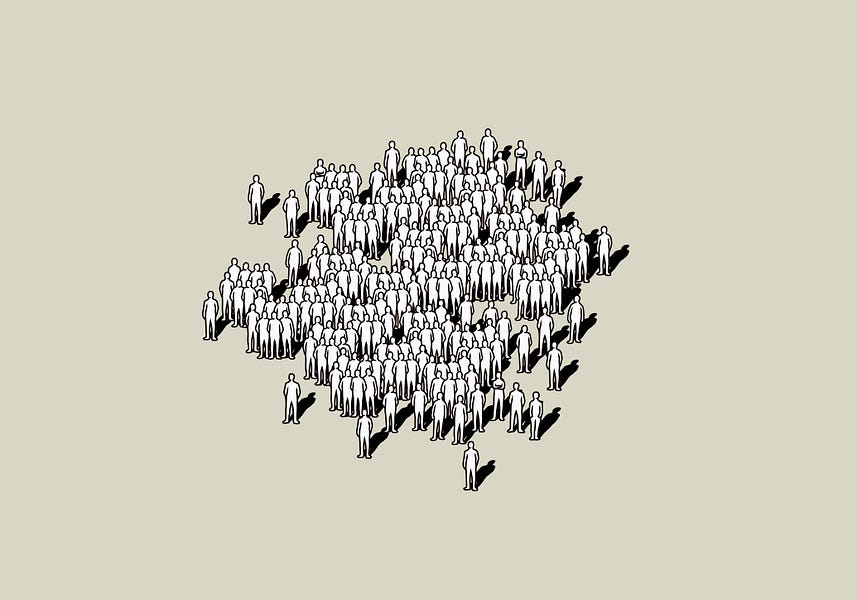
The harm to the public discourse, however, is broader than that: by turning a bunch of labels into “communities”, we are advancing the creation of tribes where none might have existed. By habitually referring to mere traits or hobbies as “communities”, we plant the seeds of group consciousness (proto-tribalism) in the minds of those who share the trait.
The harm to individuals is deeper than that - especially to those too young and too online to have experienced richer, proximate communities. They may mistake mere descriptive labels for connectedness - investing their time and conforming their identities to them, in search of a sense of belonging that is bound to prove superficial and unsatisfying.
The truth is, despite the habitual over-usage of the term, far too many of us have only weak ties to any community, if we have them at all. Is the over-usage itself a consequence of the lack of experience with communities worthy of the name?, On Communities and "Communities", Sarah Haider, 01gt50hbwgy1avaez0zmtyttsj.