OpenClaw 2.0, Accidentally - OpenClaw Blog

🔗 **Source:** [OpenClaw 2.0, Accidentally - OpenClaw Blog](https://openclaw.ai/blog/openclaw-2-accidentally)
> [!note]+ Document Notes
> ---
> tags: [openclaw, ai-agents, open-source, release-management, agent-security, self-hosting]
> author: OpenClaw (unsigned)
> source: OpenClaw Blog
> reference: https://openclaw.ai/blog/openclaw-2-accidentally
> date created: 2026-08-30 22:30
> ---
> > [!info] Generated analysis — not the author's words. Sections below are machine-written
> > from the captured source. Only text inside `> [!quote]` blocks is verbatim from the author.
> > Do not quote or attribute any other line to the named author.
> # 🏷️ Title: OpenClaw 2.0, Accidentally
> ## 🧭 Table of Contents
> - [📝 Summary](#-summary)
> - [📖 Main Content](#-main-content)
> - [🗒️ Notes](#️-notes)
> - [📚 References](#-references)
> - [🗣️ Paraphrase](#️-paraphrase)
> - [📰 Newsletter](#-newsletter)
> - [✅ Action Items](#-action-items)
> - [🧪 Hypotheses](#-hypotheses)
> - [📊 Methodology](#-methodology)
> - [❓ Questions](#-questions)
> - [🔮 Future Research](#-future-research)
> - [💡 Implications](#-implications)
> - [🧠 Learning Styles Assessment](#-learning-styles-assessment)
> - [📊 Accessibility Assessment](#-accessibility-assessment)
> - [🌍 DEIB Assessment](#-deib-assessment)
> - [✅ Logical Validity](#-logical-validity)
> - [🛡️ DARVO Analysis](#-darvo-analysis)
> - [🎯 Conclusion](#-conclusion)
> ### 🔗 References
> - [OpenClaw 2.0, Accidentally — the post under analysis](https://openclaw.ai/blog/openclaw-2-accidentally)
> - [Full release notes, v2026.8.1](https://docs.openclaw.ai/releases/2026.8.1)
> - [openclaw/openclaw on GitHub](https://github.com/openclaw/openclaw)
> - [Control UI / browser app docs](https://docs.openclaw.ai/web/control-ui)
> - [Upgrading an existing Claw](https://docs.openclaw.ai/install/updating)
> - [Shared cloud sessions](https://docs.openclaw.ai/gateway/cloud-sessions)
> - [Plugin SDK migration guide](https://docs.openclaw.ai/plugins/sdk-migration)
> - [Getting started](https://docs.openclaw.ai/start/getting-started)
> ## 📝 Summary
> - **What happened.** OpenClaw shipped v2026.8.1, branded "OpenClaw 2.0," on 2026-08-30 (GitHub release timestamp 2026-08-31T03:30:51Z). The post claims 933 contributors including 569 first-time, over 16,000 pull requests, and roughly 50% of all PRs ever merged into the project. It frames the version number as emergent rather than planned: the team set out to simplify installation and rebuild the browser app, and "doing that properly meant carrying the cleanup through the rest of OpenClaw until it became OpenClaw 2.0."
> - **Why it matters.** This is the release that moves OpenClaw from a single-user agent to a multiplayer one — shared cloud sessions, team operator roles, a shared credential store — and simultaneously expands what the agent does on its own initiative. Several defaults changed toward more autonomy. For anyone routing real work through OpenClaw, this is a release where reading the notes matters more than reading the announcement.
> - **Key stakeholders.** Existing OpenClaw operators facing two breaking changes. External plugin authors, who have a deprecation gate dated **2026-09-01 — two days after this post** — that the post never mentions. New users, who are the post's actual audience. The 933 claimed contributors. Teams evaluating OpenClaw for shared use, for whom the new operator roles carry an explicit caveat the post omits.
> - **Risks and tradeoffs.** The post's two illustrative workflows involve an agent reading your inbox, reading your iMessages, and sending messages as you. That is a substantial trust ask, and the post's framing — "We are not selling anything here or asking you to trust one company, one model, or one AI provider" — answers a *vendor lock-in* concern while leaving the *agent autonomy* concern untouched. The release notes show the team has thought hard about this. The post does not tell you so.
> - **Bottom line.** The engineering appears real and the headline numbers check out — 16,000 of 30,789 total merged PRs is 52%, matching the "roughly 50%" claim. The post is a well-written, warm, deliberately modest announcement that is nonetheless a poor operational document. It mentions "security" exactly once, in a list. It omits both breaking changes, the 48-hour deprecation gate, and at least six defaults that changed toward more agent autonomy — including background memory consolidation and automatic application of self-generated skills, both now on by default. Read the 125KB of release notes, not the 731-word post.
> ## 📖 Main Content
> **The "accidentally" framing, and what it does.** The post's central narrative is that 2.0 was not planned. The team started with installation and the browser app; doing it properly meant cleaning up everything downstream; the result crossed a threshold that made a major version number appropriate. This is charming and probably true. It also converts a seven-week gap in a project that had shipped 106 releases in 230 days from a schedule slip into an emergent virtue. Both readings can be correct at once — the work is real *and* the framing is favorable — and it is worth noticing the second while crediting the first.
> **The numbers, checked.** Three claims are independently verifiable and I verified them. The repository reports **30,789 total merged pull requests**; the post claims over 16,000 in this release and "roughly 50% of all pull requests ever merged." 16,000/30,789 = 52%. That checks out, and it is a genuinely striking concentration of work into one release. The repo was created 2025-11-24 and now carries 388,104 stars against 5,752 open issues. The "106 releases in 230 days" window would start around 2026-01-12, which fits the repo's timeline.
> The contributor figure is the one I cannot confirm. GitHub's contributors endpoint pages out at **377** contributors, against the post's claim of 933. These are not necessarily in conflict — GitHub's endpoint counts commit authors on the default branch matched to accounts, while a project counting "contributors" will often include PR authors whose work was squash-merged, `Co-Authored-By` trailers, translators, and documentation contributors. But the post never defines the term, and a 2.5× gap between the marketing number and the platform number is worth a footnote the post does not provide.
> **What the post says the release touches.** One sentence enumerates: "installation, messaging, memory, skills, models, automations, the browser and native apps, plugins, security, and a very long tail of fixes." Security appears there, once, and the post never returns to it. This turns out to understate the release considerably, which is an unusual direction for a launch post to err in.
> **What the release notes contain that the post omits.** The v2026.8.1 notes run about 125,000 characters. Three categories are missing from the announcement entirely, and each matters to a different audience.
> *Two breaking changes.* The OpenProse migration removes the bundled plugin and the `/prose` command, requiring `openclaw doctor --fix`. The OpenAI route migration moves `codex/*` and `openai-codex/*` model references, provider config, stored sessions, and automation routes to `openai/*`. Both are labeled "(breaking)" in the notes. Neither appears in the post, which instead reassures readers that the team took extra time so as not to "hand them an update that broke what they already had." That reassurance is about care taken during upgrade, and it is not the same as disclosure — a reader who takes the post at face value will not know to run `doctor --fix`.
> *A deprecation gate two days out.* The notes flag **2026-09-01** as the date external plugins must migrate off several `plugin-sdk` subpaths. The post published 2026-08-30. Plugin authors reading only the announcement get zero notice of a 48-hour window. The notes are careful to say these are "upcoming gates, not removals in this release," which is fair — but the notice period is still the notice period.
> *At least six defaults that changed toward more autonomy.* This is the substantive omission. Counting "by default" in the release notes returns eight entries. Among them: **Grounded dreaming** enables model-backed background memory consolidation by default, promoting material into long-term memory. **Automatic self-learning** captures reusable lessons and *automati

Today we released by far the largest update in the history of OpenClaw. It was built by 933 contributors, including 569 first-time contributors, and is composed of over 16,000 pull requests. You can read the full release notes [HERE](https://docs.openclaw.ai/releases/2026.8.1).
This update touches every part of OpenClaw, including installation, messaging, memory, skills, models, automations, the browser and native apps, plugins, security, and a very long tail of fixes. We started by simplifying installation and rebuilding the [browser app](https://docs.openclaw.ai/web/control-ui) as a first-class experience, but doing that properly meant carrying the cleanup through the rest of OpenClaw until it became OpenClaw 2.0.
#### Why this took nearly two months
Before this update, we had shipped 106 releases in 230 days, most within a day or two of the one before them, so going nearly seven weeks without shipping was not normal for us. The release cadence slowed, but development moved in the opposite direction because our team was growing, and the increased volume and pace of work outgrew both the foundation of OpenClaw and the process we used to ship it, so we reworked both at the same time.
That acceleration left us with a release containing roughly 50% of all pull requests ever merged into OpenClaw, so we took the extra time to make sure it worked for people starting from scratch and people [upgrading an existing Claw](https://docs.openclaw.ai/install/updating) rather than shipping quickly and handing them an update that broke what they already had.
#### Getting to a useful Claw faster
Installation was the first place we needed to make OpenClaw easier, so for first-time installs we are starting with what is already on someone’s computer, including existing ChatGPT or Claude subscriptions, API keys, and local models. We cut or simplified a lot of configuration and moved the rest out of initial setup, letting people get to a first conversation faster and finish setting up their Claw by talking to it.
The browser app is where most people meet OpenClaw and have their first conversation, so we rebuilt it as a first-class experience where they can keep setting things up, return to ongoing work, or follow along live when they want to.
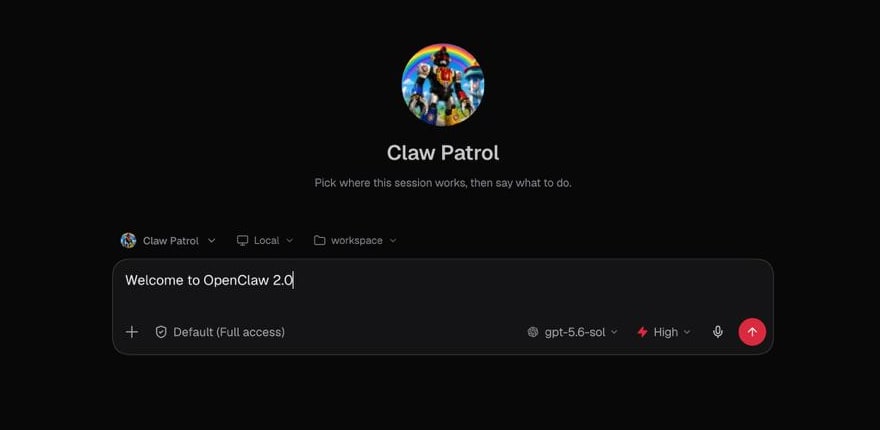The rebuilt browser app opens directly into a conversation with your Claw.
#### How a useful Claw can grow
Your Claw does not need to be complicated, and a simple workflow might have it watch your inbox for your kids’ school emails and send you a Telegram message whenever something important comes through, like homework due or an upcoming activity you need to prepare for. It uses one inbox, looks for a few important things, and sends the result to one place, which is already enough to be useful.
From there, a task can reach across more places without becoming harder to use, so when your brother sends an iMessage asking which iPad you bought for your dad, you can skip searching your email for the receipt and simply tell your Claw that your brother just messaged, then ask it to find the answer and send it to him. The Claw just does it.
The same progression showed up inside our own team while building this release as we used our Claws for more of the work and wanted to share tasks, collaborate on them, and sometimes hand them off entirely. OpenClaw had no way to bring another team member into the work without losing what the Claw already knew. [Shared cloud sessions](https://docs.openclaw.ai/gateway/cloud-sessions) changed that and turned OpenClaw into a multiplayer experience our team now uses to build OpenClaw, bringing the right person into live work or handing it over with the context intact.
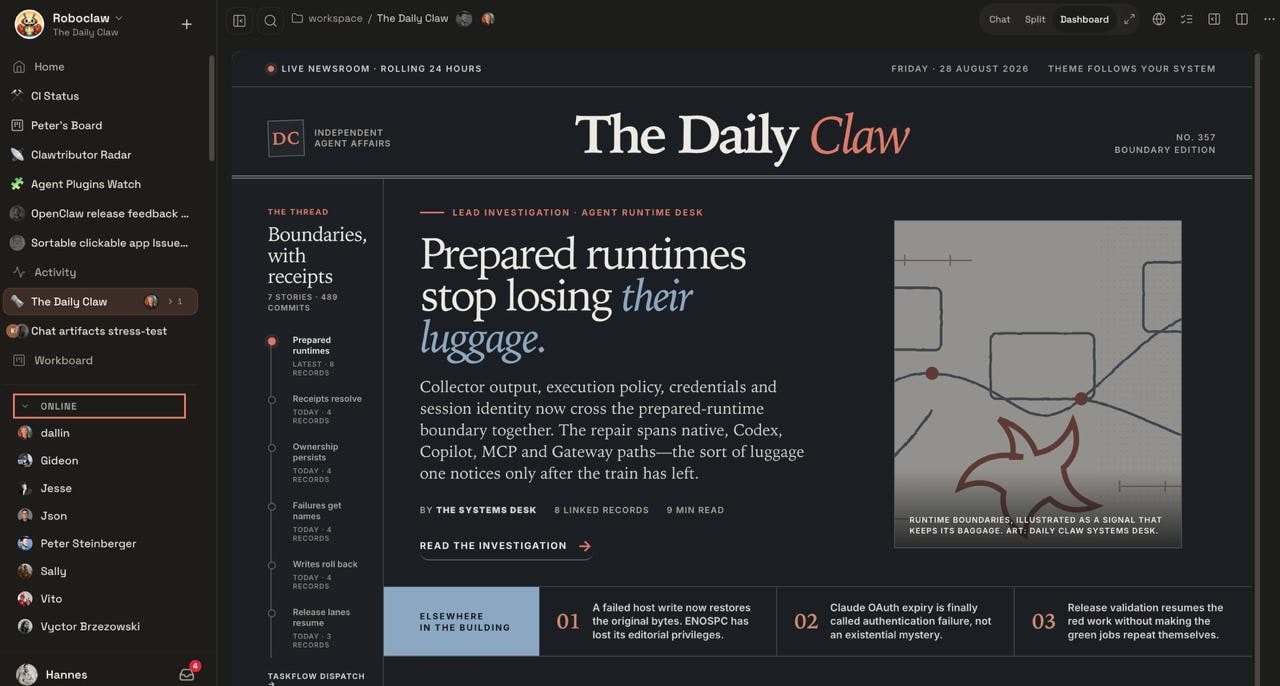A user-built dashboard inside a shared multiplayer OpenClaw workspace.
#### What this adds up to
Your OpenClaw starts with one useful workflow and grows as far as you want it to, with the possibility of reaching across more of your life and work or becoming multiplayer with your family or team when you want and how you want. This has changed the relationship people have with software, turning it from something designed somewhere else that you have to accept into something you can tell what to do, shape around your life and work, and actually own.
We are not selling anything here or asking you to trust one company, one model, or one AI provider with that future, because OpenClaw is open source and belongs to the people who use it and help build it. [Come use it](https://docs.openclaw.ai/start/getting-started), [build it with us](https://github.com/openclaw/openclaw), and [call us on our shit](https://discord.gg/openclaw) when we get something wrong., OpenClaw 2.0, Accidentally - OpenClaw Blog, OpenClaw, 01m1azb12jxbyce6k82jas5x3c.