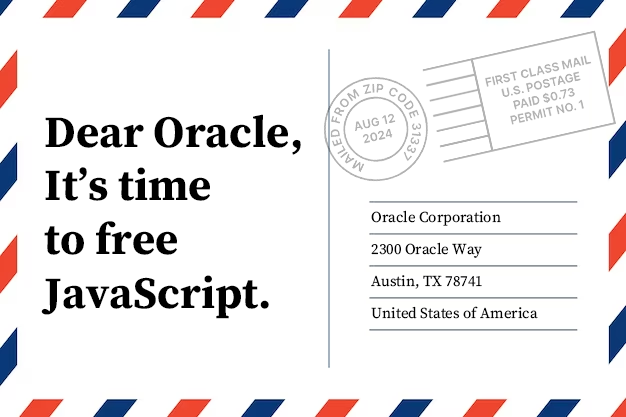
Oracle, It’s Time to Free JavaScript.
## Metadata
- Author: [[JavaScript™]]
- Full Title: Oracle, It’s Time to Free JavaScript.
- Category: #articles
- Document Note: ---
tags:
- #trademark
- #open_source
- #javascript
Author: JavaScript™ (Open letter organizers incl. Ryan Dahl; cites Brendan Eich)
Source: Website
Reference: https://javascript.tm/
date created: 2025-08-21 00:00
---
# Title: Oracle, it’s time to free JavaScript.
## Table of Contents:
- [📚 Context & Thesis](#-context--thesis)
- [⚖️ Trademark Abandonment Law](#️-trademark-abandonment-law)
- [🏛️ History: Netscape → Sun → Oracle](#️-history-netscape--sun--oracle)
- [🧾 Nonuse: “Use it or lose it”](#-nonuse-use-it-or-lose-it)
- [🧮 Genericide and Standards](#-genericide-and-standards)
- [🧭 Community Confusion & Constraints](#-community-confusion--constraints)
- [🕊️ Call to Action: Free the Mark](#️-call-to-action-free-the-mark)
- [🤝 How to Support (Signatures & Legal Help)](#-how-to-support-signatures--legal-help)
- [🔗 References](#-references)
### References: Include a list of sources consulted and cited in the article.
- United States Code 15 U.S.C. § 1127 (Trademark Act definitions)
- Ecma International TC39 and ECMA-262 specification
- Historical notes by Brendan Eich on JavaScript/ECMAScript naming
- Node.js, Deno, OpenJS Foundation, Oracle JET, GraalVM
## 📝 Summary:
The open letter argues that Oracle’s ownership of the “JavaScript” trademark meets both legal criteria for abandonment: (1) nonuse in commerce and (2) the mark becoming generic. It recounts the mark’s history from Netscape/Sun to Oracle, explains how JavaScript is standardized as ECMAScript by TC39 and implemented by independent engines (V8, SpiderMonkey, JavaScriptCore), and asserts Oracle neither offers a bona fide “JavaScript” product nor enforces the mark. This has created confusion and unnecessary constraints (e.g., communities avoiding “JavaScript” in names like “JavaScript Conference”). The authors urge Oracle to release the mark; failing that, they plan to petition the USPTO for cancellation and solicit public signatories and pro bono trademark counsel.
## 📖 Main Content:
The letter’s core claim is legal: under 15 U.S.C. § 1127, a mark is abandoned if it’s not genuinely used in trade or if it becomes generic. The authors argue both are true for “JavaScript.”
- Legal framing: They cite § 1127’s two prongs and apply them to Oracle’s behavior and market reality.
- Historical context: “JavaScript” originated at Netscape; Sun owned the trademark; Oracle acquired Sun and, with it, the mark. The mark has been maintained administratively rather than used as a brand for a product.
- Nonuse: Oracle’s cited uses—Node.js references and Oracle JET (a set of libraries), plus GraalVM’s support for JS—are portrayed as insufficient to constitute bona fide trademark use.
- Genericide: Since Sun refused to allow “JavaScript” as the standardized name in 1996, the official spec became “ECMAScript.” Nonetheless, the entire industry colloquially uses “JavaScript” for a language with many implementations and standardization via TC39, not tied to Oracle. The authors argue this widespread generic use, coupled with Oracle’s lack of enforcement, demonstrates genericide.
- Harm: Community efforts must avoid “JavaScript” in formal names (e.g., JSConf instead of “JavaScript Conference”), which is misaligned with reality and adds friction.
- Remedy: Oracle should voluntarily release the mark; if not, the authors will file a cancellation petition and invite public and legal support.
Personal reflection: This argument resonates with open-source norms: a de facto public standard should not be encumbered by a dormant private mark that restricts naming and community organization. The letter’s strengths are its clear legal predicate, historical narrative, and practical community impacts.
### 🗒️ Notes
- Problem statement
- “You have long ago abandoned the JavaScript trademark” causing “widespread, unwarranted confusion and disruption.” [0%]
- Millions use the term independent of Oracle’s products. [0%]
- Law: 15 U.S.C. § 1127 criteria [11%]
- Abandonment via nonuse with intent not to resume (3 years nonuse = prima facie).
- Abandonment via genericide or loss of source-indicating significance.
- Claim: both apply to “JavaScript.”
- Chain of title and origin [22%]
- 1995: Netscape + Sun; Brendan Eich creates JS in 10 days.
- Sun holds trademark; 2009 Oracle acquires Sun and the mark.
- “Relic of acquisition”; no Oracle-branded “JavaScript” product. [22%]
- Nonuse argument: “Use it or lose it” [33%]
- Netscape’s decline; JavaScript flourishes cross-browser and on servers.
- 2019 specimen references Node.js (not Oracle) and Oracle JET (a library suite).
- OpenJS hosts Node.js; Oracle not involved. [33%]
- GraalVM supports JS but is not a canonical JS engine; product page barely mentions JS. [44%]
- Genericide and standardization [56%]
- 1996: ECMA standardization; Sun refused “JavaScript” name → “ECMAScript.”
- Brendan Eich quote on ECMAScript as an “unwanted trade name.” [56%]
- TC39 maintains ECMA-262; cross-vendor participation. [56%]
- Confusion and community constraints [67%]
- Oracle’s non-enforcement implies generic use.
- Communities forced to avoid direct use of “JavaScript” in official names (e.g., JSConf vs. “JavaScript Conference”). [67%]
- “Vast misalignment” between ownership and use. [67%]
- Call to action [78%]
- By law, both abandonment prongs apply; ask USPTO to cancel. [78%]
- Oracle likely lacks business interest; renewals are rote legal admin. [78%]
- Urge Oracle to release; otherwise, file a cancellation petition. [78%]
- Public participation [89%]
- Invite signatures (individuals, orgs ≥25 employees).
- Seek pro bono trademark lawyers for USPTO petition. [89%]
## 📖 References:
- 15 U.S.C. § 1127 (Lanham Act definitions of abandonment)
- Ecma International TC39 and ECMA-262 specification
- Brendan Eich commentary on ECMAScript naming
- OpenJS Foundation (governance for Node.js)
- Oracle JET and GraalVM product pages (as context for claimed “use”)
## 🗣️ Paraphrase:
1) Original idea: Oracle has abandoned the JavaScript trademark through nonuse.
Paraphrase: Oracle does not operate a bona fide product under the “JavaScript” brand. Past references to Node.js and Oracle JET do not qualify as genuine trademark use because Node.js is not an Oracle property and JET is just one of many JavaScript library suites. Similarly, GraalVM’s capability to run JavaScript does not make it a primary JavaScript product, and even its own materials barely foreground JavaScript support.
2) Original idea: The mark has become generic.
Paraphrase: “JavaScript” functions as a common, industry-wide name for a standards-based language defined by ECMA-262 and implemented by several independent engines. Oracle neither polices the term nor collects licenses for its use, while developers, companies, and conferences rely on it generically. This pattern demonstrates that the word no longer signals Oracle as a source, but rather denotes a type of technology.
## 📰 Newsletter:
This week in the web: Learning JS the right way, important trademark news, and community highlights you shouldn’t miss.
- JavaScript trademark shake-up: An open letter urges Oracle to release the “JavaScript” trademark, arguing it’s both unused and generic under U.S. law. Why it matters: de facto standards thrive when names match reality. The letter calls for signatures and pro bono trademark counsel. Read the letter at javascript.tm.
- Level up your skills: If you’re learning web development, focus on fundamentals—HTML semantics, accessible CSS patterns, and modern JavaScript (modules, promises, async/await). Pair practice with projects: build a standards-compliant form, a11y-first navigation, and a fetch-powered API dashboard.
- Community highlights: TC39 continues iterating on ECMAScript proposals (keep an eye on Records/Tuples and Temporal). JSConf-style events remain strong—even if they avoid “JavaScript” in the title—so check your local dev meetups.
- New plugins and tools: Explore ESLint flat config, Biome for fast formatting/linting, and Vite’s plugin ecosystem for instant dev servers.
- For open-source contributors: Start small—docs, tests, and issues. Join foundations and working group
- Summary: Oracle, it's time to free the JavaScript trademark. Join us in asking Oracle to release the trademark, and helping us file a Petition for Trademark Cancellation with the USPTO.
- URL: https://javascript.tm/

**You have long ago abandoned the JavaScript trademark, and it is causing widespread, unwarranted confusion and disruption.**
JavaScript is the world’s most popular programming language, powering websites everywhere. Yet, few of the millions who program in it realize that JavaScript is a trademark you, Oracle, control. The disconnect is glaring: JavaScript has become a general-purpose term used by countless individuals and companies, independent of any Oracle product.
**Oracle’s hold on the JavaScript trademark clearly fits the legal definition of trademark abandonment**. A previous [blog post](https://tinyclouds.org/trademark) addressed this issue, requesting that you, Oracle, release the trademark. Unsurprisingly, the request was met with silence. It is therefore time to take active steps in order to bring the JavaScript trademark into the public domain, where it belongs.
#### Trademark abandonment
Title 15 of the United States Code, section 1127, states:
> A [mark](https://www.law.cornell.edu/definitions/uscode.php?width=840&height=800&iframe=true&def_id=15-USC-3344077-1913738695&term_occur=999&term_src=) shall be deemed to be “abandoned” if either of the following occurs:
>
> 1. When its [use](https://www.law.cornell.edu/definitions/uscode.php?width=840&height=800&iframe=true&def_id=15-USC-85351-1913738695&term_occur=999&term_src=) has been discontinued with intent not to resume such [use](https://www.law.cornell.edu/definitions/uscode.php?width=840&height=800&iframe=true&def_id=15-USC-85351-1913738695&term_occur=999&term_src=). Intent not to resume may be inferred from circumstances. Nonuse for 3 consecutive years shall be prima facie evidence of abandonment. “[Use](https://www.law.cornell.edu/definitions/uscode.php?width=840&height=800&iframe=true&def_id=15-USC-85351-1913738695&term_occur=999&term_src=)” of a [mark](https://www.law.cornell.edu/definitions/uscode.php?width=840&height=800&iframe=true&def_id=15-USC-3344077-1913738695&term_occur=999&term_src=) means the bona fide [use](https://www.law.cornell.edu/definitions/uscode.php?width=840&height=800&iframe=true&def_id=15-USC-85351-1913738695&term_occur=999&term_src=) of such [mark](https://www.law.cornell.edu/definitions/uscode.php?width=840&height=800&iframe=true&def_id=15-USC-3344077-1913738695&term_occur=999&term_src=) made in the ordinary course of trade, and not made merely to reserve a right in a [mark](https://www.law.cornell.edu/definitions/uscode.php?width=840&height=800&iframe=true&def_id=15-USC-3344077-1913738695&term_occur=999&term_src=).
> 2. When any course of conduct of the owner, including acts of omission as well as commission, causes the [mark](https://www.law.cornell.edu/definitions/uscode.php?width=840&height=800&iframe=true&def_id=15-USC-3344077-1913738695&term_occur=999&term_src=) to become the generic name for the goods or services on or in connection with which it is used or otherwise to lose its significance as a [mark](https://www.law.cornell.edu/definitions/uscode.php?width=840&height=800&iframe=true&def_id=15-USC-3344077-1913738695&term_occur=999&term_src=). Purchaser motivation shall not be a test for determining abandonment under this paragraph.
>
>
**In the case of JavaScript, both criteria apply**.
#### Netscape, Sun, Oracle
The JavaScript trademark is currently held by Oracle America, Inc. ([US Serial Number: 75026640, US Registration Number: 2416017](https://tsdr.uspto.gov/#caseNumber=75026640&caseSearchType=US_APPLICATION&caseType=DEFAULT&searchType=statusSearch)). How did this come to be?
In 1995, Netscape partnered with Sun Microsystems to create interactive websites. Brendan Eich famously spent only 10 days creating the first version of JavaScript, a dynamic programming language with a rough syntactic lineage from Sun’s Java language. As a result of this partnership, Sun held the JavaScript trademark. In 2009, Oracle acquired Sun Microsystems and the JavaScript trademark as a result.
The trademark is simply a relic of this acquisition. Neither Sun nor Oracle has ever built a product using the mark. Legal staff, year after year, have renewed the trademark without question. It’s likely that only a few within Oracle even know they possess the JavaScript trademark, and even if they do, they likely don’t understand the frustration it causes within the developer community.
#### Use it or lose it
**Oracle has abandoned the JavaScript trademark through nonuse.**
Oracle has never seriously offered a product called JavaScript. In the 1990s and early 2000s, Netscape Navigator, which supported JavaScript as a browser feature, was a key player. However, Netscape’s usage and influence faded by 2003, and the browser saw its final release in 2008. JavaScript, meanwhile, evolved into a widely used, independent programming language, embedded in multiple browsers, entirely separate from Oracle.
The most recent [specimen](https://tsdr.uspto.gov/#caseNumber=75026640&caseSearchType=US_APPLICATION&caseType=DEFAULT&searchType=statusSearch), filed with the USPTO in 2019, references [nodejs.org](http://nodejs.org/) (a project created by Ryan Dahl, the author of this letter) and Oracle’s [JavaScript Extension Toolkit (JET)](https://www.oracle.com/webfolder/technetwork/jet/index.html). But Node.js is not an Oracle product, and JET is merely a set of JavaScript libraries for Oracle services, particularly Oracle Cloud. There are millions of JavaScript libraries; JET is not special.
(Oracle is not even a member of the OpenJS Foundation - the body that the Node.js project lives under now. Nor does Oracle have any involvement whatsoever in the development of Node.js.)
Oracle also offers [GraalVM](https://www.oracle.com/java/graalvm/), a JVM that can execute JavaScript, among other languages. But GraalVM is far from a canonical JavaScript implementation; engines like V8, JavaScriptCore, and SpiderMonkey hold that role. GraalVM’s product page doesn’t even mention “JavaScript”; you must dig into the documentation to find its support.
**Oracle’s use of JavaScript in GraalVM and JET does not reflect genuine use of the trademark.** These weak connections do not satisfy the requirement for consistent, real-world use in trade.
#### A generic term
A mark can also be considered abandoned if it becomes a generic term.
In 1996, Netscape [announced](https://web.archive.org/web/19981203070212/http://cgi.netscape.com/newsref/pr/newsrelease289.html) a meeting of the ECMA International standards organization to standardize the JavaScript programming language. Sun (now Oracle), refused to give up the “JavaScript” mark for this use though, so it was decided that the language would be called “ECMAScript” instead. (Microsoft happily offered up “JScript”, but no-one else wanted that.) Brendan Eich, the creator of JavaScript and a co-signatory of this letter, [wrote in 2006](https://web.archive.org/web/20200621202321/https://mail.mozilla.org/pipermail/es-discuss/2006-October/000133.html) that “*ECMAScript was always an unwanted trade name that sounds like a skin disease*.”
Ecma International formed TC39, a technical steering committee, which publishes ECMA-262, the specification for JavaScript. This committee includes participants from all major browsers, like Google’s Chrome, Apple’s Safari, and Mozilla’s Firefox, as well as representatives from server-side JavaScript runtimes like Node.js and Deno.
Oracle’s ownership of the JavaScript trademark only causes confusion. The term “JavaScript” is used freely by millions of developers, companies, and organizations around the world, with no interference from Oracle. Oracle has done nothing to assert its rights over the JavaScript name, likely because they do not believe their claim to the mark would hold up in court. Unlike typical trademark holders who protect their trademarks by extracting licensing fees or enforcing usage restrictions, Oracle has allowed the JavaScript name to be used by anyone. This inaction further supports the argument that the trademark has lost its significance and has become generic.
Programmers working with JavaScript have formed innumerable community organizations. These organizations, like the standards bodies, have been forced to painstakingly avoid naming the programming language they are built around—for example, [JSConf](https://jsconf.com/). Sadly, without risking a legal trademark challenge against Oracle, there can be no “JavaScript Conference” nor a “JavaScript Specification.” The world’s most popular programming language cannot even have a conference in its name.
**There is a vast misalignment between the trademark’s ownership and its widespread, generic use**.
#### Free the mark
**By law, a trademark is abandoned if it is either not used or becomes a generic term. Both apply to JavaScript.**
It’s time for the USPTO to end the JavaScript trademark and recognize it as a generic name for the world’s most popular programming language, which has multiple implementations across the industry.
Oracle, you likely have no real business interest in the mark. It’s renewed simply because legal staff are obligated to renew all trademarks, regardless of their relevance or use.
We urge you to release the mark into the public domain. However, asking nicely has been [tried before](https://tinyclouds.org/trademark), and it was met with silence. If you do not act, we will challenge your ownership by filing a petition for cancellation with the USPTO.
#### To you, the readers of this letter:
If you agree with us, you are encouraged to sign this open letter below. Your support will help raise awareness and add weight to this cause. If you want to sign as an organization (minimum 25 employees), please email [
[email protected]](mailto:
[email protected]).
In addition, we’re seeking pro bono assistance from lawyers with experience in trademark law to help file a [Petition for Trademark Cancellation](https://www.uspto.gov/trademarks/ttab/initiating-new-proceeding) with the USPTO. It’s likely that simply asking nicely will not get a response from Oracle; a legal challenge must be made. Reach out to [
[email protected]](mailto:
[email protected]) if you can help.
Sincerely,, Oracle, It’s Time to Free JavaScript., JavaScript™, 01k36yz9sgmba2b8426cb1gpx3.