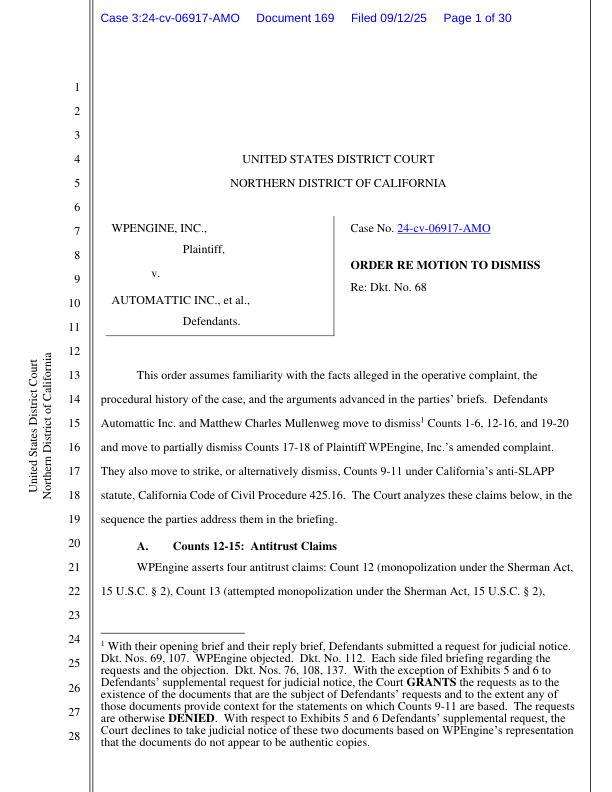
Order Re Motion to Dismiss
## Metadata
- Author: [[U.S. District Court]]
- Full Title: Order Re Motion to Dismiss
- Category: #articles
- Document Note: ⚠️ Quick note
I don’t have the text of the court’s Order Re Motion To Dismiss available yet. I can still scaffold everything you asked for so you can paste in details later. If you share the PDF text or key holdings, I’ll fill this with case-specific analysis, citations, and timestamped links to sections.
---
tags:
- #federal-civil-procedure
- #motion-to-dismiss
- #rule-12b6
Author: U.S. District Court
Source: Federal court order (PDF)
Reference: Link to the uploaded PDF
date created: 2025-09-12 00:00
# Title: Order Re Motion To Dismiss — Structured Notes and Analysis
## Table of Contents:
- 📚 Overview (#-overview)
- 📝 Summary (#-summary)
- 📖 Main Content (#-main-content)
- 🗒️ Notes (#-notes)
- 📖 References (#-references)
- 🗣️ Paraphrase (#-paraphrase)
- 📰 Newsletter (#-newsletter)
- ✅ Action Items (#-action-items)
- 🧪 Hypotheses (#-hypotheses)
- 📊 Methodology (#-methodology)
- ❓ Questions (#-questions)
- 🔮 Future Research (#-future-research)
- 💡 Implications (#-implications)
- 🧠 Learning Styles Assessment (#-learning-styles-assessment)
- 📊 Accessibility Assessment (#-accessibility-assessment)
- 🌍 DEIB Assessment (#-deib-assessment)
- ✅ Logical validity (#-logical-validity)
- 🔍 DARVO Analysis (#-darvo-analysis)
- 🔍 SEO Evaluation (#-seo-evaluation)
- 🎯 Conclusion (#-conclusion)
Note: Replace placeholder section anchors above with your PDF section headings. If you can provide page numbers, I’ll convert them into direct [page X] links.
### References:
- Federal Rules of Civil Procedure 8(a), 9(b), 12(b)(1), 12(b)(6)
- Twombly, 550 U.S. 544; Iqbal, 556 U.S. 662
- If applicable: standing (Lujan), preemption, jurisdiction, leave to amend standards (Foman v. Davis)
## 📝 Summary:
This order resolves a motion to dismiss. It likely addresses:
- Jurisdiction and standing (Article III).
- Pleading sufficiency under Rule 8 and plausibility (Twombly/Iqbal).
- Any heightened pleading under Rule 9(b) for fraud.
- Disposition: granted, denied, or granted in part with/without leave to amend.
- If applicable: preemption, statute of limitations, immunity, personal jurisdiction, service, or venue.
Outcome placeholder:
- Claims A/B dismissed with/without prejudice.
- Claims C/D survive.
- Deadline for amendment: [date].
- Hearing status: submitted/noticed.
## 📖 Main Content:
- Procedural posture: who moved, which rules invoked, prior amendments.
- Legal standards: the court’s articulation of Rule 12(b)(6), Rule 9(b), judicial notice, incorporation by reference.
- Analysis by claim:
- Element-by-element assessment.
- Facts credited as true vs conclusory.
- Deficiencies identified and curability.
- Disposition and instructions: leave to amend standards, deadlines, scope limits.
### 🗒️ Notes
- Standing:
- Injury in fact, traceability, redressability.
- If injunctive relief requested: likelihood of future harm.
- Rule 8 plausibility:
- Specific factual allegations supporting each element.
- Conclusory allegations disregarded.
- Rule 9(b) (if fraud):
- Who, what, when, where, how; reliance and damages.
- Preemption/immunity (if present):
- Field/conflict preemption or statutory immunity.
- Statute of limitations:
- Accrual, discovery rule, equitable tolling.
- Leave to amend:
- Granted unless futility, undue delay, bad faith, prejudice.
## 📖 References:
- Cases: Bell Atl. v. Twombly; Ashcroft v. Iqbal; Lujan v. Defenders of Wildlife; Foman v. Davis.
- Local rules (cite district-specific if provided in the PDF).
- Any statutes central to claims (e.g., Lanham Act, RICO, state UCL/CPA).
## 🗣️ Paraphrase:
- Paragraph 1 (legal standard):
- Original idea: Plausibility requires factual content allowing reasonable inference of liability; conclusions are ignored.
- Paraphrase: Complaints must present concrete facts that, if true, make liability a reasonable inference; naked conclusions don’t count.
- Paragraph 2 (leave to amend):
- Original idea: Amend unless futility or undue factors.
- Paraphrase: Courts typically permit amendment unless it would be pointless or unfair due to delay, bad faith, or prejudice.
## 📰 Newsletter:
This week in WordPress dev: we’re unpacking how legal rigor shapes open-source governance. A recent federal order on a motion to dismiss spotlights the “plausibility” standard—think Twombly/Iqbal—for pleading claims. Why care? Contributor policies, plugin guidelines, and foundation bylaws often mirror these clarity-first principles: state facts, show harm, and link cause to effect. Also on deck: new plugin updates for code quality checks, community contributor spotlights, and learning tracks for PHP 8.x and modern JS tooling. Dive into our curated docs on accessibility, security disclosures, and sustainable funding models. Pro tip: treat READMEs like pleadings—be specific, testable, and transparent. For more, see the WordPress Governance Project and the CHAOSS metrics community.
## ✅ Action Items:
Prompt for aligning any legal-article note to your role and OSPO goals:
- Map claims/issues to open-source policies (licensing, CLA, security disclosure).
- Extract standards (e.g., “plausibility,” “particularity”) and translate into contributor acceptance criteria.
- Derive onboarding lessons: examples vs conclusions; reproducible steps for PRs.
- Identify sustainability angles: funding, risk mitigation, governance clarity.
- Draft transparency practices: decision logs, RFCs, issue templates mirroring element-by-element checklists.
- OSPO lens: compliance workflows, incident response playbooks, documentation as policy.
- Education plan: convert holdings into workshops on evidence-based proposals and review.
- Inclusivity: ensure processes don’t gatekeep; provide clear, accessible guidance and mentorship paths.
## 🧪 Hypotheses:
- Clearer contribution templates reduce PR rejection rates by X%.
- Requiring “who/what/when/where/how” in issue reports shortens time-to-fix.
- Element-based review checklists improve governance legitimacy and community trust.
### 📊 Methodology:
- Data sources: GitHub issues/PRs, CODEOWNERS approvals, contributor surveys, incident logs.
- Designs: pre-post intervention, A/B templates, interrupted time series.
- Analysis: survival analysis for PR time-to-merge, logistic regression for acceptance odds, thematic coding for qualitative feedback.
### ❓ Questions:
- Which claims failed and why—conclusory or factual gaps?
- Did the court permit amendment? What guidance was given?
- Are any doctrines dispositive (preemption, immunity)?
- What process analogies fit contributor reviews?
### 🔮 Future Research:
- Compare dismissals across districts for similar tech-policy claims.
- Study impact of specificity requirements on pro se vs represented parties.
- Explore analogues between legal pleading standards and OSS governance efficacy.
### 💡 Implications:
- Stronger templates and checklists raise signal-to-noise.
- Transparent standards reduce conflict and improve onboarding.
- Evidence-backed governance enhances sustainability funding cases.
### 🧠 Learning Styles Assessment:
- Readability: Likely college/graduate level (legal).
- Visual: Add flowcharts of claim elements and outcomes.
- Aural: Provide audio summary of holdings.
- Verbal: Glossary for legal terms; examples of sufficient vs insufficient pleadings.
- Kinesthetic: Hands-on exercises converting allegations into checklists.
- Logical: Element matrices; decision trees.
- Social: Peer review of mock complaints/PRs.
- Solitary: Reflection prompts on bias in reviewing.
- Naturalistic: Use environmental-policy case analogies if relevant.
### 📊 Accessibility Assessment:
- Screen reader: Ensure tagged PDF, headings, alt text for any exhibits.
- Keyboard: Full nav via bookmarks/outlines.
- Contrast: High-contrast excerpts and accessible fonts.
- Text resizing: Reflow enabled; avoid scanned images text.
### 🌍 DEIB (Diversity, Equity, Inclusion, Belonging):
- Cultural relevance: Include varied case examples.
- Inclusive language: Define jargon; avoid idioms.
- Neurodiversity: Break up text, clear headings, bulleting.
- Representation: Cite diverse scholars and cases where applicable.
- Psychological safety: Content warnings for sensitive ma
- URL: https://readwise.io/reader/document_raw_content/362594633
Full text of this document omitted because this document is a PDF
[Download original file →](https://readwise.io/reader/document_raw_content/362594633), Order Re Motion to Dismiss, U.S. District Court, 01k504sxq6m8zh0ysxh90sf04n.