Pilate’s Secret Hebrew Message
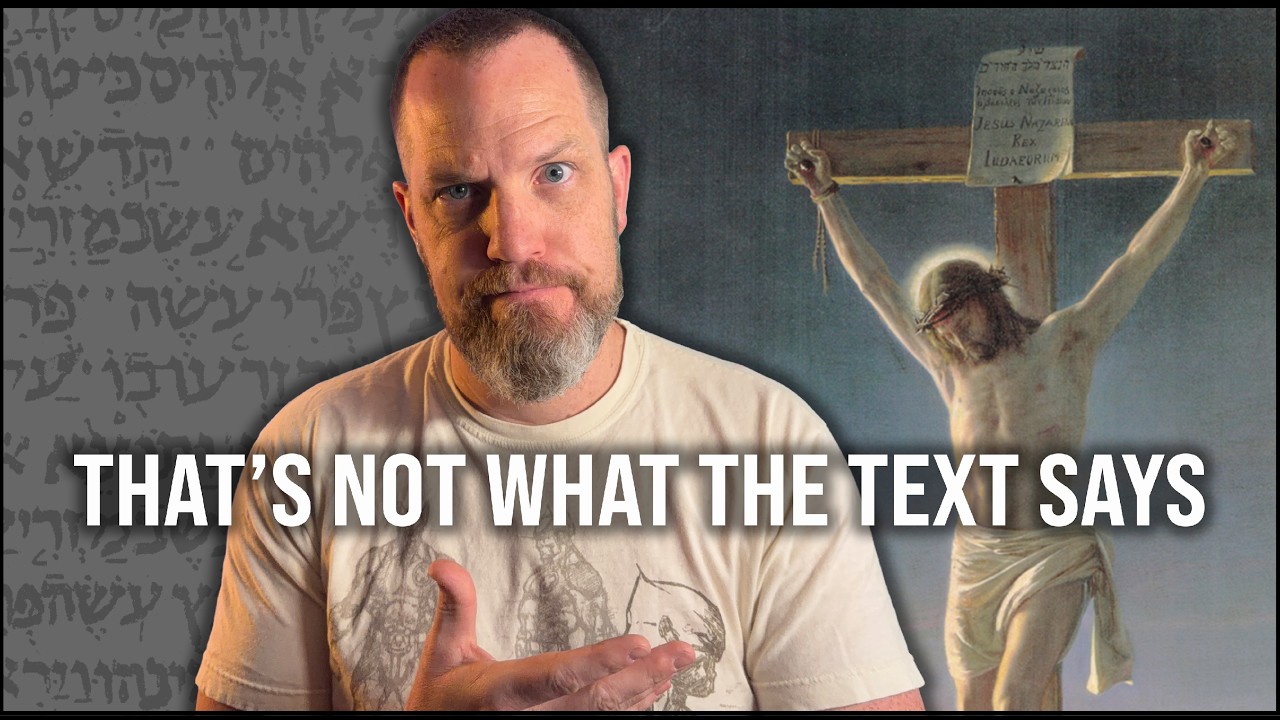
🔗 **Source:** [Pilate’s Secret Hebrew Message](https://www.youtube.com/watch?v=6MzUYeeCXHM)
Here's something a lot of people don't know. >> All right, let's see it. >> Pilate made a sign when Jesus was crucified and he placed it right above his head. Do you remember what that sign said? >> Well, that depends entirely on which gospel you imagine is most historical because they all say different things. Here is the Gospel of Mark in Greek. The bottom two lines have ton that means the king of the Judeans or the Jews. So that's what the gospel of Mark has. If we go to Matthew, we got
to look at the bottom three lines udeon. This is Jesus the king of the Judeans or the Jews. That's what Matthew says the sign had. Here we have the bottom three lines in the gospel of Luke 23:38 and that means the king of the Judeans or the Jews. this is or this is the king of the Judeans or the Jews. And then we have John 19:19 and this is the one that
this content creator is going to focus on and it reads Isus ho Nazareoson and this means Jesus the Nazaren the king of the Jews. So it depends on which gospel you imagine is most historical and the reality is none of these is likely to be historical. It said Jesus of Nazareth, the King of the Jews. >> So, this content creator is giving priority to the Gospel of John. And I
and many other scholars would point out as the latest and the most literary and the most expansive, the Gospel of John is probably the least likely to be historical and particularly in those places where the author significantly expands upon the narratives as they are found in this gospel author's sources. Now, of course, his intention was to mock Jesus. But what's amazing is that as soon as the Pharisees saw it, they ran to Pilate. They panicked and they asked them to take it down. And Pilate
refused. He said, "What I have written, I have written." But why did the Pharisees panic? So, a couple of things here. It was not the Pharisees. It was quite explicitly the chief priests. At least according to the Gospel of John. And additionally, the Gospel of John gives a pretty good idea why this happened. Here are the relevant verses. We can go down to verses 21 and 22. Then the chief priests of the Jews said to Pilate, "Do not write the king of the Jews." But this man said, "I am king of
the Jews." So based on this passage, it seems pretty clear that the chief priests, not the Pharisees, didn't like that Pilate seemed to be endorsing Jesus's identification as king of the Jews. They wanted him to make clear that this was something that Jesus claimed, but that was not true. That seems to be what is at issue, at least according to the author of the Gospel of John. And once again, the author of the Gospel of
John is likely creating this story themselves. So what they have to say about this reasoning is almost certainly the actual reasoning >> because they saw something in that sign that no one else did. >> I don't think this is true. >> You see, the Hebrews had a tradition of hiding secret codes in their writing. When they didn't want everyone else to understand, they would conceal a message inside the Hebrew words. And the way they would do it is they would use the
first letter of consecutive words to put together a message. >> U so this is not accurate. Acrostics are far more common centuries after the development of the New Testament in languages like Hebrew. But when we see them prior to the first century CE, it's primarily alphabetic acrostics where the first letter of each line is a consecutive letter of the alphabet. But they tend not to hide words or messages or names in acrostics in this period.
There are ciphers and cryptography and things like that that are in use at Kuman, but there are very very different techniques going on there that don't really have much to do with acrostics. But also across aren't really about hiding things that are secrets so nobody else can see them because that's not incredibly effective. the message tends to sit on the surface. Uh so this is not an incredibly accurate description of
what went on within first century CE Judaism and completely unknowingly that is exactly what Pilate had done. When you write Jesus of Nazareth, the king of the Jews in Hebrew and take the first letter of each word, it spells out an amazing word and that word is Yahweh. >> So we got two problems here. One of them a pretty small issue, the other utterly catastrophic for this claim. So here is the image that this content creator put
on the screen. And in the red in the middle you see Hebrew text and then in the black underneath you see a transliteration that is close to that Hebrew text but is actually not quite that Hebrew text. And the two smaller things going on here. One, that is not transliterated the way it's spelled out below. Hanatare would be the masculine plural construct form and that's not what's in the
Hebrew. Additionally, the next line begins with vime, but the Hebrew has ume because the vav when it is uh put before certain consonants, sometimes it changes from a consonant to the shurik, the long u quality vowel. But not a big deal. All that indicates is whoever wrote out this transliteration uh either was not following the Hebrew that is shown in this image or didn't
really know how to transliterate. The catastrophic issue is that this text in Hebrew does not say Jesus the Nazaren or Jesus of Nazareth the king of the Jews. This text says Jesus the Nazaren and King of the Jews because they have just arbitrarily added a conjunction at the beginning of Melik to provide the third consonant of the tetetrogrammaton because if you actually translated
directly from the Greek back into Hebrew, the third consonant would just be a mem. it would not be a vav and so it would not spell out the tetetrogrammaton as this content creator is going to suggest the sign spelled out. So we've taken what almost spelled out the tetetrogrammaton and we've just arbitrarily altered it to say something entirely different that none of the gospels says pilot wrote so that we can
find this tetra grammaton hidden as an acrostic in this text. So this is made up. This is entirely false. Uh there is no acrostic in what John 19:19 says Pilate had written in Hebrew on the sign over Jesus's head. What man intended as mockery, God turned into a proclamation. So the sign that was meant to shame the king became a declaration of his eternal identity. Even at his darkest hour,
Jesus was announced God. So again, this is not true. Even if you take that sign that was almost certainly composed originally in Greek by the author of the Gospel of John and you back translated it to Hebrew, you would not get the tetetrogrammaton. And the author of the Gospel of John did not identify Jesus as Adonai, the very God of Israel. I don't think there's any text in the New Testament that clearly does that. But it's certainly not going on in the Gospel of John. And it is certainly not
indicated by a hidden acrostic in the Hebrew of the sign that Pilate was supposed to put over Jesus's head. That's just not something you can arrive at based on any of the four gospels. And even if you say we're arbitrarily going to take the Gospel of John and say that what is written there is what was written on the sign and we're going to back translate it to Hebrew, we don't get the tetetrogrammaton. This is misinformation. This is a falsehood
based on post-biblical identifications of Jesus with Adonai, the God of Israel. And this is just another attempt to use misinformation, use lies, to try to plunk the tuning fork in the loins of the dogmatism of people out there who don't know any better. Um, don't fall for this kind of stuff. And when you see people sharing stuff on the internet that sounds like they're secret hidden messages hidden throughout the Bible
that confirm ideologies and dogmas that are unique to specific movements within Christianity or even within Judaism and those movements are overwhelmingly post-biblical developments. You need to think critically about those things. You need to take a harder look at the data and you need to go in search of expert commentary. So you can see if those are actually true because the overwhelming majority of the time and particularly when they sound like they are confirming
supernatural claims, they're not true. Somebody has just made something up or has misunderstood something, which is most likely what is the case with this particular video. And the fit for this video has been the Frank Miller Ben Grim, Pilate’s Secret Hebrew Message, YouTube, 01kv3rw771vbds7a7hwmt5jx00.