Project Fetch: Phase two

🔗 **Source:** [Project Fetch: Phase two](https://www.anthropic.com/research/project-fetch-phase-two)
> [!note]+ Document Notes
> ---
> tags: [embodied-ai, agentic-ai, ai-capabilities, robotics, model-scaling, anthropic-research]
> author: Michael Ilie, C. Daniel Freeman, Kevin K. Troy
> source: Anthropic
> reference: https://www.anthropic.com/research/project-fetch-phase-two
> date created: 2026-06-21 14:30
> ---
> # 🏷️ Title: Project Fetch: Phase two
> ## 🧭 Table of Contents
> - [📝 Summary](#-summary)
> - [📖 Main Content](#-main-content)
> - [🗒️ Notes](#️-notes)
> - [📚 References](#-references)
> - [🗣️ Paraphrase](#️-paraphrase)
> - [📰 Newsletter](#-newsletter)
> - [✅ Action Items](#-action-items)
> - [🧪 Hypotheses](#-hypotheses)
> - [📊 Methodology](#-methodology)
> - [❓ Questions](#-questions)
> - [🔮 Future Research](#-future-research)
> - [💡 Implications](#-implications)
> - [🧠 Learning Styles Assessment](#-learning-styles-assessment)
> - [📊 Accessibility Assessment](#-accessibility-assessment)
> - [🌍 DEIB Assessment](#-deib-assessment)
> - [✅ Logical Validity](#-logical-validity)
> - [🛡️ DARVO Analysis](#-darvo-analysis)
> - [🎯 Conclusion](#-conclusion)
> ### 🔗 References
> - [Project Fetch: Phase two](https://www.anthropic.com/research/project-fetch-phase-two) (this article)
> - [Project Fetch — Phase One post](https://www.anthropic.com/research) (the original August 2024 experiment referenced throughout)
> - Claude Code (the agentic harness used to run Opus 4.7 in the trials)
> ## 📝 Summary
> - **What happened.** Anthropic re-ran "Project Fetch," its experiment operating an off-the-shelf robotic quadruped (a "robodog"). In Phase One (August 2024), Claude Opus 4.1 helped non-expert human teams but could not do the tasks alone. In Phase Two, **Claude Opus 4.7 — operating with no human assistance via Claude Code — completed the same tasks roughly 20x faster than the fastest human team** from a year earlier (connect to video/lidar sensors, write control programs, detect a beach ball).
> - **Why it matters.** It's a concrete data point that the recurring AI progression — *models help humans → humans help models → models do it themselves* — already seen in cybersecurity, is now appearing at the intersection of AI and the physical world. The authors call this the "early era of physical agentic AI."
> - **Key stakeholders.** Anthropic (author and self-interested party), robotics and embodied-AI researchers, AI-safety/evaluation teams tracking capability jumps, and anyone modeling how general scaling spills into hardware control.
> - **Risks and tradeoffs.** The headline is real but bounded: Claude still **fails the actual "fetch"** — the fine-motor closed-loop control to precisely nudge the ball. None of the tasks touch low-level actuation policies. The research is Anthropic's own, on its own models, framed favorably (flag for self-interest). Speed claims rest on three trials against a prior small human sample.
> - **Bottom line.** LLMs have not "solved robotics," but apparently large capability distances are being crossed fast; ruling out a similar trajectory in hardware would be unwise.
> ## 📖 Main Content
> - **The setup and the through-line.** Project Fetch tested whether Claude could help non-roboticist Anthropic employees operate a robodog. Phase One pitted a Claude-enabled team against a Claude-less team; the Claude team got more done, faster, but Opus 4.1 could not do the tasks autonomously (it got stuck just connecting to the robot). Phase Two revisits this with a newer model to measure model-only capability.
> - **The headline result.** On every task at least one human team completed in August, **Opus 4.7 finished at least 10x faster**. Across the four tasks completed by *both* human teams, Opus 4.7 averaged **>37x faster than Team Claude-less and >18x faster than Team Claude** (361 min vs 181 min vs 9 min 35 sec). On the five-task table comparison, Team Claude took 264 minutes; Opus 4.7 averaged 12 min 7 sec over three trials.
> - **Why it was faster — and leaner.** Where humans dithered between approaches to interface with the sensors, the model quickly identified the best path and much of its code worked on the first try. It was as or more successful while writing **~10x less code** than Team Claude (1,045 lines vs 10,309; Team Claude-less wrote 1,136).
> - **Reliability.** Across three trials, completion times were consistent (low within-task variance). One beach-ball-detection trial ran long, attributed to the model defaulting to an outdated object-detection algorithm — which it then worked around. For tasks "within its capability envelope," Claude is now "quite reliable."
> - **What it still can't do.** The literal "fetch" — using the robot to precisely move the beach ball home — requires a fast perceive-error → adjust-input closed loop that humans do well after practice. Claude could position the robot behind the ball but its control was poor and unsuccessful, mirroring the human participants who reached that stage. A more experienced human researcher *did* program autonomous fetching; the authors expect current Claude could too with more time and scaffolding — what they'll watch for is doing it at the same speed and reliability as the other tasks.
> - **The framing claim.** This progress is not a targeted robotics effort; it "emerged from much more general scaling." The pattern (models help humans → humans help models → models do it themselves) seen in cybersecurity is now taking shape in the physical world. The analogy: just as models learned to use existing software-editing tools (e.g., string-replace) on the way to agentic coding, they now seem close to using off-the-shelf *physical* tools with relative ease — "the early era of physical agentic AI."
> - **Uncertainties / contested points.** Whether models can make physical tools more bespoke (writing tailored control policies, designing robotic systems) is open, and the authors concede "substantial barriers" may exist. The methodology footnote also discloses that the **Mythos-class** model ("Claude Mythos Preview") was excluded because the experiment setup and serving wouldn't allow an apples-to-apples comparison.
> ### 🗒️ Notes
> - **20x headline** is the load-bearing number: Opus 4.7, *alone*, ~20x faster than the fastest human team from ~a year prior on completed tasks.
> - **Two distinct comparisons** in the piece: (1) 4 tasks all teams completed → 37.7x vs Claude-less, 18.9x vs Claude; (2) 5-task table → 264 min (Team Claude) vs 12 min 7 sec (Opus 4.7 avg of 3). Don't conflate the two denominators.
> - **Researcher role was minimal but nonzero**: plug laptop into robodog, enter initial prompt, approve commands, approve task progression. Not "fully autonomous" in the strict sense — there's a human approving steps.
> - **Excluded tasks**: they couldn't have Claude use the physical controller, and they didn't time a researcher using the Claude-programmed controller to retrieve the ball (though they confirmed it worked).
> - **Code-volume metric** doubles as an efficiency proxy: ~10x less code than Team Claude while matching/beating success — argues the speed isn't brute force.
> - **Failure mode named**: outdated object-detection algorithm default → one slow detection trial; model self-recovered.
> - **The capability boundary** is the fine-motor closed loop ("the fetching part"), plus untouched low-level actuation policy.
> - **Scaling claim**: improvements are a byproduct of general scaling, not robotics-specific tuning — recurring motif in Anthropic's capability narrative.
> - **Pattern claim** ("models help humans → humans help models → models do themselves") explicitly ported from cybersecurity to embodied AI.
> - **Mythos confirmation**: footnote states Opus 4.7 was "our most advanced non-Mythos-class model," and names "Claude Mythos Preview" — confirms Mythos-class as a real Anthropic model line.
> - **Self-interest flag**: Anthropic authoring research about Anthropic models' capability gains; tone is measured but promotional.
> ## 📚 References
> - [Project Fetch: Phase two — Anthropic](https://www.anthropic.com/research/project-fetch-phase-two) — primary source.
> - [Anthropic Research index](https://www.anthropic.com/research) — locus of the Phase One post referenced throughout.
> - Claude Code — the agentic environment running Opus 4.7 with adaptive thinking, effort set to maximum.
> - (Referenc
*Michael Ilie, C. Daniel Freeman, and Kevin K. Troy*
In August 2024, we ran an [experiment](https://www.anthropic.com/research/project-fetch-robot-dog) to see how much Claude could help Anthropic employees—who were not robotics experts—perform sophisticated (and amusing) tasks with an off-the-shelf robotic quadruped (henceforth, a robodog). We called this Project Fetch. We found that access to our state-of-the-art model at the time (Claude Opus 4.1) helped one team substantially outperform the other, who had to rely only on the internet and their own ingenuity. The Claude-enabled team got more done, faster.
Before we dragged our colleagues to a warehouse for the experiment, we double checked whether Opus 4.1 could do the tasks entirely on its own. Unquestionably, it could not. Much like our team without Claude, it got hung up on the preliminary task of figuring out how to connect to the robot.
But AI models are moving fast—even faster than the runaway robodog that almost rammed into one of our human teams back in August.
We figured it was time to revisit Project Fetch to see if our newer models could outperform the previous generation. Not only did they do that, but **Claude Opus 4.7—operating without human assistance—was about 20 times faster than the fastest human team at all tasks completed by our participants less than a year ago**.
This doesn’t mean that LLMs have now solved robotics. Far from it. The latest Claude models still struggled with using the robot to precisely move the beach ball—the “fetching” part of Project Fetch. And none of the tasks in these experiments implicate the more challenging, low-level elements of robotic control, such as developing a specific actuation policy. However, once again, we are seeing a pattern whereby first, models are helpful to humans. Then, humans are helpful to models. Finally, models are largely able to do things themselves. We have seen this in [cybersecurity](https://red.anthropic.com/2026/mythos-preview/) and now the same dynamics are starting to take shape at the intersection of AI and the physical world.
The original Project Fetch had teams of Anthropic employees (randomly assigned to work with or without Claude) do the following steps: operate the robodog using the manufacturer-provided controller, connect to the robodog’s video and lidar sensors, write and operate a program to manually control the robodog, develop a way to monitor the robodog’s path through space, write a program to detect the beach ball, and finally put it all together to autonomously retrieve the ball.
For this autonomous update, we couldn’t ask Claude to use a physical controller, nor did we evaluate the time it took a researcher to use the Claude-programmed controller to retrieve the ball (though we did confirm that it worked as intended). On the remaining subset of tasks, we ran three trials of Opus 4.7 using adaptive thinking with effort set to maximum in Claude Code. We measured the elapsed time for each objective and qualitatively assessed the models’ success.
The role of our researcher was limited to plugging a laptop running Claude Code into the robodog, entering the initial prompt, approving commands, and approving the model to go to the next task.
Very simply: on every task that was completed by at least one human team in August, Opus 4.7 completed the same task at least ten times faster.1 If you consider the four tasks that were completed by both human teams, Opus 4.7 was, on average, more than 37 times faster than Team Claude-less and more than 18 times faster than Team Claude.
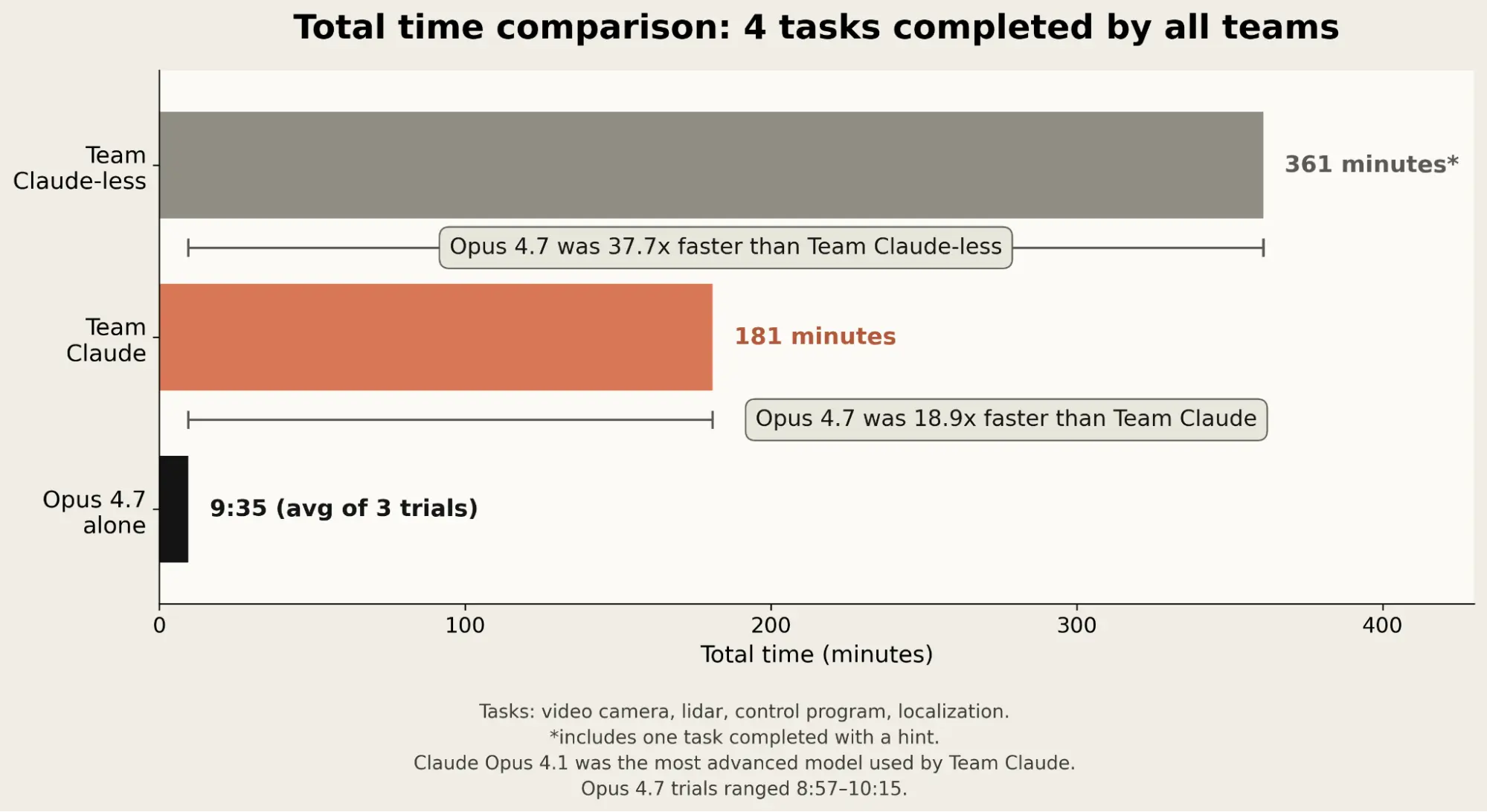Bar chart labeled "Total time comparison: 4 tasks completed by all teams." The chart shows that Team Claude-less completed tasks in 361 minutes; Team Claude completed tasks in 181 minutes, and Claude Opus 4.7 alone completed tasks in 9 minutes 35 seconds. Opus 4.7 was 37.7 times faster than Team Claude-less and 18.9 times faster than Team Claude.
The table compares the speed of the original teams (Team Claude and Team Claude-less) to Opus 4.7 on all of the tasks we tested as part of Phase Two.
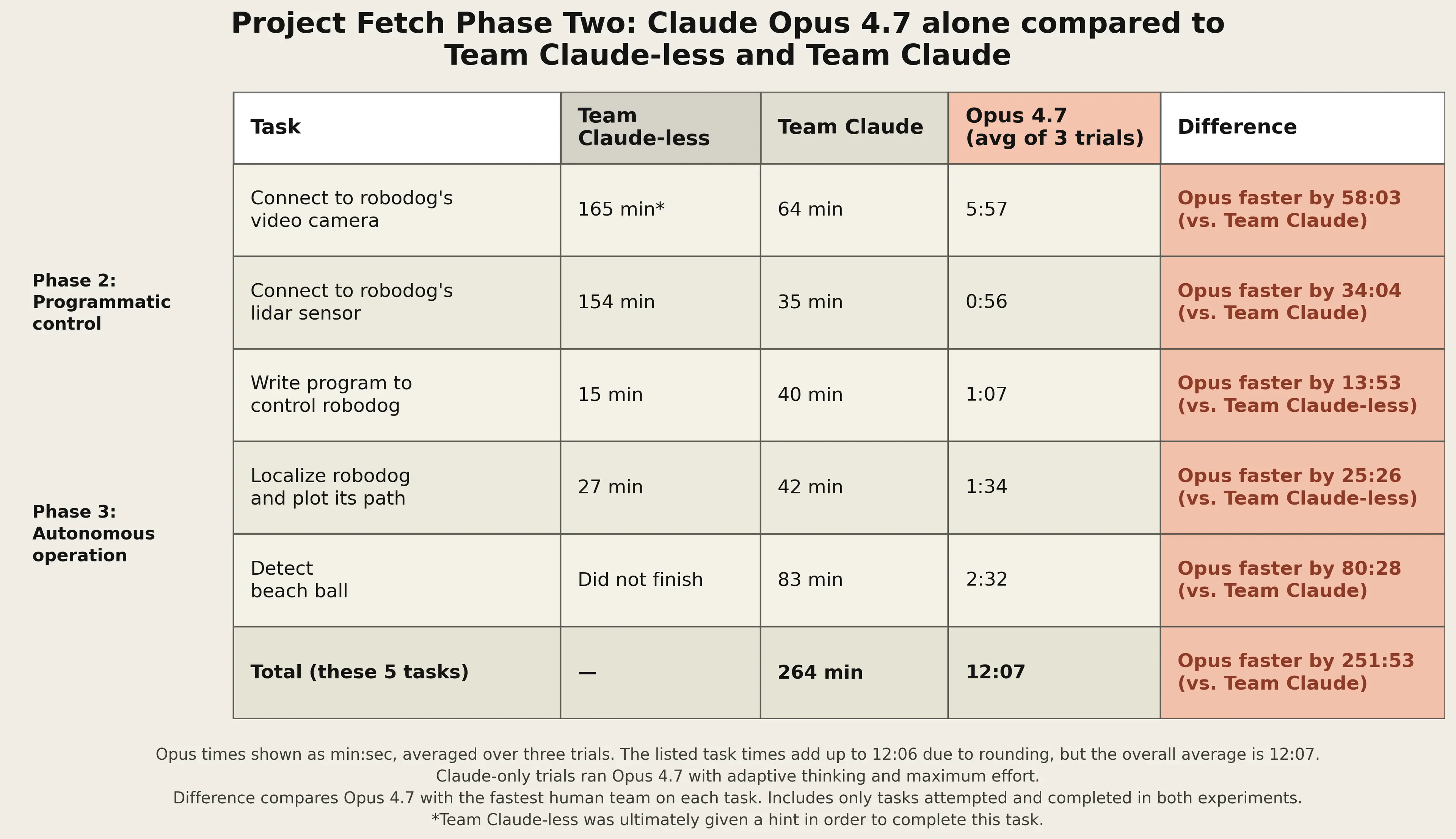Table comparing Claude Opus 4.7 to Team Claude-less and Team Claude performance on tasks related to programmatic control and autonomous operation. Tasks include "Connect to robodog's video camera," "Connect to robodog's lidar sensor," and "Detect beach ball." Opus 4.7 was faster than Team Claude-less and Team Claude on all tasks. Team Claude-less did not complete all 5 tasks in the table; Team Claude completed them in 264 minutes; and Opus 4.7, averaged over 3 trials, completed them in 12 minutes 7 seconds.
Whereas the humans struggled to choose between multiple different approaches to interface with the dog’s sensors, Opus 4.7 was able to quickly identify the best path. Much of the code it wrote was effective on the first try (which was not the case for Team Claude or Team Claude-less in the original experiment). Indeed, we can see evidence of Opus 4.7’s efficiency when we look at the volume of code it generated: it was as or more successful than both human teams while producing almost ten times less code than Team Claude.
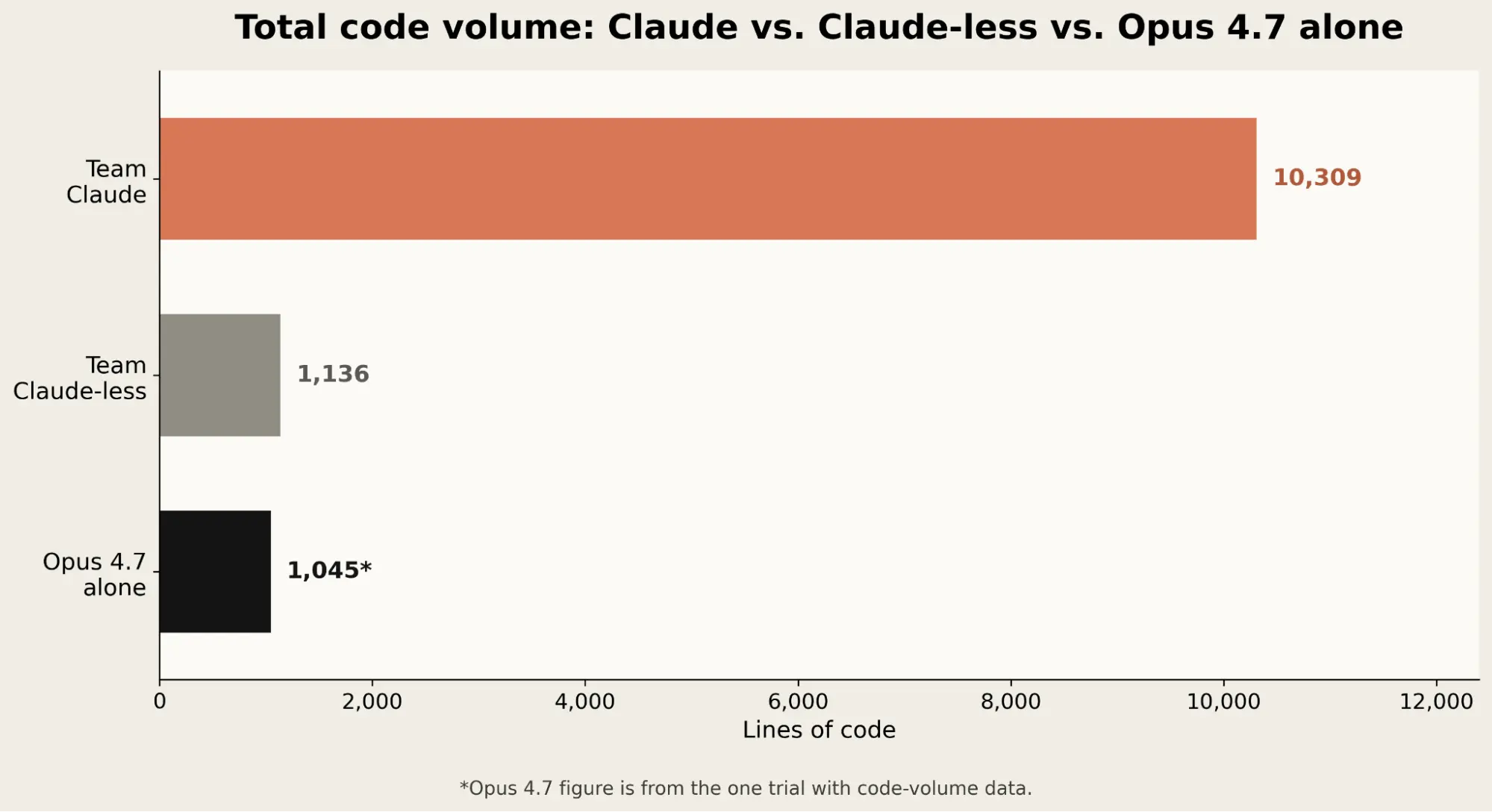Bar chart showing total code volume for Team Claude, Team Claude-less, and Opus 4.7 alone. Team Claude wrote 10,309 lines of code; Team Claude-less wrote 1,136 lines of code; Opus 4.7 alone wrote 1,045 lines of code.
Opus 4.7 was not perfect. For example, it defaulted to using an outdated object detection algorithm. But even then, it was able to work around this and arrive at an effective solution.
We observed little within-task variance (in absolute terms) on completion times for steps the model finished. (Though the aforementioned suboptimal algorithm selection is likely why one of the beach ball detection trials took substantially longer than the others.) Overall, for the tasks in this experiment within its capability envelope, Claude is now quite reliable. (See the next section for an analysis of what Claude is still unable to do.)
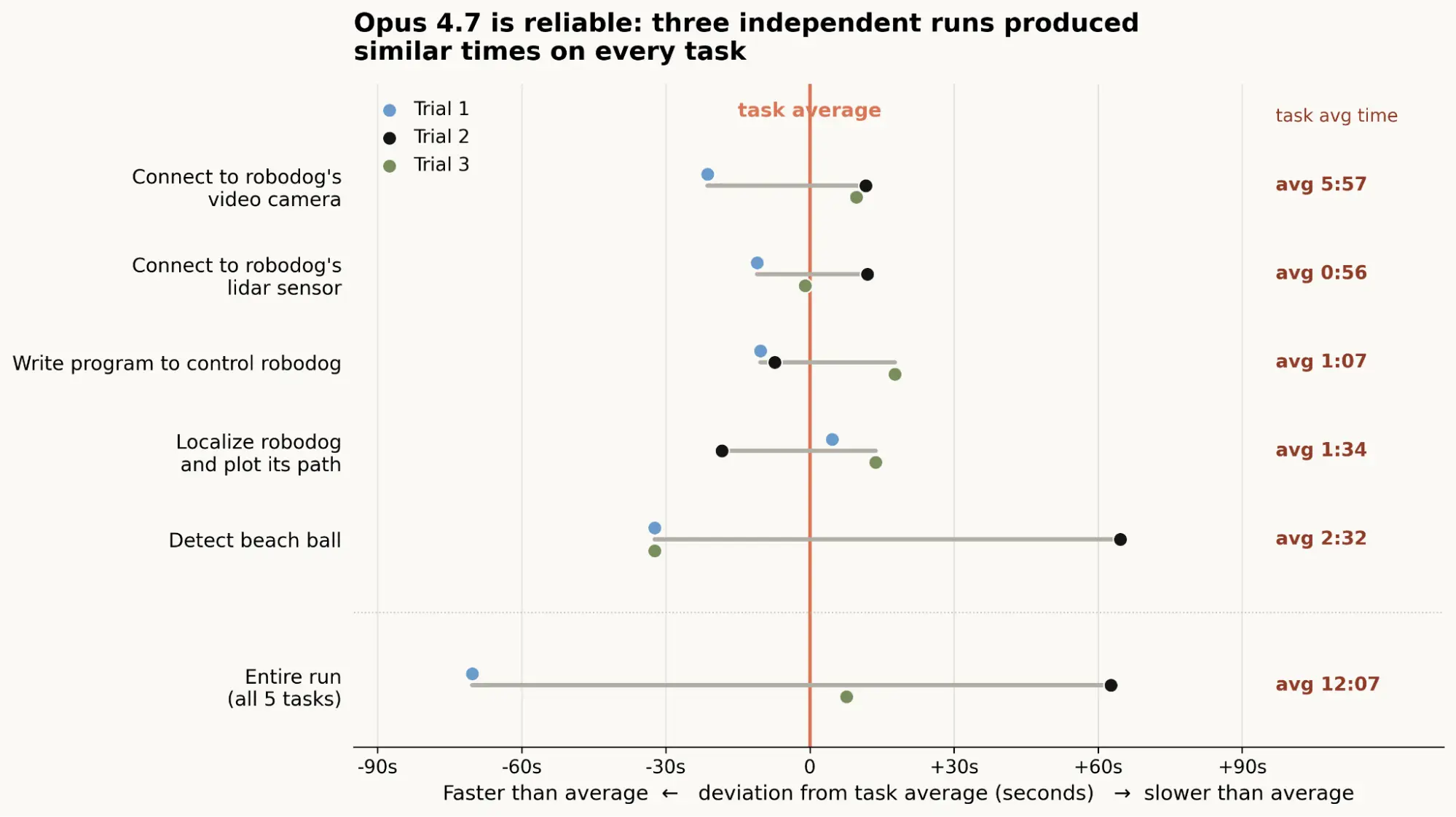Scatter plot showing Opus 4.7's reliability on task performance. Opus 4.7 performed each task three times; the scatter plot shows that the performance time was relatively consistent across runs.
It is worth underscoring (as we did in our previous post) that this progress is not the result of a concerted effort to improve the robotics capabilities of our models. These improvements, like so many others in the history of LLM development, have emerged from much more general scaling.
When using their hands, and with some practice, our humans were able to pilot the robodogs to gently nudge a beach ball back to the home base (a patch of fake grass) where the robots started. This required the ability to quickly perceive if the ball had gone off course, how that error related to the previous command, where the ball was now, and then how to adjust future inputs to more precisely move the ball. This is a kind of closed loop at which people excel (at least after making some mistakes and learning from them).
In our Phase Two experiments, Claude struggled to capture this subtlety. Like the humans who reached the phase of needing to write a program for autonomous beach ball retrieval, Claude was able to move the robot behind the ball and position it to knock the ball back to the starting point. But the efforts to do so were poorly controlled and (again, like our human participants) not successful.
One of our researchers with more robotics experience than our Phase One volunteers successfully accomplished the task of programming autonomous fetching. With more time and additional scaffolding, we think it is very likely that current generations of Claude could do the same. What we will be watching for next, though, is the ability of the models to accomplish this final task with the same speed and reliability they displayed on the other elements of Project Fetch.
Writing about Phase One, we emphasized how LLMs could provide uplift to non-expert humans needing to use robots. This is even more true now than before. Models now complete what was previously pair-programming work between humans and models much more quickly by themselves, which means that people can more quickly transition to controlling and using the robots. And for some tasks, a human in the loop controlling the robot may still outstrip the AI model with its (virtual) hand on the D-pad.
What is interesting and different is that we now seem much closer to a world where models will be able to use off-the-shelf physical tools with relative ease—at least for limited purposes. This is similar to how AI models used existing software editing tools like string-replace when they made the transition to more agentic coding. We are plausibly entering the early era of *physical* agentic AI.
More research is needed to understand models’ ability to make these physical tools more bespoke, whether by writing control policies tailored to particular tasks or by designing robotic systems. And there may be substantial barriers to this more generalized vision of physically capable and adaptable language models. But as we have seen, apparently large distances in model capability can be traversed quickly. Models building their own software tools might have seemed outlandish not long ago, but it is happening. It would be unwise to rule out the same trajectory in hardware.
1. We report results from Claude Opus 4.7 because it was our most advanced non-Mythos-class model at the time we ran this experiment. Preliminary trials with Claude Mythos Preview showed that it would not provide an apples-to-apples comparison with other models because of how we had set up the experiment and how the model was served., Project Fetch: Phase two, anthropic.com, 01kvnj5d17fsaawp6cta6femky.