Re-Framing Productivity with Chris Dancy
## Metadata
- Author: [[YouTube]]
- Full Title: Re-Framing Productivity with Chris Dancy
- Category: #articles
- Document Note: ---
tags: [productivity, values, digital-wellness]
author: Chris Dancy
source: Keep Productive
reference: https://www.youtube.com/watch?v=xQuYV0dZzVk
date created: 2024-12-19 15:30
---
# 🏷️ Title: Re-Framing Productivity with Chris Dancy
## 🧰 Action Inbox
- [H1] Define personal values with family members — comprehensive framework discussion #values
- [H2] Map productivity tools to value domains rather than efficiency — tool selection strategy #productivity
- [H3] Implement weekly reflection/intention exercises with colored stickies — family values practice #habits
## 🧭 Table of Contents
- [📝 Summary](#-summary)
- [📖 Main Content](#-main-content)
- [🗒️ Notes](#️-notes)
- [📚 References](#-references)
- [🗣️ Paraphrase](#️-paraphrase)
- [📰 Newsletter](#-newsletter)
- [✅ Action Items](#-action-items)
- [🧪 Hypotheses](#-hypotheses)
- [📊 Methodology](#-methodology)
- [❓ Questions](#-questions)
- [🔮 Future Research](#-future-research)
- [💡 Implications](#-implications)
- [🧠 Learning Styles Assessment](#-learning-styles-assessment)
- [📊 Accessibility Assessment](#-accessibility-assessment)
- [🌍 DEIB Assessment](#-deib-assessment)
- [✅ Logical Validity](#-logical-validity)
- [🛡️ DARVO Analysis](#-darvo-analysis)
- [🎯 Conclusion](#-conclusion)
### 🔗 References
- [Don't Unplug by Chris Dancy](URL)
- [Our Balance App](URL)
## 📝 Summary
- Chris Dancy, "the most connected human on the planet," argues that productivity systems fail because they focus on time-saving rather than value alignment
- He proposes a five-domain maturity model moving from task-focused productivity through health, values, nature-centered thinking, to transcendence
- The core framework involves identifying key people in your life, defining shared values with concrete actions/guardrails, making those values visible, and selecting tools that support mutuality rather than individual optimization
- Productivity evolution shows we're shifting from "me-focused" personal technology (1990-2020) to "we-focused" collaborative tools
- Bottom line: Stop trying to save time and start spending it right by aligning all decisions and processes to explicitly defined, visible values
## 📖 Main Content
Chris Dancy spent nine years (2008-2017) as a quantified self pioneer, tracking every aspect of his life through sensors and data integration. This experience led him to conclude that traditional productivity approaches are fundamentally flawed because they prioritize time optimization over value alignment.
The "productivity problem" manifests in four key areas: it's time-consuming to maintain systems, expensive beyond free tiers, ultimately ineffective as processes get abandoned, and inherently selfish by focusing solely on individual optimization rather than mutual benefit.
Dancy proposes a five-domain maturity model for productivity evolution: (1) Product-centered domain focused on time optimization, (2) Health-centered domain measuring personal metrics, (3) Value-centered domain aligning time with principles, (4) Nature-centered domain considering interdependencies with others and systems, and (5) Transcendence domain integrating all previous levels during major life transitions.
His framework involves three core steps: First, identify yourself and the key people/entities in your life (spouse, children, pets, business). Second, define shared values with concrete definitions, actions, and guardrails, making these visible to all involved parties. Third, select tools based on modality, access, and integration capabilities rather than features or aesthetics.
## 🗒️ Notes
#### ⏱️ [00:00:00](https://www.youtube.com/watch?v=xQuYV0dZzVk?t=0) — [H1] Introduction and Background
- Key idea: Chris Dancy spent 2008-2017 systematically documenting every aspect of his life
- Evidence: "I took every piece of information ever created about me... organized and structured that data"
#### ⏱️ [00:03:12](https://www.youtube.com/watch?v=xQuYV0dZzVk?t=192) — [H2] The Productivity Problem Framework
- Key idea: Productivity fails in four critical areas that most people ignore
- Evidence: "Time consuming, expensive, ineffective, and selfish - these are the core problems"
#### ⏱️ [00:05:45](https://www.youtube.com/watch?v=xQuYV0dZzVk?t=345) — [H2] Evolution of Productivity (1990s-2000s)
- Key idea: Productivity tools evolved from PC-based office suites to web workflows
- Evidence: "The 1990s early 1990s and the advent of everyone starting to own a pc productivity was really in vogue"
#### ⏱️ [00:07:30](https://www.youtube.com/watch?v=xQuYV0dZzVk?t=450) — [H2] App-Based Productivity Era (2010s)
- Key idea: Smartphones created single-purpose productivity apps that didn't integrate well
- Evidence: "Apps did something else they created a single focus... a lot of these things didn't talk to each other"
#### ⏱️ [00:09:15](https://www.youtube.com/watch?v=xQuYV0dZzVk?t=555) — [H2] Current Hyper-Focus Era Problems
- Key idea: Modern productivity systems are props for aspirational lives rather than practical tools
- Evidence: "Bespoke well-designed systems which... are just props for the life we wish we had"
#### ⏱️ [00:11:20](https://www.youtube.com/watch?v=xQuYV0dZzVk?t=680) — [H1] Five-Domain Maturity Model Introduction
- Key idea: Productivity development follows predictable domains with specific costs and benefits
- Evidence: "Five domains that we fundamentally need to all talk about and all agree on"
#### ⏱️ [00:13:45](https://www.youtube.com/watch?v=xQuYV0dZzVk?t=825) — [H2] Domain Analysis: Product to Transcendence
- Key idea: Each domain has specific costs - relationships suffer as productivity/health improve
- Evidence: "The cost of a health-centered domain is really relationships balance and isolation"
#### ⏱️ [00:16:30](https://www.youtube.com/watch?v=xQuYV0dZzVk?t=990) — [H2] Technology Shift: Me to We
- Key idea: Applications are shifting from individual optimization to team/community solutions
- Evidence: "We are moving from personal technology... most apps today are created for teams"
#### ⏱️ [00:19:10](https://www.youtube.com/watch?v=xQuYV0dZzVk?t=1150) — [H1] Step 1: Identify Key People and Entities
- Key idea: Start with yourself and immediate circle, not extended networks or coworkers
- Evidence: "Your spouse your children not your coworkers not your mother-in-law just the people that keep you going"
#### ⏱️ [00:21:45](https://www.youtube.com/watch?v=xQuYV0dZzVk?t=1305) — [H1] Step 2: Define Values with Actions and Guardrails
- Key idea: Values require concrete definitions, specific actions, and clear violation boundaries
- Evidence: "You have to have a plan that has actions and guardrails... for when those values are being violated"
#### ⏱️ [00:24:20](https://www.youtube.com/watch?v=xQuYV0dZzVk?t=1460) — [H1] Step 3: Tool Selection Based on Values
- Key idea: Choose tools after establishing who and why, never automate bad values
- Evidence: "Don't try to automate your way into a better life you'll just make bad values go faster"
#### ⏱️ [00:28:15](https://www.youtube.com/watch?v=xQuYV0dZzVk?t=1695) — [H2] Behavioral Framework: Thinking to Thriving
- Key idea: Six behavioral levels from spontaneous thinking to generational thriving align with different time scales
- Evidence: "Goals are yearly or longer your values are actually generational"
#### ⏱️ [00:32:40](https://www.youtube.com/watch?v=xQuYV0dZzVk?t=1960) — [H1] Practical Implementation: Family Exercises
- Key idea: Weekly reflection and intention-setting with colored stickies mapped to values
- Evidence: "We actually do reflections and intentions... stickies align to the colors of our values"
#### ⏱️ [00:35:25](https://www.youtube.com/watch?v=xQuYV0dZzVk?t=2125) — [H1] Resources and Next Steps
- Key idea: Offers book, app (Our Balance), and personal consultations for implementation
- Evidence: "I speak to people every single day i love chatting with them... i value service"
## 📚 References
- [Don't Unplug Book](URL)
- [Our Balance App](https://apps.apple.com)
- [Keep Productive Channel](https://youtube.com/keepproductive)
## 🗣️ Paraphrase
- Traditional productivity systems fail because they optimize for time-saving rather than meaningful value alignment, leading to expensive, complex, and ultimately selfish approaches that don't consider relationships or long-term impact
- A five-domain maturity model shows how people evolve from task-focused productivity through health optimization, value-centered thinking, nature-based interdependence, to transcendent integration during major life transitions
- The practical framework involves three steps: identify key people in your life, define shared values with concrete actions and guardrails, then select tools that support collaboration and visibility rather than individual optimization
## 📰 Newsletter
**Shifting from Time-Saving to Value-Spending in Your WordPress Workflow**
Chris Dancy's talk challenges the fundamental assumption behind most productivity advice: that saving time is the goal. Instead, he argues we should focus on spending time right by aligning all our decisions with explicitly defined values.
For WordPress professionals, this reframe is powerful. Rather than optimizing for the fastest deployment or most efficient client onboarding, consider: What values drive your work? How do your development practices, client relationships, and community contributions reflect those values?
Try Dancy's three-step approach: Map your key relationships (clients, team, family), define shared values with concrete actions, then choose tools that support collaboration rather than just personal efficiency. Your WordPress toolkit should serve your values, not the other way around.
Resources: [Learn WordPress](https://learn.wordpress.org/), [Developer Docs](https://developer.wordpress.org/), [WP-CLI](https://wp-cli.org/)
## ✅ Action Items
#### DevRel
- Developer advocacy: Create value-aligned speaking topics focused on community benefit rather than individual productivity optimization
- Education: Develop workshops that help developers identify their core values and align technical decisions with those principles
- Developer experience: Audit documentation and tooling through lens of mutual benefit rather than individual efficiency
- Community management: Implement reflection/intention exercises for team meetings using value-based frameworks
#### WordPress
- Core: Integrate values-based decision making into feature prioritization discussions rather than purely technical or user metrics
- Community: Create value-identification workshops for WordCamp organizers to align event planning with community values
- Training: Develop curriculum helping WordPress professionals map their technical choices to personal/professional values
- Documentation: Restructure learning paths to emphasize value-driven development practices alongside technical skills
## 🧪 Hypotheses
- Productivity systems fail long-term because they optimize for efficiency rather than value alignment, leading to abandonment when life circumstances change
- Teams that explicitly define and visualize shared values will show higher satisfaction and retention compared to teams using traditional task-focused productivity methods
- The shift from individual to collaborative productivity tools reflects deeper social changes toward interdependence and community-focused work
- Values-based tool selection will result in higher long-term adoption rates compared to feature-based or efficiency-based selection criteria
### 📊 Methodology
- Longitudinal study tracking productivity system adoption and abandonment rates correlated with value-alignment assessments
- Comparative analysis of team satisfaction metrics between values-based vs. task-based productivity implementations
- Survey research on tool selection criteria and long-term usage patterns across different demographic groups
### ❓ Questions
- How do generational differences in technology adoption affect the transition from "me-focused" to "we-focused" productivity tools?
- What specific mechanisms make values-based productivity systems more sustainable than efficiency-based approaches?
- How can organizations measure the mutual benefit aspect of productivity improvements rather than just individual metrics?
### 🔮 Future Research
- Development of values-assessment frameworks specifically for distributed teams and remote work environments
- Investigation of cultural differences in value-based productivity approaches across different geographic regions
- Analysis of integration patterns between personal value systems and organizational productivity requirements
### 💡 Implications
- Practice: Requires fundamental shift from optimizing individual efficiency to optimizing collective value alignment in daily workflow decisions
- Policy: Organizations may need new frameworks for measuring productivity that account for relationship quality and value alignment rather than just output metrics
- Education: Professional development programs should include values identification and alignment as core productivity skills alongside traditional time management
### 🧠 Learning Styles Assessment
Reading level estimate: 12th grade (complex concepts with accessible language)
#### 👀 Visual learners
- Present: Five-domain maturity model diagram, behavioral framework pyramid
- Improve: Values mapping templates, tool selection decision trees, family exercise visual guides
#### 🔊 Aural learners
- Present: Full video presentation with clear verbal explanations
- Improve: Audio-only summary version, podcast-style discussion format
#### 🗣️ Verbal learners
- Present: Rich analogies, clear definitions, step-by-step explanations
- Improve: Glossary of terms, comparison tables between traditional vs. values-based approaches
#### 🧩 Kinesthetic learners
- Present: Practical exercises with sticky notes, hands-on tool selection process
- Improve: Interactive worksheets, role-playing scenarios for values discussions
#### 🧠 Logical learners
- Present: Clear framework structure, systematic progression through domains
- Improve: Decision matrices for tool selection, cause-effect diagrams for productivity failures
#### 🧑🤝🧑 Social learners
- Present: Family-based exercises, collaborative value-setting processes
- Improve: Group workshop formats, peer accountability structures
#### 🧘♀️ Solitary learners
- Present: Self-assessment opportunities, personal reflection prompts
- Improve: Individual workbooks, private journaling templates
### 📊 Accessibility Assessment
#### Screen reader semantics
- Present: Clear heading structure, descriptive content organization
- Improve: Alt text for visual framework diagrams, ARIA labels for complex concepts
#### Contrast and readability
- Present: Good text contrast in video presentation
- Improve: High-contrast versions of framework diagrams, larger text options for visual aids
#### Media and captions
- Present: Full video with clear audio
- Improve: Professional captions, downloadable transcript with timestamps
### 🌍 DEIB Assessment
#### Cultural breadth
- Present: References to global travel and diverse work environments
- Improve: Examples from different cultural contexts, acknowledgment of varying family structures
#### Inclusive language
- Present: Gender-neutral terms, accessible explanations of complex concepts
- Improve: Alternative examples for different family configurations, culturally sensitive value discussions
#### Representation
- Present: Personal vulnerability in sharing life changes and challenges
- Improve: Diverse case studies, acknowledgment of different socioeconomic contexts affecting productivity choices
### ✅ Logical Validity
#### Strong reasoning
- Deductive strength: Clear progression from problem identification to solution framework
- Inductive strength: Personal experience generalized to broader principles with acknowledgment of limitations
- Analogical strength: Effective use of maturity models and behavioral frameworks from other domains
#### Fallacies
- Appeal to authority: Some reliance on personal credibility as "most connected human" without always providing supporting evidence
- Hasty generalization: Broad claims about productivity system failures could benefit from more diverse supporting examples
#### Tone of voice
- Overall tone: Conversational yet authoritative, vulnerable about personal challenges while maintaining expertise
### 🛡️ DARVO Analysis
- Deny: No evidence of denial patterns
- Attack: No attacks on accusers or critics
- Reverse victim/offender: No victim/offender reversals observed
- Emotional cues and rhetoric: Uses personal vulnerability and authentic sharing to build trust rather than manipulate
## 🎯 Conclusion
Chris Dancy's framework challenges the fundamental assumptions of modern
- Document Tags: [[habits]] [[values]] [[productivity]]
- Summary: Re-Framing Productivity with Chris Dancy
- URL: https://www.youtube.com/watch?v=xQuYV0dZzVk
hello everyone welcome back to the keyproductive youtube channel it isfrancesco here so in today's video i amvery lucky to be passing over to chrisdancywho many of you know is the mindfulcyborg heis the most connected human on theplanet uh you just have to google mostconnected and he pops upwell it's gonna be super interestingbecause we did a video ummaybe about three or four weeks ago nowwithmike vardy about the productivitydilemma talking about
i guess the framing of productivity andtoolsdigital values and things like that andif you watched it and chris did like apresentation but he sort of sped throughit i didn't really give him enough timeto do itso today he's going to do that fullextensive presentation abouteverything from digital values to therole ofvalues in your lifestyle withproductivity and whyproductivity i guess isn't as importantin holisticalview of things and it's a really
interesting presentationi'll be watching a second time becausethere's so much to unpackum so i just want to say a big thank youto chris but alsoi think this conversation is reallyimportant aboutum why tools andwhy productivity needs to be somethingthatis tailored to you and why it's not justabout the tools it's about this wholesystem around itabout how you approach situations i
think chris really explains it very wellin this presentationso i want to take a huge thank you tochris for putting the time and attentioninto thisum at the end near the end of the slidesif you're looking to actuallylearn more about him and also give him abit oflove you can check out his book don'tunplugand also you can leave him a commentbelowthe video that we did on air table wasone of the most successful videos whenit comes toengagement people loved it and i think
you'll love this video here todayso without further ado i'll pass over tochris dancycheers hello my name is chris danceyand i'm excited to be back on keepproductive i'm here today to talk aboutreframing productivity from task list togravemanaging your time by using your valuesthis is a deeply personal topic to meand it's one i'm really excited to besharing with the audience todayyou see productivity i think has a
problemand some of it is it's incessant desireto manage time which in many ways isan exercise in managing our attentionyet our attention is veryvery small some days and ourfocus can be very very large so by usingvalues we can fundamentally start toshift how we think aboutour productivity into thinking about howwe think of our values
i hope you're excited because i know iam let's jump right into get started we have to talk a littlebit about my journeyas of today i'm 52 years old and i'mmarriedonly about three years and i live intexas the united states and i split mytime between texasnew york city and the nordicsbut it always wasn't this way you see ibecame kind ofa d-list internet celebrity by
documentingand organizing a lot of my life duringthat timewhat i would do was actually start tosystematic look at how i was spending mytimestarting in 2008 i took every piece ofinformationever created about me some of it i had ahand insome of it i passively created andorganized and structured that datathat data then was orchestrated todaywhat we would use zapier forin a way to send me real-time updates onhow i should be thinking and spending my
timefrom there i allowed that data to bevisiblein google calendar hundreds thousandstens of thousands of miniature littleappointmentsevery day categorized by how i spentthat timeand this allowed me from 2008 to 2017to really start to explore what wasimportant to meand how i thought about it you seei found we fundamentally have a problemor at least i did
and that's we don't know how to measurewhat we care aboutso we care about what we measure and formei had to back away from that so what i'mgoing to do today is explain to you someof the things i learnedthrough that journey and through mylatest incarnationof managing my productivity and healthand so manyother aspects of my life i call thisthe productivity problem you seein reality if we're honest with eachother
productivity has a major problem and itfalls into fourareas the first is it's time consumingfor many of us let's be honest we lovethe concept of setting up systemsit's what we do it allows us to thinkabout how we thinkthe second thing which can't beunderestimatedis it's expensive yes many systems havefree plans the reality though isthey're not free if we can't get our
data outor make our processes visible or shareour workflow with othersthird they are often ineffectivewhen you think about all the processesand productivity you've put together inyour lifevery few things make it all the way tothe endyou might try this process this skillset butat the end of the day it's just goneeverything becomesineffective sooner or later and finally
and most harshly if we're honest aboutproductivityit's selfish so often i've been sent anemail where someone saidhere's an appointment you can book meand i have to go to a web formuse the web form figure out theircalendar figure out my calendarand hope somehow i can end up meetingwith someoneyou see productivity at its core isaboutme it's about my time and very oftenit doesn't ever go beyond that
yes you can hope with your family youcan align around a certain set of thingsbut the end of the day it's prettyselfishyou see productivity actually failsbecause of its short term focus it's allaboutsaving your time and i've never metanyonewho did anything with the time theysavedit's a lie but that's another talkso let's go on and talk about evolution
and productivitybecause we didn't just end up here in2020 or whenever you're watching thisvideowe've had a long time to get in thismess when i think back aboutthe 1990s the early 1990s and the adventofeveryone starting to own a pcproductivity was really in vogueoffice suites were like the du joursoftwareand everyone had to have some accesspoint where they could createsome people liked microsoft paint somepeople liked microsoft outlook
it was all about how you saw whatproductivity meant to youand at that time we had all sorts ofbooks and thought leadersthat helped us understand our times oneof the mostprominent ones that really shaped myworld view at that timewas the seven habits by stephen coveybut that didn't last very long becauseas the internet camepcs and pc productivity started toshift and we went more intoweb-based workflows and new thought
leaders in systemsgetting things done still referencedtodayit's almost like the old testament forproductivitybut in reality it wasn't new and none ofthe things being said were profoundthey just gave us all a common frameworkand languagein which to talk about productivitythrough and that's really whatproductivity is at the end of the dayit's about finding a common frameworkalso at that time we moved away fromthese centers of influences being
traditional mediato websites i remember spending a lot oftime on life hackerwondering gosh what can i learn todaysometime around 2010as let's be honest work andpersonal life became more on balance wehad a sprawland suddenly the phone so the phone gaverise to app-based productivity some ofour favorite apps from the early 2010sare gone todayi still sometimes get a little bit
misty-eyed when i think about howamazing they werebut apps did something else they createda single focus on our productivity wehad apps just for a specific piece ofproductivityand back then a lot of these thingsdidn't talk to each other apis weren'tasrobust or as commonplace as they aretodaybut also new types of influencers cameon the scenepeople like tim ferriss who made youbelievewith just a little bit of effort youcould only spend four hours a weekworkingand then take the rest of the time off
but the challenge ismost of us don't want to have time offwe like being busywe like structure something last andthen of coursetim and and like david and the peoplebefore him they move onthe centers of influence to move tobiggerwhole technology focus brands liketechcrunchsometime around 2015 that we shiftedagainpeople like cal newport in deep workthis idea that if we just understood and
could use our focuscould really harness it all sorts ofsystems and bio hacking started to mergetogetherour app platforms became much moreubiquitous as weall kind of raced toward this new futurebut we were on different pages anddifferent times with differentpriorities and even ourinfluencers started looking more likespokespeople than actually people whowere trying to get anything doneyou see the gary vees of the world while
they promised us hustlethey left us pretty lonely because noone wants to be married to someone who'salways hustlingno one ever and no one wants to befriends with anyone who's always sellingno one ever so here we are todayin the generation of hyper focus bespokewell-designed systems which on the frontend look amazing
but in reality are just propsfor the life we wish we hadand it's important that we start toadmit this becauseall the systems in the world will neverhelp us focusall the atomic habits will never help usbuildstrong routines we need to be honestabout where we areand what we value and build systems andlanguage around thatwe have to stop letting our phonesdictate what we're allowed to do
and we need to just do and dictate toour phonesfor me when i think about the evolutionof productivity it's excitingbecause i can tell things are changingand changing for the betterand while i might not be a thoughtleader or an influencerlet's be honest there's people who dothat much better than i doi do have pretty strong opinions aboutit because i'm at an age in my lifewhere i think about these thingsand i think maybe you are too it doesn't
matter if you're 15or 30 or 50 or 65we all spend a lot of time thinkingabout our timeand this time has helped us focus onwhat that meansyou see hyper focus the time we're innowis actually an exploitation of what wevaluebecause it ignores all the other thingsthat are dependentwhen we're not focusing solet's kill flow and actually start to
move so what does that look likeyou know when i think about time and ithink about productivityi see five domains that we fundamentallyneed toall talk about and all agree on andunderstandwhile it looks like a maturity levelevery day we spend time in some domainsand sometime in others but overall we'rematuring and going through these domainsin an order together the first one thegateway drug to productivity is what icall the productproductivity center domain now
this is probably the coolest domainbecause it's the one where you can startto focus on timeoptimization but as we've alreadydiscussed there are some prettyhefty prices to pay and unfortunatelythere are a lot of peoplea lot of folks on the internet who makea lot of money and get a lot of viewstelling you that if you just do thisrightyour life will somehow magically cometogetherand that is a lie the next level if you
somehow can manage to get through thisor you've got some extra cycles isusually the health centerdomain health productivity is completelydifferentthan clerical productivity healthproductivity is really about measuringyourselfwhether it's the sprints you're doingthe distracted timer you're usingor your weight your sleep your love lifebut the cost of a health-centered domainis really relationships balance and
isolation once you master productivityand health you sometimes can findyourselfalone may be successful but probablyaloneand chances of you meeting someone elsewho's at the exact same point youare are pretty slim the next one is thevalue center domainthis one is provocative because it cancome from nowhereall of a sudden your life could beperfect and then boomyou've had a change you move you change
jobsa pandemic hits suddenlyyour productivity in your health is outthe windownow you could spend all your time in thevalue domainyou might gain a few pounds you mightnot save your receiptsbut you will certainly be fundamentallyhappierthe value center domain is sointeresting when you actually get intoit because focusing onhow your time is executed not saving it
but spending it rightcan be very intoxicating but in the endyou end up kind of falling behind theretoobecause once you get out of your timeyou start to think aboutour time and that's your impact onthingsnow some people are naturalconservationalists and the naturedcenter domain is perfect for themthey might not be the best at clericalthings or taking care of their healthbut they think about the
interdependencies the mutuality ofproductivitysomething a lot of productivityprofessionalsnever think of mutuality we think ofaccessnot codependency the nature centerdomain is really about aligningeverything you've done to this pointproductivity healthvalues to the world around you it can bea world of systemslike people friends or a world oforganic systemslike nature the heavens
food cycles seasons whatever thatalignment that mutuality isyou'll find it and then unfortunatelyfor so many of us when somethingabsolutely terrifying happens we usuallyenter what i call the transcendencedomainand that's where because of a major lifechangeor possibly an illness we start to haveto considerhow we spent our entire timethe mutuality of our time the values of
our timethe health of our time and theproductivity of our timenow this is not an ex exclusiveexhaustive list of the waythat i want you to think about yourproductivity journey but it's a goodstartbecause there are trends and costs inevery single one of these domainsthat i know you've experienced i knowbecause i've done a lot of these thingsmyselfand i still do them but the reality is
we need to get honest about ourproductivity journeyand realize that it's about time becauseour productivity evolves because of ourlong-termdesires and once we establish what thoseareand those long-term desires becomelong-termconcrete agreements with ourselves thatwe call valuesthis won't change if we dig a littledeeperwe can see even in our everyday tools
things from rescue time to help usmanage and be productive and help ourfocusto gyroscope to help us with our healthsleep meditationto tools like life cycle which go a stepfurther and help us focus on ourquality of being our qualityrelationships to each otherall the way out to newer tools like theone i've developed called our balancewhich helps us focus strictly on ourwell-doingour mutuality with other great peoplethere's a lot here to think aboutand as soon as you start seeing yourapplications through this lens
seeing your process deep within theinterconnectedness of thingsthe sooner you'll be able to start tofeel good aboutanything you do in any one of thesedomains becauseeach domain needs the one before itfinally you can judge a manby the tools he uses seriously so ofteni travel around the world and i dosomething called phone palmistryat conferences i'll have a booth after iget done a keynotei'll sit there it looks like a fortune
teller booth people will wait in linehours it's amazing they'll hand me theirphones they'll unlock their screensi won't open anything and i'll start totell them about their livesam i psychic maybe but the reality isthe way we design our phones the apps wekeep on our home screensthe order those apps are in even thepeople they cover up in the photossay a lot about what we value and ithink it's such an exciting time tostart to have these conversations
finally just backing outto three simple levels you can start tounderstandwhere you are and where you want to bebecause if youexclude productivity and just focus onthe integration of your healthyou realize the quantified self fallsshort in so many areasbut if you somehow evolve enough tobecome focused onthe qualitative nature of yourrelationships that too will fall shortand you can promise yourself you willend up in the quantified
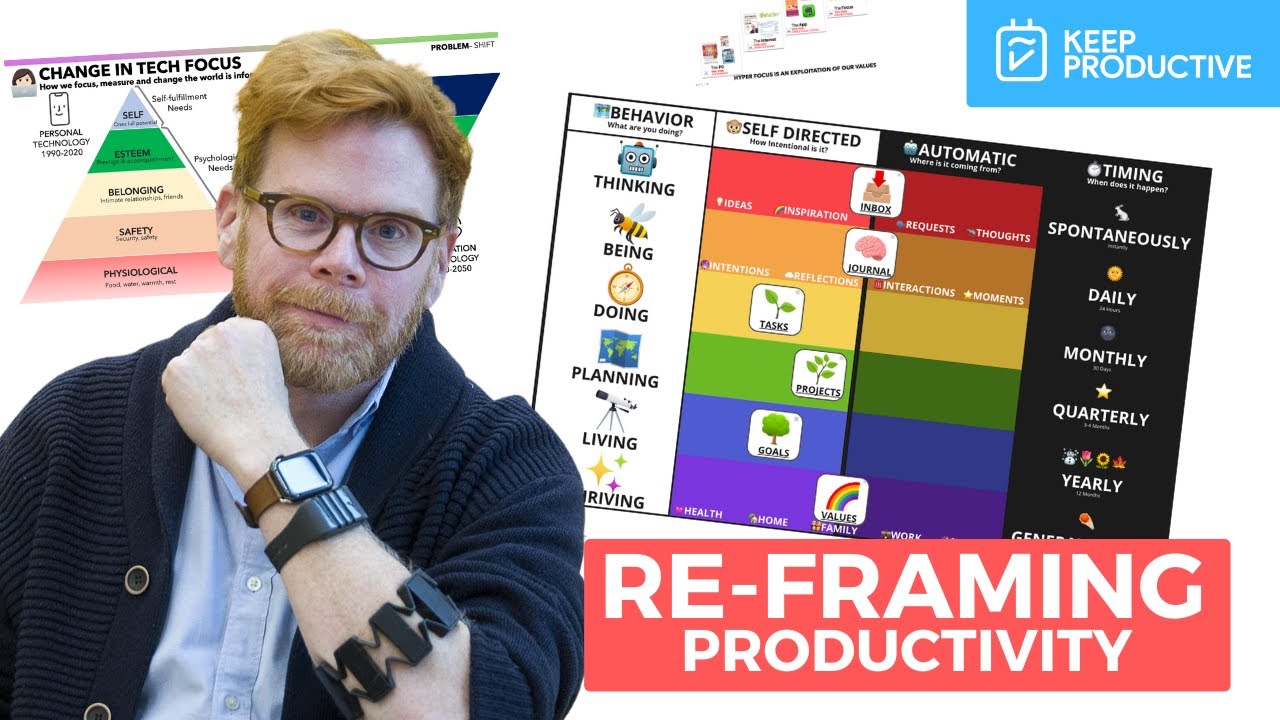
selflessness i call it of understandingthe impact of your systems and processeson our peopleand that's what we're talking abouttoday impact and effectiveness on yoursystemso where do we go from here well thefirst thing is we have to understandthat fundamentally we are seeing a shiftin the world we are moving from personaltechnology personal technology softwaresand platformsfrom 1990 to 2020 a 30-year span
where most the apps that were createdand are usedare solely for you but if you're like meand you've been watching the last fiveyears you'll realize that most appstodayare created for teams it's not becauseeveryone's becoming a businessit's because everyone's becomingconnectedtoday's applications take that samepyramidthat same maslow's hierarchy of needsand flips it on its headtoday it's about solving for the big
problems health well-being shelterand the tools people are using adesigning are matching thatif you want to get ahead of theproductivity game it's about connectingnot to you not to your processes but tothe real problems that existin your community because i canguarantee that they're not your problemstodaythey will be soon see we're moving fromsoftware based on meto software based on weand it is an exciting ride let me tell
you thisso how do you get started wellyou could re-watch the beginning of thisvideo a million times agoi don't understand what he's saying buti'll try to make it a little bit simplerfirst you can do what i did in 2017 isat down i looked at all thedependencies on my life and thoughthow do i integrate my business processeswith the fact i'm getting married andhow do i integrate the fact i'm gettingmarried with the fact that my spouse hasa differentexercise schedule than i do and my
spouse'sfamily has completely different habitsand and i started looking at thisprocess and realizingi had this little teeny part about myproductivitydiagram called life and it wasn'tconnected toany of the things i needed to do yes myprocesses were great but they wereimpacting and were going to crash intothe rest of the worldthe hyper focus had to die but a biggerproblemwhen i looked at how all of my processesdidn't integrate with my life and i
tried to map themi had to come to the realization whatabout other peoplesee this is where productivity has itsbig faultall the team billing all the teamaccess points all the team spaces reallydon't consider other people and theirneedsevery single one of us works differentlyif there's anything in the last fiveyears we've learned about theneurotypical movement and theneurodivergent movement
is we're each so different and how wethink and process problems is differentso we've got to start there so for meand what i would suggest you to do isstart with yourselfyou've got you there should be someplace you can find all the informationabout youand that's it your productivity doesn'tneed to be more than thatwhere do you find your name phone numbercredit cards address simple things likethatdo you have a business card for yourselfthat you can reference that's easilyaccessiblenext replicate that replicate it for the
people in your lifeyour spouse your children not yourcoworkersnot your mother-in-law just the peoplethat keep you goingthese are the people and the entitiesand organisms that make your lifeand i said a new word there entitiesin this there might be a business thatyou runit's okay that can be a focus alsomight even be pets but the end of the
day youyour spouse your children or pets maybeeven your business if you'reself-employedare the fundamental groundwork foreverything you doso knowing what you know about thoseparts of your lifeis the critical first stepnow the second step a little bit morecomplicated and a lot of usdon't talk like this so bear with me whyi use someuncomfortable walt disney like wordsbecausewell i'm getting to be that age although
i quit smoking i don't think walt everdidso start with why step twowhy are you doing this this is reallyabout defining your valuesand i use that word values on purposeit stands for something value somethingof worthnow some people like the term start withybut for me y sounds a little bit like apetulant two-year-old and i like theword valuei value this and where this is you writedown what that is
but when you do this you have to do itwith the people in your lifeyou have to talk to them about what theyvalue by creatingsimple words i value health i valuesafety i value familyi value work i valueservice once you have these reallysimple wordscreate some definitions and attach themto the wordsbut don't stop there you next actuallyhave to define the harder part of values
and those are the actions you will takeand the guard rails you will respectfor when those values are being violatedso uncritical you have to have a planthat has actions and guardrails nextyou take those things and you make themvisible you might usesoftware you might have a whiteboard youmight have sticky notesbut these values need to be postedsomewherefor you and your family and anyone youcome in contact
with to notice and i say thisvery deliberately your values need to bevisiblebecause we no longer live in an agewhere you can justdo what you say you're gonna do peopleforget itpeople just expect you to act likenetflix when they call you're supposedto drop everythingwhen they don't reply to an email you'resupposed to let that gobut making your values visible is superimportantbecause when they're visible when
they're clearand you know who they relate toall your decisions and processes becomepretty simplevery simple because you know the orderin which youvalue life and you know what theguardrails and actions are for thoseso it doesn't matter if you're spendingmoney on a billor creating a task it doesn't matter ifyou're sending an emailor ordering something online all ofthose things then
tie to values so let's unpack that alittle bityou know step three is really aboutselecting a toolso now you've got yourself you've gotyour values and you've got to findsomething to put this innow i'm not going to tell you what touse you can use anything you wantfor a long time outlook was my valuesystemwho i responded to when i respondedevernote was my value system what tag itgot how i found it who i shared a notewithi even tried notion i could do a whole
video on thatbut the reality is whatever tool you usethe framework of selecting who and whyneeds to be first don't try to automateyour way into a better life you'll justmake badvalues go fasterso to select a tool there are some guiderails some guardrails just like i saidwith valuesthe first thing is modality you knowtoday there are so many ways to accesstools but we have to think about how wework
i for one prefer my laptop on my desktopso the modality of a web browseris super important i'm not a big personfor my appsi'm getting old and i don't want to keepthe phone on zoom becausei feel judged second thingis apps maybe you like apps but is thereaweb app for your i'm sorry not a desktopapp for yoursystem because if there's just a mobileapp again that's not going to helpi for one not a big app person thebrowser is going to be everywhere i go
in the world i need a browserand then finally consider the modalityof automationi'm not saying create automation i'msaying consider itbecause if you select a tool thatdoesn't have any type of automationcapabilitiesyou might end up abandoning that toolall right step b access so you'veselected your modalityyou've selected your tool now thinkabout that accesstoday tools need to be configurable tothe way you workfor me when i think about that that's as
simple as going out and creatinga portal where i can access all thepieces of my life that i find mostimportantmore than my values i can accesseverything in a single placebut it needs to be flexible maybe i needa very detailed view into my tasks but anot so detailed view under my billsso whatever you decide accessand how you access your system is superimportantdo not select a system just because ithas a pretty interface
that's someone else's choice and whatyou should valueabout your system not yours this iswhere creating custom web pagesand i believe probably why notion hasbecome so popularbut again there'll be a time where wewonder why did we ever do thatnext think about how that access pointcan be mademobile so for me or a lot of peopleyou can create shortcuts on your mobiledevices to get to specific
parts so maybe you're a to do this fancould you create a shortcut that went toa specific area in todoistyour tool in step three about access issuper important because if you don'tuse the tool and make it prettyeffortlessyou won't keep up with it nextaccess for others believe it or notbecause mutuality is part of this newgame plan the tool has to haveaccess for other people that means youneed to be able to sharethe entire tool or just pieces of it
maybe it's a single record in your tasklist you need to sharemaybe it's a whole table of billswhatever that iswhether it's your spouse or your cpathembeing able to get access to it is afundamental part of your mutualitybecause if they can't see it it doesn'texist and if you're going into the toola million times a day to createdifferent routines for other peopleyou might as well get a job for them soaccess to youis fundamental so you need to create
access for others and it needs to bepart of your tooland then finally process flow when ithink about process flow i think aboutthe views that my tool would allow meam i someone who likes to work in a gridview a kanban viewam i like to someone who likes to workon a gallery view or a calendar viewam i someone who likes forms over tablesthese views to your flow are socritically important to your stickstickiness to this tool right this uh
this thisthis feeling of wanting to use the toolbecause sometimes if you're like meyou need something more design heavy butsometimes you just want somethingstraightforward and simple just get itin and get it outthat's kind of where process works idon't want you to go into like well howdoes this all work together i want youto think about how you think about itfirstand then next but not last isintegration and reportingonce you've decided who is important toyou and what you value
you then can create the other parts ofyour lifeyou want to be productive with whetherit's your inboxyour journaling other people ororganizationsyour task goals and projects how youspend your moneycollect assets that you buy maybe evenhow you manage your healthor your business all of these things siton top of the foundationof who you are who you care about andwhy you do it but most importantly
it allows you then to start to takesimple thingslike the productivity of build pay andmap it towhere that money goes not by categorybut by valuethen doing that same thing with tasksmore importantlylooking at very long trends yearsdecadesand how those shaped and changed youand your happiness as it relates to yourvaluesbecause we'll talk about toward the endof this chat
how values differ from tasks if in noother waythe time frame that they get created inlast but not least integration into timeyou've got a system you've thought aboutit you're starting to map thedependenciesyou created the access points you nowhave to somehowfunction like the rest of the world therest of the world functions on tasks andprojects and timeframes but we actually have a way ofthinking about this that
often isn't explained very well you seeeach one of us has a behaviorwhat are we doing right now you might bewatching a videoyou might be multitasking but you'redoing somethingand that behavior is tied to a time foraninstance you're doing it right nowbut how does that work you seebetween the behavior and the time thereare twoways things happen to you self-directedyou made the decision or automatic
someone else made the decision or ithappened to yousee now that we understand behaviorsintentionand timing map to each other we canstart to look atall of these other processes over timevery important so let's take the simpleprocess ofthinking my behavior is thinking i'msitting down i'm talking to a friend i'mwatching a tv showi'm thinking it's happening spontaneousit's happening i'm not planning onthinking it's just happening
now these thoughts can either beself-directedideas or inspiration or they can berequestswhere all of a sudden my thinking isjarred by someone elseor they can be requests nowthis is important because productivityusually saysyou need an inbox and i agree but howyou treat the inboxfor spontaneous things dictates what'sreally important to youi separate ideas and inspiration from
requests and thoughtsan email from someone who's interestedin working with me is a lotless important regardless of money thanmecapturing a moment of inspiration andforcing myself to writedraw or diagram something i just figuredoutyou need to be productive for you in awaythat helps yourself in the future andthat means understanding the mutualitycomponentson how you value others the second layeris actually
one most people are used to they don'teven think about thinking they're justlikestart doing and that's being sowe've done thinking now we're just beingbeing is different because it happensdailysometimes you're just going through yourday you're not thinking at all you'rejust being that's when you're doingthings like settingintentions you're reflecting in a momentthat's not a thought that's a reflectionyou're having interactions with otherpeople not requests from themand you're having moments like oh thatwas really neat
next you've done thinking you're donebeingit's happened spontaneously it'shappened every day you're doingdoing is a monthly thing when we thinkabout doing usually that's when we talkabout task managementdoing is the process of being inthinkingorchestrated in a way that helps youfeel fulfilledif you try to do tasks daily you willfailtasks are a monthly process now you cando a task every daybut your goal setting your success
around a taskusually is reflected on monthly so tryto be daily think every momentuh but do only monthlynow we wouldn't be good time keepers orproductivity if we didn't go a littlebit furtherthe next one is planning so often wethink when we're thinking we're planningwe're really not planning sits way belowthinking you've got it thinking beingdoingplanning planning is the integration of
thinking being and doingyou understand enough contextually andthis is where we usually talk aboutprojects over tasks projects areaspirationaltasks that we've put some thought intothe dependenciesin place into the future projectsusually are more than a month but nevermore than a yearso i often think of projects asquarterly or a little longerbeyond projects we havegoals now goals is a big one everyonetalks about goals
but goals lives in the behavior domainof livingliving and this is so important becausemost of uswho say we want to just feel like we'reliving what we want our goalsgoals that are managed to through ourprojects projects that are managedthrough through our habitual taskstasks that are created from ourindividual work on journaling and beingthat comes through our deep thoughtfulideas inspirations requests and thoughts
but this whole talk wasn't aboutthinking being doing planning or livingit was about thriving and thriving iswhere your values happenso while your goals are yearly or longeryour values are actually generationalif you think about it not a whole lotchanges in what your core beliefs arein five or ten years usually takes alittle bit longerso really aligning your valuesthat is the rock foundation of your
goals projectstasks journals and inbox whether they'reself-directed or automaticwhether happening now daily monthlyquarterlyyearly or generationally it's all linkedtogether it's about integratinginto time the process system you'reabout to createand aligning to your values you see wecan't save timewe can only spend it rightand you won't know if the transactionwas correctuntil you're a lifetime away from it
so i'm asking you to consider that nowlast but not least when you're designingthis system of valuesconsider others so often as i said inthe beginning of the talkproductivity is selfish and mutualityis the only thing that unlocks that sofor my familywe've got two exercises we do daily andweeklythe first one is our system as a feelingwheelwhere we actually can log how we'refeeling but we take time to map the
feelingfrom their core feelings like badhappy fearful angry all the way out tothe things that are really hard todescribethe next thing we do because why i mightbe someone who loves tasks and planningmy spouse isn't so once a week my familysits downand we actually do reflections andintentionswe have stickies and the stickies alignto the colors of our valuesthose being health home family
work financial and service then we goback and our first part of the exerciseand we'll reflecton the week in a colored sticky thetimes when wesaw ourselves or someone in our familymeet and exceed those values it's kindof like ayou did a good job but it's importantbecause we then share those with eachother after we write them downand we support each other and we learnto speak with intentionabout these values but speaking of
intention we don't stop with lookingbackwe actually do next what i call feelforwardfeel forward is the idea of taking yourvaluesand imagining the week coming up andwhat you would like to experienceit's not about finishing a project orgetting a specific task doneit's about a feeling you have so maybeyou want to feel at peaceyou might have a task or a habit ofmeditation but what you want is thefeeling
so we actually align to our values andwe write them down on the coloredstickiesand we put them on our boardthis simple act will fundamentallyrewire yourselfyour family maybe even your co-workersif you're close enough to themto start talking about the things youvaluesee you don't need a corporate missionvision and valuesyou need conversations you needconversations where you're allowed tohaveall your feelings the ones that are
uncomfortable to be aroundand the ones that are a joy to be withbecause we're not peoplewith settings that can be toggled on andoffwe are thinking feeling organismswho are mutually dependent on each otherand desperately need to talk aboutall of our lives the good the bad themiddlewith that you can start todaykeep productive is an amazing channel iwatch it
religiously i'm one of those people whoactually have notificationsturned on francesco is a remarkablepersonwho's literally having a baby gettingmarried and doing all those things rightin front of uswe get to see his values every singleday but for youi want you to go back and think aboutwhat your place on that productivitymaturity chart is now you can be in allthedomains one through five at once butfind itunderstand the pitfalls and the
drawbacksbut more importantly decide where youwant to benext thing you can do if you want to getstarted is i wrote a book a couple yearsagoif you're interested in that reach outto me i'll send you oneno cost i would love you guys to startto think about the importance of beingconnectedbecause unlike a lot of books andinfluencersi don't think you should unplug i thinkyou should plug in moreyou should find the love and connection
and supportthat's inside every single one of youbecauseit's not a phone it's a way to beloving and this isn't productivityit's a way of caring and showing ourvalues third to last thing you can docheck out my latest app it's called ourbalanceit's in the app store and the androidplay storethe whole function of this applicationis to help you start to think aboutmutualityyou can see your balance between work
and home but more importantlyyou can see the balance of the placesyou go and the people who go thereyou can set up a group for you and maybeyour spouseyou can set up a group for yourneighborhood but you can see howeveryone's doingin real time anonymously whether they'regoing to workstaying home seeing friendsor sleeping there's the four domainsand the last thing you can do today iswork with meif you this kind of thing made youinterested and you want help
give me a shout i can tell you you canask a lot of people in the communityi speak to people every single day ilove chatting with them but more thananything i valueservice i value helping other people ivalue letting other people beas full or as empty as they need to bebecause that's what i need and that'swhat we all needjust remember the best appsare people thank you so much
and have a great rest of your day[Music]you, Re-Framing Productivity with Chris Dancy, YouTube, 01ka7wrnssxx92ep508kxkq9xf.