Read Widely, Apply Selectively, Share Regardless

## Metadata
- Author: [[James Stanier]]
- Full Title: Read Widely, Apply Selectively, Share Regardless
- Category: #articles
- Document Note: ---
tags:
- #engineering-management
- #knowledge-sharing
- #career-development
Author: James Stanier
Source: Article
Reference: https://www.theengineeringmanager.com/book/read-widely-apply-selectively-share-regardless/
date created: 2025-08-22 00:00
---
# Title: Read widely, apply selectively, share regardless
## Table of Contents:
- [📚 Context and Thesis](#-context-and-thesis)
- [🚀 The Great Acceleration](#-the-great-acceleration)
- [🧱 Raising the Floor in Tech Writing](#-raising-the-floor-in-tech-writing)
- [👐 Share What You’ve Learned](#-share-what-youve-learned)
- [🌪️ The Oppressive Weight of Prior Art](#️-the-oppressive-weight-of-prior-art)
- [🧭 Practical Starting Points](#-practical-starting-points)
- [📈 Evidence of Progress](#-evidence-of-progress)
- [🧩 New Book Announcement](#-new-book-announcement)
- [📝 Summary](#-summary)
- [📖 Main Content](#-main-content)
- [🗒️ Notes](#️-notes)
- [📖 References](#-references)
- [🗣️ Paraphrase](#️-paraphrase)
- [📰 Newsletter](#-newsletter)
- [✅ Action Items (Advocacy/OSPO Alignment)](#-action-items-advocacyospo-alignment)
- [🧪 Hypotheses](#-hypotheses)
- [📊 Methodology](#-methodology)
- [❓ Questions](#-questions)
- [🔮 Future Research](#-future-research)
- [💡 Implications](#-implications)
- [🧠 Learning Styles Assessment](#-learning-styles-assessment)
- [📊 Accessibility Assessment](#-accessibility-assessment)
- [🌍 DEIB Assessment](#-deib-assessment)
- [✅ Logical Validity](#-logical-validity)
- [🛡️ DARVO Analysis](#️-darvo-analysis)
- [🔍 SEO Evaluation](#-seo-evaluation)
- [🎯 Conclusion](#-conclusion)
### References:
- Michael Lopp, Camille Fournier, Will Larson, Sarah Drasner, Tanya Reilly
- Tim Urban’s “What’s Our Problem?”
- progression.fyi
- LeadDev “Staff Plus” track
- Pragmatic Programmers (publisher)
## 📝 Summary:
James Stanier argues that personal and collective progress in engineering and leadership thrives when people read broadly, apply ideas judiciously, and share their experiences openly—even if those experiences aren’t novel or universally successful. He illustrates the rapid acceleration of human knowledge, shows how engineering leadership literature has “raised the floor,” and encourages readers to publish their learnings despite intimidation from existing “prior art.” He closes by announcing a forthcoming book focused on senior engineering leadership (managing managers, strategy, execution, and operating at director/VP levels).
## 📖 Main Content:
- Context and Thesis
- The author initially worried about overlap with Will Larson’s work, then realized the goal isn’t to be first but to contribute diverse perspectives that collectively raise the industry’s baseline.
- The Great Acceleration
- From stone tools to the internet, progress compounds via shared knowledge. Tim Urban’s metaphor of a 1,000-page history emphasizes how quickly capabilities have expanded due to mass communication.
- Raising the Floor in Tech Writing
- A cascade of influential works (Lopp, Fournier, Larson, Drasner, Reilly) and initiatives (LeadDev Staff Plus) demonstrates how shared experiences formalize intuition and expand accessible tools for practitioners.
- Share What You’ve Learned
- Sharing implementation narratives (what worked, what didn’t) is as valuable as invention. This builds collective intuition and gives others starting points and guardrails.
- The Oppressive Weight of Prior Art
- Social feeds can discourage contribution. The author reframes: your perspective is unique, and there’s likely an audience it will help, especially when it lowers complexity or broadens inclusion.
- Practical Starting Points
- Start with your lived experiments: changes to planning, staying hands-on as a leader, remote work outcomes. Publish posts, code, slides—clarify your thinking and help others.
- Evidence of Progress
- The growth of public career ladders (progression.fyi: ~25 to ~75) and the surge in relevant books show rising transparency and standardization in engineering leadership.
- New Book Announcement
- The next book will demystify senior leadership (director/VP): time management, managing managers and staff engineers, peer/stakeholder alignment, strategy, budgets, planning cycles, peacetime/wartime postures, and non-linear career paths. The author plans to serialize drafts as articles.
### 🗒️ Notes
- Fear of duplication
- Early anxiety about similar books is reframed as evidence of a healthy ecosystem.
- Multiple viewpoints provide varied tools for varied contexts.
- Read widely
- Avoid dogmatism; treat ideas as hypotheses to test locally.
- Overwhelm is a risk—use selective application.
- Apply selectively
- Experiment, keep what works, discard what doesn’t; build personal and collective intuition.
- Share regardless
- Implementation write-ups (even failures) are valuable.
- Your voice reaches audiences existing authors may not.
- Acceleration of knowledge
- Communication tech accelerates knowledge diffusion; LLMs are a contemporary example.
- Community infrastructure
- Growth in published career tracks and Staff Plus recognition signals maturity.
- Practical prompts to share
- Planning approaches, hands-on leadership, remote work experiments—publish artifacts and reflections.
- Author’s roadmap
- Forthcoming senior leadership book to clarify director/VP competencies and operations.
## 📖 References:
- Tim Urban’s “What’s Our Problem?” and thread on the acceleration of history.
- LeadDev Staff Plus track (context for IC leadership).
- progression.fyi (public engineering career frameworks).
- Books: The Manager’s Path (Fournier), An Elegant Puzzle (Larson), Staff Engineer (Larson), The Staff Engineer’s Path (Reilly), work by Michael Lopp and Sarah Drasner.
## 🗣️ Paraphrase:
- Original idea: Don’t be discouraged by existing literature; diversity of perspectives raises the industry’s baseline.
- Paraphrase: Instead of aiming to be the only voice on a subject, see your contribution as one more piece in a broader mosaic that makes the path clearer for everyone who follows.
- Original idea: Share your implementation stories—even if not novel—because others will benefit from practical lessons learned.
- Paraphrase: Even when you’re applying known techniques, documenting the outcomes—successes and failures—creates practical guidance that others can adapt to their own situations.
## 📰 Newsletter:
This week’s spotlight: learning web development through the power of shared experience. The engineering leadership world shows how progress accelerates when we read broadly, test ideas locally, and publish our results. Whether you’re shipping your first Gutenberg block or optimizing your headless WordPress stack, treat every experiment as a teachable moment—your notes could be the missing guide for someone else.
Recent updates:
- WordPress 6.x improvements continue to refine site editing and performance—great time to revisit your theme’s Core Web Vitals.
- The community is buzzing about sustainable funding models for open source; if you maintain a plugin, consider adding a transparent sponsorship page.
Community highlights:
- Contributor onboarding sprints are opening doors for first-time committers—bring a friend to your next local meetup.
- Shoutout to maintainers publishing their decision logs and postmortems; these are gold for learners and future maintainers.
New plugins and tools:
- Explore developer-focused telemetry opt-ins that respect privacy while informing product direction.
- Keep an eye on CI/CD helpers tailored for WordPress, streamlining plugin release pipelines.
Takeaway: Read widely, apply selectively, share regardless. Your write-up might unlock a solution across the globe. If you’ve tried a new planning cadence, refactored a block, or piloted a contributor mentorship—publish it. We’ll feature the best in next week’s issue.
## ✅ Action Items (Advocacy/OSPO Alignment):
Prompt to align future articles with your goals:
- Purpose: Describe how this article contributes to open-source advocacy within WordPress and the broader ecosystem (e.g., transparency through publishing career ladders, sharing implementation notes, documenting contributor journeys).
-
- Summary: In this article, the author discusses the importance of reading widely, applying selectively, and sharing knowledge regardless of competition or the presence of existing works on a subject. The author emphasizes the value of diverse perspectives and experiences in driving progress in any field, including engineering management. They highlight the abundance of resources available, such as books, blog articles, and social media posts, and encourage individuals to not be overwhelmed but rather to contribute their unique insights and experiences. The author also announces their upcoming book, which will focus on senior engineering leadership and provide practical guidance for managing large organizations. They express their excitement about sharing their thoughts and plan to serialize some content as separate articles throughout the writing process.
- URL: https://www.theengineeringmanager.com/book/read-widely-apply-selectively-share-regardless/
*Pssst*. I’m writing a new book. There’s more information at the end of this article.
### Snap!
When I was several months into writing [Become an Effective Software Engineering Manager](https://pragprog.com/titles/jsengman/become-an-effective-software-engineering-manager/), I remember getting freaked out that Will Larson’s [An Elegant Puzzle](https://lethain.com/elegant-puzzle/) had just been published. This was the first time that I’d written a book, and I couldn’t help the feeling that I was beaten to the punch.
However, after submitting the final draft in early 2020, I realised that writing isn’t about beating the competition, or being the *only* piece of work out there on a subject. Instead, an indicator of real progress within our industry — or in any aspect of human knowledge — stems from a diverse collective of people sharing their experiences of what they’ve learned, which then hopefully makes it easier for others to walk the same path in the future.
For modern takes on the discipline of engineering management, early writing by [Michael Lopp](https://www.oreilly.com/library/view/managing-humans-biting/9781430243144/) paved the way. Then Camille Fournier came along with [The Manager’s Path](https://www.oreilly.com/library/view/the-managers-path/9781491973882/); then it was [Will](https://lethain.com/elegant-puzzle/), [me](https://pragprog.com/titles/jsengman/become-an-effective-software-engineering-manager/), and more recently we’ve seen a new contribution from [Sarah Drasner](https://www.engmanagement.dev/). I’m sure there are others that I haven’t read too. I welcome many more. Each book offers a unique set of tools from authors with unique perspectives.
And that’s just the books!
The internet is stuffed full of blog articles, recordings of conference talks and posts on social networks. There’s so much to read and learn. Sometimes the wealth of content can be overwhelming and confusing to those that want to dive in and contribute.
Where do you start? In the worst case you can:
* **Get overwhelmed by the amount of material and not read anything at all.** This is bad, because you’re missing out on ideas that can help you improve.
* **Interpret ideas too dogmatically, thinking they are gospel.** This is also bad, since there is rarely a right answer to complex people or technology problems: there are just hypotheses and experiments and your mileage may vary.
* **Feel that you have nothing to contribute back to the pool of knowledge.** This is probably the *worst*, because everyone has something to share, even if they tried something and it didn’t work. It means the world misses out on valuable insights.
So don’t be discouraged. *Read widely, apply selectively, and share regardless.* There is always value in this approach. It’s how we collectively make progress.
This isn’t something new. Humans have been doing it for quite a while now.
### The great acceleration
I recently started re-reading [Sapiens](https://www.ynharari.com/book/sapiens-2/), and the book opens with a reminder of the rapid acceleration of human capabilities over time. Here’s an excerpt which I’ve edited down for brevity and also added a little extra at the end.
The numbers represent the years before the present day.
* **2.5 million** — First usage of stone tools.
* **300,000** — First usage of fire.
* **70,000** — The Cognitive Revolution. Emergence of fictive language.
* **12,000** — The Agricultural Revolution. Domestication of plants and animals. Permanent settlements.
* **2,500** — Invention of coinage, universal money.
* **500** — The Scientific Revolution.
* **200** — The Industrial Revolution.
* **The present** — The internet, smartphones, nuclear weapons, intelligent design rather than natural selection, and a number of decent books about managing engineers.
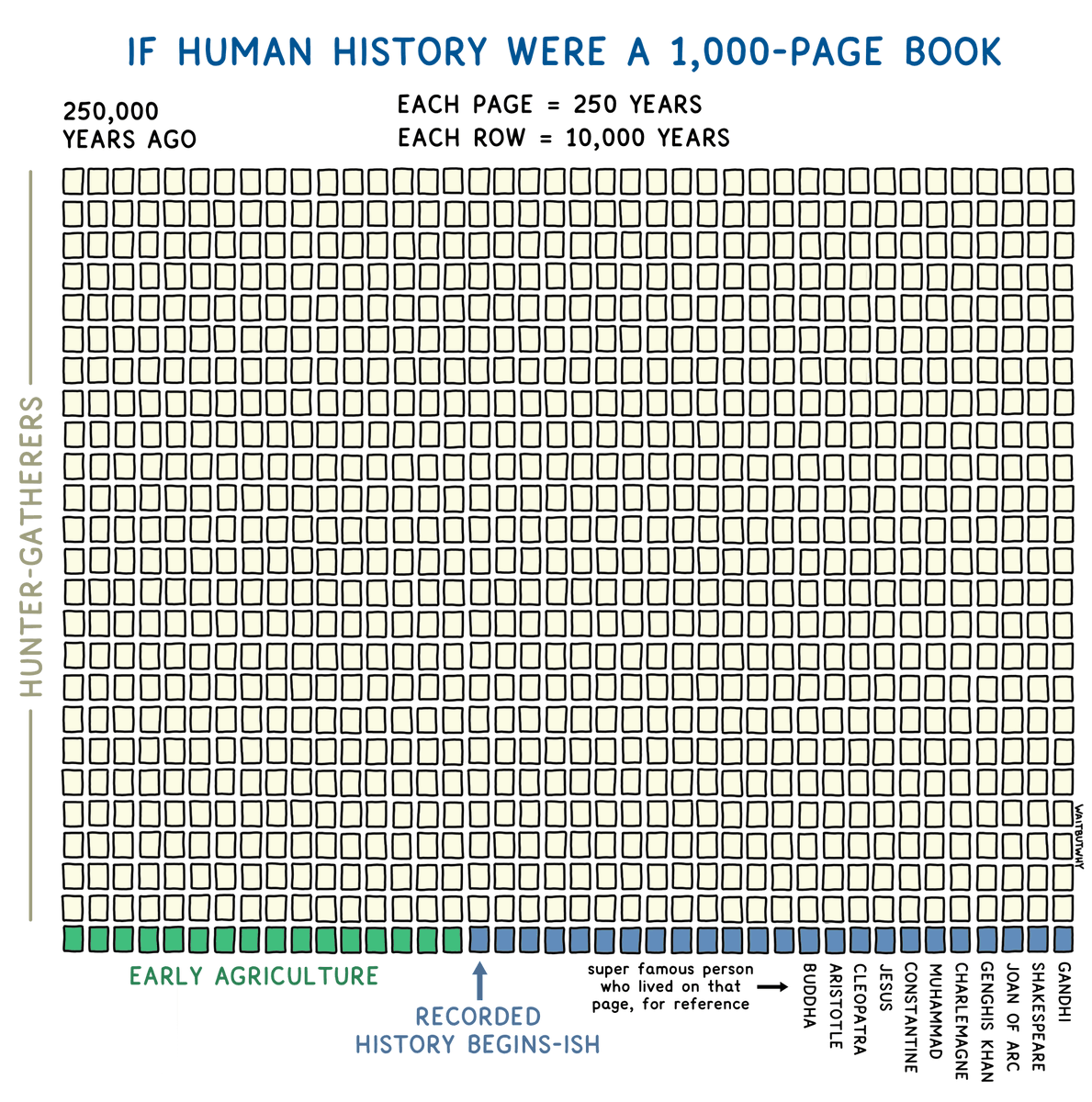
Tim Urban put together a visualisation of the oh-my-god-we-are-progressing-really-fast effect that you can see in the tweet below. It’s part of his excellent book, [What’s Our Problem?](https://www.goodreads.com/en/book/show/102146148)

[Tim Urban](https://twitter.com/waitbutwhy)
[@waitbutwhy](https://twitter.com/waitbutwhy)
Imagine human history were written in a big 1,000-page book. Every page would cover 250 years. If we tore out all the pages, it would look like this.
The very earliest permanent settlements started around page 760 and recorded history doesn't start until around page 775.
1/5
[Posted Mar 15, 2023 at 8:04PM](https://twitter.com/waitbutwhy/status/1636095952887881732)
> Imagine human history were written in a big 1,000-page book. Every page would cover 250 years. If we tore out all the pages, it would look like this.
>
> The very earliest permanent settlements started around page 760 and recorded history doesn't start until around page 775.
>
> 1/5 [pic.twitter.com/Jr9o1FE7lG](https://t.co/Jr9o1FE7lG)
>
>
Once you have the capability of abundant mass communication to acquire and disseminate information, the floor rises *really* quickly by people iteratively building on top of what is already out there. Just look at the recent progress in large language models.
#### The great technology writers’ acceleration
We’ve seen this raising of the floor play out in our little writers’ sphere. Building on top of the wave of engineering management writing, there has been an uptick in high quality material about navigating the higher rungs of the individual contributor career track.
Will wrote the [Staff Engineer](https://staffeng.com/) book and blog and more recently Tanya Reilly wrote [The Staff Engineer’s Path](https://www.oreilly.com/library/view/the-staff-engineers/9781098118723/). We’ve also seen the [Staff Plus track](https://leaddev.com/staffplus-london) created and hosted alongside the management tracks at [Lead Dev](https://leaddev.com/node/11). I’m sure there will be many more books here soon. Once we start to share our ideas, it helps build a platform for others to do the same. This is good for everyone.
Experimentation is also good, where you gather ideas from different places and try them out for yourself. You then discard the ones that don’t work for you, and keep the ones that do. I wrote about this [process of building your intuition as a leader](https://www.theengineeringmanager.com/qa/no-number-one-tip/) where you discover and hone your set of tools, apply them to your learned experiences, and then iteratively discover and hone some more. This continually makes you a better engineer, manager, or leader.
Since that model was about building your *own* intuition, I missed something that’s important for building *collective* intuition, and that’s sharing what you’ve learned with other people. Even if you haven’t invented something novel yourself, you can write and record your experiences in implementation to teach others about what’s worked for you and what hasn’t. This is *just* as useful as coming up with some brand new technique.
It’s likely that someone else will stumble across what you’ve produced while working through a similar quandary and they will find some value in it. Even if they decide not to go down that path, they’ll have expanded their knowledge and gained some valuable real world insight.
We owe it to each other to share our experiences of applying what we’ve learned, so don’t be put off on getting it out there.
### The oppressive weight of prior art
This is especially true when you think that nobody will listen.
When you open up your favourite social network and are bombarded by countless hot takes, it can make you feel like you don’t want to contribute. You may say: after all, why does *my* opinion matter when there are already plenty of opinions from others that have more followers, readers or subscribers? Well, your opinion matters because of exactly that: it’s *your* opinion. That’s what makes it unique, and that is why it needs to be heard.
After all, there is no definitive way to do anything. There are almost limitless possibilities, approaches, and situations that you have faced that others haven’t yet. There may be an entire market out there for your ideas that you don’t yet know exists: a readership that is looking for a new and fresh take that is unlike the status quo. Perhaps you are an incredible teacher, but you don’t know it. Maybe you have a unique ability to convey complex ideas in a simple way that brings people who feel excluded into the conversation.
And if you don’t know where to start, share your experiences of what you *already* know. Think about it. Did you switch from strict quarterly planning to an approach with no plans and no estimates? How did that go? Did you stay technical and hands-on as a leader? What worked and didn’t work for you? Tell us. Is remote work working out for you and your team? Share your results: we would love to hear them.
Do it.
Write that blog post, share that code, or put those talk slides up where other people can search for them. Put your opinion out there in order to better work through what you’re learning in your own brain. You never know; you might just end up on the front page of Hacker News.
Never feel discouraged because you’re not a well known personality or highly trafficked author. When I started my blog all of those years ago I felt that success meant a small handful of people reading what I’d written and finding it useful, with those people most likely being my colleagues.
I certainly didn’t expect that I’d have to keep upgrading my [Plausible](https://plausible.io/) subscription over the years, nor that I’d end up writing any books. That’s the beauty of the internet: without knowing, you may have helped unlock someone’s thinking on a problem on the other side of the world.
Sharing our unique experiences is why our leadership capabilities have never been better. When I submitted the career tracks from my previous company to [progression.fyi](https://progression.fyi/) in 2020, there were about 25 tracks on there in total. Now there’s 75. Ten years ago, you’d struggle to find one relevant book on engineering management, leadership as an individual contributor or on remote work. Now you can fill a bookshelf.
The floor keeps on rising because more people are trying things out, seeing whether it works for them, and then sharing their experiences with the rest of the world.
*Read widely, apply selectively, and share regardless.* I encourage you to do the same.
### My new book: a blueprint for senior leadership
With that in mind, I guess it’s time to put my money where my mouth is. It’s time for a new book.
Back in 2020, I wrote a few articles on managing managers before getting swept up in writing [Effective Remote Work](https://pragprog.com/titles/jsrw/effective-remote-work/) in 2021; a priority switch that happened because of the pandemic. However, now I feel like it’s time to give Become an Effective Software Engineering Manager its spiritual sequel.
I’ve been in the game of running large engineering organisations for a little while now, and I think that this set of skills is the next big unlock that we need in our collective knowledge. Senior engineering leadership is somewhat nebulous: just what exactly do Directors and VPs do all day? How do you get there? How can you be successful? How do you even know you’re doing a good job?
Whereas my first book focussed on the *first* giant leap of management, which is becoming a manager and leading a team for the first time, this book will focus on the *second* giant leap, which is becoming a manager of managers and running a large organisation. Last week I signed my third contract with [Pragmatic Programmers](https://pragprog.com/), so we’re already getting underway.
I’m aiming to focus on lifting the lid on this role in such a way that makes it practical, understandable and reachable for those that want to grow their career in that direction. It’ll focus deeper on defining the management career track in the upper echelons, and the patterns, techniques and models of gaining entry and succeeding there.
It will look at how to manage your time, your staff (which includes managers and senior right-hand engineers), your peers, and your manager, which are all unique challenges at higher levels of seniority — especially if you report to a founder or high ranking executive. We’ll also dive deep into strategy, communication, budgets, resourcing, natural planning and execution cycles, peacetime and wartime, and the non-linear path to getting to where you want to be and becoming world class at what you do.
I’m really looking forward to getting all of my thoughts down on paper.
I also want to do a better job of serialising some of the content as separate articles as I go along. For Effective Remote Work, I pretty much entered a black hole of silence for a year, so I’d like to approach that differently this time around. Expect snippets of the book to appear here as I progress.
So stay tuned — there’s a whole lot of writing to do. Until next time., Read Widely, Apply Selectively, Share Regardless, James Stanier, 01h86tmq2f5pk7tanznk59nvwe.