Russ Rutledge – Welcome Address #InnerSourceSummit2025
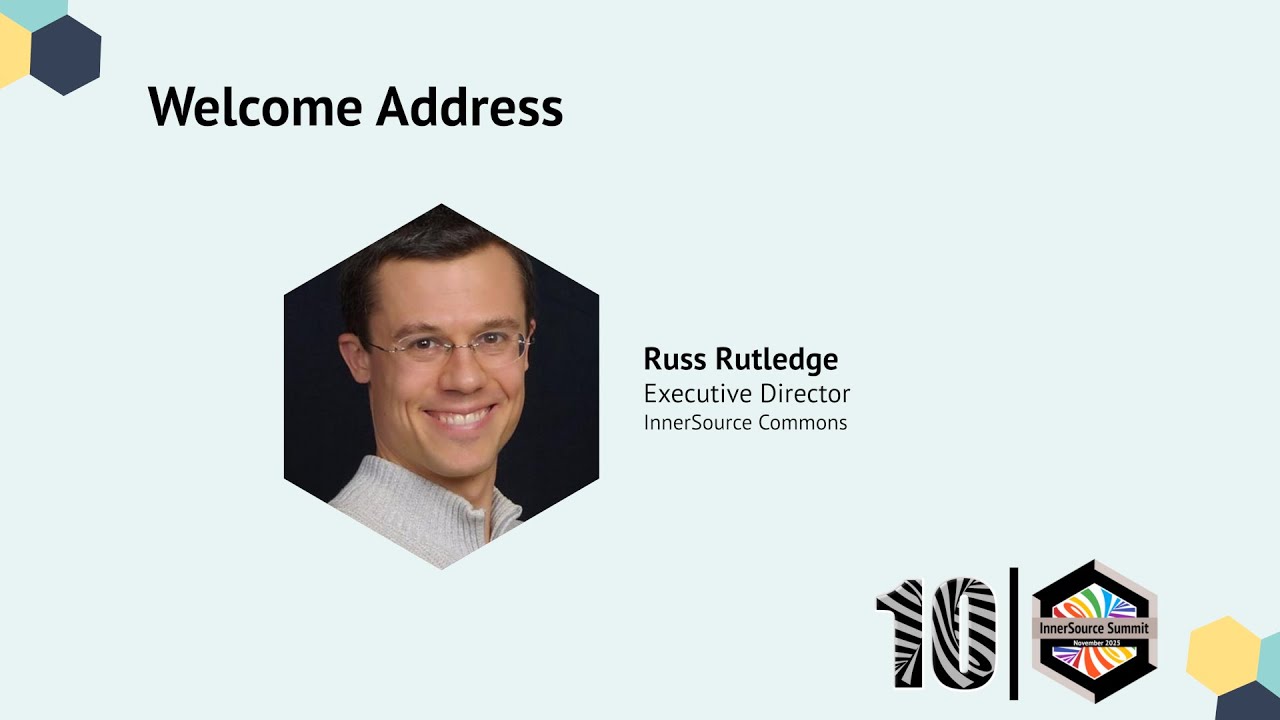
We'll get started uh here in the room in New York. And uh also uh welcome to any people online who are just joining uh or more likely who have stayed over and are continuing to watch the the broadcast. I think we've got a little over a hundred people online also joining in for this leg of Inner Source Summit. Well, my name is Russ Rutled. I'm the executive director of the Inner Source Commons uh
that is co-sponsoring uh this event. It's my pleasure to give the welcome to our uh New York leg of Inner Source Summit 2025. Uh so this event today is a special one. Well, I think an inner source day is always special. Uh we have a a saying uh in the inner source comments, happy innersource day. uh any day that we're doing inner source is a day of happiness for ourselves and a chance to give happiness to others and uh this event is
especially happy because we're celebrating the 10-year anniversary of the Interceource Commons Foundation as an organization. So 10 years ago the organization started and it's been a long and storied journey to this point where there's a global community and we're celebrating today with 24 hours of inner source uh summit. We're here on the last leg of it here in New York. So uh for the event today uh we want to start by thanking our event sponsors. Uh
we're all sitting here in this wonder wonderful facility here at IBM. I want to thank IBM for hosting uh also our other location sponsors. This event started uh about 16 hours ago in Japan, hosted in Yokohama at Mitsubishi Electric and then we just received the handoff from SC SAP hosted in Berlin. So thanks to our uh host sponsors. Uh in addition uh we have other SP others that
have helped with uh Inner Source Summit. uh thanks to GitH uh Git Lab, Red Hat and then uh Bera solutions which are also some Summit sponsors. Um in addition to sponsors for this particular event, we're thankful for our general sponsors of the Inner Source Commons whose support also goes into putting on events like these. Um the support of these organizations are what allows this community to thrive and for
us to be meeting here together today. Thank you for our partners, sponsors, our supporting sponsors. Uh I'll call out here since we're at the uh IBM headquarters, IBM is also a general sponsor of the Inner Source Commons for which we're very thankful and really helps the work of Inner Source throughout the world. So for those who are uh just joining whether online or in person, we want you to post and share about what you're learning here, about what you're excited
about. put it on your favorite social media platform. Uh we're watching encouraging the use of the Inner Source Summit 2025 tag. Uh also uh for in person and uh online, we want to invite you to join the Inner Source Commons Slack. I know that many of you are on the Slack already. Some of you, it's probably how you found out about the event, but if you're not there, you can find the link very easily on the Inner Source Commons website. uh or you can
take out your mobile device and scan this QR code. That'll put you in the Slack. For the event today, if you have questions for the speakers, we're going to be using the Slack as our location for Q&A. So, just right there in the general channel of Slack, you can post your questions. And if you're online, there'll be people watching for those and making sure that your question gets asked of the in-person speaker. All right. Well, today we got a
fantastic program lined up with inner sorcerers uh from uh around the world and around the Americas here in our New York lake. Uh the way things are going to go today is for those watching online, there's a continuous schedule of inner source content. Uh this schedule is also available on the event page on the website where you can follow it there. Now, uh, for those of us who are
here in person, there will be a chance to take a few breaks, uh, morning break, afternoon break, a lunch break. So, we will not be going as part of the 24 hours uh, here in person, but we'll have some breaks. And while the in-person crowd is on break time, uh, there'll be online virtual speakers that continue to share about innersource so that the online stream has a continuous feed of speakers. Okay. All right. Uh I'm just get started with
a little bit of background for anyone who's new to inner source, new to the inner source commons community with a little bit of history and level setting as we get started learning more about inner source. Uh first of all, what is inner source? Innersource is adopting the practices of open source software internally within an organization for code that will only ever be shared internally running it as if it were an
open source project uh within the company. That means it's visible to everyone at the organization. Everyone is invited to use it and everyone is invited to contribute to it to open a poll request or open an issue just like you would see with an open source project except for a company internal project. Uh inner source follows and adapts many of the principles of open source uh openness, transparency uh prioritizing mentorship and encouraging
voluntary code contribution. These principles are outlined on the inner source commons website. Uh there's a series of learning path videos that give more information example on the importance of these principles in making inner source work and give training ideas of how to implement them at your organization. So definitely check that out. Um so why inner source? I find this is so connected with um with what is inner source is what do we hope to gain
by it? Uh as we speak with and listen to uh organizations throughout the world these four categories of why inner source come out. Uh so you might identify uh with some of these and not with others and that's okay. Many organizations maybe have just one of these that's a motivation for inner source. Sometimes the way that we pursue or think about inner source in our organizations is different based on the results that we want to see. So I want to share these so that as you listen to
speakers and have conversations uh you can identify what is your why for inner source and uh look through it in that lens as you learn about inner source today. Uh so briefly uh inner source is a path at a personal or professional level uh or at an individual or organization level to open source mastery. Inner source gives a safe internal chance for individuals and companies to practice and learn the skills uh that will then aid them in
successful involvement with open source without having to learn in in public and have those learnings be something that are visible outside the organization. Um, next one. Inner sources. A path to engineering efficiency. It breaks down engineering silos. Avoids duplicated work. Allows teams to build on the successes of others to stop reinventing the wheel and move forward with work on the team that is specific to their product domain instead of uh doing work
that's already been discovered elsewhere inside the organization. Inner source is a path and a catalyst for innovation. Um there's a neat um innersource enablement project that I heard about uh that called itself project Fleming and as a a story about the way this works. The reason why it had this uh this name is Alexander Fleming who invented penicellin was a researcher working in a lab and uh in
the samples of uh that he was working with there was some crosscontamination from an adjacent lab that was completely by accident and as he saw the results of this contamination had in his experience it put him on the path where eventually discovered penicellin which is just a uh you know an amazing thing in the medical field today and it happened completely as a as a happy accident of people working close to each other and sharing the things they're working on. Uh in this case inadvertently uh inner source is the same way as we bring together
people from different parts of the organization. The thing that gets produced is better than anything that could have done by any single team. Uh even a central team mandated to solve a problem once for the company can never have all the insights that could come by inviting consumers from around the organization. Um and lastly, uh people development happiness. Uh inner source is an incredibly enabling methodology to adopt internally. Uh it enables anyone when
needing something from a project to get what they want by their own effort only by opening a poll request. We're taking away roadblocks and silos that are frustrating to our engineering and development teams that have to spend time on the non-engineering non-productive task of negotiating across projects uh and uh vying for features to get in. Uh with inner source you can just open a pull request and and move on with writing more code. Okay. So that's a little bit about inner source.
So the inner source commons foundation is a separate entity that is stewarding the practice of inner source in the industry throughout the world. Uh as we look at our online Slack community there's over 4,000 participants in the inner source commons representing at least a thousand organizations. uh over the past 10 years there've been over 30 in-person events and beyond talk many of the best practices of innersource are documented and probably
is in what is the foundation's most durable long-lasting asset which is the inner source patterns book you can find that linked on the inner source commons website uh we continually receive feedback that it's a very uh valuable tool for capturing patterns of how to do inner source at your organization so the innersource commons is a nonprofit organization uh uh founded uh 10 years ago as we say and incorporated uh 5 years ago as a public charity in the
United States. The stated mission of the charity is education education around inner source in the technical technical industry. So it's been a long a long journey for the innersource commons. Oh, here's our our mission. Uh, educating and supporting innersource throughout the industry and throughout the world, especially stewarding the worldwide body of inner source knowledge. We do that through assets like the patterns or conferences like we're here in today.
All right, there's some logos of organizations um the the dozens I think we're over a hundred now organizations that have publicly shared their practice of innersource online. You can find links to case studies for all these organizations on our website and uh and people the inner commons is extremely uh welcoming community with uh and it's a place where people really want to be. Uh it's a a unique community among tech communities uh where
interpersonal interaction is such a key part of pe people feeling welcomed in addition to the practice of inner source. So you see here uh some of the happy gatherings that folks have had and since we're here in New York I gathered here some pictures. Uh there's a wonderful tradition in the inner source commons whenever two inner sourcers are together at a conference whether an inner source summit or some other event uh they're always friends and always taking pictures. So these are some that have been shared in our Slack before. Uh I want to call out as Innersource grows
throughout the world you can see in the bottom right it's a picture of an innersource gathering in Brazil. So, Innersource in the Americas is more than just uh US and Canada. We're seeing that regional interource group in South America come which is really exciting. Um the leadership of the Inner Source Commons board of directors uh myself as a director um Addie who's here I don't see her in the room uh is also on the board of directors. Katie who's here in the room as a former member of the
board. Uh these are all volunteers, people who believe in inner source and want to put time into seeing the practice spread throughout the world. Uh so last uh 10 years uh inner source uh kind of has a start about 25 years ago when the term was coined. I'm not going to go through and read everything here but just touch on a few highlights and it's grown from that beginning uh here in the United States all the way until now where it's a worldwide movement. So just some of the highlights uh inner source started uh in the in the US uh
with Tim O'Reilly actually coined the term way back in 2000 uh 25 years ago uh bringing open source practices techniques uh development techniques within the corporation and Tim was advocating for this uh this was like kind of the formal start to the name innersource uh at the time the battle in the industry was really around open source at this time will open source come out on top open source hadn't won yet. So there wasn't a wide adoption and recognition of inner source at the time.
But after uh over the next 10 years after it was clear open source was the winner uh things turned to innersource and and bringing that together. So Denise Cooper who was involved in the handoff from Berlin that you just saw uh started and founded the innersource comments 10 years ago in 2015. That's the 10 years that we're we're celebrating. This was generously supported by her employer at the time uh which was uh PayPal which sponsored some of the first inner source events uh
which led to the foundation being incorporated as a public charity five years ago. Um so since that time in 2015 uh there's been over a dozen in-person events uh regional gatherings associated with conferences mostly in the United States but also also appearing uh in Europe uh in Asia as well. Um inner source patterns book we talked about that one uh continually is the asset of the inner source commons that people call out as one of the most helpful
things for starting inner source at your organization. And then besides these large um global summits uh the program of local gatherings has popped up where there's uh regional events a little bit like a Kubernetes community day or a DevOps days where particular hosts in a city will sponsor a smaller inner source gathering. We've seen a growth of these with a dozen in the past uh 12 to 15 months in 2024 and 2025 uh including
several in in Tokyo, one in China. So it's exciting to see inner source expanding in Asia. Uh and with the interest we're really excited last year, actually two years ago when inner source first popped up on the Gartner hype cycle for software engineering uh moving up uh moving up the peak showing up in 2023 uh extending further on 2024 and uh now in their reports in 2025 it's moving forward. Um, and our our task now is to
uh get up that uh to the plateau of of productivity there on the right. It's exciting to see major outlets like Gartner acknowledging Interceource and its place in the in the industry. All right, here for the New York audience, I wanted to call out some more local exciting things we see around Innersource. Uh, Innersource showed up in the United Nations uh this past year. Uh I think in the picture I see uh Addie who's also in the back here today as
part of the UN panel on inner source uh right here in New York. Uh in the middle uh there's Daniel the chair of the inner source commons uh who was also there at that UN panel. So exciting to see the concept uh recognized in other international organizations uh like the UN. Uh we almost had a a UN representative or UN person at the UN here today ended up not being able to make it but interest there in inner source. Uh also did you know that inner source is required uh by the US
government the share it act requires US agencies to share custom source code with each other. Now they don't use the term inner source uh but I'm co-opting and saying uh the US government has mandated inner source because when you look at some of the text there it's mandated that agencies share with one another. Uh what are their goals? Uh we're going to prevent uh duplicative software development. Um and it's even the the act they always do these cute
acronyms for the bills to get passed. This is the share it act and they came up with a letter uh for each of them. But in my mind, it's kind of the inner source act as well. But look at the impact that they're expecting. You have 15 billion dollars of software development that they believe could be impacted through inner source practices. So inner source uh is alive. It's growing growing in the industry. As we look forward uh now toward the future and what it means for innours
uh this is the way I see things. I know that there's others that do as well. Um there's a question in the AI area. What does that mean for innersource? I'll stand and say that in the AI era, inner source is more relevant than ever. Uh think about it. AI is the ultimate inner source consumer, the ultimate inner source contributor. and everything that we do that you've done uh in your in your organizations to make software discoverable, understandable and easy to
contribute to is the exact things that's going to help AI to do the same. Okay, so inner source uh makes sense. Think of AI as a consumer and potential inner source contributor and also inner source is helpful to AI. Inner source projects at your organization provide an abstraction layer over details that are solved problems that are already done your company way so that AI can just use the inner source projects that already exist at your organization and get it
done right by your company's security and coding standards without having to figure out how to fit all of that into a prompt. the prompt and context window for AI can focus on the partic particular business problem that you're trying to solve rather than also having to spin up the underlying infrastructure uh and code and platform that need to be done in a specific way. Uh thirdly, as AI lowers the technical barrier to in
the creation of code, the human and social barriers to effective code creation are going to become the bottleneck. In the software industry in general, we don't collaborate within our organizations as we should. That's why there's a need for inner source. We've been able to get by with this somewhat in the past because collaboration was only part of the problem in software development. Effective code generation was also a really time consuming and really expensive task. With inner
source, the amount of time and resources that need to go into generating code are lowered quite a bit. And what's happening is we're all going to come against the point where the human and social barriers and collaboration barriers end up becoming the bigger bottleneck rather than code generation itself. So the AI area and all AI era in all these ways accelerates the need uh for innersource. All right. So looking forward uh we've had 10 years of innersource awesomeness. What is there
to come in the future? Uh what I see for the inner source commons and innersource in general I see more local gatherings and chapters of the inner source commons. Inner source started in the United States. It spread throughout the world. I think there's more to go and strengthening local organizations throughout the world that have sprung up, many of them in just the past year will be an ongoing theme. Uh more published training guides and handbooks. I think in general there's a general
knowledge and direction for inner source, but a lot of the how even the specific patterns uh sometimes there's things still left to interpretation. We see companies and organizations creating internal uh guide books and trainings. I think more of those can be brought into the open and shared. So not every company has to figure things out uh completely from where things are at now to having a functioning inner source program. Uh and uh I think we'll see after 10 years inner source as the
industry industry standard. It's for software development. It's on the trend. It's on the hype cycle. uh within 10 years uh we're looking back and uh like like agile development it's the industry standard that people know is is going to happen. The tagline I have for that I have for this is we'll see robust and pervasive inner source is just the normal way that software development happens in organizations worldwide. All right. Well, that's my summary here.
10 years of awesomeness in the inner source commons. I'm so excited to uh kick off our uh New York. Thanks for having us here today. Again, a special thanks for IBM for hosting all of us and hosting the Inner Source Commons uh in that venue. Let's have a great day today here with Innersource. Thank you., Russ Rutledge – Welcome Address #InnerSourceSummit2025, YouTube, 01kchhe6nr3rk01v52xhzv3p9p.