SBOM Sharing Primer
## Metadata
- Author: [[Cybersecurity & Infrastructure Security Agency]]
- Full Title: SBOM Sharing Primer
- Category: #articles
- Document Note: ---
tags: [#SBOM, #Cybersecurity, #SoftwareSupplyChain, #SoftwareBillOfMaterials]
Author: Multiple Contributors
Source: SBOM Sharing Primer
Reference: Pages 1-17, Cybersecurity and Infrastructure Security Agency (CISA)
date created: 2024-09-14 10:00
---
# Title: SBOM Sharing Primer
## Table of Contents:
- [Executive Summary](#Executive-Summary)
- [Introduction](#Introduction)
- [Scope](#Scope)
- [Definitions](#Definitions)
- [SBOM Sharing Lifecycle Phases and Sophistications](#SBOM-Sharing-Lifecycle-Phases-and-Sophistications)
- [Examples of SBOM Sharing in Use Today](#Examples-of-SBOM-Sharing-in-Use-Today)
- [Example 1: SBOMs for Proprietary Software Shared via Email](#Example-1-SBOMs-for-Proprietary-Software-Shared-via-Email)
- [Example 2: SBOMs for Proprietary Software Shared via Vendor Portal](#Example-2-SBOMs-for-Proprietary-Software-Shared-via-Vendor-Portal)
- [Example 3: SBOMs for Proprietary Software Shared via Vendor Portal with Pre-Vetting](#Example-3-SBOMs-for-Proprietary-Software-Shared-via-Vendor-Portal-with-Pre-Vetting)
- [Example 4: SBOM for Open Source Software (OSS) Shared via Tooling](#Example-4-SBOM-for-Open-Source-Software-OSS-Shared-via-Tooling)
- [Example 5: SBOMs for OSS Shared via Platform](#Example-5-SBOMs-for-OSS-Shared-via-Platform)
- [Example 6: SBOMs for Proprietary Software Shared Along Supply Chain](#Example-6-SBOMs-for-Proprietary-Software-Shared-Along-Supply-Chain)
- [Conclusion](#Conclusion)
- [Contributors](#Contributors)
- [References](#References)
## 📝 Summary:
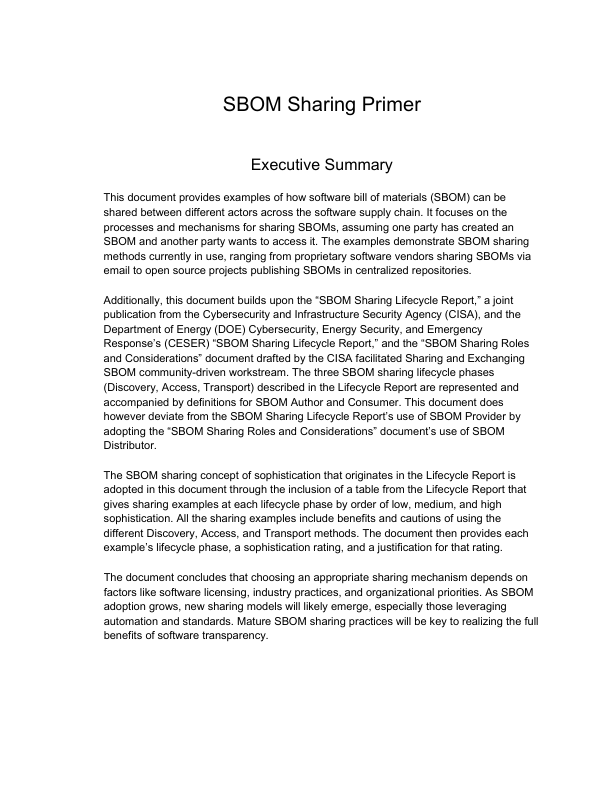
This primer provides examples of how Software Bill of Materials (SBOMs) can be shared between actors across the software supply chain. It highlights current SBOM sharing mechanisms, from simple email exchanges to more complex platforms, and discusses the benefits and limitations of each. The document also introduces definitions and roles involved in SBOM sharing and categorizes sharing methods by their sophistication level.
## 📖 Main Content:
The primer covers methods for SBOM sharing that are already in use, each accompanied by a sophistication rating for discovery, access, and transport phases. It emphasizes that the choice of sharing method depends on factors like software licensing and industry practices.
### 🗒️ Notes
- **Discovery Methods**: Vary from low-sophistication, consumer-initiated methods (e.g., email requests) to high-sophistication automated solutions using distributed ledgers.
- **Access Methods**: Range from no controls (open access) to detailed authentication and authorization processes.
- **Transport Methods**: Can be human-initiated (e.g., manual emails) or highly automated using APIs and distributed networks.
- **SBOM Sharing Phases**:
- Discovery
- Access
- Transport
- **Examples**:
1. SBOMs shared via email.
2. SBOMs shared via vendor portal.
3. SBOMs shared via portal with pre-vetting.
4. Open-source SBOM shared via tooling.
5. OSS SBOMs shared via platform.
6. Proprietary software SBOMs shared along the supply chain.
## 📖 References:
- SBOM Sharing Lifecycle Report
- SBOM Sharing Roles and Considerations
## 🗣️ Paraphrase:
- SBOM sharing methods can vary in sophistication, from email-based requests to fully automated exchanges using APIs. The choice of method depends on industry standards, security requirements, and the sophistication of the involved parties.
- As SBOM adoption grows, new models that leverage automation and improved security protocols will emerge, making SBOM sharing more scalable and secure.
## 📰 Newsletter:
In the world of SBOMs (Software Bill of Materials), transparency is key. In our latest edition, we dive into a new primer that breaks down how SBOMs can be shared across the software supply chain. From email exchanges to advanced automation tools, this guide covers it all. Whether you're new to SBOMs or looking to streamline your processes, check out the primer's insights on improving transparency and security in software development. Full article [here](link-to-article).
## ✅ Action Items:
I am focused on open-source advocacy, onboarding contributors, and supporting sustainable development practices. This primer aligns with my professional goals, as it promotes transparency and standardization in software supply chains, critical to open-source ecosystems. The examples provided can be used to develop educational materials on secure SBOM sharing practices and contribute to discussions on industry-wide standardization.
## 🧪 Hypotheses:
- Automating SBOM sharing processes increases security and scalability in software supply chains.
- Standardized SBOM sharing practices will lead to widespread adoption across industries.
### 📊 Methodology:
- Investigate adoption rates of SBOM sharing methods across different industries.
- Conduct surveys and interviews with companies using SBOMs to evaluate the effectiveness of different sharing methods.
### ❓ Questions:
- How can the open-source community adopt standardized SBOM sharing methods?
- What are the potential challenges of automating SBOM sharing processes?
### 🔮 Future Research:
- Exploring the integration of SBOM sharing with existing cybersecurity frameworks.
- Investigating how SBOM sharing impacts regulatory compliance in different industries.
### 💡 Implications:
Adopting automated SBOM sharing methods can enhance software security and supply chain transparency, leading to reduced vulnerability risks and better regulatory compliance.
### 🧠 Learning Styles Assessment:
1. **Visual Learners**: Include more flowcharts and infographics to illustrate SBOM sharing processes.
2. **Aural Learners**: Provide podcasts or audio summaries discussing key concepts.
3. **Verbal Learners**: Incorporate detailed case studies and examples for better understanding.
4. **Kinesthetic Learners**: Offer hands-on workshops where participants can generate and share SBOMs.
5. **Logical Learners**: Add more data-driven examples and logical breakdowns of processes.
6. **Social Learners**: Create forums or discussion groups for peer-to-peer learning.
7. **Solitary Learners**: Include self-paced exercises and reflection prompts.
8. **Naturalistic Learners**: Provide examples of SBOM's impact on environmental sustainability in software.
### 📊 Accessibility Assessment:
- **Screen Reader Compatibility**: Ensure all images have alt text for better accessibility.
- **Keyboard Navigation**: The document should support full navigation through keyboard controls.
- **Contrast and Readability**: Use high-contrast colors to improve readability for users with visual impairments.
- **Text Resizing**: Ensure the content is responsive to different screen sizes and text adjustments.
### 🌍 DEIB (Diversity, Equity, Inclusion, and Belonging) Assessment:
- **Cultural Relevance**: Include more examples from global software supply chains.
- **Inclusive Language**: Ensure gender-neutral language is used throughout the document.
- **Neurodiversity Support**: Break content into smaller, digestible sections to cater to individuals with ADHD or ASD.
- **Representation**: Highlight diverse contributors and their roles in the SBOM ecosystem.
- **Psychological Safety**: Foster a welcoming tone for individuals new to SBOMs.
### ✅ Logical Validity:
- **Strong Reasoning**: The primer provides a solid explanation of why different SBOM sharing methods vary in sophistication, supporting arguments with real-world examples.
- **Potential Weakness**: The emphasis on manual methods in some examples might downplay the need for automation in more complex supply chains.
- **Suggestions**: Include more detailed comparisons between manual and automated methods to highlight scalability benefits.
### 🔍 SEO Evaluation:
1. **Keywords**: "SBOM," "Software Bill of Materials," "Cybersecurity," "Software Supply Chain" are well-used.
2. **Meta Description**: Add a concise meta description summarizing SBOM sharing methods.
3. **Title Tag**: Ensure the title includes key phrases like "SBOM Sharing."
4. **Headers**: The document uses H1, H2, H3 headers properly to structure content.
5. **Content Length**: The document is comprehensive and detailed, covering multiple sharing examples.
6. **Internal Links**: Add links to related CISA resources and SBOM guidelines.
7. **URL Structure**: Ensure the URL is concise and includes relevant keywords.
8. **Image Optimization**: Add alt text to all figures and optimize images for faster loading.
9. **Mobile Optimization**: The document should be fully responsive for mobile use.
10. **User Engagement**: Encourage comments or feedback from users through calls to action.
11. **Schema Markup**: Consider adding FAQ schema markup for search engine optimization.
12. **Social Sharing**: Include share buttons to improve engagement.
## 🎯 Conclusion:
This primer is a comprehensive guide to SBOM sharing practices, offering examples and suggestions for different levels of sophistication. As SBOM adoption continues to grow, automated sharing methods and standardization will play a crucial role in securing the software supply chain.
- Document Tags: [[sbom]]
- Summary: This text discusses how software bill of materials (SBOM) can be shared among different parties in the software supply chain, focusing on sharing processes and mechanisms. It provides examples of SBOM sharing methods currently in use, from proprietary software vendors sharing via email to open source projects publishing in centralized repositories. The document aims to help organizations understand and implement SBOM sharing practices to enhance software transparency and security.
- URL: https://read.readwise.io/read/01hxs7x4p9anmt3pth6pgyd3d8
Full text of this document omitted because this document is a PDF
[Download original file →](https://readwise.io/reader/document_raw_content/169878340), SBOM Sharing Primer, Cybersecurity & Infrastructure Security Agency, 01hxs7x4p9anmt3pth6pgyd3d8.