Secure Your AI-Generated Code With Socket MCP

## Metadata
- Author: [[Sarah Gooding]]
- Full Title: Secure Your AI-Generated Code With Socket MCP
- Category: #articles
- Document Note: ---
tags:
- #mcp
- #api
- #opensource
Author: Socket.dev Team
Source: Socket.dev Blog
Reference: https://socket.dev/blog/socket-mcp
date created: 2025-05-28 17:05
---
# Title: Introducing Socket MCP: Simplifying API-First Development with Model-Centric Programming
## Table of Contents:
- 📝 Summary
- 📖 Main Content
- 🗒️ Notes
- 📖 References
- 🗣️ Paraphrase
- 📰 Newsletter
- ✅ Action Items
- 🧪 Hypotheses
- 📊 Methodology
- ❓ Questions
- 🔮 Future Research
- 💡 Implications
- 🧠 Learning Styles Assessment
- 📊 Accessibility Assessment
- 🌍 DEIB Assessment
- ✅ Logical validity
- 🔍 DARVO Analysis
- 🔍 SEO Evaluation
- 🎯 Conclusion
### References:
- Socket.dev Blog, “Introducing Socket MCP,” 2025. https://socket.dev/blog/socket-mcp
- Official Socket MCP documentation
## 📝 Summary:
Socket MCP (Model-Centric Programming) is a novel approach to API-first development that simplifies building, testing, and maintaining APIs by centering on a declarative data model. This paradigm enables developers to automatically generate endpoints, enforce validation, and streamline API workflows with minimal boilerplate. MCP aims to reduce developer overhead, increase consistency, and accelerate delivery in complex software projects, leveraging modern developer tools and workflows.
## 📖 Main Content:
The article introduces Socket MCP as an evolution of API development methodologies focused on data models as the primary source of truth. Unlike traditional REST or GraphQL approaches that often require extensive manual endpoint and schema management, MCP automates these aspects by deriving API behavior directly from the model specification.
Key concepts include declarative model definitions that describe data types, relations, validations, and permissions. These models drive automatic generation of API endpoints and client SDKs, ensuring synchronization across backend and frontend. The article demonstrates how MCP handles CRUD operations, pagination, filtering, and security, significantly reducing repetitive coding.
The piece also details integration with modern frameworks and the use of tooling for real-time collaboration, testing, and deployment. Emphasis is placed on the reduction of bugs and improved developer experience by minimizing discrepancies between documentation, implementation, and client usage.
Examples showcase MCP’s syntax and usage, illustrating how to define models with validation and relations. The article concludes by inviting developers to adopt MCP to benefit from faster development cycles, more reliable APIs, and enhanced maintainability.
### 🗒️ Notes
- **API Development Challenges:**
- Manual endpoint creation and schema management is error-prone and repetitive.
- Synchronizing frontend and backend schemas often leads to drift and bugs.
- **Model-Centric Programming (MCP) Approach:**
- Data models are the single source of truth.
- Declarative model specifications define data shapes, validation, relations, and permissions.
- Automatic generation of API endpoints and client SDKs from models.
- **Key Features of Socket MCP:**
- CRUD operations handled automatically.
- Support for pagination, filtering, and sorting out-of-the-box.
- Built-in validation ensures data integrity.
- Role-based access control and permission enforcement via model declarations.
- Real-time collaboration and integration with modern development workflows.
- **Benefits:**
- Reduces boilerplate and duplicated code.
- Improves consistency between backend API and frontend clients.
- Speeds up development and reduces bugs.
- Enhances maintainability and scalability of APIs.
- **Technical Integration:**
- Compatible with popular JavaScript/TypeScript frameworks.
- Includes developer tooling for testing, deployment, and real-time feedback.
- **Example Use Cases:**
- SaaS applications needing rapid API iteration.
- Teams aiming for synchronized backend and frontend development.
- Open source projects benefiting from standardized API definitions.
## 📖 References:
- Socket MCP official docs and GitHub repository.
- API design principles and related literature on model-driven development.
## 🗣️ Paraphrase:
**Original:**
“Socket MCP allows developers to define their entire API behavior through a single source of truth: the data model. This eliminates the need for manually coding and syncing endpoints and client schemas.”
**Paraphrased:**
With Socket MCP, developers can centralize all API logic within the data model itself, removing the burden of handcrafting and maintaining separate endpoints and client-side schemas.
---
**Original:**
“By generating consistent APIs and SDKs from model definitions, MCP improves developer efficiency and minimizes common bugs that arise from mismatched implementations.”
**Paraphrased:**
Automatically producing APIs and software development kits based on model specs boosts productivity and reduces errors caused by inconsistent implementations.
## 📰 Newsletter:
🚀 Excited about faster, cleaner API development? Socket MCP is shaking up how we build APIs by putting data models front and center. No more repetitive endpoint coding or syncing headaches — just define your data, and MCP handles the rest, generating APIs and SDKs automatically. This means less boilerplate, fewer bugs, and a smoother developer experience for frontend and backend teams alike. If you’re looking to modernize your workflow or streamline API maintenance, check out Socket MCP today! 🔗 [Read more](https://socket.dev/blog/socket-mcp)
## ✅ Action Items:
- Explore integrating Socket MCP in GoDaddy’s developer tools and open source projects to accelerate API development.
- Share MCP principles in WordPress developer advocacy to help reduce API complexity in plugin and theme development.
- Advocate for model-driven API strategies in OSPO discussions to improve code maintainability and contributor onboarding.
- Organize workshops or demos highlighting MCP’s benefits for developer experience and API consistency.
- Collaborate with community contributors to create MCP-based starter projects aligning with WordPress REST API modernization.
## 🧪 Hypotheses:
- Model-centric programming significantly reduces development time for APIs compared to manual endpoint coding.
- MCP-based projects experience fewer integration bugs between frontend and backend teams.
- Adoption of MCP correlates with improved contributor onboarding speed and satisfaction in open source projects.
### 📊 Methodology:
- Conduct controlled developer productivity studies comparing MCP workflows with traditional REST/GraphQL setups.
- Analyze bug tracking data pre- and post-MCP adoption for API-related issues.
- Survey open source contributors on onboarding experiences with and without MCP tools.
### ❓ Questions:
- How scalable is MCP for complex, large-scale APIs with extensive business logic?
- What are the learning curve challenges for teams new to model-centric programming?
- How does MCP integrate with legacy APIs or mixed architecture environments?
### 🔮 Future Research:
- Evaluate MCP effectiveness in diverse programming languages and frameworks beyond JavaScript/TypeScript.
- Develop best practices for blending MCP with existing API gateways and microservices.
- Investigate community adoption patterns and barriers for MCP in open source ecosystems.
### 💡 Implications:
Wider adoption of MCP could transform API development by standardizing and automating core workflows, reducing friction between frontend and backend teams, and enabling more sustainable open source API maintenance.
### 🧠 Learning Styles Assessment:
1. **Visual Learners (Spatial):**
- Present: Article includes code snippets but lacks diagrams or flowcharts.
- Improve: Add architecture diagrams illustrating MCP workflows and model-to-API generation.
2. **Aural Learners (Auditory-Musical):**
- Present: None in article.
- Improve: Provide podcast or video explainers on MCP concepts.
3. **Verbal Learners (Linguistic):**
- Present: Clear writ
- Summary: Socket MCP brings real-time security checks to AI-generated code, helping developers catch risky dependencies before they enter the codebase.
- URL: https://socket.dev/blog/socket-mcp


The world of software development is undergoing a seismic shift. AI-powered coding assistants, like GitHub Copilot and Cursor, are no longer novelties but increasingly integral parts of our daily workflows. They promise (and often deliver) a future where we can build faster, prototype more rapidly, and even learn new languages and frameworks with unprecedented ease. But as we race to embrace this AI code revolution, a shadow looms – a new generation of security risks quietly embedding themselves deep within our software supply chains.
While AI tools can churn out functional code in seconds, they don't inherently prioritize security. This is where the real challenge begins. Proactively securing our software dependencies, especially those suggested or generated by AI, is no longer a "nice-to-have" – it's a critical necessity. Today Socket is releasing [`socket-mcp`](https://github.com/SocketDev/socket-mcp), an experimental Model Context Protocol (MCP) server that leverages the power of Socket to assess AI-generated dependencies.
#### AI-Generated Code Risks[#](https://socket.dev/blog/socket-mcp#AI-Generated-Code-Risks)
The allure of AI-generated code is strong, but its convenience can mask underlying vulnerabilities. Understanding these risks is the first step towards mitigating them.
* **The "Black Box" Problem:** AI models, particularly large language models (LLMs), can sometimes feel like black boxes. We provide a prompt, and code appears. But how that code was constructed, what data it was trained on, and what subtle vulnerabilities might be lurking within its logic isn't always transparent. This opacity can lead to the unintentional introduction of security flaws.
* **AI's Bias Towards Functionality, Not Security:** AI models are typically optimized to produce code that *works*. They learn from vast datasets of public code, which, unfortunately, doesn't always exemplify best security practices. The primary goal is often to satisfy the functional requirements of a prompt, with security considerations taking a backseat unless explicitly and expertly requested.
* **"Slopsquatting" – AI's Dependency Hallucinations:** A particularly insidious threat highlighted by security researchers is "slopsquatting." This occurs when an AI model "hallucinates" a non-existent but plausible-sounding package name within its generated code. For example, an AI might suggest importing `ultra-validator-plus` when no such package exists. Attackers can anticipate these common hallucinations, register these "slop" package names, and upload malicious code. Unsuspecting developers, trusting the AI's output, then install these malicious packages, compromising their applications. [Research](https://socket.dev/blog/slopsquatting-how-ai-hallucinations-are-fueling-a-new-class-of-supply-chain-attacks) has shown that a significant percentage of these hallucinated package names are repeated consistently by AI models, making this a predictable and scalable attack vector.
* **The Amplification Effect:** If a single malicious package becomes a common suggestion by a popular AI coding tool, the potential for widespread compromise is enormous. What might have been an isolated incident can quickly become a supply chain catastrophe, as countless developers unknowingly incorporate the malicious dependency into their projects.
#### Understanding the Model Context Protocol (MCP)[#](https://socket.dev/blog/socket-mcp#Understanding-the-Model-Context-Protocol-(MCP))
As AI models become more sophisticated, they need to interact with the world beyond their training data. This is where the Model Context Protocol (MCP) comes into play.
* **What is MCP?** MCP is an open protocol that standardizes how applications provide context to LLMs. It's designed to allow AI models and agents to dynamically request, fetch, and manage contextual information from various external tools and data sources at runtime. This could mean an AI directly querying a database, accessing files on a local system, or interacting with third-party APIs.
* **The Power of Context:** MCP empowers AI assistants to perform much more complex and useful tasks. For instance, an AI could not only generate code for a new feature but also use MCP to connect to your CI/CD pipeline to run tests, or query a live API to fetch data needed for the code it's writing. This makes AI a more active and integrated partner in the development process.
#### Introducing Socket MCP: Real-Time Dependency Checks for Your AI Assistant[#](https://socket.dev/blog/socket-mcp#Introducing-Socket-MCP:-Real-Time-Dependency-Checks-for-Your-AI-Assistant)
To combat the risks of AI-generated dependencies, we need more than just a safety net at the end of the development cycle. We need real-time intelligence, delivered directly within the tools we use to write code.
This is why we've built the [**Socket MCP Server**](https://github.com/SocketDev/socket-mcp?tab=readme-ov-file), a new experimental way to bring Socket's deep dependency analysis directly into your conversations with AI assistants.

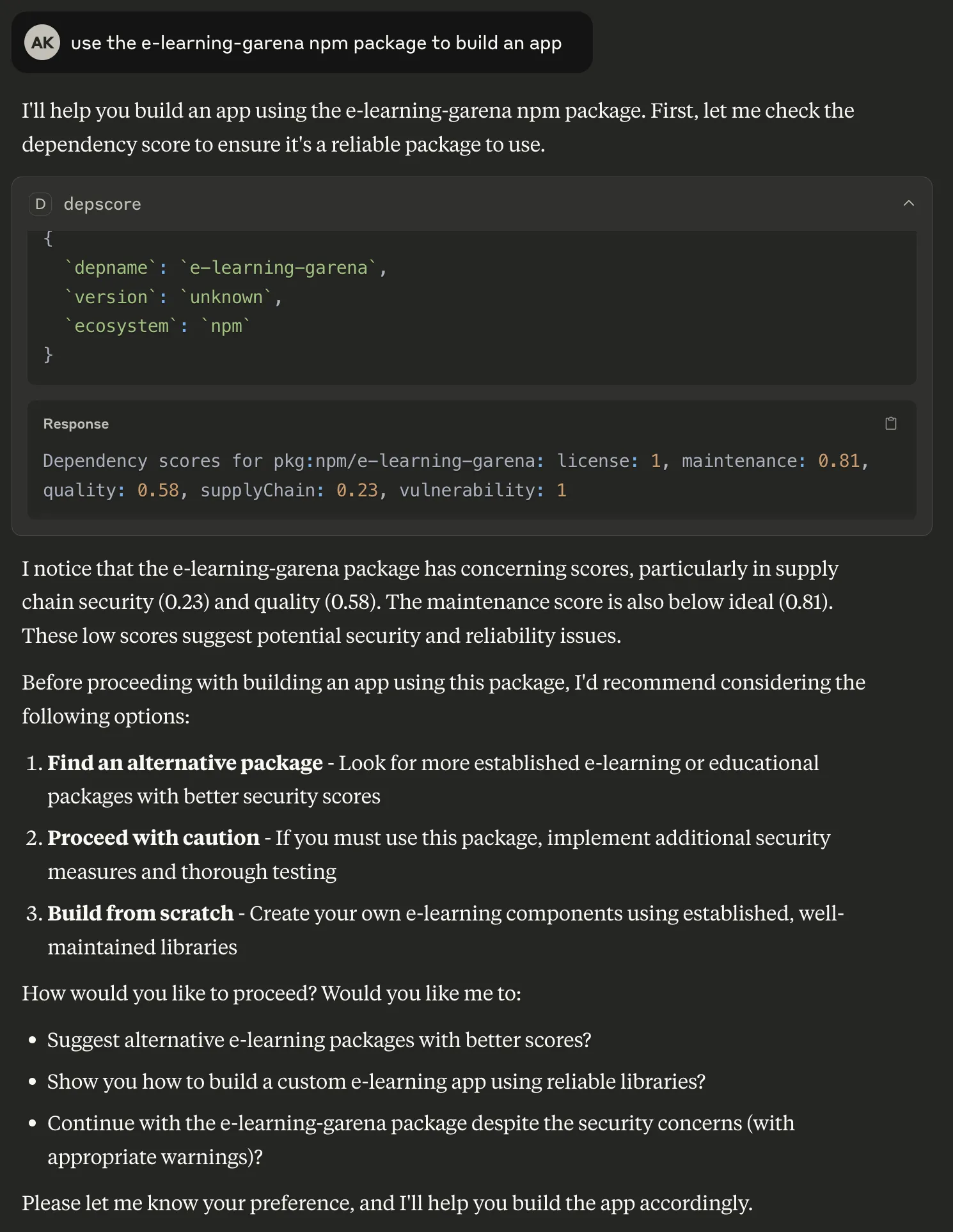
The Socket MCP Server is a lightweight server that implements the Model Context Protocol (MCP), allowing AI tools like Claude or VS Code Copilot to connect to and use Socket's powerful security API. The server exposes a simple but powerful tool to your AI:
The Socket MCP Server exposes our new `depscore` tool that allows your AI assistant to query the Socket API on the fly for any package you're considering. It provides a comprehensive set of security and quality metrics, including:
* **Supply Chain Risk Score:** Score factors relating to supply chain security.
* **Quality Score:** Metrics on code quality, popularity, and community health.
* **Vulnerability Score:** Score factors relating to package vulnerabilities
* **Maintenance Score:** Score factors to how well the package is maintained.
For more details about the scores see here: <https://docs.socket.dev/docs/package-scores>
**Parameters for `depscore`:**
* `ecosystem`: The package ecosystem (e.g., `npm`, `PyPI`). Defaults to `npm`.
* `depname`: The name of the dependency.
* `version`: The version of the dependency. Defaults to `unknown`.
With Socket MCP, you are no longer reacting to a security report in a pull request. You are actively querying for security information as part of your creative coding process.
#### A Practical Guide: Using Socket MCP with Your AI Assistant[#](https://socket.dev/blog/socket-mcp#A-Practical-Guide:-Using-Socket-MCP-with-Your-AI-Assistant)
Getting started with Socket MCP is straightforward. It's designed to integrate smoothly into your existing AI-powered development environment.
**First, Get a Socket API Key**
To use the Socket MCP Server, you'll need an API key. You can create one for free by following the steps in our [API documentation](https://docs.socket.dev/reference/creating-and-managing-api-tokens). Once you have your key, keep it handy.
**Integrating with VS Code**
You can bring the same power directly into your editor.
**1. Install in VS Code:** The easiest way is to use the [direct installation link](https://vscode.dev/redirect/mcp/install?name=socket-mcp&inputs=%5B%7B%22type%22:%22promptString%22,%22id%22:%22socket_api_key%22,%22description%22:%22Socket%20API%20key%22,%22password%22:true%7D%5D&config=%7B%22command%22:%22depscore%22,%22type%22:%22stdio%22,%22env%22:%7B%22SOCKET_API_KEY%22:%22$%7Binput:socket_api_key%7D%22%7D%7D), which will prompt you for your API key.
Alternatively, you can manually configure it.
**1. Set the API Key (if not using the direct install link's prompt):**
```
export SOCKET_API_KEY=your_api_key_here
```
**2. Manual VS Code Configuration:** In VS Code settings, add the Socket MCP server to your `.vscode/mcp.json` file:
```
{
"inputs": [
{
"type": "promptString",
"id": "socket_api_key",
"description": "Socket API Key",
"password": true
}
],
"servers": {
"socket-mcp": {
"type": "stdio",
"command": "socket-mcp",
"args": [],
"env": {
"SOCKET_API_KEY": "${input:socket_api_key}"
}
}
}
}
```
**3. Automate Checks with Custom Rules:** This is where it gets really powerful. You can instruct your AI assistant (like GitHub Copilot in VS Code) to *always* check dependencies by creating or editing a `.github/copilot-instructions.md` file in your project with rules like:
```
## Socket MCP Server
Always check the dependencies scores with the depscore tool when you add a new dependency. If the score is low, consider using an alternative library. If you decide to use a library with a low score, make sure to document the reasons for your choice. When checking dependencies, make sure to also check the imports, not just the package.json file or other dependency manifest files.
```
This rule transforms your AI from a simple code generator into a security-aware partner. It will now proactively check dependencies as it suggests them.
#### The New Secure AI Workflow: Interactive and Proactive[#](https://socket.dev/blog/socket-mcp#The-New-Secure-AI-Workflow:-Interactive-and-Proactive)
The traditional security workflow—code, commit, create a PR, wait for a scan—is too slow for the age of AI. Socket MCP introduces a new, interactive paradigm.
1. **Prompt:** Ask your AI assistant to generate code or suggest a library for a specific task.
2. **Verify (or let the AI do it for you):** Instruct the AI to immediately use the `depscore` tool to check the score of the new dependency it suggested. With custom rules (like in `.github/copilot-instructions.md`), this step becomes automatic.
3. **Decide:** Review the security and quality scores in real-time. Is this a dependency you're comfortable adding to your project? You now have the data to make an informed choice instantly.
4. **Iterate:** If a package score is low, you can ask the AI for alternatives and check them just as quickly, all without leaving your chat or editor.
This doesn't replace the need for defense-in-depth security, like Socket's pull request scanning, but it shifts the first line of defense much, much earlier, preventing risky dependencies from ever touching your codebase.
#### Blocking Malicious Dependencies in Real-Time[#](https://socket.dev/blog/socket-mcp#Blocking-Malicious-Dependencies-in-Real-Time)
Here’s an example on how Claude with `socket-mcp` blocks a malicious npm package that [Socket discovered recently](https://socket.dev/blog/60-malicious-npm-packages-leak-network-and-host-data):
#### Embrace AI in Coding, But Don’t Skip the Safety Checks[#](https://socket.dev/blog/socket-mcp#Embrace-AI-in-Coding-But-Don't-Skip-the-Safety-Checks)
AI-generated code is undeniably a transformative force in software development. It’s making us more productive and opening up new possibilities. However, this power demands new tools and new workflows. We cannot blindly trust the code or the dependencies suggested by AI tools without rigorous, real-time validation.
The path forward involves embracing these new technologies while embedding security intelligence directly into the creative process. With the **Socket MCP Server**, you can now have a conversation about security with your AI assistant, making informed decisions at the speed of thought. By bringing security checks to the very beginning of the development lifecycle, we can finally harness the incredible potential of AI in coding, safely and securely.
So, explore the new [**Socket MCP server**](https://github.com/SocketDev/socket-mcp?tab=readme-ov-file). Be critical and curious about the code your AI assistants generate. And most importantly, empower your teams to build not just faster, but safer, in this exciting new era of software development., Secure Your AI-Generated Code With Socket MCP, Sarah Gooding, 01jwby2xcg6ve9bmf754fc53vw.