September 17, 2026
🔗 **Source:** [September 17, 2026](https://nerdy.dev/jev)
> [!note]+ Document Notes
> ---
> tags: [jev, typesafe-ai, structured-decisions, indie-web, programming-models]
> author: nerdy.dev (Adam Argyle)
> source: Adam's Indie Social Feed
> reference: https://nerdy.dev/jev
> date created: 2026-09-18
> ---
> > [!info] Generated analysis — not the author's words. Sections below are machine-written
> > from the captured source. Only text inside `> [!quote]` blocks is verbatim from the author.
> > Do not quote or attribute any other line to the named author.
> <!-- deep-read: light-touch -->
> Light-touch: the capture is a single ~429-word personal feed post — an enthusiastic first-impression note with outbound links, not an argued article.
> ## 🏷️ Title
> September 17, 2026 — a dated entry on Adam's Indie Social Feed reacting to Jev by Typesafe.ai.
> ## 🧭 Table of Contents
> Excitement about Jev → three standout attributes → tokenization without generated prose → "fast path to machine learning" → read the docs → a shared playground → the Doom demo → three open questions.
> ## 🔗 References (in-page)
> - Typesafe.ai — https://typesafe.ai/
> - Jev docs, "Introduction" — https://docs.typesafe.ai/introduction
> - Author's shared playground (is a human or an agent the creative?) — https://console.typesafe.ai/playground?share=shr_1521e5ca32f52ab4094844675f786316270
> - "Introducing System One Models and Jev" — https://typesafe.ai/blog/introducing-system-one-models-and-jev (the Doom example is a text-fragment link into it)
> - Image: Jev playing Doom, with state machine and probability scoring — https://nerdy.dev/media/jev-doom.jpg
> ## 📝 Summary
> **What happened:** Adam posted a short, openly infatuated first take on Jev, a Typesafe.ai product that tokenizes structured data and answers blunt near-natural-language questions with scores rather than prose. **Why it matters:** he frames it as a programming-model shift — code owns the workflow, the model owns narrow structured decisions. **Stakeholders:** developers building decision logic, teams who previously needed bespoke ML. **Risks:** enthusiasm after a few hours of play; the no-hallucination and speed claims come from vendor framing, untested here. **Bottom line:** a credible "go look at this" signal — follow it to the primary sources rather than cite it as evidence.
> ## 📖 Main Content
> The post opens with unguarded excitement and lists three attributes that stood out: common-sense judgments over unstructured data, machine interfaces mattering more than chat interfaces, and code owning the workflow while AI handles narrow, structured decisions. His mental model: Jev gives you an LLM's tokenization powers without the generated prose, so there is nothing to hallucinate; it instead exposes the connections it found across ingested data, which you interrogate with blunt questions. He calls it a fast path to machine learning, replacing large datasets and slow custom models, and urges an hour-plus with the tutorials, videos, and docs. He shares a playground asking whether a human or an agent is the creative in agent-assisted art, with instructions to comment out one story and watch the scores move. He closes on the System One post, its Doom demo, and three unresolved questions.
> ### 🗒️ Notes
> - The Doom framing is the clearest explanation: speed plus structured game state equals usable judgment in a loop.
> - His sharpest self-directed challenge: if Jev wants narrow structured decisions and not the code, isn't choosing the right line of code exactly that? He speculates someone could build "a Claude Code out of this."
> - The playground link is a reproducible artifact — unusual for a feed post.
> ## 📚 References (primary sources preferred)
> Primary: the Typesafe.ai docs and the "Introducing System One Models and Jev" announcement (both linked above) are the vendor's own descriptions, and should be read before repeating any claim here. The shared playground is the author's construction and the only reproducible artifact. No third-party benchmark, review, or critical source is cited.
> ## 🗣️ Paraphrase
> 1. He is excited about Jev; Typesafe.ai has built something fresh and unique.
> 2. Three attributes stood out: judgments over unstructured data, machine interfaces over chat interfaces, code keeping the workflow while AI takes the narrow decisions.
> 3. You get LLM-style tokenization without generated prose, and therefore, in his framing, no hallucination; it surfaces connections in your data and you query them bluntly.
> 4. He calls this a fast path to machine learning, admits the words may not land, and asks for an hour with tutorials, videos, and docs — he thinks it is a next-gen programming model.
> 5. He shares a playground on agent-assisted art, with instructions to skew the dataset and watch the scores shift, then points to the System One post and Doom example.
> 6. He closes with three open questions: code-as-narrow-decision, tool versus programming-model shift, and what sub-second judgment unlocks.
> ## 📰 Newsletter
> **Some developers fall in love in public, and it's useful when they do.** Adam Argyle — yes, the CSS person — spent an evening with Jev from Typesafe.ai and came back describing a thing that tokenizes your structured data, refuses to write a paragraph about it, and answers blunt questions with scores. His pitch in one line: code owns the workflow, the model owns the narrow decision. WordPress folks: park the hype, keep the shape — it describes a lot of unglamorous CMS work. Is this comment spam? Does this ticket belong to Polyglots or Support? Is this photo actually of a bird? Today those are regex, a paid API, or a human. A fast layer returning a score instead of a sentence is a different thing to plumb into a plugin. Worth an hour: the [docs](https://docs.typesafe.ai/introduction), the [System One post](https://typesafe.ai/blog/introducing-system-one-models-and-jev), and Adam's own [playground](https://console.typesafe.ai/playground?share=shr_1521e5ca32f52ab4094844675f786316270). He flags the tension himself: if narrow structured decisions are the sweet spot, isn't picking the next line of code one? Nobody has answered that, including him.
> ## ✅ Action Items
> - **DevRel / OSPO:** read the primary docs before repeating "no hallucinations"; treat this post as a lead, not a source.
> - **Core AI:** log "structured judgment, scored output" as an architecture distinct from chat-completion in AI evaluation matrices.
> - **Core Performance:** sub-second judgment is what would make in-request use plausible; nothing here benchmarks it.
> - **Support / Community:** sketch triage routing (ticket to team, flag to moderator) as a thought experiment.
> - **Photos:** a scored classification layer is relevant to submission review; watch only.
> - **Core, Core Program Team, Mobile, Playground, Training, Marketing, Design, Documentation, TV, Polyglots, Accessibility, Meta, CLI, Hosting, Tide, Openverse, Themes, Plugins, The WPOCC, FAIR:** no action.
> ## 🧪 Hypotheses
> 1. Jev's output is scores over a declared question set, so "no hallucinations" is a property of output format, not of correctness — testable in the playground.
> 2. Commenting out one story shifts question scores measurably, as claimed — he gives the steps.
> 3. The Doom demo depends on structured game state and degrades sharply on raw pixels.
> 4. Latency, not accuracy, binds the "many judgments per second" class of apps.
> ## 📊 Methodology
> Little method to assess, and the post claims none. A first-impression note after hands-on play: read docs, watched videos, built one playground, reported what he noticed. No benchmark or comparison.
> ## ❓ Questions
> - What exactly does Jev return — a score per question, a ranking, a classification?
> - What is the actual latency, on what hardware or endpoint, and what happens when data is out of distribution?
> - Is there a self-hosted or open path, or only a hosted console?
> - How do "System One" models relate to Jev the product?
> ## 🔮 Future Research
> Run the playground twice as instructed and record the score deltas. Read the System One post for the architecture. Compare the pattern against existing options for the same jobs: small classifiers, embeddings plus threshold, constrained-decoding LLM calls.
> ## 💡 Implications
> - **Practice:** cheap fast judgments move de
I am very excited about [Jev](https://typesafe.ai/). [Typesafe.ai](https://typesafe.ai/) has something fresh, powerful, unique here. I'm mentally infactuated.
**Attributes of Jev that stood out to me:**
* common-sense judgments over unstructured data
* machine interfaces matter more than the chat interfaces
* code owns the workflow and AI handles narrow, structured decisions
We get the tokenization LLM powers to breakdown input (token window) but without the word vomit. No hallucinations because it's not using probability to hopefully create a pleasing string.
It's exposing the intricate connections it made to the input data. To extract meaning from that super brain that just ingested your JSON, you ask it blunt questions in near natural language.
**It's like a fast path to machine learning.**
Where you used to need a ton of data and custom machine learning, then run that somewhere and have it probably be slow. Jev is fast, learns data patterns near instantly, and lets you ask questions and make decisions about it's processing of the data.
I don't know how many of those words will resonate with you.
But I urge you to sit down for more than an hour with this. Run through all the tutorials, watch a few of their videos and **[read the docs](https://docs.typesafe.ai/introduction)**.
I think we're looking at a next-gen programming model.
Here is a [playground](https://console.typesafe.ai/playground?share=shr_1521e5ca32f52ab4094844675f786316270) I made to see what Jev thinks about agent assisted art and whether or not a human or an agent is actually the creative.
Comment out one of the stories so the dataset is lopsided, run it and observe the question scores. Then switch to the other story, run it, observe the scores.
**This is powerful stuff.**
[System One](https://typesafe.ai/blog/introducing-system-one-models-and-jev) has some really compelling examples, and of course I loved the [Doom](https://typesafe.ai/blog/introducing-system-one-models-and-jev#:~:text=the%20team%E2%80%99s%20favorites%3A-,Doom,-We%20love%20how) example.
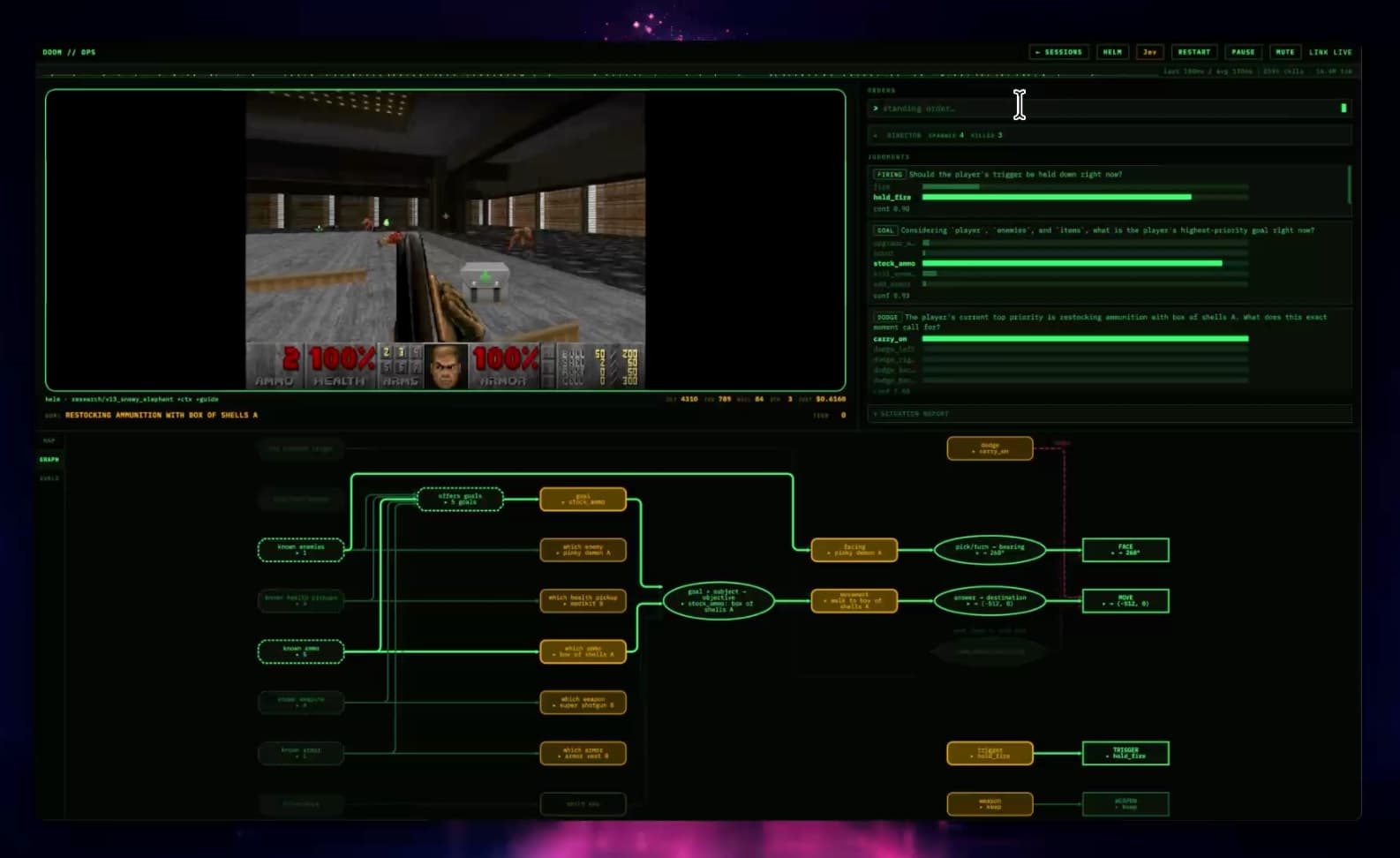Jev playing Doom, theres a state machine of input and jev probability scoring next to it
Since Jev is fast, it can process the game's structured data (enemies, room details, etc) and "make common sense judgements", AKA play the game damn good.
Q: Jev doesnt want to own the code, but does want to own narrow structured decisions… which **shouldnt the right line of code be a narrow structured decision?**
Seems to me like someone could make a Claude Code out of this.
Q: At first I felt the usages of Jev were limited, but **I think we're looking at more of a programming model shift then some new tool**?
It's fundementally making me think different about how I could write logic to create systems.
Q: **What kind of apps does it unlock because it's so fast?**
A lot of early use cases will be periodic queries, but if you can get intelligent judgements multiple times a second…, September 17, 2026, nerdy.dev, 01m2rdrw4eekv26vgzjke6smjk.