Solving the Maker-Taker Problem

## Metadata
- Author: [[Dries Buytaert]]
- Full Title: Solving the Maker-Taker Problem
- Category: #articles
- Document Note: ---
tags: [#open-source, #wordpress, #maker-taker, #community-governance]
Author: Dries Buytaert
Source: Blog Post on Dri.es
Reference: [Solving the Maker-Taker problem](https://dri.es/solving-the-maker-taker-problem)
date created: {{date:2024-10-02}} {{time:17:10}}
---
# Title: Solving the Maker-Taker Problem in Open Source
## Table of Contents:
1. [📝 Summary](#-summary)
2. [📖 Main Content](#-main-content)
1. [Introduction to the Maker-Taker Problem](#introduction-to-the-maker-taker-problem)
2. [Drupal's Contribution Credit System](#drupals-contribution-credit-system)
3. [Recommendations for WordPress](#recommendations-for-wordpress)
4. [🗒️ Notes](#-notes)
3. [📖 References](#-references)
4. [🗣️ Paraphrase](#-paraphrase)
5. [📰 Newsletter](#-newsletter)
6. [✅ Action Items](#-action-items)
7. [🧪 Hypotheses](#-hypotheses)
8. [📊 Methodology](#-methodology)
9. [❓ Questions](#-questions)
10. [🔮 Future Research](#-future-research)
11. [💡 Implications](#-implications)
12. [🧠 Learning Styles Assessment](#-learning-styles-assessment)
13. [📊 Accessibility Assessment](#-accessibility-assessment)
14. [🌍 DEIB Assessment](#-deib-assessment)
15. [✅ Logical Validity](#-logical-validity)
16. [🔍 SEO Evaluation](#-seo-evaluation)
17. [🎯 Conclusion](#-conclusion)
## 📝 Summary:
The article discusses the "Maker-Taker" problem in the open-source community, where the creators ("Makers") contribute to projects, while others ("Takers") profit without fair contributions. Dries Buytaert, the creator of Drupal, presents the Drupal contribution credit system as a solution to this problem and recommends a similar approach for WordPress to create a fairer ecosystem.
## 📖 Main Content:
### Introduction to the Maker-Taker Problem
- **Definition**: Makers are those who contribute to open source projects, while Takers benefit without contributing back, creating an imbalance.
- **Current Issues**: This imbalance discourages Makers, threatens sustainability, and harms the growth of open-source projects.
- **Broader Implications**: This dynamic discourages new entrants into open-source business due to the lack of fair competition and rewards for contributions.
### Drupal's Contribution Credit System
- **Concept**: The Drupal community introduced a contribution credit system to incentivize contributions. This system aims to encourage organizations to become Makers rather than Takers.
- **How It Works**:
- Contributions, such as code or event organization, earn credits tracked transparently by the Drupal Association.
- Benefits include improved visibility on Drupal.org and priority at Drupal events.
- This system ensures that only active contributors (Makers) are highlighted within the Drupal ecosystem, encouraging more companies to contribute actively.
- **Challenges**: The credit system isn’t perfect; tracking contributions accurately across different areas like documentation and event organizing remains difficult.
### Recommendations for WordPress
- **Governance Expansion**: The WordPress ecosystem could benefit by adopting similar governance models and defining clear roles for Makers and Takers.
- **Contribution Tracking**: Establishing a transparent contribution tracking system would help reward contributors and promote sustainability.
- **Reward System**: WordPress could provide recognition and privileges, such as improved listing on WordPress.org or marketing opportunities, to those actively contributing to the project.
### 🗒️ Notes
- **Makers vs. Takers**:
- Makers directly contribute to the open-source ecosystem, while Takers profit without providing meaningful contributions.
- Drupal uses a system to reward contributors transparently, providing visibility and incentives.
- **Key Challenges**:
- Open-source communities face challenges in balancing the ecosystem to prevent unfair advantages for Takers.
- Drupal’s approach highlights the importance of active governance and transparent contribution tracking.
## 📖 References:
- Dries Buytaert, "Solving the Maker-Taker Problem", [Dri.es](https://dri.es/solving-the-maker-taker-problem), 2024.
## 🗣️ Paraphrase:
1. The Maker-Taker problem in open source involves the imbalance between major contributors (Makers) and companies that profit without contributing (Takers). This imbalance harms the open-source ecosystem and discourages contributions.
2. Drupal’s contribution credit system aims to reward organizations that actively contribute by providing visibility and other incentives, thus encouraging more companies to be Makers rather than Takers.
## 📰 Newsletter:
🚀 **Tackling Open Source Challenges**: The "Maker-Taker" issue is a hot topic right now! Drupal’s solution? A contribution credit system that incentivizes those who actively give back. Could WordPress follow suit? Read about Dries Buytaert’s recommendations for WordPress and how we could create a more sustainable community for everyone. [Learn more here](https://dri.es/solving-the-maker-taker-problem)
## ✅ Action Items:
- Develop educational resources that explain the importance of contribution credits in open-source.
- Advocate for WordPress governance reforms that reward active contributors.
- Create a WordPress community discussion on adopting a contribution credit system.
## 🧪 Hypotheses:
1. Implementing a contribution credit system in WordPress will increase active contributions from businesses.
2. Transparent governance and contributor incentives will foster greater sustainability and growth for open-source communities.
### 📊 Methodology:
- **Surveys**: Collect feedback from WordPress contributors and businesses to understand their motivation for contributing.
- **Comparative Analysis**: Analyze contribution systems in other open-source projects like Drupal to derive best practices.
- **Quantitative Study**: Track changes in the number of active contributors before and after introducing a credit system.
### ❓ Questions:
1. How can WordPress define and clearly communicate the roles of Makers and Takers within its ecosystem?
2. Would adopting a contribution credit system deter or attract new businesses to WordPress?
### 🔮 Future Research:
- Investigate different models for incentivizing contributions and their impact on community growth.
- Explore how other open-source projects have managed to balance contributions and rewards effectively.
### 💡 Implications:
Researching contribution credit systems could help create fairer incentives for open-source communities, leading to increased sustainability and engagement, ultimately benefiting both contributors and end-users.
### 🧠 Learning Styles Assessment:
1. **Visual Learners (Spatial)**:
- **Present**: Diagrams explaining the Maker-Taker problem.
- **Improve**: Add visual examples of contribution tracking systems.
2. **Aural Learners (Auditory-Musical)**:
- **Improve**: Add an audio summary of the issue.
3. **Verbal Learners (Linguistic)**:
- **Present**: The article uses descriptive language.
4. **Physical Learners (Kinesthetic)**:
- **Improve**: Include exercises to simulate governance decisions.
5. **Logical Learners (Mathematical)**:
- **Present**: Logical explanation of contribution impacts.
6. **Social Learners (Interpersonal)**:
- **Improve**: Facilitate group discussions on governance models.
7. **Solitary Learners (Intrapersonal)**:
- **Improve**: Add reflective prompts about contributing to open source.
8. **Naturalistic Learners**:
- **Improve**: Include examples comparing ecosystems to open source.
### 📊 Accessibility Assessment:
- **Screen Reader Compatibility**: Add alt text to all visuals.
- **Keyboard Navigation**: Ensure interactive elements are keyboard accessible.
- **Contrast and Readability**: Improve contrast for better visibility.
### 🌍 DEIB Assessment:
- **Cultural Relevance**: Include perspectives from contributors globally.
- **Inclusive Language**: Simplify jargon for better accessibility.
- **Representation**: Highlight diverse contributors to emphasize inclusion.
### ✅ Logical Validity:
- **Positive Reasoning**:
- **Balanced View**: The article presents both the challenges and potential solutions to the Maker-Take
- Document Tags: [[Drupal]] [[Matt Mullenweg]] [[metrics]] [[open source corporate contribution]] [[wordpress contribution]] [[wpdrama]] [[wp engine]]
- Summary: How open source projects can balance Makers and Takers: lessons from Drupal's contribution credit system and recommendations for WordPress and other open source communities.
- URL: https://dri.es/solving-the-maker-taker-problem
##### On this page
* [The Maker-Taker problem](https://dri.es/solving-the-maker-taker-problem#0)
* [Drupal's approach: the Contribution Credit System](https://dri.es/solving-the-maker-taker-problem#1)
* [Governance and fairness](https://dri.es/solving-the-maker-taker-problem#2)
* [Recommendations for WordPress](https://dri.es/solving-the-maker-taker-problem#3)
* [Conclusion](https://dri.es/solving-the-maker-taker-problem#4)
How open source projects can balance Makers and Takers: lessons from Drupal's contribution credit system and recommendations for WordPress and other open source communities.
Open Source Makers and Takers: a unbalanced scale
Recently, a [public dispute](https://lwn.net/SubscriberLink/991906/e5bc182f5602ffca/) has emerged between WordPress co-founder Matt Mullenweg and hosting company WP Engine. Matt has accused WP Engine of misleading users through its branding and profiting from WordPress without adequately contributing back to the project.
As the Founder and Project Lead of [Drupal](https://www.drupal.org/), another major open source Content Management System (CMS), I hesitated to weigh in on this debate, as this could be perceived as opportunistic. In the end, I decided to share my perspective because this conflict affects the broader open source community.
I've known Matt Mullenweg since the early days, and we've grown both our open source projects and companies alongside each other. With our shared interests and backgrounds, [I consider Matt a good friend](https://dri.es/two-internet-entrepreneurs-walk-into-an-old-publishing-house) and can relate uniquely to him. Equally valuable to me are my relationships with WP Engine's leadership, including CEO Heather Brunner and Founder Jason Cohen, both of whom I've met several times. I have deep admiration for what they’ve achieved with WP Engine.
Although this post was prompted by the controversy between Automattic and WP Engine, it is *not* about them. I don't have insight into their respective contributions to WordPress, and I'm not here to judge. I've made an effort to keep this post as neutral as possible.
Instead, this post is about two key challenges that many open source projects face:
1. The imbalance between major contributors and those who contribute minimally, and how this harms open source communities.
2. The lack of an environment that supports the fair coexistence of open source businesses.
These issues could discourage entrepreneurs from starting open source businesses, which could harm the future of open source. My goal is to spark a constructive dialogue on creating a more equitable and sustainable open source ecosystem. By solving these challenges, we can build a stronger future for open source.
This post explores the "Maker-Taker problem" in open source, using Drupal's contribution credit system as a model for fairly incentivizing and recognizing contributors. It suggests how WordPress and other open source projects could benefit from adopting a similar system. While this is unsolicited advice, I believe this approach could help the WordPress community heal, rebuild trust, and advance open source productively for everyone.
##### The Maker-Taker problem
At the heart of this issue is the Maker-Taker problem, where creators of open source software ("Makers") see their work being used by others, often service providers, who profit from it without contributing back in a meaningful or fair way ("Takers").
Five years ago, I wrote a blog post called [Balancing Makers and Takers to scale and sustain Open Source](https://dri.es/balancing-makers-and-takers-to-scale-and-sustain-open-source), where I defined these concepts:
> The difference between Makers and Takers is not always 100% clear, but as a rule of thumb, Makers directly invest in growing both their business and the open source project. Takers are solely focused on growing their business and let others take care of the open source project they rely on.
In that post, I also explain how Takers can harm open source projects. By not contributing back meaningfully, Takers gain an unfair advantage over Makers who support the open source project. This can discourage Makers from keeping their level of contribution up, as they need to divert resources to stay competitive, which can ultimately hurt the health and growth of the project:
> Takers harm open source projects. An aggressive Taker can induce Makers to behave in a more selfish manner and reduce or stop their contributions to open source altogether. Takers can turn Makers into Takers.
Solving the Maker-Taker challenge is one of the biggest remaining hurdles in open source. Successfully addressing this could lead to the creation of tens of thousands of new open source businesses while also improving the sustainability, growth, and competitiveness of open source – making a positive impact on the world.
##### Drupal's approach: the Contribution Credit System
In Drupal, we've adopted a positive approach to encourage organizations to become Makers rather than relying on punitive measures. Our approach stems from a key insight, also explained in [my Makers and Takers blog post](https://dri.es/balancing-makers-and-takers-to-scale-and-sustain-open-source): customers are a "common good" for an open source project, not a "public good".
Since a customer can choose only one service provider, that choice directly impacts the health of the open source project. When a customer selects a Maker, part of their revenue is reinvested into the project. However, if they choose a Taker, the project sees little to no benefit. This means that open source projects grow faster when commercial work flows *to Makers* and *away from Takers*.
For this reason, it's crucial for an open source community to:
1. Clearly identify the Makers and Takers within their ecosystem
2. Actively support and promote their Makers
3. Educate end users about the importance of choosing Makers
To address these needs and solve the Maker-Taker problem in Drupal, I proposed a [contribution credit system](https://dri.es/a-method-for-giving-credit-to-organizations-that-contribute-code-to-open-source) 10 years ago. The concept was straightforward: incentivize organizations to contribute to Drupal by giving them tangible recognition for their efforts.
We've since implemented this system in partnership with the [Drupal Association](https://www.drupal.org/association), our non-profit organization. The Drupal Association transparently tracks contributions from both individuals and organizations. Each contribution earns credits, and the more you contribute, the more visibility you gain on [Drupal.org](https://www.drupal.org/) (visited by millions monthly) and at events like [DrupalCon](https://dri.es/tag/drupalcon) (attended by thousands). You can earn credits by contributing code, submitting case studies, organizing events, writing documentation, financially supporting the Drupal Association, and more.
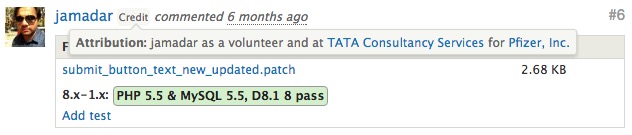A screenshot of an issue comment on Drupal.org. You can see that jamadar worked on this patch as a volunteer, but also as part of his day job working for TATA Consultancy Services on behalf of their customer, Pfizer.
Drupal's credit system is unique and groundbreaking within the Open Source community. The Drupal contribution credit system serves two key purposes: it helps us identify who our Makers and Takers are, and it allows us to guide end users towards doing business with our Makers.
Here is how we accomplish this:
* Certain benefits, like event sponsorships or advertising on Drupal.org, are reserved for organizations with a minimum number of credits.
* The [Drupal marketplace](https://www.drupal.org/drupal-services) only lists Makers, ranking them by their contributions.
* Top contributors appear first, and organizations that stop contributing gradually drop in rankings or are removed.
* We encourage end users to require open source contributions from their vendors. Drupal users like Pfizer and the State of Georgia only allow Makers to apply in their vendor selection process.
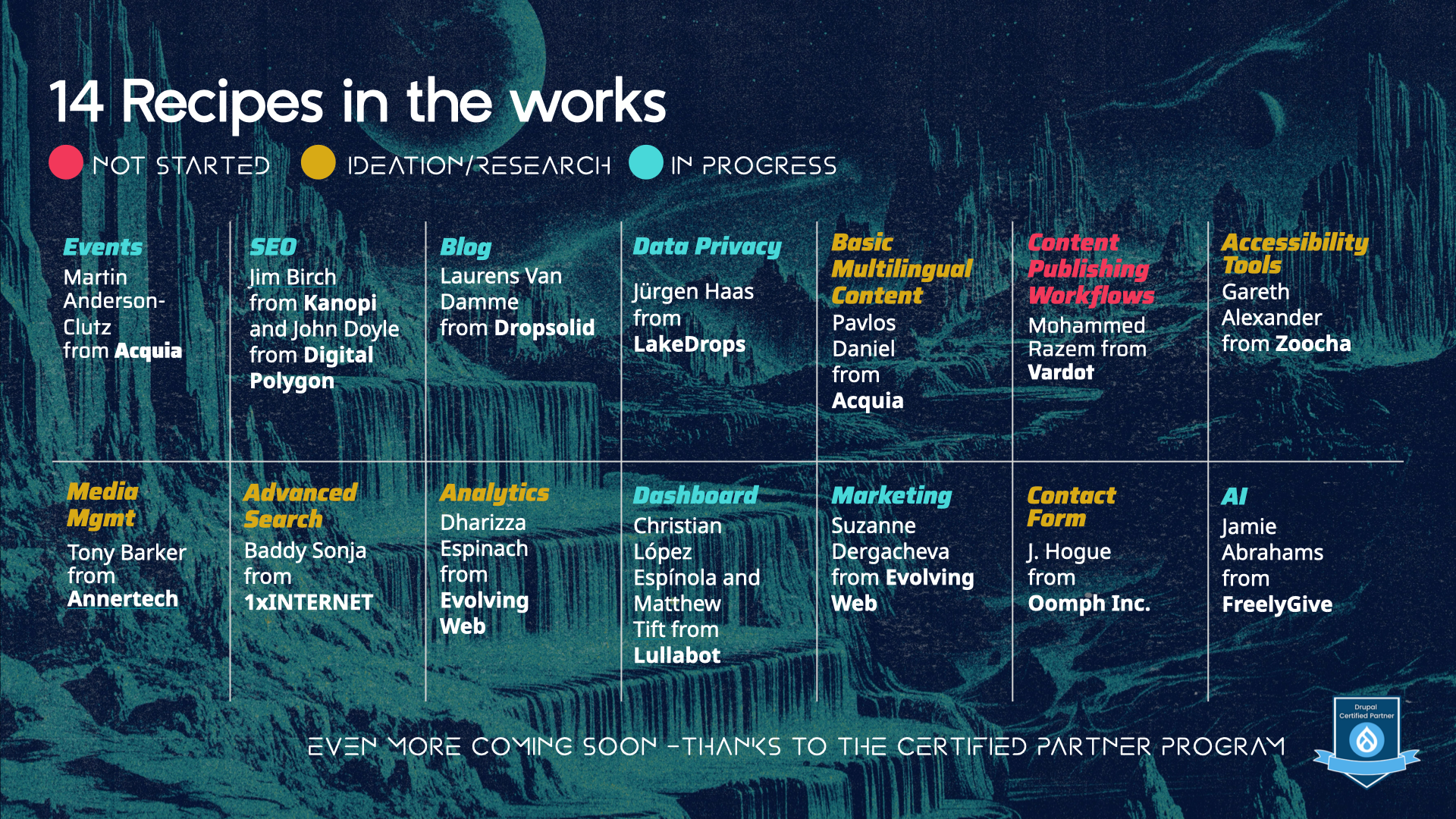A slide from my recent [DrupalCon Barcelona State of Drupal keynote](https://dri.es/state-of-drupal-presentation-september-2024) showcasing key contributors to Drupal Starshot. This slide showcases how we recognize and celebrate Makers in our community, encouraging active participation in the project.
##### Governance and fairness
Fairness in the open source credit system requires oversight by an independent, neutral party. This entity must objectively assess contributions to maintain equity.
In the Drupal ecosystem, the Drupal Association fulfills this crucial role. The Drupal Association operates independently, free from control by any single company within the Drupal ecosystem. Some of the Drupal Association's responsibilities include:
1. Organizing DrupalCons
2. Managing Drupal.org
3. Overseeing the contribution tracking and credit system
It's important to note that while I serve on the Drupal Association's Board, I am just one of 12 members and have not held the Chair position for several years. My company, Acquia, receives no preferential treatment in the credit system; the visibility of any organization, including Acquia, is solely determined by its contributions over the preceding twelve months. This structure ensures fairness and encourages active participation from all members of the Drupal community.
Drupal's credit system certainly isn't perfect. It is hard to accurately track and fairly value diverse contributions like code, documentation, mentorship, marketing, event organization, etc. Some organizations have tried to game the system, while others question whether the cost-benefit is worthwhile.
As a result, Drupal's credit system has evolved significantly [since I first proposed it ten years ago](https://dri.es/a-method-for-giving-credit-to-organizations-that-contribute-code-to-open-source). The Drupal Association continually works to improve the system, aiming for a credit structure that genuinely drives positive behavior.
##### Recommendations for WordPress
WordPress has already taken steps to address the Maker-Taker challenge through initiatives like the [Five for the Future](https://wordpress.org/five-for-the-future/) program, which encourages organizations to contribute 5% of their resources to WordPress development.
Building on this foundation, I believe WordPress could benefit from adopting a contribution credit system similar to Drupal's. This system would likely require the following steps to be taken:
1. Expanding the current governance model to be more distributed.
2. Providing clear definitions of Makers and Takers within the ecosystem.
3. Implementing a fair and objective system for tracking and valuing various types of contributions.
4. Implementing a structured system of rewards for Makers who meet specific contribution thresholds, such as priority placement in the WordPress marketplace, increased visibility on WordPress.org, opportunities to exhibit at WordPress events, or access to key services.
This approach addresses both key challenges highlighted in the introduction: it balances contributions by incentivizing major involvement, and it creates an environment where open source businesses of all sizes can compete fairly based on their contributions to the community.
##### Conclusion
Addressing the Maker-Taker challenge is essential for the long-term sustainability of open source projects. Drupal's approach may provide a constructive solution not just for WordPress, but for other communities facing similar issues.
By transparently rewarding contributions and fostering collaboration, we can build healthier open source ecosystems. A credit system can help make open source more sustainable and fair, driving growth, competitiveness, and potentially creating thousands of new open source businesses.
As Drupal continues to improve its credit system, we understand that no solution is perfect. We're eager to learn from the successes and challenges of other open source projects and are open to ideas and collaboration.
— Dries Buytaert
[new posts emailed to you](https://app.goodbits.io/e/e7fa5967-3e71-4666-bb9b-573ef20a807f) or [subscribe using RSS](https://dri.es/rss.xml). Write to Dries Buytaert at [
[email protected]](mailto:
[email protected])., Solving the Maker-Taker Problem, Dries Buytaert, 01j978cj4wm5gdv54316jf9s5g.