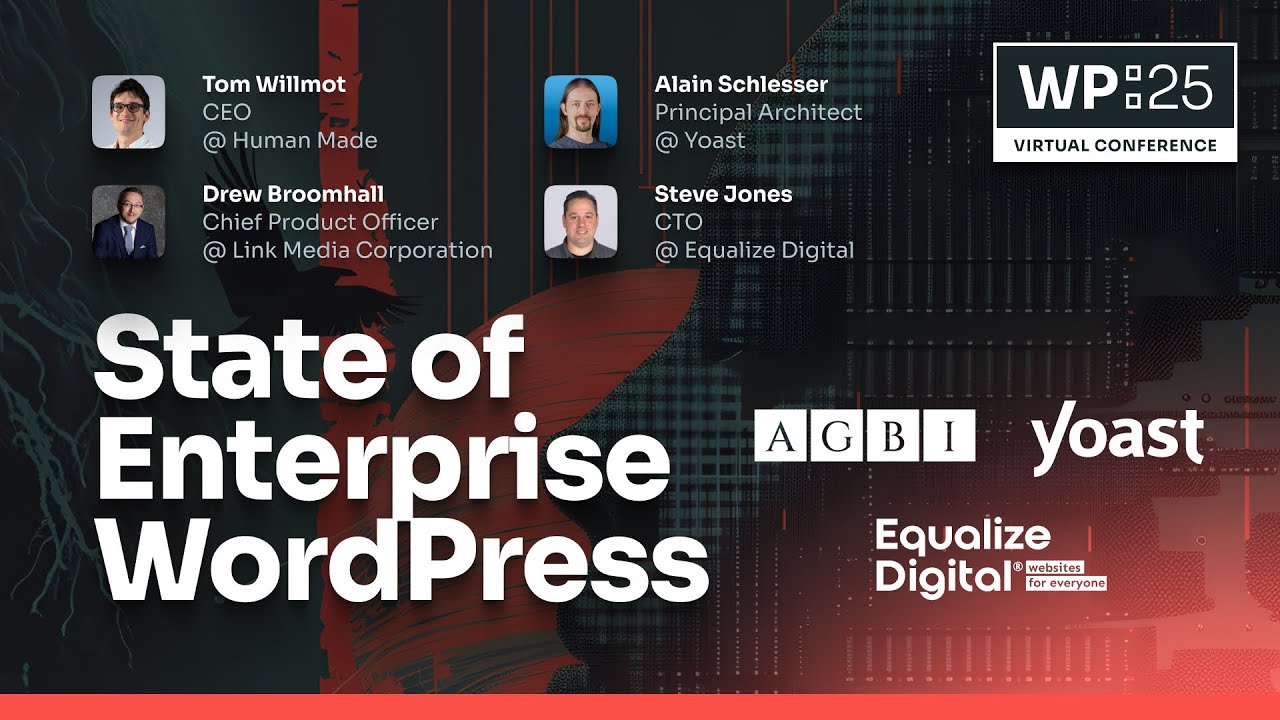
State of Enterprise WordPress
## Metadata
- Author: [[Human Made]]
- Full Title: State of Enterprise WordPress
- Category: #articles
- Document Note: ---
tags: [#EnterpriseWordPress, #StateOfEnterpriseWordPress, #OpenSource]
- #EnterpriseWordPress
- #StateOfEnterpriseWordPress
- #OpenSource
Author: [Panel Discussion Participants: Drew Broom Hall, Alain Schleser, Steve Jones, Tom, etc.]
Source: [State of Enterprise WordPress Transcript](https://www.youtube.com/watch?v=ObB_x9MVGps)
Reference: Transcript timestamps & related reports (e.g., ROI statistics, Red Hat report)
date created: {{date:2025-03-09}} {{time:HH:mm}}
---
# Title: 🚀 State of Enterprise WordPress: A Comprehensive Panel Analysis
## Table of Contents:
- [📝 Summary](#%F0%9F%93%9D-summary)
- [📖 Main Content](#%F0%9F%93%96-main-content)
- [🗒️ Notes](#%F0%9F%97%92-notes)
- [📖 References](#%F0%9F%93%96-references)
- [🗣️ Paraphrase](#%F0%9F%97%A3-paraphrase)
- [📰 Newsletter](#%F0%9F%93%B0-newsletter)
- [✅ Action Items](#%E2%9C%85-action-items)
- [🧪 Hypotheses](#%F0%9F%A7%AA-hypotheses)
- [📊 Methodology](#%F0%9F%93%8A-methodology)
- [❓ Questions](#%E2%9D%93-questions)
- [🔮 Future Research](#%F0%9F%94%AE-future-research)
- [💡 Implications](#%F0%9F%92%A1-implications)
- [🧠 Learning Styles Assessment](#%F0%9F%A7%A0-learning-styles-assessment)
- [📊 Accessibility Assessment](#%F0%9F%93%8A-accessibility-assessment)
- [🌍 DEIB Assessment](#%F0%9F%8C%8D-deib-assessment)
- [✅ Logical Validity](#%E2%9C%85-logical-validity)
- [🔍 DARVO Analysis](#%F0%9F%94%8D-darvo-analysis)
- [🔍 SEO Evaluation](#%F0%9F%94%8D-seo-evaluation)
- [🎯 Conclusion](#%F0%9F%8E%AF-conclusion)
## 📝 Summary:
The "State of Enterprise WordPress" panel explores the evolution and future trajectory of WordPress in the enterprise space. Celebrating 21 years of development, the platform is discussed in terms of its rapid evolution—highlighted by innovations such as AI integration and enhanced site editing. Key topics include the benefits of customizable editorial workflows, measurable ROI, improved performance and accessibility, and the rise of headless and composable architectures. The panel also addresses how these trends affect regulatory compliance and the integration of AI tools to streamline content management.
## 📖 Main Content:
Panelists discuss how WordPress has transformed to support large-scale content publishing, adapt to new regulatory environments, and incorporate modern technologies such as AI and headless CMS frameworks. The discussion is segmented into various themes, including the platform's enduring ROI, the need for tailored workflows in enterprise settings, performance enhancements, and the challenges of maintaining accessibility in a rapidly evolving technological landscape.
### 🗒️ Notes:
- **Panel Introduction & Context**
- 😊 [0:03](https://www.youtube.com/watch?v=ObB_x9MVGps&t=3): Welcome to the panel session; technical setup and greeting.
- 😊 [0:09](https://www.youtube.com/watch?v=ObB_x9MVGps&t=9): Introduction of the session's focus on Enterprise WordPress.
- **Evolution & ROI of WordPress**
- 😊 [0:27](https://www.youtube.com/watch?v=ObB_x9MVGps&t=27): WordPress, now 21 years old, continues to evolve with AI and site editing work.
- 😊 [0:58](https://www.youtube.com/watch?v=ObB_x9MVGps&t=58): 75% of organizations rate WordPress's ROI as good or excellent, indicating long-term commitment.
- **Custom Workflows & Content Publishing**
- 😊 [2:21](https://www.youtube.com/watch?v=ObB_x9MVGps&t=141): Drew emphasizes the importance of customizing workflows to support large-scale content publishing.
- 😊 [2:28](https://www.youtube.com/watch?v=ObB_x9MVGps&t=168): Discussion on meeting high traffic and content demands.
- **Performance, Accessibility & Compliance**
- 😊 [7:01](https://www.youtube.com/watch?v=ObB_x9MVGps&t=421): Enhancements in front-end performance are evident at an internet-wide scale.
- 😊 [9:25](https://www.youtube.com/watch?v=ObB_x9MVGps&t=565): Focus on accessibility governance, automation tools, and procurement for ensuring compliance.
- **Hybrid, Headless & Composable Architectures**
- 😊 [16:41](https://www.youtube.com/watch?v=ObB_x9MVGps&t=1001): WordPress is described as a hybrid CMS, combining traditional server-side rendering with headless capabilities.
- 😊 [17:29](https://www.youtube.com/watch?v=ObB_x9MVGps&t=1049): Discussion on composable architecture as a means to distribute risk and enhance flexibility.
- **AI Integration in WordPress**
- 😊 [29:01](https://www.youtube.com/watch?v=ObB_x9MVGps&t=1741): AI tools like Lovable and 10Web enable users to build sites with minimal technical input.
- 😊 [29:00](https://www.youtube.com/watch?v=ObB_x9MVGps&t=1741): Integration of AI and LLMs to enhance editorial capabilities and streamline workflows.
- **Accessibility in Headless Setups**
- 😊 [20:59](https://www.youtube.com/watch?v=ObB_x9MVGps&t=1259): Challenges with JavaScript frameworks and dynamic content affecting screen reader compatibility.
- **Balancing Priorities & Risk Management**
- 😊 [25:35](https://www.youtube.com/watch?v=ObB_x9MVGps&t=1535): Discussion on collaboration between different CMS approaches and converging features.
- 😊 [28:38](https://www.youtube.com/watch?v=ObB_x9MVGps&t=1718): Emphasis on managing risk and long-term project sustainability.
- **Regulatory & Compliance Considerations**
- 😊 [27:40](https://www.youtube.com/watch?v=ObB_x9MVGps&t=1660): Emphasis on accessibility regulations and compliance as key drivers for enterprise adoption.
- 😊 [8:01](https://www.youtube.com/watch?v=ObB_x9MVGps&t=481): Steve discusses accessibility challenges, particularly in headless implementations.
- **Final Trends & Future Outlook**
- 😊 [30:03](https://www.youtube.com/watch?v=ObB_x9MVGps&t=1803): Emerging trends include faster content delivery, AI-enhanced workflows, and increased modularity.
- 😊 [31:43](https://www.youtube.com/watch?v=ObB_x9MVGps&t=1903): Closing remarks emphasize the need for standardization, compliance, and continuous improvement.
## 📖 References:
- [State of Enterprise WordPress Transcript](https://www.youtube.com/watch?v=ObB_x9MVGps)
- Timestamp links:
- [0:03](https://www.youtube.com/watch?v=ObB_x9MVGps&t=3)
- [0:27](https://www.youtube.com/watch?v=ObB_x9MVGps&t=27)
- [0:58](https://www.youtube.com/watch?v=ObB_x9MVGps&t=58)
- [2:21](https://www.youtube.com/watch?v=ObB_x9MVGps&t=141)
- [7:01](https://www.youtube.com/watch?v=ObB_x9MVGps&t=421)
- [9:25](https://www.youtube.com/watch?v=ObB_x9MVGps&t=565)
- [16:41](https://www.youtube.com/watch?v=ObB_x9MVGps&t=1001)
- [20:59](https://www.youtube.com/watch?v=ObB_x9MVGps&t=1259)
- [25:35](https://www.youtube.com/watch?v=ObB_x9MVGps&t=1535)
- [28:38](https://www.youtube.com/watch?v=ObB_x9MVGps&t=1718)
- [29:01](https://www.youtube.com/watch?v=ObB_x9MVGps&t=1741)
- [30:03](https://www.youtube.com/watch?v=ObB_x9MVGps&t=1803)
- [31:43](https://www.youtube.com/watch?v=ObB_x9MVGps&t=1903)
## 🗣️ Paraphrase:
- **Paragraph 1 Original ([0:27]-[0:40]):**
*"WordPress, now 21 years old, is evolving rapidly with new innovations like AI and site editing. The platform's continued evolution is driven by the demands of enterprise users seeking scalable and customizable solutions."*
- **Paraphrased:**
"At 21 years, WordPress is undergoing significant transformation, incorporating advanced features such as AI and enhanced site editing. This evolution is largely fueled by enterprise needs for scalable, tailored solutions that keep pace with modern demands."
- **Paragraph 2 Original ([16:41]-[16:54]):**
*"WordPress operates as a hybrid CMS by combining traditional server-side rendering with headless capabilities. This approach allows for robust content management alongside flexible front-end development, crucial for mitigating long-term project risks."*
- **Paraphrased:**
"Functioning as a hybrid CMS, WordPress merges conventional server-rendered content with headless functionality. This dual strategy supports both strong content management and adaptable front-end design, which is essential for reducing risks over a project’s lifespan."
## 📰 Newsletter:
Hello WordPress enthusiasts! In our latest newsletter, we dive deep into the "State of Enterprise WordPress" panel. Discover how WordPress continues to evolve at 21 years, incorporating groundbreaking features like AI integration, advanced site editing, and hybrid CMS functionality. Learn how these innovations enhance performance, regulatory compliance, and customizable workflows for large-scale publishing. Stay informed on the future of enterprise WordPress by checking out the full discussion [here](https://www.youtube.com/watch?v=ObB_x9MVGps). Keep pushing the boundaries of open source and digital innovation!
## ✅ Action Items:
- **For Developer Advocates & Educators:**
- Integrate insights from the panel into training sessions on enterprise content management and WordPress customization.
- Develop workshops on optimizing editorial workflows and leveraging hybrid CMS architectures.
- Emphasize the importance of accessibility, performance, and compliance in your community outreach.
- Use the discussed trends to advocate for open source and sustainable funding models.
- **Career Alignment:**
- Leverage these insights to strengthen your role in open-source advocacy and contributor engagement.
- Align your educational materials with strategies that promote transparency, inclusivity, and long-term innovation in WordPress.
- Utilize the panel’s findings to support your aspirations toward an OSPO role by emphasizing risk management and strategic decision-making.
## 🧪 Hypotheses:
- 😊 **Hypothesis 1:** Enterprise adoption of WordPress will increase as hybrid CMS features and AI integrations improve scalability and performance.
- 😊 **Hypothesis 2:** Focused investments in accessibility and compliance will lead to higher long-term ROI for enterprises using WordPress.
- 😊 **Hypothesis 3:** The modular, composable architecture of WordPress will enable more effective risk management and customization for large-scale projects.
### 📊 Methodology:
- **Data Sources:** Gather data from enterprise case studies, user surveys, and performance analytics from WordPress deployments.
- **Research Designs:** Conduct comparative studies between organizations using traditional CMS approaches versus those leveraging hybrid and headless architectures.
- **Analysis Techniques:** Utilize quantitative metrics (e.g., ROI, performance benchmarks) and qualitative interviews to assess workflow efficiency and compliance outcomes.
### ❓ Questions:
- How does AI integration in WordPress impact content publishing workflows at an enterprise level?
- What are the most significant barriers to achieving full regulatory compliance in a hybrid CMS environment?
- How can modular design and composable architectures further mitigate risk in large-scale WordPress projects?
### 🔮 Future Research:
- Investigate the long-term performance differences between traditional and hybrid WordPress setups.
- Explore the evolving role of AI in automating content creation and workflow management.
- Assess the effectiveness of accessibility automation tools versus manual testing in maintaining regulatory compliance.
### 💡 Implications:
- **Advancing Knowledge:** Results could redefine best practices for enterprise CMS strategies and improve our understanding of scalable digital infrastructures.
- **Influencing Practice:** Findings may drive the development of new features in WordPress, especially around AI integration and accessibility.
- **Policy Impact:** Insights could inform regulatory standards and open-source funding priorities, promoting a more inclusive and secure digital ecosystem.
## 🧠 Learning Styles Assessment:
1. **Visual Learners (Spatial)**
- **Present:** The panel includes slides and visual demonstrations of performance metrics.
- **Improve:** Enhance with more detailed infographics and flowcharts illustrating hybrid CMS architectures and AI workflows.
2. **Aural Learners (Auditory-Musical)**
- **Present:** The session is delivered as a live panel discussion.
- **Improve:** Offer audio summaries or podcast episodes featuring panel highlights.
3. **Verbal Learners (Linguistic)**
- **Present:** Detailed explanations and technical discussions are prevalent.
- **Improve:** Supplement with annotated transcripts and deeper textual analyses.
4. **Physical Learners (Kinesthetic)**
- **Present:** References to interactive Q&A sessions and live demos are made.
- **Improve:** Organize hands-on workshops or live coding sessions to demonstrate enterprise WordPress optimizations.
5. **Logical Learners (Mathematical)**
- **Present:** Structured discussion on performance, ROI, and risk management.
- **Improve:** Incorporate step-by-step guides, comparative charts, and case study data.
6. **Social Learners (Interpersonal)**
- **Present:** Emphasis on panel discussions and collaborative problem-solving.
- **Improve:** Facilitate group discussions and peer review sessions centered on Enterprise WordPress strategies.
7. **Solitary Learners (Intrapersonal)**
- **Present:** In-depth analysis and reflective commentary are provided.
- **Improve:** Include self-assessment checklists and journaling prompts on strategic decision-making.
8. **Naturalistic Learners**
- **Present:** Limited direct references.
- **Improve:** Introduce analogies comparing system architectures to natural ecosystems for enhanced relatability.
## 📊 Accessibility Assessment:
- **Screen Reader Compatibility:**
- **Present:** The content is well-structured; however, multimedia elements require alt-text.
- **Improve:** Ensure all images and diagrams have descriptive alt-text and utilize semantic HTML.
- **Keyboard Navigation:**
- **Present:** The text structure is inherently navigable.
- **Improve:** Confirm that interactive components (e.g., timestamp links, embedded media) are fully keyboard accessible.
- **Contrast and Readability:**
- **Present:** Clear formatting is used.
- **Improve:** Utilize high-contrast color schemes for any visual materials and test readability across devices.
- **Text Resizing:**
- **Present:** Content appears responsive.
- **Improve:** Optimize layout to maintain clarity when text is resized on different devices.
## 🌍 DEIB Assessment:
- **Cultural Relevance:**
- **Present:** Focuses on global enterprise and open source communities.
- **Improve:** Incorporate diverse case studies and examples from various cultural contexts.
- **Inclusive Language:**
- **Present:** Language is professional and neutral.
- **Improve:** Update terminology periodically to ensure inclusivity and accessibility for non-native speakers.
- **Neurodiversity Support:**
- **Present:** The structured format aids comprehension.
- **Improve:** Break up lengthy sections with bullet points and headers to improve focus.
- **Representation:**
- **Present:** Panel features diverse industry experts.
- **Improve:** Include additional perspectives from varied socioeconomic and cultural backgrounds.
- **Psychological Safety:**
- **Present:** Tone is respectful and constructive.
- **Improve:** Include trigger warnings for highly technical sections if necessary.
## ✅ Logical Validity:
- **Sound Deductive Reasoning:**
- **Example:** The claim that WordPress’s hybrid nature enhances scalability is supported by architectural details ([16:41](https://www.youtube.com/watch?v=ObB_x9MVGps&t=1001)).
- **Strength:** Logical connection between system design and performance benefits.
- **Suggestion:** Include more empirical data to further substantiate these claims.
- **Strong Inductive Reasoning:**
- **Example:** Drew’s discussion on customized editorial workflows ([2:21](https://www.youtube.com/watch?v=ObB_x9MVGps&t=141)) draws on observable industry trends.
- **Strength:** Real-world examples strengthen the argument.
- **Suggestion:** Augment with additional case studies.
- **Potential Logical Fallacies:**
- **Strawman:** Minimal occurrence; some challenges of headless configurations might be oversimplified.
- **Suggestion:** Address these complexities with more nuanced counterarguments.
- **Circular Reasoning:** Some points reiterate benefits without introducing new evidence.
- **Suggestion:** Break the cycle by providing fresh supporting data.
- **Appeal to Authority:** Heavy reliance on statistics (e.g., ROI and accessibility reports) without critical examination.
- **Suggestion:** Supplement with independent data sources.
- **Overall Logical Flow:**
- **Observation:** The discussion follows a coherent progression from platform evolution to future trends.
- **Suggestion:** Ensure smooth transitions between topics for enhanced clarity.
## 🔍 DARVO Analysis:
- **Deny:**
- **Observation:** Panelists acknowledge challenges (e.g., accessibility issues at [9:25](https://www.youtube.com/watch?v=ObB_x9MVGps&t=565)) rather than denying them.
- **Analysis:** This transparency builds credibility by openly addressing limitations.
- **Attack:**
- **Observation:** No ad hominem or personal attacks; criticisms target system shortcomings.
- **Analysis:** Constructive critiques promote a collaborative approach to problem-solving.
- **Reverse Victim and Offender:**
- **Observation:** The panel does not shift blame; it focuses on joint responsibility for improvement.
- **Analysis:** Maintaining a balanced tone avoids manipulative rhetoric.
- **Overall DARVO Conclusion:**
- The discussion is free of DARVO tactics. Panelists engage in factual, respectful dialogue and focus on systemic improvements.
## 🔍 SEO Evaluation:
- **Keywords:**
- **Presence:** Keywords like "Enterprise WordPress," "hybrid CMS," "accessibility," "composable," and "AI" are well integrated.
- **Placement:** Keywords appear in the title, headers, and early content.
- **Meta Description:**
- **Observation:** A meta description can be derived from the summary.
- **Suggestion:** Craft a concise description (150–160 characters) that highlights WordPress's evolution and enterprise benefits.
- **Title Tag & Headers:**
- **Observation:** The title and headers are clear and keyword-rich.
- **Suggestion:** Continue using concise headers to enhance search engine visibility.
- **Content Length & Value:**
- **Observation:** The content is detailed and exceeds 1,000 words, offering substantial insights.
- **Internal/External Links:**
- **Observation:** Timestamp links and source references bolster credibility.
- **Suggestion:** Ensure all links are current and lead to authoritative sources.
- **URL Structure:**
- **Observation:** The source URL is descriptive and concise.
- **Image Optimization & Mobile:**
- **Observation:** Future images should include alt text.
- **Suggestion:** Optimize multimedia for fast loading and mobile responsiveness.
- **User Engagement:**
- **Observation:** Interactive elements, such as timestamp links, encourage engagement.
- **Suggestion:** Add social sharing buttons and clear calls-to-action.
- **Schema Markup & Social Sharing:**
- **Observation:** Implementation of schema markup can further enhance search visibility.
- **Suggestion:** Use Open Graph and Twitter Card tags for better social sharing previews.
## 🎯 Conclusion:
The "State of Enterprise WordPress" panel offers a thorough exploration of WordPress's ongoing evolution within the enterprise landscape. The discussion highlights its transformation into a hybrid CMS, the increasing role of AI and site editing, and the vital importance of performance, accessibility, and compliance. With insights from leading experts, the panel emphasizes how WordPress supports scalable content publishing and customizable workflows while adapting to regulatory demands. Overall, the panel provides valuable guidance on managing risk, optimizing editorial processes, and leveraging emerging technologies to ensure WordPress remains a robust platform for enterprise use.
- URL: https://www.youtube.com/watch?v=ObB_x9MVGps&ab_channel=HumanMade
Okay, here we are. I think we're now livein this room. Give us a wave in chatif you are hearing me and seeing us all.There should be four of us onscreen. This is going to be apanel session, so we've got some esteemedguests. I'm excited to hear fromeach of them, and we're going to betalking about the state of EnterpriseWordPress. WordPress is 21 years oldand it's still evolving pretty rapidly,as we've just been seeingwith all this AI and siteediting work. The site editor inparticular is starting to be adopted byEnterprise, and we're really seeing that.We’ve also got collaborative editingcoming soon as we get into the meetof phase three, and even multilingualafter that with phase four.
A stat I saw from thestate of Enterprise WordPress report,which folks may have already seen,can go and check that out. If not,75% of organizations rate WordPress'sreturn on investment as good orexcellent and plan to stick with it forthe long term. That's agreat foundation.
It's also a great time for opensource. More generally, we're seeing theopen source AI movement. I thinkthis introduces more enterprise companies tothe concept of open source, and thecore benefits of open source are alsojust starting to be, or I thinkactually now have become much moreaccepted within the enterprise.One of my favorite stats is from RedHat's annual state of enterprise open source, and that's thatnearly 90% of IT leaders — 89% — they saysee enterprise open source as moresecure or as secure as proprietarysoftware, which those of us who have beenin open source or related for a longtime have seen that shift. So
anyway, enough from me. We're going to diginto all that and more. I'm joined byDrew Broom Hall, the chief productofficer at Link Media, oneof their publications is Agbi. Wejust saw a little showcase of some coolAI stuff. We've also got AlainSchleser, the principal architect at Yast,and Steve Jones, CTO of Equalized Digital.So I'm going to dive right in with aquestion for you, Drew. I'll askyou just at the beginning of theQuestion: give us a bit of background,and explain a little bit of your background as it’s relevant towhat we’re talking about today.
As someone who’s in product at a fast-growing media company that’schosen WordPress, how do you think aboutthe platform's strengths and weaknesseswhen it comes to supporting large-scale agile content and publishingteams and workflows and the kind of needs that youhave?
Yeah, sure. Um, so hello everyone,my name is Drew. I’ve been in onlinepublishing slightly longer thanWordPress has been around; I think it’s23 years now. I started out as ajournalist and website editor, thenstarted specializing in SEO for mediabusinesses and ended up runningsearch for a lot of very large websiteswith millions of pages ofcontent. I then sort of pivoted intoaudience development and eventually into what I’m doing now, whichis product and technology formedia businesses. In terms ofwhat I’m looking for regardingenterprise-scale publishing,Um, I would say I kind of look at scale
in a couple of ways. You know, can wesupport the editorial team trying to dowhat they’re trying to do? Um, which meanscan we provide them the workflows, thecustom workflows that they need to beproductive? Can we provide them thetools that allow them to dothe job? Um, in which case, you know, WordPressis a good choice for that because of thecustomization options that are availableto design custom workflows and make surethat it’s tuned to do exactly whatwhat the editorial team wants it to do. Iguess then you can look at, um, youknow, what are we trying to publish?
You know, how much are we trying to publish?Um, what quantity of content are wepublishing? And importantly, how muchtraffic are we actually tryingto deliver?Um, and what performance do we actuallywant to try and get out of theplatform? Um, and there I think, you know,WordPress has made some pretty goodstrides in becoming, you know, just anaturally more performant platformthan it was many years ago. Um, and youcan get a pretty good level ofperformance out of a fairly small amount.
The use of hardware, which is a definite plus,for small media businesses likeourselves that don't want to spend a huge amount,allows us to get things out quickly.So, yeah, that'sgreat.Thanks, Elain. Maybe I'll come to younext as someone who has been deeplyin the architecture of WordPress forquite a long time. I wonder whether youcould speak a little bit about thatjourney that WordPress has been on andthe improvements Drew was talking aboutin terms of really making surethat WordPress is able to scale tomeet the content needs oforganizations that have a lot of peopleworking on the content and mayhave complex workflows.
[Music]Um, yeah, sure. So first of all, hieveryone. I'm the principal architect withYAST. I'm generally very involvedin WordPress and open source in general.As Tom mentioned, I've done myfair share of core contributions as welland peeked behind the curtain. WhatI've seen is that there's more ofa focus on enabling customizations toThe core of the editorial workflow is whereit really matters. So what R mentionedwith the editorial workflow reallybeing at the center of attention when building a new site,I think that is the main problem to solve forany scalable solution. You don't onlyneed to scale it in terms of performance
so that it technically runs, but you alsoneed to scale it across teams and acrosscorporate structures and so on. So,what I've seen is that there's apronounced focus on making thiseditorial scalability work. Then,there are teams like the performanceteam that make sure that once you'vebuilt a solution that actually fits theeditorial requirements, you also then have allsorts of automatic performance gainsthat are being done for you behind thescenes. There has beenan accelerating trend towards gettingbetter and better front-end performance.
For the actual visitor opening thewebsite in the browser, there’s anoticeable improvement between major versions of WordPress already.This is happening at a scale where thisCan be measured at the internet level,where we actually notice that theinternet in general is getting fasterand more performant because of thechanges in WordPress. Wow, that’s a prettyincredible thing to be able tomeasure and to say. Um, Steve, I’d love tocome to you next, and step a littlebit back from content. I think somethingthat’s becoming increasingly importantto enterprise and the public
sector where we’re seeing WordPressgrowth, is the broader regulatory andcompliance landscape. Um, and so I’d lovefor you to just share a little bit aboutyour background there, because I knowthat’s something that you reallyspecialize in. Uh, and then I think if youcould talk a little bit about thatlandscape and how that’s likely to beimpacting enterprise companies who arechoosing WordPress over the nextcouple of years. Sure, thanks, Tom. Glad tobe here. A little bit of background onmyself: I’m the CTO of Equalized Digital.
We focus on making WordPress moreaccessible for enterprise, government, andhigher education organizations.We built the Accessibility Checkerplugin to help automate maintenance.
Accessibility compliance. I've been working inWordPress for over 15 years and havecontributed accessibility fixes toWordPress core releases. As far as regulation, I thinkwe're at a turning point whereaccessibility is no longer just a bestpractice; it's a legal requirement inmany industries, with regulations likethe Americans with Disabilities Act increasinglybeing applied to digitalspaces. The European Accessibility Actis coming into force later this year, andupdates to Section 508 in the USmean enterprise companies can no longerafford to ignore accessibility or
treat it as an afterthought. We'veseen several lawsuits across awide range of industries. For enterprise companiesthat are looking to get this right,and in our limited time here, I want to justfocus on three key areas that I thinkwould be good to prioritize:one, governanceandaccountability. Assign responsibility;if accessibility is everybody's job, it'snobody's job. Define clear ownershipover accessibility, and document training.
And make policies in those regards, too.Automation and testing,while the accessibility checkerplug-in is an automated tool and can catcha lot and can help you, um, accelerateyour accessibility compliance. Um, manualtesting and user testing are stillrequired. And finally, um, procurement andthird-party integrations. So accessibilityisn't just about what we build; it's alsoabout the themes, the plugins, the thirdparty software that we integrate intoour projects. Uh, with procurementpolicies that consideraccessibility. Um, there is a defined, uh,standard level of compliance forsoftware that we introduce into ourprojects. So ultimately, accessibilityshould be a core part of the digitalstrategy. It reduces legal risk, itimproves user experience and produces, uh,better engagement and businessoutcomes. Um, actually a question thatI saw come up at a recent WordPress meetupI was at, uh, where someone deliveredan accessibility talk was around usertesting. And so I, um, thinkthe person, uh, didn't really get aquestion there. So maybe I'll just readit here: do you have any, um, any tips or
Signposting for how people can approachuser testing, if that's notsomething they've done before. Um, becausethat's something I do hear come up. Ireally would love to. It's onething to use these automated tests, butthey don't necessarily catcheverything. But do I go about findinguser tests? So, you know, are thereorganizations that you could signpost tothat offer that? Yeah, yeah, so you canpartner with accessibility companiessuch as Equalized Digital. But thereare many companies out there, not just topromote ourselves, but where we canhelp facilitate that user testing. Wecan help put together thoseuser test stories on whattypes of audiences need to betested—whether you know it's fully blindusers, users with different kindsof assisted technologies. Um, and youcould put that together and then wecould do the user testing and providethose reports back. You can alsolook at doing that in-house,reaching out to local industries thathave blind users and trying to pay them,hire them to come in and do user testing.
They don't always necessarily have to betechnical, but we want to be respectful of these people andprovide this as a freelance opportunity for them. Bringthem in, have them test it, and pay them afair wage to do so. Very cool, thank you. Okay, that'suseful to know. I'll offer that as ananswer next time at a WordPress meetupand see that asked. Um, Drew, maybe Icome to you next as someone who'smaking these kinds of product decisions.I'd love to hear a bit about how youthink about prioritizing accessibility, performance,and SEO. Sometimes, these can feel likecompeting priorities. I think we have asense sometimes in the industry you'llhear people who work in agencies orplatforms saying, "God, I wish clientscared about this more" or something. How do you think aboutthe rigor environment and balancing those prioritiesas you're approaching your product decisions?
I'm not sure I really see them ascompeting priorities. I mean, ultimately,accessibility, as Steve points out, youhave a legal responsibility.
You can know virtually any sector now to makeyour website compliant. So,it’s really—you’ve justgot to do that and make sure youdedicate time to it. Do businesses alwaysdo that and prioritize it? Probably not.But I think, gradually, as people become moreunderstanding of the regulations, I thinkpeople do take it seriously. I thinkperformance and SEO have converged to apoint where you can’t really separatethe two, and SEO teams end up nowactually being a primary driver andsponsor of performance improvements.
They end up actually, you know, reallychallenging their DevOps teamsto really maximize performance on sites.This is something that I hear fromSEOs, you know, in large and smallpublishers. So, yeah, I don’t think therereally is a convergence. I thinkGoogle introducing Core Web Vitals wasprobably the critical thing that broughtall that together. Because all of asudden, there was this relationshipbetween, you know, supposed search engineperformance and a little marginal gainthat you might get, and ensuring thatYour platform was fast, and I thinkthat has really brought it together.
It's also given you a very obviousvisual indicator which the wholebusiness can get around to be ableto visually measure the improvement of the userexperience. Okay, that's greatto hear. Yeah, I mean not these things aren't competing forpriority. I think that's progressprobably in the industry as well, thatwe've managed to get to the point wherethose things are not competing so muchfor budget and time. Okay, I'dlike to step back a littlefrom that. I think another thing thatcame through really clearly in theState of Enterprise WordPress report, andalso is the topic of discussionwhen I'm talking to other CMSvendors and providers, is thisrise of headless and composable asa trend. We've kind of gone from thesetraditional CMS to this DXPera, now hearing a lot about composable.
Elaine, maybe I'd come to you first.I think it'd be really interesting to hearyour architectural take on what thoseLet's sort out what some of thatactually means and then relatethat back to WordPress, because weare probably not used to thinkingof WordPress using these industryterms. However, we find that WordPressdoes have elements that speak to some of those terms.
So, first of all,WordPress is, according to currentdefinitions, considered a hybrid CMS — ahybrid between a traditional CMS, whichbasically means that everything happenson the server, and the server puts outthe content to your browser in some way,and a headless CMS, which allows youto decouple the server from the frontend that the visitor actually sees.
If you consider a traditional press theme,the theme generates the output for the browser onthe server side and sends it to thebrowser, whereas a headless approachwould mean that the browser never contactsthe server; it just sees that front end.The front end makes REST APIrequests to the WordPress back end tofetch the content and display it in away that is decoupled from theactual WordPress system.
Server, and so WordPress is considered ahybridCMS because it can actually offerboth of theseapproaches. Composable has been a morerecent term, which means everythingand nothing. Basically, it just means thatyou're not putting all your eggs in onebasket, and that is generallygood business advice. Morespecifically, in terms of a tech stack, itmeans that you have more dedicatedmodular systems for parts of yourentire web presence. Basically, youmight have your WordPress sitethat is serving your landing pages. You
might have a dedicated e-commercesolution for your shop, and so on,and so forth. Composable, dependingon what granularity it can be, is a very smallsystem or a very big system. So basically, itmeans that you try to manage risk asbest as you can. And so, as anarchitect, my role is basically tounderstand the risk, understand therequirements, and the expected lifespanof a project, and then come upwith a way of properly managing the riskacross that entire lifespan of theproject.
On this page, you don’t need to care too much; youcan just pull it up in whatever you cancome up with because you don’t need tolive with the consequences of yourdecision 20 years down the road.Usually in the enterprise space, you makemore long-term decisions, and thatmakes everything a bit harder, and that’swhy something like a hybrid CMS likeWordPress is so interesting. Youcan basically mix and match as neededand just splityour larger project into smallerprojects and optimize the solutions forthose smaller project spaces so that youget more of the benefits and less of the
drawbacks. Because in the end, everythingis a trade-off, and if you can spliteverything up into multiple decisions, youcan optimize those decisions for thedifferent parts. So as anarchitect, I really would encourageeveryone to consider this entireequation that you want to solve: howcan I best manage my risk? Because therewill not be any guarantees, but you cando your best to understand and mitigatethe long-term risks and make sure thatyou have the best chance of having asuccessful project delivery.
Uh, having a project that is viableand sustainable throughout its entirelifespan makes long-term decisions important.
I'm going to come to you in a minute because I'd love to getyour thoughts on that decision point that a lot ofproduct leaders are faced with. But,Steve, first of all, I think if youknow people are choosing theseheadless or decoupled approaches,I think it'd be useful tounderstand whether there are specificaccessibility considerations that comeinto play there.
So, maybe youcould speak a little bit to that.Sure, headless absolutely introduces anadditional level of complexity foraccessibility. Whereas your traditional WordPress themeactually comes with semanticHTML and WordPress best practices out ofthe box. Headless setups requirebuilding front ends from scratch inJavaScript using frameworks likeReact and Vue, so accessibility is no longer a givenat that point and it must be intentionallyimplemented. Sure, there’s a lot ofstuff with frameworks that kind of help.
This along, but you really need tomake considerations for HTML SMS becauseI mean it's a kind of a blank canvasthat you can kind of do anything on, andyou need to make considerationsfor keyboard functionality anddynamically loaded content, which youknow these front-end frameworks, that'spretty much what they do; they justmanipulate parts of the DOM in and out,and that's kind of withoutannouncing that to a screen reader. Like,the screen reader reallydoesn't, or the screen reader user has nocontext for what's happening on that
single-page application. So, you have tomake lots of considerations foraccessibility when using thesefront-end frameworks. Yeah, and I mean I think thatproblem, that's kind of reflective, you know,a little bit of what you were touchingon actually, Alen, that if you're goingto decide to do something decoupled,you're really taking much moreresponsibility for then buildingeverything that you no longer are goingto get as part of the hybrid or traditional system,which you know maybe that's a good thing.
And you're excited by that extraresponsibility and the flexibilitythat's going to give you, but moreoften than not, I think what we seeare people not realizing that, and thenperhaps they bring surprisedown the road when they're missingsome of those things that maybeyou take for granted. Um, Drew, anyway,how did you approach makingthis decision for Agbi? How do youthink about this headless? I mean,in the industry, we think ofheadless and non-headless as ifthey're two sides of the industry. Doesthat even matter so much to you? Um, howdo you think about that? I think thereare three questions you need to askyourself about the product that you aregoing to be shipping, and your usersare going to be engaging with. So thefirst one is, how static or dynamic doesmy platform need to be? Because if
you're going down a very static routewhere everybody is seeing exactly thesame thing, then you don't necessarilyneed the gains that you might be gettingfrom a JavaScriptframework. Then related to that iscontent freshness. So how much am I goingTo be publishing, how often are my pagesgoing to be changing? Because again, thathas implications on things like cachingstrategy. If you’re not changing much, ifit’s very static landing pages, they canjust sit there in cache for a long, longtime, and again, you don’t really need todo anything. Whereas if you’re publishingreally up to the minute, you know, lots ofnews coming out, then you mightwant to be making some changes. Thefinal one would then be, am I relyingjust on content from my CMS, or does theproduct that I build use data from otherAPIs? You know, am I using other services?
So for example, at my last company, Ibuilt a business intelligence platformwhich had a mobile app, a websiteapp, and also integrated data into a CMS.It was using editorial contentand a very complex database. It madesense to run everything completelyheadless in that context, because it ggave us the flexibility to be able topull together all the APIs, and it was avery, very dynamic experience. I thinkwhat you’re seeing now, you know, thestatistics were saying that people aremoving away from headless. I think what’shappened is a lot of publishers.
Particularly, publishers got very excitedabout the idea of headless. They ended upbuilding these solutions and discovered that, actually,they're far more complex when it comesto making SEO work, getting Google bot tofind them. Even things like gettingyour analytics working are that muchharder, and they've realized thatactually they don’t need thatfunctionality and they can do perfectlywell with just static sitegeneration based on a hybrid approach. SoI think that's where the retrenchment iscoming from.
Yeah, that makes a lot of sense. Imean, it has been somewhat heartening tosee it go through that cycle asan industry, and although there isstill quite a lot of interest, it feelslike, yeah, that it’s maturing a littlebit in terms of understanding, okay, whereis it a good fit and actually whereis it a bit unnecessary? And we’reseeing this trend where kind of all theplayers, whether they were pure headlessor traditional, are all starting toadd each other’s features, and so there’sthis little bit of a kind of meeting inthe middle happening.
This is interesting. Alright, gosh,we're already 25 minutes in, so Ithink we're doing pretty well. We'vekept the session tight. 30 minutes isn'tlong for a four-person panel. I'mdiscovering, so I think we could wrapup with a bit of a lightning round.I think I could ask each of youto give me a major trendthat you're seeing, and give us a littlesense of how you think that's going to impactWordPress, and maybe what you'd like tosee from either the product or theplatform, or kind of the broader
ecosystem. And Steve, maybe I'llcome to you first on that. I'll give youthe easy one out of the way, and then make the othertwo think a bit harder. There yougo. What I'd like to see from theecosystem is just more continuedstandardization, accessibility,security. You know, compliance is oftenleft to individual agencies and siteowners to figure out. If we buildWordPress core, hosting environmentsor hosting providers, and plugindevelopers build compliance first.
Software, I think it's going to be, uh, somuch easier for enterprise companies touh, have a smoother path toadoption. Very cool! I mean, yeah, I wonderjust already off the top of my head, uh,whether there could be morecollaboration between, uh, you know, peersin the space, even competitors in thespace, uh, to just kind of worktogether and raise the bar for everyoneon that. Um, love it! Uh, Ela, I'm going tocome to you next.
Um, yeah, so what we've seen alreadyas a paradigm shift that has started dueto the rise of AI agents and LLMs isthat more and more of your content willbe consumed by machines as the firstpoint of contact instead of humans.Uh, so that makes, um, things likeinformation architecture and structuralcontrol much more important,and, um, I hope that WordPress will addthe necessary features in the editorialworkflow so that you can actually manageum, the site as a whole in terms ofhow it can be paused and navigated aswell. Um, and, um, by the way, accessibilityis a big part of that because alsoeverything that is accessible is usuallyeasier to parse by LLMs and be forwarded.
To the users' agent, I personally hope that WordPress will takeits role as market leader seriously anduse its critical mass to help emerge newstandards and new protocols todrive this paradigm shift in theright direction.Yeah, very cool. Um, okay Drew,you can close us out with yourtrend and perhaps what you’rehoping to see from WordPress.
Well, seeing as you did a great job of sneakpreviewing our better AI product, itwould be remiss of me not to talk aboutAI.Um, a couple of things I want to talkabout. The first one is something thatNoel didn’t cover, which is the ideaof sort of AI coding. Um, you know,kind of being able to build thingswithout that much technical expertise.I’m fascinated by products like Lovableand 10Web. You know, the latter inparticular is fascinating. Youknow you can spin up a WordPress sitejust by giving it prompts, withall the security taken care of, hostingtaken care of, performance, all of thatup and running. That’s obviously going tohave an impact at the lower end.
One person, bound to a small agency and WordPress, to begin with, but where I'mlooking at it as a product leader, isif that opens up opportunities for usto be able to ship things faster,especially when we start taking intoaccount the kind of things that the teamis showing around the block editor andthe changes that WordPress is makingin being able to build thingswith much less involvement fromdevelopers. Perhaps the next step is youknow, to actually be able to allowproduct owners to really command thatwith even less technical input,and get things out faster.
Secondly, and I think you know, LLMs aremaking their way into WordPress viaplugins. You know, for example, you canget it to generate page titlesand meta descriptions for you; that'sgreat. I think looking at ways of morenatively bringing that in, so that wecan start using LLMs for slightly morecomplex tasks. I've got an editorial teamthat's already asking me for new AIfeatures. You know, they're already coming tome saying "What about this? What aboutthat?" Some quite complex things are beginningto bubble up.
How we get that integrated more tightlyis going to be a key thing over thenext couple of years. Very cool! Yeah, I feellike this is going to be the year where we're going to seethe rubber hit the road with abunch of that stuff. Last year was moreexperimental. I think that's really cool. Um, okay, folks, I think we'llwrap the panel there. I hopeeveryone who's been listening alonghas enjoyed it. Thank you very much, Drew,Steve, and Elaine for sharing yoursignificant experience and yourtime with everyone here. I am goingto press end on the broadcast here and
then I'll hop over to the other room for everyone watching,and pulleveryone over there. We’re goingto have our closing session, which Ithink is going to segue perfectly fromsome of the discussions we’ve had here.We’ve been talking about what we mightwish for the future of WordPress. MaryHubbard, the Executive Director ofWordPress, is going to outline howshe’s thinking about the future ofWordPress. So, let’s get on withthat., State of Enterprise WordPress, Human Made, 01jnystd6jeaktgvwvk8cme5ka.