Stop Brainstorming: Do THIS Instead
🔗 **Source:** [Stop Brainstorming: Do THIS Instead](https://www.youtube.com/watch?v=v_vCPAqpEBI)
Reflect on this question for a moment.What kills your productivity?Microsoft had the same question. Theyran a study a couple of years ago, and theyfound that in fact, none of these thingscame out on top. It wasn't socialmedia. It wasn't multitasking. It wasn'tthe overload of meetings or the manyemails.But if it wasn't any of these, then whatdo you think kills your productivity?Well, the Microsoft study found that itwas unclear objectives.And in fact, you need to understand thedifference between speed and velocity.Speed is how fast you're running, howfast you're moving. Velocity is how fastyou're getting from point A to point B.How much progress you're making becauseyou know you can be running super fastbut if you're running around in circles,you're going to get from point A topoint A, and maybe you're not running sofast, but you're making constant progressfrom point A to point B. You're stillGoing to have a decent velocity.
So, essentially, what kills yourproductivity is running around incircles. And it's not because we lackinformation. In fact, in my experience,it's because we lack structure. Andtoday, I want to show you a deceptivelysimple and childish tool called thecircle map that helps you address this.And don't be fooled by the simplicity.
This tool is amazingly powerful. This isone of the eight thinking mapsintroduced in visual tools fortransforming information into knowledge.And you can think of the circle map andall the diagrams and visualframeworks. If you want to use a fancyword, you can think of them as cognitivescaffolding. Effectively, they're toolsthat help you organize, see, and reflecton information.
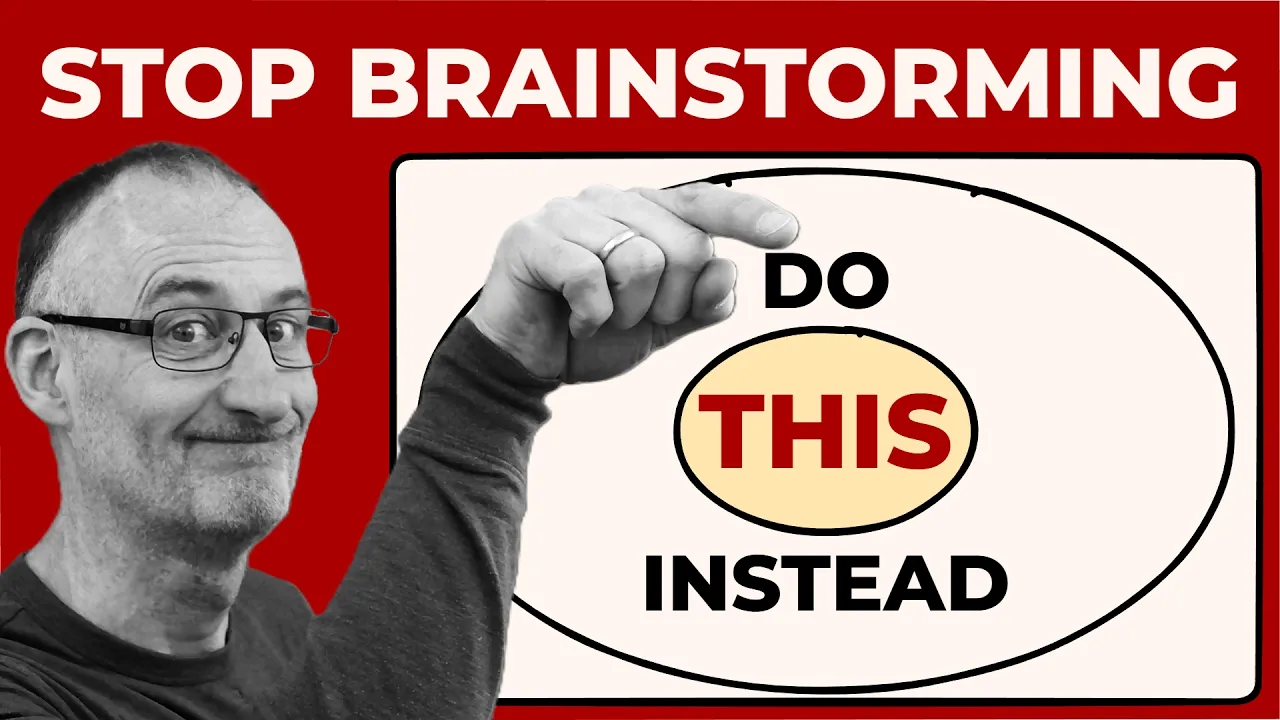
And so, what is a circle map? Well, it'svery simple. In the center, you writedown the topic that you want to define.And in the outer circle or the donut,You write the context. You know, you write down everything that you knowabout the topic. And I can hear you already at this moment. You say thathorriel, but you said stopbrainstorming. And this is effectivelybrainstorming. What's the difference?
Well, the difference is the frame ofreference. It's that rectangle aroundthe outer circle. That's where you askthe question of how do I know what Iknow? What is influencing thisdefinition? So, [clears throat] let'slook at an example. We're going to lookat the circle map of casino carpets tohelp you understand the entire concept.
So in the center I'm going to writecarpet and around the center in theouter circle I'm going to define thatcarpet. It has busy patterns. It hasclashing colors. It's aggressive. It'sugly. It has a chaotic pattern. It'sdisorienting.
And then here comes the interestingpart. Let's look at a different frame ofReferences, different frames for thiscarpet. And let's first imagine that youare a graphic designer. You're aminimalistic designer. And in your mind,a good minimalistic design has cleanlines, clean colors.
And with this frame of reference, if youlook at this carpet, the only conclusionyou can come to is that this carpet isan absolute design disaster.
But I want to ask you to try to imaginethat you're now the casino owner.What is your frame of reference? Whatwould you write on the outer rectangleof the circle map?I believe that if I'm the casino owner,I would write utility and profit as myframe of reference. And in this frame ofreference, the carpet is the perfectsolution. It hides dirt. It hides wearand tear. It keeps players stimulated.It prevents boredom. It draws your eyesupwards to the slot machines, to thetables.
Disagreements.The issue is not that we are arguingabout the data in the circle. The issueis that in reality we are arguing aboutthe frame. And what the circle map doesis it forces us to articulate thatframe.
Now, let's look at two examples. First,we're going to look at a life designexample. And if you watched my previousvideo, the intelligence trap, you willalready know Arthur. Later on, we'regoing to look at a project example aswell. Arthur is 42 years old. He's yourstereotypical gray man. He's married,has two children, has a mortgage, has astable career. On social media, his lifelooks perfect.Inside,it feels gray. It feels boring. He'sdreaming of doing woodworking, but hedoesn't have time for that. So, Arthurfills out the circle map for his life.
He's actually doing something a bitspecial. And I'm going to ask you toFigure out what’s the difference betweenthe items in the outer circle and in thespace between the outer circle and therectangle. So think about why I havesome words or why Arthur has some wordsin the rectangle and other words in thecircle. But his initial frame ofreference for his circle map is the keyfactors affecting my life today. So inthe center he writes my life, and then inthe outer circle he has statements likehis savings, fitness, his 60-hour workweek, his different certifications, hisfamily, like his wife, kids, parents. Hisidentity as a provider, his love ofwoodworking, his mortgage, etc. And thenoutside this circle also are factors thataffect his life today, like his age, the economy, the reality ofstarting his own business, the number ofhours in a day, political factors, etc.
And so,if you think about what’s thedifference, the difference is items inthe circle are in Arthur’s control. Hehas control over his fitness. He canjoin a fitness club. He can go running.
He can walk more. His 60-hour work weekis also in his control. He can decide towork less and accept the consequences ofcourse. But things outside the circlebut within the frame are things that areso-called gravity problems. Gravityproblems are problems that you cannotchange. You cannot change gravity. Youknow, if you drop something, it's goingto fall. There's nothing you can doabout it. You can work around it. Youcan build a cushion under it or you cansomehow stop the thing from falling byputting something under it or hanging it
or whatever. You can work around theseissues, but you cannot change worldpolitics. You cannot change the numberof hours in a day. Those are given. Andif you spend your life trying to changegravity problems, you're settingyourself up for failure. But once thiscircle map is done, then Arthur can moveon to play with the framing and he canRemove the key factors affecting my lifetoday. And instead, he can start to thinkabout how would I frame this circle map?
And one question he can ask is what ismy frame of success? And here, it'salways important to reflect on whatdefinition of who you should be did yougrow up with or feel pressured tobelieve, because that can drive who youthink you need to become instead of whoyou believe internally, intrinsically, youare. And this is then the second stepthat you need to reflect on yourauthentic self. Nine years ago, as I wasmoving home from the Netherlands, Icompleted the Gulup StrengthFindersurvey. It was one of the moremeaningful personalitysurveys I did in my life. And they focuson identifying your strengths. And these
are things that you're intrinsicallydriven to do. You might not be the bestat them, but this is what gives youfulfillment. And completing this surveyand reflecting on the description ofThese five strengths that came out at thetop led me eventually to start workingon the excolro plug-in to start myYouTube channel and start participatingin various online communities. So itreally had a significant impact on how Ithink. But the point I want to highlighthere is burnout or depression comes fromthe friction between your true center,who you actually are and the frame ofwho you think you should be.
And in this sense, the circle map actskind of like a compass because itconnects who you are at the center withwhat you do in the context and what youbelieve in the frame. And I want to stophere just for five seconds and remindyou that if you're interested in thisstuff, join the waiting list. I'mworking on a course that is going toexplore tools like the circle map andmany other maps. And also I want tomention quickly the PKM summit. It'sgoing to happen in two weeks in Utre theNetherlands. I'm going to be there. I'mGoing to talk about a similar topicthere as well. So if you want to meetwith me, this is an amazing place to go.
I have a link in the description thatgives you a bit of a discount. So youcan check that out as well. But movingon, let's look at the other example, theproject example. So imagine you're in acompany and you're working on an ITproject on an you're developing somesort of application and you have a bigproject a day where you reflect on wherethe project is, where it's heading andyou start with this circle map. Youwrite the project in the center and thentogether maybe at a white board withpost-it notes. You add the differentthings that define the project in thecircle. Things like features, tasks,stakeholders,your to-do list, everything that comesto mind regarding the project. And once
you're done with defining the circle,then everyonewill work on their own for a couple ofMinutes. And every participant shouldreflect on their frame of reference forthis circle map and write down a singlesentence defining their frame ofreference. And this is then going to beshared. So once everyone has writtenthis down, you can go around andeveryone can share their perspective andmaybe the engineer says that his frameof reference is to stabilize theplatform and reduce technical debt. Theproduct owner might say that herpriority is to ship the next big feature,and the project manager might say thather priority is to fit in the budget.
And then the next thing to do is to askwhat are we assuming here. Theengineer assumes that the customervalues stability. The product ownerassumes the customer values features.The project manager might assumethat the customer is cost-conscious. Soyou will have all of these assumptionson the table. And the idea I want toremind you of is something I read in howThe way we talk can change the way wework.
The authors talk about the subject toobject shift, which means that ifsomething is only in your head, itbecomes the lens through which you seethe world. You're subject to yourassumptions. It is how you see theworld. The moment you're able toexternalize it, you can write it down.
You can write down your frame ofreference. You can write down yourunderlying assumptions.These things move out of your head ontopaper. They become objects that can beexamined, reshaped, or discarded. This is the power of this approach.
And so, in this sense, once the frame is onthe paper, it moves from being your lensto objects we can debate, validate, basedon market data, etc.
And so, now in closing, here's somehomework I recommend if you want to stoprunning around in circles and insteadyou want to start to move ahead.
Homework one is create a circle map ofyour life like Arthur did, and thenreflect on the frames and look at ifthere's a tension or friction between yourauthentic self and the frames that youput on that circle map.
Second, if youdo regular, long-formjournaling, then tomorrow instead oflong form journaling, create a circlemap of your day. You can just take asheet of paper, you can draw the circlemap and you can create your day in thecenter, the ideas that define your dayaround it, and then you can give yourday a frame.
This is the frame fortoday, and see how that works for you.
And then the third thing I recommend youto do is to play with the map. This mapis super deep, and there are differentways you can fill it out, and they're allgood and will serve different purposes.
So, you can set the center, then identifythe context and reflect on the frame. Oryou can set the frame, then think aboutThe context and define the center. Oryou can set the center and definedifferent frames and then fill out thecontext for each frame. This last one iswhat you could call empathy mapping,because the frame could be different,stakeholders, and the context could bewhat they see, hear, say, think aboutthe center subject.
So stop brainstorming and do this instead.Start using the circle map andstart thinking about your frame ofreference because 90% of the argumentsand 90% of the issues are in the frameof reference, not in the context withinthe outer circle. Thank you., Stop Brainstorming: Do THIS Instead, YouTube, 01krbm8ec9z1j7dxv54rtz61jb.