The Camunda Developer Relations Career Path

## Metadata
- Author: [[Mary Thengvall - Community Builder]]
- Full Title: The Camunda Developer Relations Career Path
- Category: #articles
- Document Note: ## Summarize:
The article discusses the importance of creating a career path for Developer Relations professionals and outlines the process of building such a path. It emphasizes the significance of career progression and growth in the tech industry and explains how a well-defined career path can address the knowledge gap and offer clear guidance to employees. The article presents insights into why a career path is essential for both managers and individual contributors, promoting career development and retention of talented professionals. It introduces the specifics of Camunda's Career Path, which comprises four stages with room for growth within each stage. The path is based on topics and complexity, with attributes and values that measure functional skills, delivery, teamwork, and leadership. The article highlights the need for external influence and mentorship as Developer Relations professionals advance in their careers.
## Bullet Points:
- Importance of Career Path for Developer Relations Professionals
- Addresses knowledge gap and provides clear guidance for career advancement.
- Signals to employees that their growth is valued and supported.
- Helps managers work actively with employees to accelerate their careers.
- Assists in creating job descriptions and identifying skill gaps in the team.
- Camunda's Career Path
- Comprises four stages: DR1 to DR4, with growth within each stage.
- Based on topics and complexity, progressing from linear to structural and foundational.
- Includes three pillars of Developer Relations: Developer Advocacy, Developer Experience, and Developer Community, as well as supporting roles.
- Emphasizes the importance of mentorship and leadership qualities in higher stages.
- Expects employees to exhibit full qualities of the desired stage before applying for promotion.
- Attributes and Values
- Four key areas: Functional Skills, Delivery, Teamwork, and Leadership.
- Specific attributes and values measured within each key area.
- Functional Skills include product knowledge, feedback, delivery, and communication.
- Emphasizes the importance of technical expertise and community engagement.
- External Influence and Mentorship
- Senior Developer Relations professionals expected to give back to the broader industry.
- Importance of mentorship and helping others beyond thought leadership.
- Benefits of external mentorship for the company and recruiting efforts.
## Paraphrase:
1. **Importance of Career Path for Developer Relations Professionals:**
The article highlights the significance of having a career path for Developer Relations professionals, addressing the existing knowledge gap and providing clear guidance for career advancement. This path not only signals to employees that their growth is valued and supported but also empowers managers to actively work with their team members to accelerate their careers. In the tech industry, where frequent job switching is common, having a career path becomes essential for retaining and promoting employees, fostering a culture of growth and mentorship.
2. **Camunda's Career Path:**
Camunda's career path is designed with four stages, namely DR1 to DR4, each offering opportunities for growth within itself. The path is centered around two key concepts: topics and complexity. As professionals progress, they are expected to take on projects of increasing complexity in an autonomous manner, expanding their impact beyond their immediate work. The path encompasses three pillars of Developer Relations, including Developer Advocacy, Developer Experience, and Developer Community, along with supporting roles like Program Manager, ensuring all team members find representation in the path. To avoid the "Peter Principle," employees must exhibit the full qualities of the desired stage before applying for promotion.
## Conclusion:
The article stresses the importance of establishing a clear and defined career path for Developer Relations professionals. It serves as a guide to accelerate career growth and development while ensuring retention and promoting a culture of mentorship. Camunda's career path, with its four stages and room for growth, emphasizes autonomy and increasing complexity in project work. By focusing on key attributes and values, such as functional skills, delivery, teamwork, and leadership, the path enables professionals to excel in their roles. Additionally, the article advocates for external influence and mentorship, with senior professionals giving back to the broader industry, thereby benefiting both individuals and the company.
## Questions:
1. How can a well-defined career path benefit both Developer Relations professionals and their managers?
2. What are the key pillars of Developer Relations represented in Camunda's career path, and how are they interconnected?
3. How does Camunda's career path promote growth and mentorship within the team?
4. What are the specific attributes and values measured within the functional skills, delivery, teamwork, and leadership categories?
5. Why is mentorship and external influence important for higher-level Developer Relations professionals, and how does it differ from thought leadership?
## Auto-tagging:
Developer Relations, Career Path, Professional Growth, Mentorship, Technology Industry, Autonomy, Complexity, Managerial Support, Career Advancement, Teamwork
## Index Creation:
- Career Path: DR1, DR2, DR3, DR4
- Pillars of Developer Relations: Developer Advocacy, Developer Experience, Developer Community
- Key Areas and Attributes: Functional Skills, Delivery, Teamwork, Leadership
- External Influence and Mentorship
- Autonomy and Complexity
## Table of Contents:
1. Introduction
2. Importance of Career Path for Developer Relations Professionals
- Addressing the Knowledge Gap
- Managerial Support for Career Advancement
3. Camunda's Career Path
- Four Stages with Room for Growth
- Focused on Topics and Complexity
- Emphasizing Pillars of Developer Relations
- Avoiding the "Peter Principle"
4. Attributes and Values
- Key Areas for Assessment
- Specific Attributes within Each Area
- Balancing Technical Expertise and Community Engagement
5. External Influence and Mentorship
- Giving Back to the Broader Industry
- Benefits for Individuals and Companies
6. Conclusion
## References:
The article doesn't mention any specific sources. Further research would be needed to gather references on the topic of Developer Relations career paths and professional growth in the tech industry.
## Future Research:
- Investigate how other companies in the tech industry approach career paths for Developer Relations professionals and compare their methodologies.
- Conduct surveys or interviews with Developer Relations practitioners to gather insights into their career experiences, challenges, and aspirations.
- Examine the impact of mentorship and external influence on the career trajectories of senior Developer Relations professionals.
- Analyze the correlation between career path clarity and employee retention within Developer Relations teams.
## Hypotheses:
1. Developer Relations professionals who have access to a well-defined career path are more likely to exhibit higher job satisfaction and commitment to their roles.
2. The inclusion of mentorship and external influence as expectations for higher-level Developer Relations professionals positively correlates with their impact on the broader industry.
3. Companies that implement clear career paths for Developer Relations teams experience improved team performance and overall industry reputation.
## Methodology:
- Conduct surveys and interviews with Developer Relations practitioners to gather qualitative data on their experiences with career growth and mentorship.
- Analyze internal data from companies with well-established Developer Relations teams to measure the impact of career paths on employee retention and advancement.
- Employ content analysis to study public contributions and mentorship activities of senior Developer Relations professionals in the broader technical community.
## Implications:
Future r
- Document Tags: [[career]] [[devrel]]
- Summary: Establishing a career path for Developer Relations is one more step forward in creating a mature industry. It makes a bold statement that we know our value, we’re here to stay, and here’s our plan on how to move forward in our careers! I recently rolled out a Career Path with my team at Camunda, and
- URL: https://www.marythengvall.com/blog/2020/6/29/the-camunda-developer-relations-career-path
Over the past few years since I began actively [tracking trends](https://www.marythengvall.com/blog/2019/2/8/devrel-weekly-year-one-patterns-projections-and-plans) and conversations about Developer Relations, it’s clear that Developer Relations is gaining steam in the tech industry and starting to be “normalized” in a number of ways. However, there’s still a knowledge gap when it comes to career advancement.
Unlike “Engineering Career Path,” which turns up 300 *million* results on Google, “Developer Relations Career Path” has a lot of questions but only one valid result: [an amazing blogpost](https://slack.engineering/defining-a-career-path-for-developer-relations-cf70257352dd) by Bear Douglas, Director of Developer Relations at Slack.
As a result, it’s common to find job descriptions for Senior Developer Advocate or Principal Technical Community Manager that look the same as an entry-level Associate or Junior Developer Relations role.
While we’ve made progress toward [defining what each of the various roles means](https://www.marythengvall.com/blog/2019/5/22/what-is-developer-relations-and-why-should-you-care), we still have a long way to go with regard to career progression. I recently rolled out a Career Path with my team at Camunda, and in the spirit of driving the DevRel industry forward, thought I’d share the process of creating it as well as the final result.
*Here only for a link to the path? I won’t make you wait…*[*Click through*](https://docs.google.com/spreadsheets/d/e/2PACX-1vRQacA6lQTwJeiWrpTFgor-7UkcVtfRQ2GseMwbC2ZlflDLRyhEmrSBawTbBf1fAgD1g2owPzhfiC2u/pubhtml#) *to see the full path as well as a summary for each level.*
Photo by Vlad Bagacian on Unsplash
### Why a Career Path?
Let’s start with the basics: why is a career path necessary?
As a Manager, a career path signals to your employees that you’re willing to work with them to accelerate their careers. While coaching and mentoring your staff in order to help them progress sounds like an obvious thing to do as a manager, this step is missed far too often in the tech industry. When the status quo is that [tech professionals switch jobs every two years](https://www.synerfac.com/2018/02/09/how-often-should-you-change-jobs-four-things-for-it-professionals-to-keep-in-mind/#:~:text=A%20good%20rule%20of%20thumb,stay%20longer%2C%E2%80%9D%20she%20said.), retaining or promoting employees becomes a lower priority, which only perpetuates the issue. A manager equipped with a career path that gives direct and explicit guidance on how to move from one level to the next offers a clear way forward and indicates that the company values the career growth of its employees.
*Note: When a small functional team is led by a caring and supportive manager, it’s possible to exist without an explicit or formal career path for the first few years. However, a career path becomes more important as the team scales beyond a few individuals in order to establish a clear progression of growth and mentorship.*
As an Individual Contributor (IC), without a clear path showing a way forward, it’s difficult to understand where you should be in your career. What skills should you be still developing? What should innately characterize your day-to-day work? If you’ve been in Developer Relations for 10+ years but still have the generic title of Developer Advocate or Community Manager, how do you distinguish yourself from someone else who’s brand new to the industry?
A career path also assists in creating job descriptions. While the general day-to-day work might look the same for a Community Manager and a Principal Community Manager, there are different expectations for how that person will act, from the amount of responsibility that they’ll take on to their leadership and mentorship qualities. Having a specific definition of what makes a Senior teammate “Senior” makes it easier to decide exactly who you need to add to your team next as you can easily identify which gaps need to be filled and what skillsets those gaps require.
Lastly, establishing a career path for Developer Relations is one more step forward in creating a mature industry. It makes a bold statement that we know our value, we’re here to stay, and here’s our plan on how to move forward in our careers!
*One quick note about the usage of “path” instead of “ladder.” While I’ve seen both terms used often, I see a “path” as a journey. While you’re joined by your coworkers, there’s no competition. There aren’t limited spots that people are fighting over. It’s professional development, pure and simple. You commit yourself to the journey ahead, checking your “path” to see where you are and making adjustments along the way in order to reach where you’re going.*
*A “ladder” on the other hand is more difficult to navigate as a group. It’s a single file, with one person reaching the top before the others. If someone does pass up other people along the way, there’s a good chance someone has gotten hurt or stepped on in order for that leader to reach their goal at the expense of those around them.*
So what does this look like on a practical basis? At [Camunda](https://www.marythengvall.com/blog/2019/11/10/joining-camunda-director-devrel), the career path serves two purposes:
1. It helps me as a manager ensure that I’m taking an active part in working with each employee to advance their specific career. I believe people should be rewarded for their progress and a clearly defined path allows me to do that more objectively.
2. It helps my employees know where they stand. The career path offers them a transparent view of what’s expected of them in order to progress their career at Camunda. By measuring each teammate’s work against the career path, we can work together to quickly identify the gaps that need to be filled if they want to move to the next step and form goals to help them fill those gaps in the days, weeks, and months to come.
### The Specifics for Camunda’s Career Path
Before we get into the nitty-gritty of what this career path actually looks like and how it works at Camunda, there are a few facts I should present upfront.
**First, this path encompasses all three pillars of Developer Relations**: Developer Advocacy, Developer Experience, and Developer Community, as well as the supporting functions of the team (e.g. Program Manager). No matter which specific role an individual occupies on the team, they should be able to find themselves represented in this path.
**Second, while there are only 4 stages (DR1-DR4), there is room for growth within each of these**. Within each stage, there is the understanding of a junior, mid, and senior-level salary range. Someone new to the role is expected to fall into the "junior" category, whereas someone who's been in the role for some time and is making progress toward the next stage on the career path will be mid-level. An individual who falls into the senior salary range for their role is expected to be at least 70% of the way toward the next stage.
**Lastly, we aim to avoid the** [**Peter Principle**](https://www.mindtools.com/pages/article/newTMM_68.htm), which allows people to be promoted into failure because they're allowed to advance quickly without having proved their full competence and abilities. Because of that, I expect employees to be exhibiting the full qualities of the stage they wish to move into before they can apply for promotion.
#### Definitions
The path is based around two basic ideas: **topics** and **complexity**. Thanks to [Daniel Meyer](https://twitter.com/meyerdan), [Cornelius Suermann](https://twitter.com/lius1982), and [Roman Smirnov](https://twitter.com/RomanSmi) for laying the groundwork for this with the Camunda Engineering Career Path.
* A **topic** is a project, program, or general work output.
* The **complexity** of a project progresses from linear to structural and foundational.
+ A topic of **linear complexity** is one that builds on top of or uses already-existing structures and processes. This could include being a guest on [Camunda Question Corner](https://camunda.com/learn/webinars/camunda-question-corner/), creating an Airtable filter to view our events in a different way, or running a demo that someone else built. These topics can be handled by anyone on the team.
+ A topic of **structural complexity** builds on top of already-existing principles/projects but is either the expansion of the current scope of a project or a significant addition to the current program. This could include adding a client library or SDK for an additional language (we already have an example of one, so you’re building on top of the already-existing library of extensions and expanding it to include a new language). It also applies to the Camunda Cloud Documentation and tutorials - they already existed, but needed care and nurturing. There was a multi-phased approach that took teamwork and collaboration. Lastly, it includes projects like the DevRel CRM. We're using a framework that already exists (HubSpot) but adapting it to work for our purposes and collaborating with another team to make it happen. These topics are typically handled by DR2-DR4.
+ A topic of **foundational complexity** is a broader project that needs to be scoped from “soup to nuts” - ideation to execution. This might be a brand-new topic or it may be the refactoring of a current project. This includes projects like Hacktoberfest, which is brand new to Camunda and requires significant coordination and collaboration across teams. The Camunda Question Corner falls into this category as well – it's a new project that needed to be scoped, implemented, and measured to determine success. These topics are typically handled by DR3-DR4.
One concrete way to represent this came out of a conversation with [Nathen Harvey](https://twitter.com/nathenharvey):

[Mary Thengvall (she/her)](https://twitter.com/mary_grace)
[@mary\_grace](https://twitter.com/mary_grace)
- A Level 1 Dev Advocate can run the demo someone else on the #DevRel team built.
- Level 2 can build the demo.
- Level 3 can design the demo.
- Level 4 can coach the person designing, building, or running the demo.
[Posted May 23, 2020 at 1:05AM](https://twitter.com/mary_grace/status/1264010405975711746)
**TL;DR**: With **increasing seniority,** DevRel professionals are able to complete topics of growing complexity in an increasingly autonomous way, expanding their impact beyond the scope of their own work.
### Attributes/Values
There are 4 key areas that contain various attributes or values:
* **Functional Skills:** How knowledgeable are you in your particular focus area, with regard to the product, project, or program as well as the other stakeholders?
* **Delivery:** Are you able to deliver topics of an appropriate level of complexity in an autonomous way?
* **Teamwork:** Do you know how and when to ask for and offer assistance? Are you able to clearly communicate decisions and status updates?
* **Leadership:** How are you using your influence, both internally at Camunda and also in the broader technical community?
Within each of these key areas is a set of specific attributes and values that are measured.
* Functional Skills:
+ Product Knowledge
+ Feedback
* Delivery
+ Implementation
+ Transparency
* Teamwork
+ Communication
+ Collaboration
* Leadership
+ Mentoring
+ Empathy
+ Influence
You’ll notice I don’t call out specific technical skills here, or require that a DR3 also have the communications abilities of a Stage 2 Marketing professional. Don’t get me wrong -- I firmly believe that Developer Advocates have to have coding experience and all Developer Relations professionals should be able to have a high-level conversation about the technology their company creates.
However, I don’t need my Developer Advocates to prove that they’re up to speed on all the latest bells and whistles of Python 3.7, for instance. Here’s what I do expect:
1. They’re able to relate to the folks in our community on a deep technical level
2. They can provide valuable content that meets the needs of our customers (e.g. blogposts, sample applications, conference talks, etc.)
3. They know how to connect technical community members within the communities they participate in
4. They stay up-to-date on the relevant technical components for the products, projects, or programs they’re responsible for
Some attributes (e.g. transparency) are foundational attributes that won't need to progress much, if at all, beyond DR2. Others will build on top of the previous stages’ attributes and add additional success metrics or expectations. Holistically, each of the categories come together to illustrate the qualities, skills, and character traits that are expected from an individual in a particular role.
As you take a deeper look at the path, you’ll likely see that as an employee moves from DR1 to DR4, more mentorship and leadership qualities are required, both with coworkers as well as outside of the company. Developer Relations intrinsically has a somewhat unique opportunity to impact the larger technical industry, beyond our specific community members. My hope is that as employees progress in their careers, they’ll have a desire to give back to the larger industry and people outside of Camunda in addition to maintaining relationships with their coworkers and community members.
This expectation led to a fascinating conversation with a member of senior leadership at Camunda who isn’t as familiar with the broader value of Developer Relations. They were curious about this external influence, which gave me an opportunity to explain the need for additional leaders and mentors in the DevRel industry as a whole. As a Senior or Principal Developer Relations professional learns and grows in their own career, I expect them to give back to the broader industry. This can take on many different forms, from speaking at industry events to producing content or mentoring more junior professionals, but this external mentorship is something that I would expect a DR4 (Principal) to be interested in doing as well as capable of executing on.
*Note: from a purely opportunistic standpoint, this expectation of a more experienced DevRel Professional giving back to the broader community benefits the company as well. For instance, as a Developer Advocate creates a name for themselves in a relevant adjacent community, they can function as a conduit into that community, creating additional traction or awareness. From a recruiting perspective, it’s common to look for Developer Advocates who already have this reputation for sharing and mentoring others in the broader community, since they already have a strong standing in relevant key communities.*
The next question was how this mentorship and external influence differed from that of a thought leader or industry expert. Other than the fact that many DevRel professionals don’t like being called “thought leaders” (that’s a whole other topic for another time!), there’s one main reason why I don’t want to conflate the two. The tech industry as a whole is full of smart people who proclaim their ideas, which are often, without a doubt, brilliant. These people are often seen as industry thought leaders and experts.
However, there are many of these “industry leaders” who don’t have the desire or drive to actively help others, which is a core tenant of Developer Relations. For this Principal/DR4 role, it’s not enough for someone to be a thought leader. They must also be empathetic and willing to mentor and help those around them.
Looking at it from another perspective, I’m not as concerned about whether someone is viewed as an “influencer” or thought leader by the broader industry, but if they qualify to be a DR4 based on their other qualities, I’d expect them to be willing to share their knowledge and experience with others in the industry.
### Camunda’s Developer Relations Career Path
Thanks for sticking with me through all of the background information and important definitions! Now that we’ve covered all of the necessary bases… it’s time to dig into the actual career path.
Here’s what an Associate DevRel Professional (DR1) looks like at Camunda:
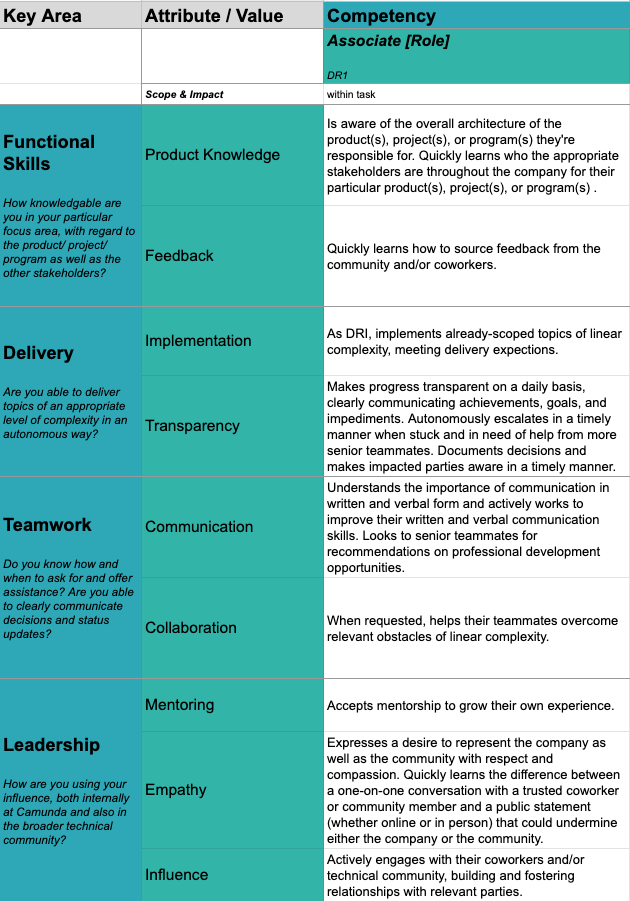Camunda Developer Relations Career Path: DR1
After a few years in the tech industry, most folks will transition into a DR2 role. Many DevRel professionals will transition directly into DR2 from another position outside of Developer Relations based on their prior (relatable) job experience.
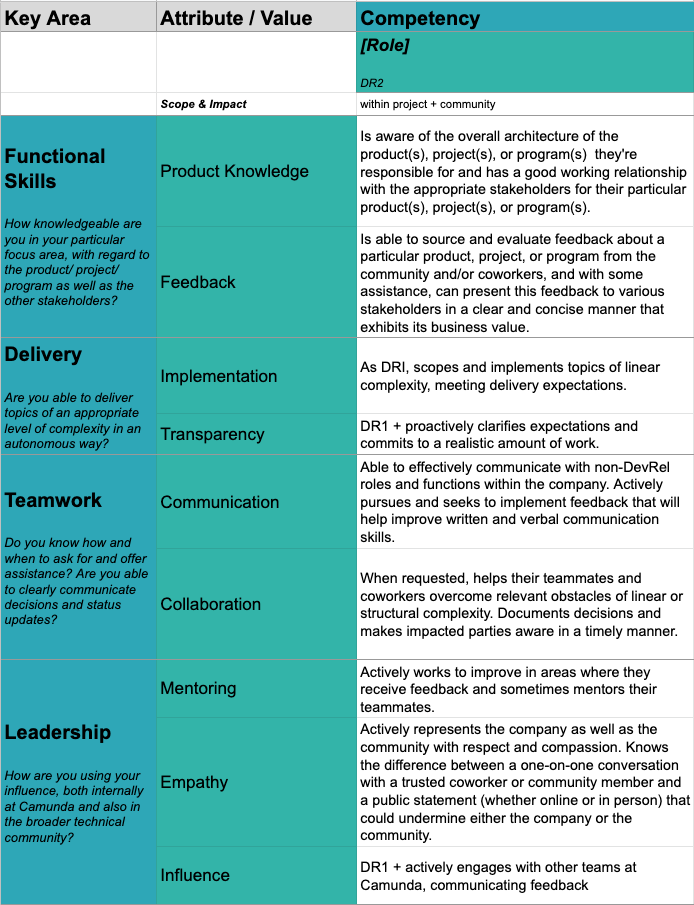Camunda Developer Relations Career Path: DR2
A Senior DevRel Professional (DR3) begins to set themselves apart as they are the go-to person for one or more products, projects, or programs, depending on their role. For instance, our DevRel Program Manager is known internally as the go-to person for our participation in Hacktoberfest as well as the DevRel CRM.
The other piece that distinguishes a DR3 is that they have moved beyond doing tasks only when asked and are now proactively engaging. This means they’re taking ownership of their projects, often defining their own quarterly goals, actively looking for opportunities to help teammates as well as other departments, and bringing new ideas to the table to further company goals.
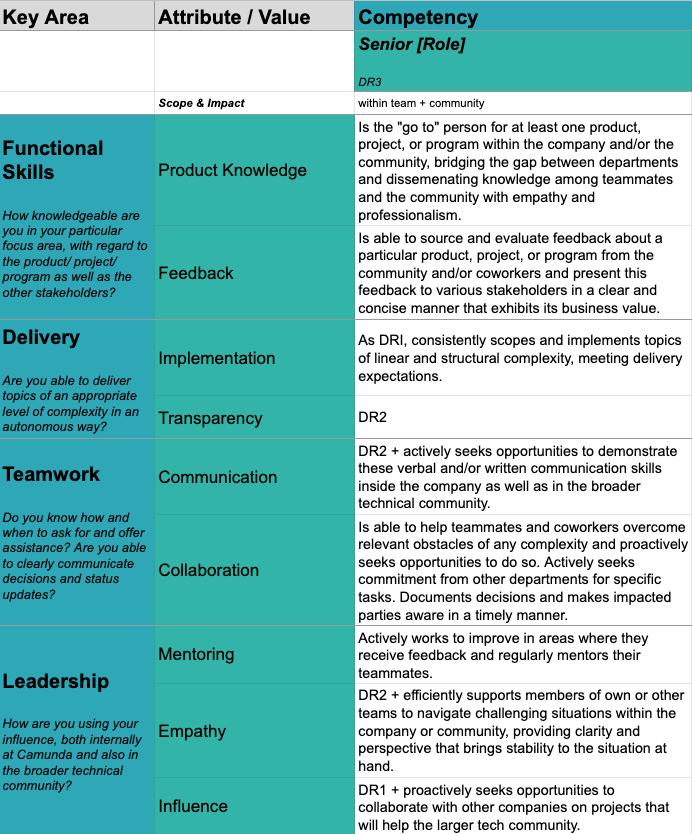Camunda Developer Relations Career Path: DR3
Many Developer Relations professionals will remain at the Senior (DR3) role for the remainder of their career. There is no expectation or requirement that they advance to a Principal (DR4) role, and some individuals may not have a desire to contribute back to the broader technical and DevRel community, as I referenced earlier is required of a DR4.
Others may choose to transition from Developer Relations into another role or into management at this point in their career. To this point, Principal DevRel professionals at Camunda are rare. Here is what’s expected of those who choose to become a Principal Developer Relations professional.
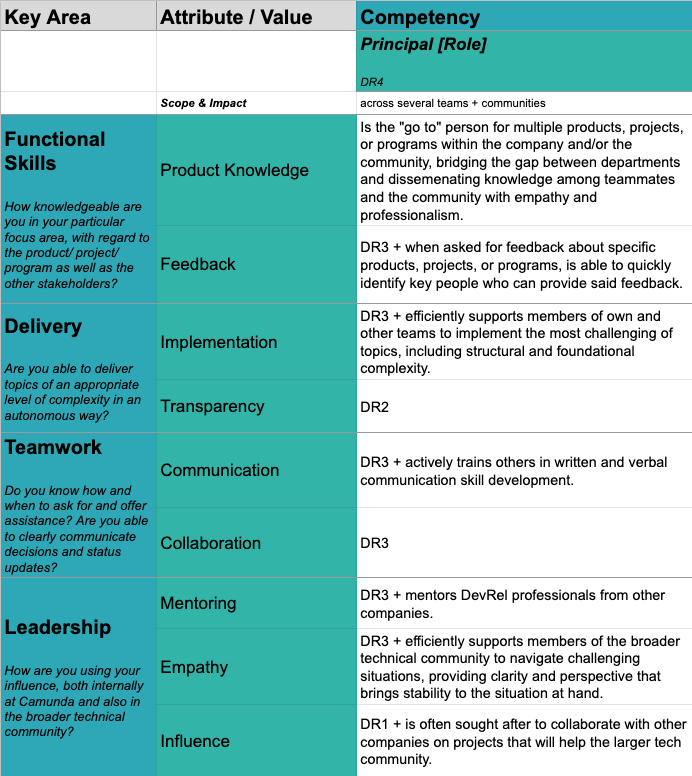Camunda Developer Relations Career Path: DR4
As I mentioned earlier, there is room for growth, both in salary as well as responsibilities, within each of these stages. The growth potential within these stages is an individualized journey and offers a perfect opportunity for mentorship and concrete guidance from management.
I’d love to hear what you think! Do you have any questions? Are there characteristics that you disagree with? What would you do differently?
If it resonates with you, keep an eye out for Developer Relations jobs at Camunda -- I have a few openings coming soon!
```
Special thanks to Bear Douglas, Greg Wilson, Felix Kreger, Nathen Harvey, Jeremy Meiss, Ash Ryan Arnwine, Peter Van de Voorde, and Daniel Meyer for their advice, mentorship, and comments on this post.
```, The Camunda Developer Relations Career Path, Mary Thengvall - Community Builder, 01gp6b7dawscag3bf55p48znkp.