The Crisis of Themes in WordPress

## Metadata
- Author: [[Hendrik Luehrsen]]
- Full Title: The Crisis of Themes in WordPress
- Category: #articles
- Document Note: ---
tags: [#wordpress, #themes, #open-source, #marketplace, #future]
- #wordpress
- #themes
- #open-source
Author: [Moritz "Mo" Sauer]
Source: [KrautPress](https://kraut.press/2025/crisis-of-themes)
Reference: [KrautPress, "The Crisis of Themes", 2025-01-23]
date created: 2025-05-16 22:10
---
# Title: 🎭 The Crisis of WordPress Themes
## Table of Contents:
- [📝 Summary](#-summary)
- [📖 Main Content](#-main-content)
- [🗒️ Notes](#️-️-notes)
- [📖 References](#-references)
- [🗣️ Paraphrase](#-paraphrase)
- [📰 Newsletter](#-newsletter)
- [✅ Action Items](#-action-items)
- [🧪 Hypotheses](#-hypotheses)
- [📊 Methodology](#-methodology)
- [❓ Questions](#-questions)
- [🔮 Future Research](#-future-research)
- [💡 Implications](#-implications)
- [🧠 Learning Styles Assessment](#-learning-styles-assessment)
- [📊 Accessibility Assessment](#-accessibility-assessment)
- [🌍 DEIB Assessment](#-deib-assessment)
- [✅ Logical validity](#-logical-validity)
- [🔍 DARVO Analysis](#-darvo-analysis)
- [🔍 SEO Evaluation](#-seo-evaluation)
- [🎯 Conclusion](#-conclusion)
---
## 📝 Summary:
Moritz "Mo" Sauer’s article, “The Crisis of Themes,” examines the state of WordPress themes as both a creative and economic force in the open-source ecosystem. The author argues that the traditional WordPress theme market is in crisis due to changing user needs, the rise of page builders and block-based editing, competition from SaaS platforms, and unclear revenue models for theme creators. Sauer advocates for new approaches to sustainability, calls for better UX, and suggests the community needs to rethink how themes fit into WordPress’s future.
---
## 📖 Main Content:
Sauer begins by lamenting the loss of “magic” that themes once brought to WordPress, noting how they were a gateway for creativity, personal branding, and business for many. However, several market shifts have challenged their relevance:
- The adoption of the block editor (Gutenberg) and FSE (Full Site Editing) empowers users to customize layouts, often bypassing the need for traditional themes.
- Commercial theme shops struggle with declining sales and increased support demands.
- The rise of SaaS solutions and website builders like Wix, Squarespace, and Shopify creates stiff competition by offering simplicity and end-to-end service.
- Open-source distribution is complicated by unclear funding and maintenance incentives, with many creators burning out or pivoting to other opportunities.
- Sauer suggests that the WordPress ecosystem must focus on sustainable models, rethink what themes should offer (e.g., design systems over “skins”), and elevate user experience as a primary goal.
### 🗒️ Notes
- **Historical Role of Themes:**
- Themes once provided individuality, business opportunities, and creative engagement.
- Theme shops flourished, but now struggle to maintain profitability.
- **Block Editor/FSE Impact:**
- Users have more granular control—reducing dependence on themes for layout/design.
- Theme authors must adapt or risk irrelevance.
- **Marketplace Disruption:**
- Competing with SaaS/website builders, which prioritize ease of use.
- Lower entry barriers for beginners with non-WordPress platforms.
- **Revenue Crisis:**
- Fewer buyers, more support work.
- Open-source models offer little recurring revenue unless bundled with services or subscriptions.
- **Sustainability & Future:**
- Need to shift focus from “theme as product” to “theme as service” or “theme as platform.”
- Suggests community collaboration, better UX, and possibly new funding mechanisms.
- **Call to Action:**
- The WordPress community should engage in frank discussions about sustainability and theme development’s future.
- Calls for innovation in business models and support systems.
---
## 📖 References:
- [KrautPress: The Crisis of Themes](https://kraut.press/2025/crisis-of-themes)
- [WordPress.org Themes](https://wordpress.org/themes/)
- [Gutenberg / Full Site Editing](https://wordpress.org/documentation/article/full-site-editing/)
- [SaaS Competitors: Wix, Squarespace, Shopify](https://www.cmscritic.com/comparison/wordpress-vs-wix-vs-squarespace-vs-shopify/)
---
## 🗣️ Paraphrase:
1. **Original:**
“Whereas themes used to be the lifeblood of WordPress businesses, many shops now face closure or must reinvent themselves to survive in a market driven by SaaS solutions and block editing.”
**Paraphrased:**
Themes were once the cornerstone of WordPress entrepreneurship, but now, many theme creators are struggling to adapt or are forced out by competition from SaaS platforms and the block editor revolution.
2. **Original:**
“Perhaps it is time to stop thinking of themes as static ‘skins’ and instead see them as adaptable design systems that empower both users and professionals.”
**Paraphrased:**
Maybe we need to redefine themes, not as fixed templates but as flexible design frameworks that support creativity and functionality for everyone.
---
## 📰 Newsletter:
🎭 **Crisis or Opportunity? The Future of WordPress Themes**
Is the age of classic WordPress themes over? Moritz Sauer’s new piece at KrautPress explores how full site editing, SaaS competitors, and a changing marketplace are shaking up the theme industry. Should themes become design systems rather than one-off products? How can we support creators when old revenue models are crumbling? Dive into the debate and join the conversation about sustainability, innovation, and what’s next for WordPress theming! [Read more](https://kraut.press/2025/crisis-of-themes)
---
## ✅ Action Items:
- **Open Source Advocacy:**
- Promote sustainable funding models for theme developers, such as subscriptions, sponsorships, or bundled services.
- Encourage transparent conversations about burnout and fair compensation.
- **Contributor Engagement:**
- Onboard new contributors with block/FSE skills, not just classic theming.
- Facilitate workshops and mentorship programs focused on design systems and UX.
- **Education:**
- Update training resources to reflect the modern theme landscape (block themes, FSE, design systems).
- Create documentation and learning pathways for the new era of WordPress theming.
- **OSPO Alignment:**
- Advocate for WordPress ecosystem innovation and community support for theme authors.
- Foster collaborations between core contributors, theme shops, and SaaS solution stakeholders.
- **Community Building:**
- Organize roundtables and working groups to brainstorm the next wave of theme-related products and support mechanisms.
---
## 🧪 Hypotheses:
- H1: Transitioning themes from static “skins” to flexible design systems will improve long-term user satisfaction and market sustainability.
- H2: SaaS competitors will continue to erode WordPress’s market share unless WordPress themes innovate and improve UX.
- H3: Sustainable funding and support models will reduce theme developer burnout and increase innovation.
### 📊 Methodology:
- Conduct user surveys comparing satisfaction and usability between classic themes, block themes, and SaaS site builders.
- Analyze sales/support data from theme shops pre- and post-FSE adoption.
- Interview theme developers on sustainability, funding, and future plans.
### ❓ Questions:
- How can theme shops successfully pivot to survive in the FSE/block-first era?
- What new business models could work for open-source theme authors?
- Is there a role for “theme marketplaces” in a design-system-first world?
### 🔮 Future Research:
- Longitudinal study tracking theme usage trends post-FSE.
- Economic impact analysis of SaaS disruption on WordPress ecosystem businesses.
- Experimental implementation of new support/funding models for theme creators.
### 💡 Implications:
- Insights may shape WordPress core roadmap and community funding programs.
- Findings could encourage other open-source projects to rethink product sustainability.
- New business models might spark renewed investment in theme development and innovation.
---
## 🧠 Learning Styles Assessment:
- **Readability:** College level. The article is clear but presumes WordPress familiarity.
- **Visual Learners:** No d
- Summary: WordPress themes are facing a significant crisis.
- URL: https://kraut.press/2025/crisis-of-themes/
WordPress themes are facing a significant crisis. The rapid evolution of Full Site Editing (FSE) has introduced complexities that make it increasingly difficult to create and sustain a successful theme product. As a result, the number of new high-quality, well-maintained themes remains limited.
Compounding this challenge is an ongoing debate about the very nature of themes. Questions like “What is a theme?” and “Do we even need themes anymore?” have sparked confusion within the WordPress ecosystem. This lack of clarity has led to hesitation among developers and users, slowing the adoption of new theme paradigms.
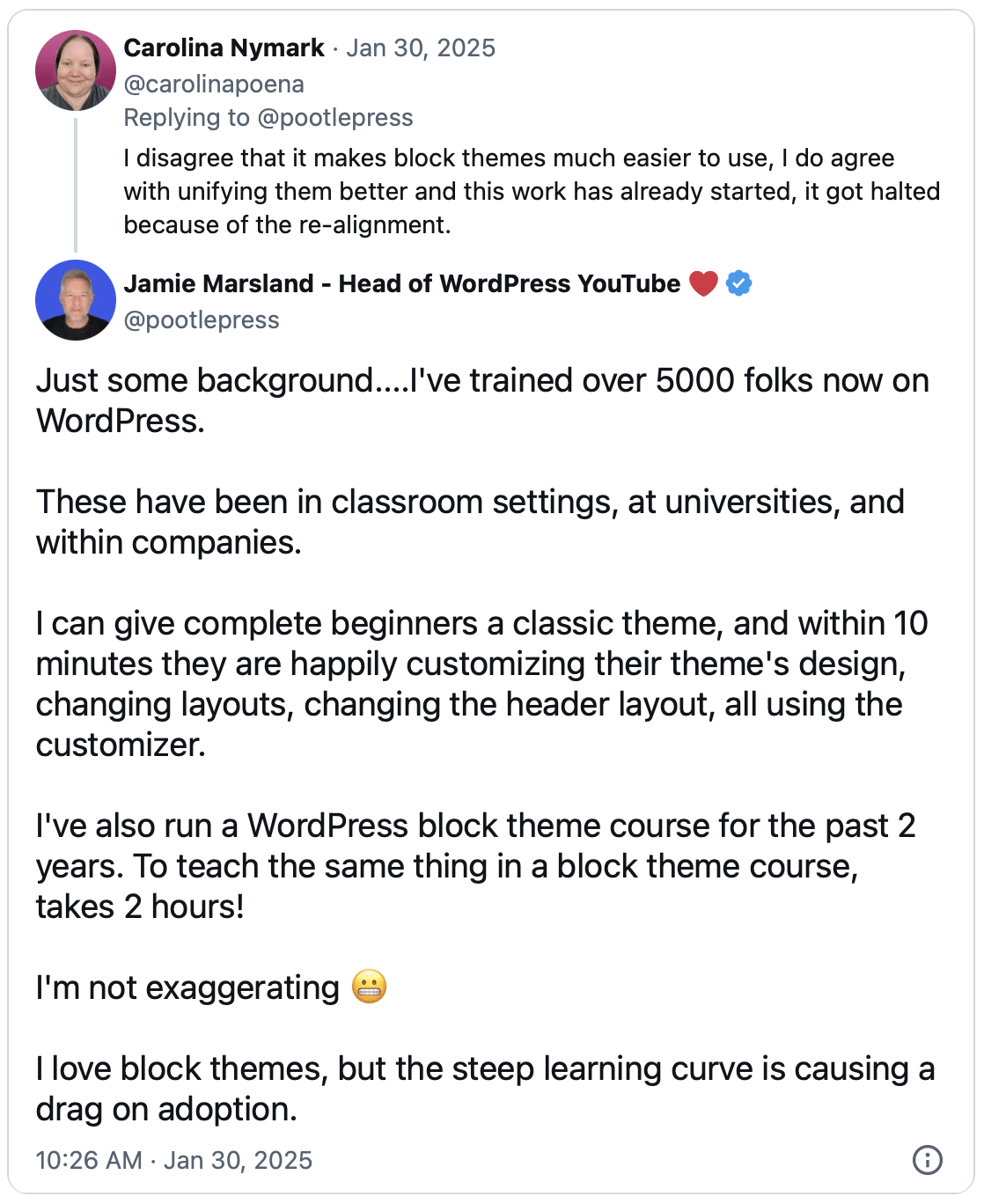
The consequences are clear: While investments in WordPress tooling continue, themes, the core components that users interact with, have seen little external innovation or funding. This stagnation threatens to undermine WordPress’ appeal, especially compared to competitors offering more structured, user-friendly solutions.
Even WordPress.org acknowledges this issue, phrasing the problem as themes being too similar. [In a post from Jan 2nd, 2025, they claim “WordPress Themes Need More Weird”](https://wordpress.org/news/2025/01/wordpress-themes-need-more-weird-a-call-for-creative-digital-homes/), directly suggesting to “Design for specific use cases”.
To address these issues, we must first understand what themes are meant to accomplish and why they are currently fallingshort of user needs.
#### **What Is a Theme?**
The definition of a theme varies depending on perspective. Traditionally, a WordPress theme has been understood as the visual presentation layer that controls the look and feel of the content. This technical perspective is widely acceptedamong developers, the Gutenberg team, and professional agencies operating within the WordPress ecosystem.
However, this perspective does not necessarily align with how most users see themes. Casual WordPress users do not think about presentation layers or content structuring; instead, they view themes as a means to solve a problem. For them, a theme is not just about design. It is a ready-made solution that helps them achieve their goal of launching a functional website as quickly and efficiently as possible.
Over the years, WordPress themes have moved toward becoming flexible, design-agnostic tools, focusing on customization and modularity rather than pre-built solutions tailored to specific industries or user needs. While this shift has given developers greater control, and with the introduction of the Site Editor, even designers, it has also diminished the practical utility of themes for everyday users simply looking for an easy way to set up a website.
This growing disconnect between the technical and user-driven definitions of themes has led to an identity crisis within the WordPress ecosystem. Are themes merely frameworks for design, or should they be packaged solutions that address specific user needs? Until this question is answered, themes will continue to struggle with adoption and relevance.
#### **The User Experience: A Realtor’s Journey**
To understand the gap between WordPress themes and user expectations, let’s take a practical example: Imagine a realtor based in rural America who needs a website. Numerous platforms promise a simple, do-it-yourself website creation experience. How do these platforms cater to the user’s needs?
##### **Competitor Approaches:**
* **Squarespace**: The homepage prominently features a “Templates” link, leading to an interactive wizard recommending templates based on user needs. Even without the wizard, users can easily navigate to a “Real Estate & Properties” category showcasing templates designed explicitly for realtors.
* **Wix**: Although not as streamlined as Squarespace, Wix places “Templates” as a secondary item in its main menu. The templates page is utility-driven, offering clear filtering options. A “Real Estate” category under “Business & Services” provides realtors with pre-designed templates tailored to their industry.
* **Elementor**: The “Elementor Kit Library” is slightly harder to find but still embraces a utility-first approach. While Elementor does not yet have a dedicated “Real Estate” category, it features filters like “Business” and “Agency.” Users can find templates such as “Personal Chef Website Kit” or “Real Estate Agency Website Kit” that directly solve their specific needs.
##### **The WordPress Theme Repository:**
Now, let’s compare this experience to the WordPress theme repository. If our realtor searches for a real estate theme, their primary method is keyword-based, yielding inconsistent results. There is no structured filtering system that immediately presents industry-specific themes. Instead, they are met with a mix of classic and block-based themes, many of which are not clearly designed to solve their problem.
The only remotely structured listing in the WordPress theme repository is under “Subject,” but even this categorization is chaotic. For instance, in the “Food and Drinks” category, users will find themes such as “Holiday Quest,” “Newspaper Flash,” and “Travel Quest,” none of which clearly address the needs of a food business. This lack of clarity creates a frustrating experience for users who simply want a theme that aligns with their business.
A look at the most downloaded block themes reveals a similar issue. The “Twenty-X” themes may be familiar to long-time WordPress users, but for newcomers, they do not indicate their purpose. Popular block themes like “Extendable,” “Yith Wonder,” and “Ollie” also fail to communicate their utility to non-technical users. These themes do not offer a clear answer for a realtor simply looking for a quick and effective website solution.
#### **The Path Forward: Fixing WordPress Themes**
To address these challenges and restore themes as essential problem-solving tools for users, WordPress must take several crucial steps:
* **Reframe the Purpose of Themes**: Themes should be more than just aesthetic frameworks. They should be solution-driven, providing users with ready-made options that cater to specific industries and use cases.
* **Improve Discoverability**: The WordPress theme repository needs a complete overhaul to introduce structured categories and utility-driven filtering. Users should be able to browse themes by industry or business type, just like on competing platforms.
* **Enhance Accessibility for Casual Users**: The theme selection process should be intuitive, guiding users toward the best choices for their needs. A wizard-style recommendation engine, similar to Squarespace, could be an effective solution.
* **Prioritize Ease of Setup**: Full Site Editing (FSE) must become more user-friendly, reducing complexity and making it easier for new users to build and manage their websites. If WordPress insists on FSE as the future, it must match the usability of traditional, classic themes.
#### **Conclusion: Making WordPress Themes Relevant Again**
If WordPress wants to remain a dominant force in the website-building space, it must rethink the role of themes. The current theme landscape is unfocused, failing to address the practical needs of users looking for simple, industry-specific solutions.
The shift towards Full Site Editing has complicated the onboarding process for new users, making it harder to find and implement themes that solve real-world problems. Meanwhile, competitors have doubled down on ease of use, ensuring their template libraries offer immediate value and clear solutions.
For WordPress to regain its competitive edge, it must make themes relevant again. By emphasizing utility over flexibility, improving discoverability, and prioritizing an intuitive user experience, WordPress can ensure that themes serve as powerful tools rather than confusing obstacles., The Crisis of Themes in WordPress, Hendrik Luehrsen, 01jjvyhj6hes3zcwd5fxeh4t9f.