The Fraudulent Legacy of John G. Lake
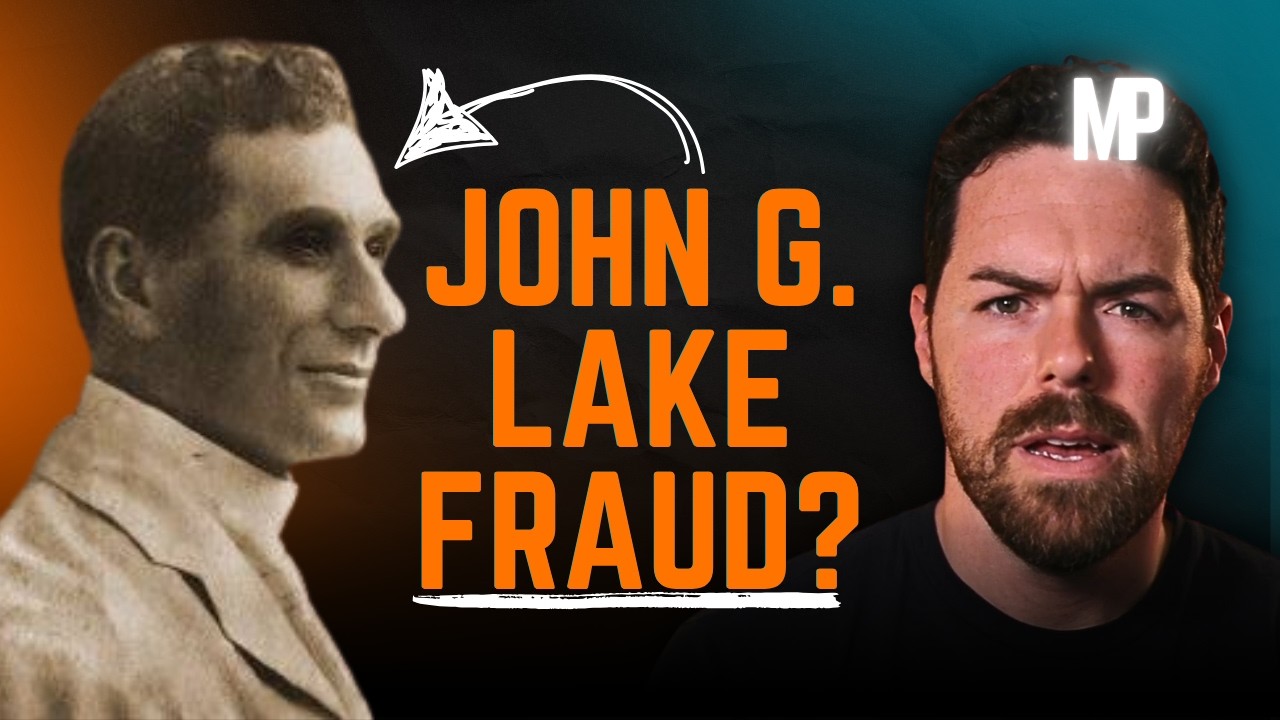
🔗 **Source:** [The Fraudulent Legacy of John G. Lake](https://www.youtube.com/watch?v=X6cOE5UepO8&feature=youtu.be)
> [!note]+ Document Notes
> ---
> tags: [nar-research, charismatic-theology, pneumatology, epistemic-closure, doctrinal-drift, spiritual-abuse]
> author: Minor Prophets Podcast (host not named in transcript; co-host David Fish referenced)
> source: https://youtu.be/X6cOE5UepO8
> reference: "The Fraudulent Legacy of John G. Lake" - 2026-08
> date created: 2026-08-26 08:15
> ---
> > [!info] Generated analysis - not the author's words. Sections below are machine-written
> > from the captured source. Only text inside `> [!quote]` blocks is verbatim from the author.
> > Do not quote or attribute any other line to the named author.
> # Title: The Fraudulent Legacy of John G. Lake
> **Attribution - partially unresolved.** Reader's `author` field records only `YouTube`. The speaker identifies the channel as the **Minor Prophets Podcast** and names **David Fish** as his co-host, but **never states his own name**. He describes himself as a charismatic, from **Newberry, Michigan**. No name has been inferred.
> **CAPTION RELIABILITY WARNING - significant, and it affects names.** The auto-captions garble a substantial number of proper nouns, several of which are load-bearing. Confidently identifiable: **"Ptoria" = Pretoria**; **"Irenaeus"** and **"Augustine"** survive intact. Almost certainly but not verifiably: **"Sean BS" = Shawn Bolz**; **"Mike Bickl" = Mike Bickle**; **"Katherine Crick" = Kathryn Kuhlman**; **"Barry Morton"**, **"Steve Kosar" = Steve Kozar**, **"Curry Blake"**, and **"Donald Schroed"** are plausible as rendered but unverified. **Not recoverable:** "Georavi"/"George Davi", "5F Church", and the alias spelling "Abdul Ben Shinandar". **Do not cite any name from this source without independent verification.**
> **Register.** **Opinion commentary by a charismatic insider**, explicitly building on other people's research rather than presenting original investigation. He says so directly: *"This is not going to be a full complete expose of John G. Lake. Other people have done that better than me."* The historical claims are second-hand from Barry Morton's 2017 article; what is original here is the **theological and epistemic analysis of the legacy**.
> **Commercial interest, disclosed by presence.** A Patreon promotion interrupts the video mid-argument, with a clip featuring the co-host. Ordinary for the format and it does not shape the argument.
> ## Summary
> **What it is.** A charismatic commentator arguing that John G. Lake - a foundational figure in Pentecostal and charismatic healing ministry - was a documented fraud, and, more importantly, that **his theology of the Holy Spirit as a manipulable force is still load-bearing in the movement.**
> **The documented frauds**, all attributed to Barry Morton's 2017 research rather than to the speaker:
> - Posed as a fake Arab faith healer under an assumed name; **a Spokane reporter exposed it as Lake in a false beard**
> - Posed as a police officer and was arrested for it
> - Posed as a minister, claiming a degree from a Methodist university in Newberry, Michigan **that never existed**
> - Claimed healings that did not occur - including a deaf girl who could suddenly hear **who had never been deaf**
> - **Solicited investment from people under his spiritual care** in securities he had interests in
> - Allegedly held a seance to consult his dead wife about permission to remarry, months after her death
> **The epistemic indictment, which is the sharpest thing in the video.** None of this is new - Morton published in 2017, and critics have said it for years. It never penetrated:
> > *"none of that news ever reached the charismatic echo chamber because we don't listen to people like that outside of our tribe... theological predisposition prevents us from actually hearing the truth from somebody that we disagree with. We've stopped our ears to the truth and it's cost us."*
> **The theology, quoted at length from Lake's own preserved sermons.** Lake repeatedly describes the Holy Spirit as a *substance* and a *force*: *"just as tangible as electricity"*; healing as *"a perfectly scientific application of God's spirit to man's needs"*; *"prayer is God's divine generator, the spirit of man is God's divine dynamo"*; and the spirit *"distributed by the action of the will wherever desired."* Most strongly: *"we are not talking about an influence. We are talking about the transmission of the living substance and being of God into your being."*
> **The critique.** If the Spirit is a substance distributed by human will, then the Holy Spirit's own will disappears - which inverts the scriptural account of gifts distributed as the Spirit wills. The person becomes a commodity; the believer becomes a broker.
> **The falsification by outcome.** Lake claimed germs died on his hand under a microscope, calling it *"the law of the spirit of life."* **Lake died of a stroke at 65.** The speaker's line: *"these people who are claiming to be able to use God... evidently can't use him when it counts for them."*
> **The working definition offered.** *"A good working definition for witchcraft would be seeking to use spiritual power apart from the authority of God"* - and using Jesus's name does not change that if the aim is enacting your own will through spiritual power.
> **The methodological rule, and the most transferable idea here.** *"Anything novel that came through the charismatic movement should be rejected"* - while anything with attestation across church history and scripture (he cites Irenaeus and Augustine on continuing gifts) can be retained. Paired with a mechanism for how novelty becomes doctrine: **experience -> phenomenological description -> doctrine -> retroactive proof-texting.**
> **The conclusion.** Against "chasing generals" and unattainable larger-than-life models; toward ordinary sanctification. *"Maybe it's just okay to be normal."* And a call for humility toward the outside critics who were right.
> ## Main Content
> ### Notes
> **[00:03-01:06] The frame.** The Pentecostal and charismatic world has *"no shortage of conmen, frauds, and schemers,"* and the list is growing - he names Mike Bickle and Shawn Bolz *(names as rendered by captions)* as recent examples, "either alleged predators and false prophets or actually both." John G. Lake is the newest addition.
> **[00:39-01:30] Pre-empting the obvious objection.** He anticipates "this is old news." **Barry Morton published in 2017.** Steve Kozar, Steve Long, and other critics have said it for years.
> **[01:06-01:30] The epistemic indictment.** The news never reached the charismatic world because *"we don't listen to people like that outside of our tribe."* Critics are dismissed as cessationists whose theological predispositions make them unreliable. His counter: **theological predisposition is what prevents hearing true things from people you disagree with.** *"We've stopped our ears to the truth and it's cost us."*
> **[01:30-02:00] Who broke it internally.** **Donald Schroed**, described as a charismatic and a friend of the channel, published a video drawing on Morton. Co-host **David Fish** previously posted the evidence on X.
> **[02:00-03:08] The documented frauds** *(all via Morton, not original research)*:
> - A fake Arab faith-healer persona; a **Spokane reporter** exposed it as Lake wearing a false beard.
> - Posing as a police officer - **arrested for it**.
> - Posing as a minister, claiming a **Methodist university in Newberry, Michigan that never existed** (the speaker notes this is his own hometown).
> - Fabricated healings, including **a deaf girl who was never deaf**.
> - **Soliciting investment** from people under his spiritual care in securities he had an interest in.
> **[03:08-03:55] The contemporary parallel.** *"Beware of any quote unquote prophet who has a great business opportunity for you to get invested in."* He references European "prophets" with hundreds of MLM victims who lost money on the basis of prophecies, who then relocated to America and are now associated with major NAR prophets, running the same playbook with "divine mandates" and prophetic words. He cuts himself off - *"maybe there's another video on that."*
> **[03:58-04:24] Why it persists.** Lake has been *"incredibly influential throughout the charismatic Pentecostal world."* **Curry Blake runs a ministry called John G. Lake Ministries.** His framing: *"The well of John G. Lake was poisoned from the very beginning."*
> **[04:24-09:25] The theology - quoted from *Sermons on Dominion Over Demons, Disease and Death*, preserved by Healing Rooms Ministries.** Seven quotations, each followed by his gloss:
> 1. *"The spirit of God is just as tangible as electricity is. You handle it. You minister it to another... Your person becomes supercharged with it. The old Apostle Paul took handkerchiefs or aprons and held them in his hands until the handkerchiefs or aprons were supercharged with the spirit of God."* -> the third person of the Trinity becomes a force you can manipulate and charge objects with.
> 2. *"the spirit of God is tangible, actual, a living quantity, just as real as electricity, just as real as any other native force. Yes, a good deal more so."* -> the Spirit's power becomes a tradeable commodity.
> 3. *"healing is a perfectly scientific application of God's spirit to man's needs."* -> healing becomes a formula; the task is figuring out how to manipulate the force.
> 4. On the **1908 Pretoria meetings**: *"God came over my life in such power in such streams of liquid glory and power that it flowed consciously off my hands like streams of electricity. The streams of God that were pouring through my hands were so powerful the people would fall as though they were hit."*
> 5. *"Prayer is God's divine generator. The spirit of man is God's divine dynamo... there is lightning in the soul of Jesus. The lightning of Jesus heals men by its flash."* -> prayer becomes an acquisition and generation mechanism. He notes candidly: *"I don't think I understand this analogy."*
> 6. *"In the spiritual world, the spirit of man is the dynamo. It is set in motion by prayer. The spirit of God being received into the spirit of man through prayer is distributed by the action of the will wherever desired."* -> **this is the crux.** Distribution according to *our* will contradicts the scriptural account of gifts distributed according to the Spirit's will. *"If you take these, the will of the Holy Spirit kind of vanishes."*
> 7. *"The spirit of God is his own substance, the substance of his being... when we speak of the spirit of God being transmitted to us and into us, we are not talking about an influence. We are talking about the transmission of the living substance and being of God into your being."* -> this forecloses the softer reading. It is not that the Spirit *has* power; the power *is* the Spirit's substance. **So what is being manipulated is God.**
> **[09:25-10:01] Patreon interruption.** A promotional clip mid-argument, featuring the co-host.
> **[10:01-11:03] The germ story and its refutation.** Lake reportedly buried plague victims in Africa saying *"disease can't live on me."* A doctor allegedly placed foam from a diseased lung on Lake's hand under a microscope and watched the germs die - Lake called it *"the law of the spirit of life."* The speaker's response is one line: **Lake died of a stroke at 65.** *"These people who are claiming to be able to use God in this way to their own ends evidently can't use him when it counts for them."*
> **[11:03-11:50] The counter-position.** *"You cannot use God. God is not a substance that you can manipulate. He is a person. We don't use God. We surrender to him. We don't distribute his gifts. He distributes himself as he wills."* On Paul's handkerchiefs: it was not infusion of a transmissible substance, it was the sovereign will of God using means.
> **[11:50-13:14] The lineage.** Schroed connects Lake's power-manipulation idea to a Kuhlman-related anointing-transfer lineage *(names heavily garbled; not reconstructible)*. The pattern described: an "anointing" allegedly **distinct from and more powerful than the Holy Spirit other Christians have**, accessible only through submission to a spiritual father, membership at a particular church, and **sometimes giving money to unlock it**. His comment: *"That should be a tell, shouldn't it?"*
> **[13:14-14:01] The witchcraft definition.** *"This sounds a whole lot like witchcraft. I think a good working definition for witchcraft would be seeking to use spiritual power apart from the authority of God."* Using Jesus's name does not change the structure if the goal is enacting your own will through spiritual power. He adds the seance allegation here as an aside.
> **[14:01-15:22] The methodological rule.** After weighing what to preserve and what to reject from the charismatic movement:
> > *"Anything novel, anything novel that came through the charismatic movement should be rejected. And the stuff that I can find great attestation to through church history and through the scriptures that can be embraced."*
> **Attested, therefore retained:** continuation of spiritual gifts, citing **Irenaeus in *Against Heresies*** and **Augustine on miracles through church history**.
> **Novel, therefore rejected:** *"suddenly there's this force called the power of God that can be manipulated and controlled."*
> **[15:22-16:13] The drift mechanism - the sharpest analytical move in the video.**
> > *"sometimes people will create doctrines based upon phenomenological language used to describe experiences that they've had and those doctrines get handed down and then they proof text them through the scriptures."*
> Worked example: Paul's handkerchiefs become a proof text for anointing-transference, *"and suddenly this doctrine becomes reified and crystallizes in the mind of the charismatic or Pentecostal."*
> **[16:13-17:32] The Bill Johnson test case, handled with care.** "Hosting the presence" is examined in two readings. **Charitable reading:** cultivating a personal relationship with God, conscious of him through the day - *"we have great attestation to that throughout church history,"* from the early fathers through **Brother Lawrence**, and non-charismatics attest to it too. **Problem reading:** cultivating a *substance* called the presence in order to use it for miracles. *"Suddenly I don't think that we're having a relationship with God. We're trafficking in power."*
> **[17:32-18:26] The subtle shift he is naming.** From *"surrendering to Jesus to have his will done"* to *"I have to get his power to enact my interpretation of his will."* The believer becomes *"a broker of the power of God"* rather than a servant. He explicitly concedes that most people from Bethel would say "yes and amen" to wanting God's will done - the disagreement is about the mechanism, not the intent.
> **[18:26-19:14] Scope of his own claim, stated honestly.** *"On my cursory research, I can't claim to have done an exhaustive deep dive on this, but it does appear that Lake may have been one of the originators of this idea of the power of God as a commodity."* Note the hedging stack: cursory, appears, may have been.
> **[19:14-20:14] The reciprocity argument.** If God grants us the dignity of agency and personhood, *"shouldn't I give the Holy Spirit of God the dignity of agency and personhood rather than treating him as a commodity or a power?"* His aim: *"I become a tool in his hand rather than him becoming a tool in mine."*
> **[20:14-22:20] The extension to politics and the counter-thesis.** The power framing shows up beyond healing - *"I need to conquer the seven mountains of influence."* **"Christianity has become this means to power, or maybe a mission to exercise power."** Against that: *"the Christian enterprise is a series of saying no to self and yes to Christ."* And the sharper version: *"maybe that pursuit for power is actually antithetical to the kingdom of God,"* because the kingdom is exhibited through service and self-emptying - *"that is how the kingdom of God invaded Rome."*
> **[22:20-26:59] The close.**
> - Humility toward the outside critics: *"perhaps we charismatics should have a more humble attitude towards those heresy hunters who have been trying to tell us the truth for quite a long time."*
> - **1 Corinthians 3**: the only foundation is Christ. Building on Lake - *"trying to redig the wells of some dead guy whose life we actually don't know as well as we think"* - is building with wood, hay, and stubble. Notes the passage's warning about destroying God's temple, and turns it toward *"those who follow after them that are building on their foundation of destruction."*
> - Against **"the unending quest for revival, the unending exhausting effort to try to get the next move of God to come down"** - always promised by the next prophetic word, prayer event, or meeting.
> - Toward *"daily humble living in community, submitting ourselves to Jesus, trying to live out the Sermon on the Mount."*
> - He carefully notes he is **not against meetings or conferences** - he attends them - only against treating them as the gateway to the next great move.
> - The closing register: *"maybe it's just okay to be normal."* Against *"chasing generals... larger than life figures that set the bar of expectation far too high for any normal person to attain."* Instead, *"the bar [should be] God's calling on our lives."*
> - Acknowledges the pitch: *"I know that that's not sexy. It doesn't sell on a flyer for an event so well."*
> ## References
> Primary sources, and the first is the one that matters:
> - **Barry Morton's 2017 article on John G. Lake** - the underlying historical research. **Every factual claim in this video traces there.** Anyone citing the frauds should cite Morton, not this.
> - ***John Lake: Sermons on Dominion Over Demons, Disease and Death*** - the source of all seven quotations, preserved by **Healing Rooms Ministries**. Worth noting: the movement itself preserved and republished this material, which is why the quotations are available.
> - **Donald Schroed's video** - the internal-to-the-movement exposure this responds to.
> - **David Fish's X thread** walking through Morton's evidence.
> - **Irenaeus, *Against Heresies***; **Augustine, *City of God*** (the miracle accounts) - his attestation standard, checkable directly.
> - **Brother Lawrence, *The Practice of the Presence of God*** - cited as the attested version of "hosting the presence."
> - **1 Corinthians 3** and **1 Corinthians 12** - the scriptural framework; the latter is implied rather than cited for the "as the Spirit wills" claim.
> ## Paraphrase
> **On what makes this different from ordinary polemic.** The genre - charismatic commentator exposes charismatic fraud - usually produces a list of scandals and a call to repentance. This does something more interesting: it takes the fraud as established by others, then asks what the fraud's *ideas* are still doing inside the movement. The historical con is the hook; the pneumatology is the argument.
> **On the epistemic point, which travels furthest.** The observation that critics were right for nine years and went unheard *because of who they were* is a general failure mode with a specific mechanism. The dismissal was not "this evidence is weak" but "this person's theological priors make them unreliable." That reasoning is available to everyone about everyone, it feels like discernment, and it makes a community unfalsifiable from outside. His formulation is the useful one: **predisposition prevents hearing true things from people you disagree with.**
> **On the theological analysis.** The seven Lake quotations do real work because they are cumulative. Any one could be read as vivid metaphor - describing an experience in the vocabulary of 1908, when electricity was the available image for invisible power. That reading survives quotes one through six. It does not survive the seventh: *"we are not talking about an influence. We are talking about the transmission of the living substance and being of God."* Lake explicitly forecloses the metaphorical reading himself. Whether the *conclusion* follows is contestable; whether Lake meant it literally is not.
> **On the strongest inference in the video.** If the Spirit is distributed "by the action of the will wherever desired," the Spirit has no will in the transaction. That is not a rhetorical flourish - it is a straightforward consequence of the quoted sentence, and it is why the personhood objection lands rather than merely asserting itself.
> **On the drift mechanism.** The four-step account - an experience, then phenomenological language to describe it, then that language hardening into doctrine, then scripture recruited afterward to support it - is the most portable idea in the video and it is not about religion. It is a general description of how a *description* becomes a *claim* and then acquires retroactive justification. The tell is the sequence: the proof text arrives after the belief, selected because it fits.
> **On what he does not do.** He does not extend fraud to falsity - nowhere does he argue Lake's teaching is wrong *because* Lake was a con man. The two indictments run in parallel and are separately evidenced. He does not tar Bill Johnson by association; he distinguishes a defensible reading of "hosting the presence" from an indefensible one and grants the charitable version real ground. He does not claim originality he lacks, and he hedges his one novel historical claim three ways.
> **On the closing move.** "Maybe it's just okay to be normal" is doing more than it appears. If the standard is set by figures whose accomplishments were fabricated, then the bar is not merely high - it is fictional, and the exhaustion of chasing it is exhaustion in pursuit of something that never happened.
> ## Newsletter
> *No WordPress angle exists here, and manufacturing one would be invention. What follows is the cross-domain observation this source actually supports.*
> **The transferable bit has nothing to do with theology.**
> Barry Morton published the evidence that John G. Lake was a fraud in **2017**. A Spokane reporter who caught him in a fake beard, a university that never existed, healings of people who were never sick. Nine years later, a charismatic commentator explains why nobody in his own world heard about it:
> > *"we don't listen to people like that outside of our tribe... theological predisposition prevents us from actually hearing the truth from somebody that we disagree with."*
> That's not a religious failure mode. That's a *general* one, and it has a specific shape: the evidence wasn't refuted, it was **pre-filtered by source**. The critics had the wrong priors, therefore their findings didn't need examining. It feels like discernment. It functions as immunity.
> The second transferable idea is a mechanism for how unfounded claims become load-bearing:
> > *"people will create doctrines based upon phenomenological language used to describe experiences that they've had and those doctrines get handed down and then they proof text them through the scriptures."*
> Experience -> description -> doctrine -> retroactive justification. **The tell is the sequence.** The supporting evidence arrives *after* the belief, selected because it fits. Anyone who has watched a team's folk explanation for a performance problem harden into architecture, then get a benchmark constructed around it afterwards, has seen the same four steps.
> And his proposed filter is genuinely usable: **anything novel gets rejected; anything with independent attestation across time can be kept.** That is a provenance test rather than a plausibility test, and provenance is much harder to fake than plausibility.
> Worth reading alongside Lukasz Olejnik's cryptanalysis piece from this week, oddly enough. Both are about the same thing from opposite ends - Olejnik says generate aggressively where verification is cheap; this says reject the novel where verification is impossible. Same underlying question: *what is your filter, and does it actually run?*
> ## Action Items
> **DevRel**
> - `#action/h3` The source-based-dismissal failure mode is a real and general one, but the framing here is too domain-specific to reuse directly. The idea transfers; the example doesn't.
> **OSPO**
> - Not applicable to this source.
> **Community**
> - `#action/h3` "We dismissed the critics because of who they were, and it cost us" is a pattern worth recognizing in any community with a strong in-group identity, including technical ones.
> **WordPress subteams**
> - **All subteams** - **Not applicable to this source.** This is theology and religious-movement criticism with no WordPress content whatsoever. Forcing subteam actions here would be pure invention, and the correct answer is that there aren't any.
> **The WPOCC**
> - Not applicable to this source.
> **FAIR**
> - Not applicable to this source.
> **Personal / vault - this is where it belongs**
> - `#action/h1` **Files to the NAR/theology research stream**, not the methods stream. Primary-source value: a charismatic insider documenting the movement's own epistemic closure, plus seven directly-quoted Lake passages with their published provenance.
> - `#action/h1` **Read Barry Morton's 2017 article directly.** Every historical claim here traces to it, and this video is explicitly not the research.
> - `#action/h2` Cross-link to the `faith-and-theology` wiki alongside other NAR/Bethel/seven-mountains material. The seven-mountains connection is made explicitly here.
> - `#action/h2` **Two genuinely cross-domain atoms** worth extracting to the reasoning material rather than the theology material: source-based pre-filtering as a form of epistemic closure, and the experience->description->doctrine->proof-text drift mechanism.
> - `#action/h3` **Verify every proper noun before citing.** The captions garble most of them, and several are people's names.
> ## Hypotheses
> *About the argument and its context, not about its theological conclusions.*
> 1. **The tribal-filter hypothesis.** If communities dismiss findings by source rather than by evidence, then true claims from out-group critics will take substantially longer to penetrate than equivalent claims from insiders. *Directly evidenced here: Morton 2017 -> internal charismatic uptake 2026, roughly nine years, with the internal messenger explicitly credited as the unlock.*
> 2. **The insider-messenger hypothesis.** If the barrier is source rather than substance, then the same evidence delivered by an in-group member will land. *Supported by the video's own causal account - Schroed is a charismatic and that is why it moved.*
> 3. **The drift-sequence hypothesis.** If doctrine derives from experience-description rather than from text, then proof texts will be found retroactively and will be sparse, isolated, and unusual. *Testable: Paul's handkerchiefs is a single narrative passage, not a didactic one.*
> 4. **The novelty-provenance heuristic.** If a teaching lacks attestation across church history, it is more likely to be error. *A reasonable prior with a real failure mode - see Logical Validity, fallacy 2.*
> 5. **The unattainable-standard hypothesis.** If foundational figures' accomplishments were fabricated, then the movement's aspirational bar is fictional and the resulting exhaustion is structural. *This is the video's most interesting sociological claim and it is asserted rather than examined.*
> 6. **The preservation-paradox observation (reviewer).** The quoted material survives because **Healing Rooms Ministries republished it**. A movement's own preservation of its founder's words is what now makes the critique possible. Worth noting as a general property of documented traditions.
> ## Methodology
> **Design: opinion commentary building on others' research.** Two distinct claim types with very different evidentiary bases, and the speaker keeps them properly separate.
> | Claim type | Basis | Strength |
> |---|---|---|
> | Lake's frauds | **Barry Morton's 2017 research**, relayed | Only as strong as Morton. Not independently verified here, and the speaker says so. |
> | Lake's teaching | **Direct quotation** from a published, movement-preserved volume | **Strong.** The quotes are checkable against a named source. |
> | The theological critique | The speaker's own reasoning from those quotes | Argued, and the inference from quote 6 is genuinely tight. |
> | The lineage claim | Relayed from Schroed | **Weakest.** Second-hand, and the names are caption-garbled beyond verification. |
> | Lake as *originator* | The speaker's own inference | **Explicitly hedged three ways** - "cursory research," "does appear," "may have been." Appropriately weak. |
> **What is well-handled:**
> - **Attribution discipline throughout.** Morton, Schroed, and Fish are credited by name for their contributions, repeatedly. He does not claim their work.
> - **The scope disclaimer is up front**, not buried: *"This is not going to be a full complete expose... Other people have done that better than me."*
> - **The one original historical claim is hedged appropriately** rather than asserted.
> - **The theological quotations are from a named, published, movement-preserved volume**, which is the strongest possible provenance for this kind of critique - the movement itself is the custodian.
> **What is not established:**
> - **No independent verification of any fraud claim.** Everything historical is one researcher's work relayed twice.
> - **The lineage section is unusable as cited.** The names are garbled past reconstruction, and it is the section that connects Lake to contemporary figures - i.e. the part doing the most contemporary work.
> - **No charismatic defence is engaged.** Nobody who reads Lake's electricity language as period metaphor is quoted or answered, though quote 7 does substantial work against that reading.
> - **Selection of quotations is unaudited.** Seven passages from a volume of sermons, chosen by someone making a case. Whether Lake wrote anything cutting the other way is not addressed.
> **The strongest methodological feature:** the fraud claims and the doctrinal claims are **kept separate and separately evidenced.** He never argues the teaching is false *because* the teacher was a fraud, which is the obvious available fallacy and the one this genre almost always commits.
> ## Questions
> 1. **What exactly does Morton's 2017 article establish, and on what sources?** Everything historical rests on it, and it is unread here. Court records versus newspaper accounts versus inference matters.
> 2. **Does anything in Lake's corpus cut against the substance-view?** Seven quotations selected to make a case is not a survey.
> 3. **How do serious charismatic theologians read the electricity language?** The period-metaphor defence is never engaged, and it is the obvious one.
> 4. **Who are the figures in the lineage section?** Caption garbling makes the most contemporary-relevant claims uncitable.
> 5. **Is Lake actually the originator?** The speaker hedges heavily and is right to - New Thought, Christian Science, and late-19th-century metaphysical currents were all circulating the same substance-language.
> 6. **What is the actual mechanism by which Schroed's video penetrated where Morton's article didn't?** In-group identity is the offered answer; platform, timing, and format are unexamined alternatives.
> 7. **Does the "reject anything novel" rule survive its own application?** It would have rejected a great deal of legitimate theological development, and the speaker does not test it against hard cases.
> 8. **What happens to people whose faith was built on this?** The video addresses institutions and teachings; the pastoral question is raised only obliquely through the 1 Corinthians 3 warning.
> ## Future Research
> - **Read Morton's 2017 article.** The single highest-value follow-up; everything else here is downstream of it.
> - **Trace the substance-pneumatology genealogy properly.** Lake, E.W. Kenyon, New Thought, and Christian Science all sit in the same period with overlapping vocabulary. The speaker's "may have been one of the originators" is exactly the claim that historical work could settle.
> - **Test the delay hypothesis across movements.** Does out-group-sourced criticism reliably take years longer to land than in-group-sourced criticism? This is a measurable sociology-of-knowledge question and this case is one clean data point.
> - **Survey Lake's full corpus** for passages that complicate the substance reading.
> - **Examine the seven-mountains connection empirically.** The claim that power-manipulation pneumatology and political dominionism share a root is asserted here in one paragraph and would repay real work.
> ## Implications
> **Practice.** The transferable habit is **separating source from substance when evaluating a claim.** The failure documented here is not that charismatics evaluated the evidence badly - it is that they never evaluated it, because the messenger's priors were disqualifying. That is available to anyone about anyone.
> **Policy.** Not applicable to this source.
> **Security.** Not applicable in the technical sense. Worth noting the structural parallel: the investment-solicitation pattern (spiritual authority converted into financial trust, then into securities sales) is a documented affinity-fraud mechanism, and the speaker flags it recurring in the present with MLM structures.
> **Education.** The drift mechanism - experience, then description, then doctrine, then retroactive proof-texting - is a genuinely good teaching frame for how unfounded claims acquire authority, and it works outside religion without modification.
> **For Courtney's vault.** This belongs to the theology stream as a **primary-source artifact of a movement examining itself**, and it is a better-than-usual specimen: an insider crediting outside critics, keeping fraud and doctrine separate, and hedging his one original claim. Two atoms belong in the *reasoning* material rather than the theology material - the source-based-filtering failure and the drift sequence. Both are subject-independent.
> ## Learning Styles Assessment
> - **Visual** - Weak. A talking head with quoted text presumably on screen; the transcript gives no indication of diagrams. A genealogy of influence would help considerably and is absent.
> - **Aural** - Strong. Conversational, well-paced, clearly the primary medium.
> - **Verbal** - **Strong, and the load-bearing channel.** The argument is carried entirely by quotation and gloss, and the alternation between the two is disciplined.
> - **Kinesthetic** - Absent. Nothing to do or test, though he does point to linked evidence in the description.
> - **Logical** - **Strong.** Clear structure: fraud established (by others) -> teaching quoted -> inference drawn -> mechanism named -> rule proposed -> application -> conclusion. The quote-then-gloss rhythm makes each inferential step inspectable.
> - **Social** - Moderate. Repeated crediting of named others (Morton, Schroed, Fish, Kozar), and a co-host appears in the Patreon segment.
> - **Solitary** - Moderate. Self-contained, but assumes substantial familiarity with charismatic and Pentecostal vocabulary, personalities, and controversies.
> - **Naturalistic** - Not applicable to this source.
> **Reading level estimate.** Spoken register roughly grade 11-12 - conversational and clear. The **prerequisite is high and specific**: cessationism, "heresy hunters," anointing transference, seven mountains, Bethel, NAR, and a dozen named figures all pass unglossed. Fully legible only to someone already inside or adjacent to the conversation.
> ## Accessibility Assessment
> Mapped to WCAG 2.2 AA:
> 1. **Perceivable - captions (1.2.2).** **Fails on accuracy, and consequentially.** Auto-generated captions corrupt most proper nouns - including, apparently, several people's names and the name of the alias at the centre of the fraud story. For a video whose evidentiary weight rests on named people and named sources, caption-dependent users receive a materially degraded version.
> 2. **Perceivable - audio description (1.2.3/1.2.5).** Likely partial fail. Quoted passages are presumably displayed on screen; the speaker reads them aloud, which mitigates substantially. The transcript suggests the audio is largely self-sufficient.
> 3. **Perceivable - contrast, text size (1.4.3, 1.4.4).** Not assessable from transcript. **Not assessed.**
> 4. **Operable - keyboard (2.1.1).** Platform-level via the YouTube player. **Pass.**
> 5. **Operable - timing, seizures (2.2, 2.3.1).** No flashing reported; user-controlled. **Pass.**
> 6. **Understandable - language (3.1).** Clear delivery undermined by heavy unglossed in-group vocabulary. **Partial pass** for the intended audience; a real barrier outside it.
> 7. **Robust - parsing (4.1).** Transcript available and machine-readable. **Pass.**
> **Highest-value remediation:** corrected captions, specifically for proper nouns. The video's entire evidentiary structure is a chain of named people and named sources, and that chain is exactly what the captions break.
> ## DEIB Assessment
> - **Cultural breadth.** Narrow by subject - American Pentecostal and charismatic Christianity. One notable exception: the video's central events are **South African** (Lake's Pretoria ministry, the plague-burial account), and the African context is treated as backdrop rather than as a place with its own people and perspectives. Lake's African ministry is discussed entirely through what he claimed about it; no South African voice or scholarship appears.
> - **Inclusive language.** Generally good. Consistent use of "we" for charismatics - he is criticising a group he belongs to throughout, which is the register that makes the criticism land. "Guys" appears once as a generic address. The recurring "heresy hunters" is placed in others' mouths and explicitly re-evaluated rather than endorsed.
> - **Neurodiversity support.** Good. Consistent quote-then-gloss rhythm, one idea per segment, explicit signposting ("here's another quote," "so why does this matter"), and a restatement of the thesis at the close. The Patreon interruption mid-argument is the one structural disruption.
> - **Representation.** All named figures are men. This reflects who holds these roles in the movement more than a selection choice - though **Kathryn Kuhlman**, the one woman referenced, appears only as a node in a lineage of suspect anointing-transfer rather than as a figure with her own account.
> - **Psychological safety.** **Strong, and structurally so.** He criticises his own tribe from inside it, using "we" throughout. He credits outside critics and calls for humility toward them, which costs him something with his own audience. He handles Bill Johnson with unusual care - steelmanning "hosting the presence" before objecting to a specific reading, and explicitly granting that Bethel people would agree with his stated goal. He hedges his own original claim three ways. Against that: the opening list of "conmen, frauds, and schemers" names living people alongside Lake, using words like "predators," on the basis of allegations characterised as such - accurate as a description of the discourse, and a heavy charge to place in an aside. And the seance allegation is introduced as a *"side note"* with an "allegedly," which is a large accusation carried lightly.
> ## Logical Validity
> **Strong reasoning.**
> 1. **Fraud and doctrine are kept separate.** The obvious available move - *he was a con man, therefore his teaching is false* - is never made. The two indictments run in parallel with independent evidence. This is the single strongest feature of the argument and the genre's most common failure.
> 2. **The teaching is quoted, not characterised.** Seven passages at length from a named published volume, each followed by explicit gloss. A reader can check whether the gloss follows.
> 3. **The crux inference is tight.** From *"distributed by the action of the will wherever desired"* to *"the will of the Holy Spirit kind of vanishes"* is not rhetoric - it is what the sentence entails.
> 4. **The strongest counter-reading is foreclosed by the source itself.** The period-metaphor defence would survive most of the quotations. Quote 7 - *"we are not talking about an influence"* - is Lake explicitly refusing it.
> 5. **Steelmanning where it costs him.** "Hosting the presence" gets a charitable reading with genuine church-historical support before the objection lands, and Bethel's intentions are explicitly granted.
> 6. **Appropriate hedging on his one original claim.** "Cursory research," "does appear," "may have been" - three hedges on the originator hypothesis.
> 7. **Self-implication throughout.** "We" charismatics, "we've stopped our ears," "we should have a more humble attitude." The criticism includes the critic.
> 8. **The falsification-by-outcome is fair.** Lake claimed germs died on contact with his hand by an operative spiritual law; he died of a stroke at 65. Where a claim is about a general mechanism, the claimant's own case is legitimate evidence.
> **Fallacies.**
> 1. **Guilt by association in the lineage section** - `#fallacy/guilt-by-association`. The chain from Lake through Kuhlman to contemporary ministries is relayed second-hand from Schroed, with names too garbled to verify, and does most of the video's contemporary work. Shared vocabulary is not shared derivation. **Fix:** establish the genealogy with sources, or scope the claim to Lake.
> 2. **Overbroad heuristic** - `#fallacy/hasty-generalization`. *"Anything novel that came through the charismatic movement should be rejected"* is unworkable as stated. Novelty is not error, all attested doctrines were novel once, and the rule would have rejected legitimate development at every historical juncture. What he *means* - treat unattested novelty with heightened scrutiny - is defensible; what he *says* is not. **Fix:** reframe as a burden-of-proof rule rather than a rejection rule.
> 3. **Selection without survey** - `#fallacy/suppressed-evidence`. Seven passages chosen from a sermon collection by someone making a case, with no indication whether anything in the corpus complicates them. **Fix:** note whether counterexamples exist.
> 4. **Definitional stipulation doing argumentative work** - `#fallacy/definist-fallacy`. *"A good working definition for witchcraft would be seeking to use spiritual power apart from the authority of God"* is offered as a working definition and then immediately used to classify practices. The conclusion is contained in the definition. **Fix:** argue the classification independently of the naming.
> 5. **Second-hand throughout on the factual claims** - `#fallacy/appeal-to-authority`. Every fraud claim rests on Morton, unread and unverified here. Correctly attributed, and it means the video establishes nothing historically on its own.
> 6. **Aside-weight mismatch** - the seance allegation arrives as a *"side note"* with a single "allegedly." That is a serious charge and it is carried very lightly.
> **Tone of voice.** Conversational, self-implicating, and noticeably more measured than the title. Uses "we" throughout rather than "they," which converts what could be a takedown into a self-examination. Repeatedly credits others and declines credit for himself. Interrupts his own tangent to stay on subject. The one register break is the opening list of living named individuals as "conmen" and "predators," which is harder-edged than anything that follows, and the closing is deliberately deflationary - *"I know that that's not sexy."*
> ## DARVO Analysis
> **Deny** - **Not present.** Nothing is denied. The video's premise is an admission: the movement was told the truth for nine years and refused to hear it.
> **Attack** - **Present, and mixed.** John G. Lake is attacked, and he is dead and the charges are researched. The opening list names *living* people as "conmen, frauds, and schemers" and "alleged predators" in an aside - attributed to public allegations rather than the speaker's own investigation, but delivered rapidly and without qualification beyond "alleged." That is the video's most exposed moment. Notably, the *primary* target of criticism throughout is the speaker's own community, including himself.
> **Reverse victim and offender** - **Not present, and actively refused.** The available narrative - *we were deceived, we are the victims here* - is precisely the one he declines. He assigns responsibility to the community for not listening, credits the outside critics who were dismissed, and calls for humility toward them. He also directs the 1 Corinthians 3 warning at *"those who follow after them,"* i.e. the present-day movement, rather than confining blame to the dead.
> **Assessment: no DARVO pattern**, and an unusually clean counter-example. A document about deception that refuses victim-framing and turns the critique inward is the structural opposite of DARVO. Recorded as a strong negative finding.
> ## Conclusion
> **Bottom line.** The historical fraud is the hook; the argument is about what a fraud's ideas are still doing.
> **What is established** (by Barry Morton in 2017, relayed here): Lake posed as a fake Arab faith healer and was exposed by a Spokane reporter as a man in a false beard; posed as a police officer and was arrested; claimed a degree from a university that never existed; claimed healings of people who were never sick; and solicited investment from those under his spiritual care.
> **What is argued** (by the speaker, from seven directly-quoted passages in a volume the movement itself preserved): Lake taught the Holy Spirit as **substance** - *"just as tangible as electricity," "a perfectly scientific application," "distributed by the action of the will wherever desired,"* and finally, foreclosing the metaphor defence, *"we are not talking about an influence... the transmission of the living substance and being of God."* If the Spirit is distributed by human will, the Spirit has no will in the transaction. That inference is tight, and it is the video's real content.
> **Two ideas here are subject-independent and worth extracting.**
> The first is the **epistemic failure**: Morton published in 2017 and it took nine years to land internally, because critics were dismissed for *who they were* rather than *what they showed*. *"Theological predisposition prevents us from actually hearing the truth from somebody that we disagree with."* Source-based pre-filtering feels like discernment and functions as immunity, and it is available to any community about any critic.
> The second is the **drift mechanism**: experience -> phenomenological description -> doctrine -> retroactive proof-texting. The tell is the sequence - supporting evidence arriving *after* the belief, selected because it fits. That describes how a great many unfounded claims acquire authority, in and out of religion.
> **Where it is weakest:** the lineage connecting Lake to contemporary figures is second-hand and its names are garbled past verification, while doing most of the contemporary work. The "reject anything novel" rule is unworkable as stated - all attested doctrine was novel once - though the defensible version (unattested novelty carries a heavier burden) is clearly what is meant. And the opening aside naming living people as frauds and predators is the video's most exposed moment.
> **Where it is unusually good:** he never argues the teaching is false because the teacher was a fraud, keeping the two indictments separate and separately evidenced. He steelmans Bill Johnson before objecting. He hedges his one original claim three ways. And he criticises his own tribe from inside it, crediting the outsiders who were right - which is the opposite of the defensive posture this genre usually takes.
> **Next steps.**
> 1. **Read Barry Morton's 2017 article.** Everything factual here is downstream of it and unverified in this source.
> 2. File to the theology stream; cross-link the `faith-and-theology` wiki.
> 3. Extract the two epistemics atoms to the reasoning material - they are not theology and they travel.
> 4. **Verify every proper noun independently.** The captions corrupt names, several of which belong to living people.
> ## Refactor Appendix
> ### Literature Split Pad (H3)
> *Proper nouns in this source are unreliable - auto-captions garble most names. Verify before citing.*
> > [!quote] `#atom/literature/h1`
> > "none of that news ever reached the charismatic echo chamber because we don't listen to people like that outside of our tribe... What we don't understand is that theological predisposition prevents us from actually hearing the truth from somebody that we disagree with. We've stopped our ears to the truth and it's cost us."
> **The most transferable idea in the video.** Source-based pre-filtering as epistemic closure. Subject-independent.
> > [!quote] `#atom/literature/h1`
> > "sometimes people will create doctrines based upon phenomenological language used to describe experiences that they've had and those doctrines get handed down and then they proof text them through the scriptures."
> The drift mechanism. Experience -> description -> doctrine -> retroactive justification. Also subject-independent.
> > [!quote] `#atom/literature/h1`
> > "Consequently, when we speak of the spirit of God being transmitted to us and into us, we are not talking about an influence. We are talking about the transmission of the living substance and being of God into your being."
> **Lake's own words**, quoted from *Sermons on Dominion Over Demons, Disease and Death*. The passage that forecloses the period-metaphor defence - Lake explicitly refusing the figurative reading.
> > [!quote] `#atom/literature/h1`
> > "In the spiritual world, the spirit of man is the dynamo. It is set in motion by prayer. The spirit of God being received into the spirit of man through prayer is distributed by the action of the will wherever desired."
> **Lake's own words.** The crux: if distribution follows human will, the Spirit's will is absent from the transaction.
> > [!quote] `#atom/literature/h2`
> > "Anything novel, anything novel that came through the charismatic movement should be rejected. And the stuff that I can find great attestation to through church history and through the scriptures that can be embraced."
> The proposed heuristic. Overbroad as stated; the defensible version is a burden-of-proof rule rather than a rejection rule.
> > [!quote] `#atom/literature/h2`
> > "I think a good working definition for witchcraft would be seeking to use spiritual power apart from the authority of God."
> The stipulated definition. Note it contains the classification it is then used to make.
> > [!quote] `#atom/literature/h2`
> > "John G. Lake died of a stroke at 65. So these people who are claiming to be able to use God in in this way to their own ends um evidently can't use him when it counts for them."
> Falsification by outcome. Fair, because the claim was about a general operative mechanism.
> > [!quote] `#atom/literature/h2`
> > "when we make this subtle shift from surrendering to Jesus to have his will done to I have to get his power to enact my interpretation of his will... suddenly I become a broker of the power of God"
> The precise shift he is naming - and note he grants that the stated intention is the same on both sides.
> > [!quote] `#atom/literature/h3`
> > "Christianity has become this means to power or maybe a mission to exercise power... maybe that pursuit for power is actually antithetical to the kingdom of God"
> The extension from healing to politics, including seven-mountains dominionism.
> > [!quote] `#atom/literature/h3`
> > "maybe it's just okay to be normal"
> The deflationary close. Sharper than it sounds: if the standard was set by fabricated accomplishments, the bar is fictional.
> ### Atomic Split Pad (H4)
> - `#atom/zettel/z1` **Dismissing a claim by its source is not evaluating it** - Rejecting findings because the finder has disqualifying priors feels like discernment and functions as immunity. It makes a community unfalsifiable from outside, and it is available to anyone about anyone.
> - `#atom/zettel/z1` **Doctrine drifts: experience, description, doctrine, retroactive proof-text** - A vivid description of an experience hardens into a claim, and supporting evidence is recruited afterward, selected because it fits. **The tell is the sequence** - the justification postdates the belief.
> - `#atom/zettel/z1` **Provenance is harder to fake than plausibility** - Asking "who else, independently, across time, has attested this?" is a stronger filter than asking "does this sound right?", because plausibility is exactly what a well-constructed error optimises for.
> - `#atom/zettel/z1` **Treating a person as a resource is a category error with predictable consequences** - Wherever an agent is reconceived as a substance or force to be directed, the question of that agent's will disappears from the account. The error is structural, not merely impolite.
> - `#atom/zettel/z1` **A general mechanism claim is testable against its claimant** - If someone asserts an operative law that protects them, their own outcome is legitimate evidence about the law. This does not apply to claims about particular occasions.
> - `#atom/zettel/z1` **A fabricated standard produces real exhaustion** - When aspirational models rest on accomplishments that did not occur, the resulting inadequacy is structural rather than personal, and no amount of effort resolves it.
> - `#atom/zettel/z1` **Traditions that preserve their founders' words enable their own critique** - The quotations here are available precisely because the movement republished them. Documented traditions are auditable in a way oral ones are not.
> ### Fleeting Queue
> - `#atom/fleeting/f1` **Read Barry Morton's 2017 article.** Every factual claim traces there and none is verified here. Highest-value follow-up.
> - `#atom/fleeting/f1` **Two atoms belong in the reasoning material, not the theology material** - source-based pre-filtering, and the drift sequence. Both are subject-independent and neither is about religion.
> - `#atom/fleeting/f1` **Unexpected pairing with Olejnik's cryptanalysis piece** from this batch. Opposite ends of one question: Olejnik says generate aggressively *where verification is cheap*; this says reject the novel *where verification is impossible*. Both are asking what your filter is and whether it runs. Worth writing up together.
> - `#atom/fleeting/f1` **Nine-year delay** between publication (2017) and internal uptake (2026), with the causal unlock being an in-group messenger rather than new evidence. That is a measurable sociology-of-knowledge datum.
> - `#atom/fleeting/f1` Trace the substance-pneumatology genealogy properly - Lake, E.W. Kenyon, New Thought, Christian Science all share the period vocabulary. The speaker's "may have been one of the originators" is exactly what historical work could settle.
> - `#atom/fleeting/f1` The seven-mountains connection - power-manipulation pneumatology and political dominionism sharing a root - is asserted in one paragraph and deserves real work. Directly relevant to the NAR research stream.
> - `#atom/fleeting/f1` **Caption reliability warning for the whole theology stream.** This source garbles most proper nouns including living people's names. Any video-sourced theology note needs the same caution flag.
> - `#atom/fleeting/f1` Lake's African ministry is discussed entirely through his own claims about it. No South African scholarship or voice appears, in a story whose central events happened in Pretoria.
> ## Template Library
> ### -> Fleeting refactor
> Two-line capture: *John G. Lake documented as a fraud by Barry Morton in 2017; the charismatic world didn't hear it for nine years because the messengers were out-group. His pneumatology - Spirit as manipulable substance - is still load-bearing.* File under theology/NAR. Revisit after reading Morton.
> ### -> Literature refactor
> One Literature Note: **"The Substance Pneumatology of John G. Lake"** - the seven quotations with their provenance, the personhood critique, and the drift mechanism. **Cite Morton for the historical claims, not this video.** Flag caption unreliability on all names.
> ### -> Atomic refactor
> Strongest Permanent Note candidates - note the first two are **not theology**:
> 1. **"Dismissing a Claim by Its Source Is Not Evaluating It"** - the best idea here, entirely subject-independent, and it connects to the existing CLAUDE.md rule about never dismissing finding B because it resembles disproven finding A. Same failure, different domain.
> 2. **"Doctrine Drifts: Experience, Description, Doctrine, Proof-Text"** - a general account of how unfounded claims acquire authority. Applies to technical folklore as readily as to theology.
> 3. **"Provenance Is Harder to Fake Than Plausibility"** - connects to source-evaluation practice across the vault, and to the deep-read pipeline's own register discipline.
> Theology-stream note: **"Spirit as Substance vs. Spirit as Person"** - the pneumatological argument proper, for the `faith-and-theology` wiki.
> ### -> Things 3
> - Read Barry Morton's 2017 article on John G. Lake (**high priority - everything else depends on it**).
> - Cross-link to the faith-and-theology wiki alongside NAR/Bethel/seven-mountains material (medium priority).
> - Draft "Dismissing a Claim by Its Source Is Not Evaluating It" permanent note (medium priority - the reusable output).
> - Add a caption-reliability caution to the theology stream's source-handling notes (low priority).
In the Pentecostal and charismatic world, unfortunately, we have no shortage of conmen, frauds, and schemers, false prophets who are trying to fleece God's flock. And the list seems to be growing. Recently, we've had Mike Bickl and Sean BS and many others being exposed as being either alleged predators and false prophets or actually both. And recently, well actually not
that recently, a new name has been added to that list and that's John G. Lake. Now, before people jump into the comments and say, "Oh man, this is old news. We've known about this for years." Yeah, obviously we've known about this for years. Barry Morton, he published an article about this in 2017. Steve Kosar, Steve Long, and some of these heresy hunters have been talking about this for years. And unfortunately, none of that news ever reached the charismatic echo
chamber because we don't listen to people like that outside of our tribe. The heresy hunters, the quote cessationists, all of these guys. We ignore them because we believe that they're not telling the truth. because of their theological predispositions. What we don't understand is that theological predisposition prevents us from actually hearing the truth from somebody that we disagree with. We've stopped our ears to the truth and it's cost us. And now Donald Schroed, he's a
charismatic. He's a friend of the channel. He just published a video exposing the fact that John G. Lake is a fraud. He lists some of the evidence leaning upon Barry Morton's article from 2017 I believe. And uh my co-host David Fish on X like last year, two years ago, I don't know, a while back, he went through Barry Morton's article and he posted all of the evidence. Uh things like the fact that John G. Lake posed as a fake Arab faith healer named Abdul Ben
Shinandar. And a Spokane reporter exposed the fact that actually it was just Lake himself wearing a fake beard. But also John G. Lake, he posed as a police officer. He was arrested for it. Um Barry Morton exposes that. Also Barry Morton exposes the fact that among other things that Lake was posing as was a minister. He he claimed to have gone to a Methodist university in my hometown of
Newberry, Michigan that never existed. Um Lake claimed many healings that never happened. A deaf girl could suddenly hear who actually was never deaf. Um there were other many fake miracles that John G Lake had intentionally perpetrated on the body of Christ for the purpose of his own financial gain. One of the things that happened was he would try to get people under his
spiritual care to invest in securities and other things that he had interest in. That sounds a little bit familiar. I'll just say this. Beware of any quote unquote prophet who has a great business opportunity for you to get invested in. Um those things run. I know of these some of these quote unquote prophets who were in uh Europe and have like hundreds of victims from their MLM who lost tons
of money who invested in this because of these quote prophecies that that these people and then they left and they came to America and now they're associated with some of the biggest N prophets around and they're doing all of the same stuff. They've got these business opportunities and these divine mandates from these prophetic words and they don't tell you about the track record of people that Anyway, I'm getting I'm getting ahead of myself. Maybe there's another video um on that thing that's coming later. Uh back to John G. Lake. Uh this guy has been incredibly
influential throughout the charismatic Pentecostal world. There's literally Curry Blake has a ministry called John G. Lake Ministries. The well of John G. Lake was poisoned from the very beginning. And that actually is what I want to talk about. Um, I'm going to link all of the evidence for all the stuff. This is not going to be a full complete expose of John G. Lake. Other people have done that better than me. What I want to talk about is the legacy of John G. Lake, the influence that he has left on the Pentecostal charismatic
world. And that begins with this teaching on the anointing. I'm going to read some quotes from John Lake and you tell me uh whether or not this sounds familiar. Here are some quotes attributed to Lake that have been reprinted in John Lake sermons on dominion over demons, disease, and death and other materials that have been preserved by Healing Rooms Ministries. Here's one quote. The spirit of God is just as tangible as electricity is. You
handle it. You minister it to another. You receive it from God through faith and prayer. Your person becomes supercharged with it. The old Apostle Paul took handkerchiefs or aprons and held them in his hands until the handkerchiefs or aprons were supercharged with the spirit of God. Then they were sent to the sick. Suddenly the Holy Spirit, the power of the Holy Spirit, who is a person, the third person of the Trinity, suddenly
that person becomes a force that you can manipulate, that you can handle, that you can you can supercharge objects with this power, this force. Um, here's another quote. It is one of the most difficult things in all the world for people who are not familiar with the ministry of healing to comprehend that the spirit of God is tangible, actual, a living quantity, just as real as electricity, just as real as any other native force. Yes, a good deal more so.
Again, uh the Holy Spirit, the person of the Holy Spirit, his power becomes a commodity that can be traded in, that can be that can be manipulated. Here's another quote. If we could make the world understand the pregnant vitality of the Holy Spirit of God, men would discover that healing is a perfectly scientific application of God's spirit to man's needs. A perfectly scientific application. So now healing becomes a
formula. You just got to figure out how to manipulate this force that comes from the Holy Spirit. Um here's another quote. description of the 1908 Ptoria meetings. Uh this is uh now Lakes saying God came over my life in such power in such streams of liquid glory and power that it flowed consciously off my hands like streams of electricity. The streams of God that were pouring through my
hands were so powerful the people would fall as though they were hit. Another quote, "Prayer is God's divine generator. The spirit of man is God's divine dynamo. You talk about the voltage of heaven and the power of God. Why there is lightning in the soul of Jesus. The lightning of Jesus heals men by its flash. So now prayer is a way to acquire this power and to generate this power and
it's being activated through this dynamo of the spirit of man. I don't think I understand this analogy but again you see this idea the Holy Spirit is not a person. He's not God. We don't surrender to him. We use him to accomplish our goals. Um, again, here's another quote. In the spiritual world, the spirit of man is the dynamo. It is set in motion by prayer. The spirit of God being
received into the spirit of man through prayer is distributed by the action of the will wherever desired. Okay? We distribute the spirit of God and we distribute it according to our will wherever we desire. This is of course contrary to what the scripture says about the gifts of the spirit which are distributed according to the will of the Holy Spirit. So it's not the Holy Spirit's will here. If if you're to take these the the will of the Holy Spirit
kind of vanishes because he is submitting himself to our will apparently. And and we can't even say he is submitting himself. It is submitting itself this power to our will that we can direct. Um, here's another quote on the spirit as substance. The spirit of God is his own substance, the substance of his being. So again, you can't say, well, there's the Holy Spirit, but the Holy Spirit has this power. No. Um, John
G. Lake is saying that that power is substance. That is the substance of the Holy Spirit. This is God that we are manipulating and controlling by our will. He says, "Consequently, when we speak of the spirit of God being transmitted to us and into us, we are not talking about an influence. We are talking about the transmission of the living substance and being of God into your being." Hey, real quick. If you want to support what we're doing here at the Minor Prophets podcast, come join
our Patreon and you can be treated to videos like this where Rouselon and I are analyzing modern worship music. Ah, this isn't fair. I'm just trying to suppress all my cringe right now, bro. I'm I'm I'm like re I'm like I'm I'm I'm doing the cost on what I really want to say. >> You got we got to move on, bro, cuz you're going to get me cancelled. >> Joining the Patreon does a lot to help us continue doing what we're doing. If you want to support us, come and join us and you can check out some of this awesome content that is exclusive on Patreon just for you. Back to the video.
Now, some of the other claims from John G. Lake are just utterly fantastical. I remember hearing the story of John G. like burying dead bodies during this this plague that had broken out in Africa. And they were warning him, hey, you're going to catch this disease. And he says, disease can't live on me. And so allegedly, a doctor uh put John Lake's hand under a microscope. They put foam from a diseased lung on it and
allegedly watched as the germs died under the microscope on John G. Lake's hand because of the power of God. He called it the law of the spirit of life that was at work within him that would just kill germs and diseases. John G. Lake died of a stroke at 65. So these people who are claiming to be able to use God in in this way to their own ends um evidently can't use him when it counts
for them. Um and I think it's just because of that you cannot use God. God is not a substance that you can manipulate. He is a person. We don't use God. We surrender to him. We don't distribute his gifts. He distributes himself as he wills according to his plan. Sometimes sovereignly, God will use the prayers and the laying on of hands of individuals. Praise God for that. When the handkerchiefs and the aprons were used uh to bring healing and
to drive out demons, uh it wasn't because Paul was like, I'm going to infuse this with some substance that you can then transmit. It was according to the will of God. His sovereign will allows for means according to his will, not according to ours. So why does this matter? Obviously, this idea has had wide ranging um uh impact within the charismatic world. Donald Schroed draws
a connection between this idea of using the power of God to manipulate it uh to the idea of Katherine Crick, the fact that she was anointed by Georavi with quote this anointing uh one of the more suspicious sayings within that Katherine Crick cult. And this anointing is allegedly different and more powerful or somehow distinct from what other Christians have, which is the Holy
Spirit. That should be a tell, shouldn't it? That suddenly it's this anointing. And in order to have access to this anointing, you have to be submitted to this spiritual father, George Davi, and under, you know, Mama Katherine Crick. And you have to be planted at 5F Church. And then suddenly this anointing and sometimes you have to give in order to unlock this anointing. This anointing is not God the Holy Spirit. We have to go
through a mediator Katherine Crick in order to access this substance, this anointing, this power uh to use it according to our will. Guys, this sounds a whole lot like witchcraft. witchcraft. I think a good working definition for witchcraft would be uh seeking to use spiritual power apart from the authority of God. Um and you can use Jesus's name, but you're still
seeking to manipulate spiritual power. You're still seeking to apart from his authority, apart from his will, enact your will on the world by use of spiritual power. Um, by the way, speaking of witchcraft, John G. Lake allegedly had a seance where he communed with his dead wife to inquire about uh whether or not he had permission to marry another woman just months after her death. Um, just side note on that.
Um, so this this legacy of John G Lake that is being left within the charismatic movement is having wide ranging effects. This is one of the risks of not examining critically some of our heroes because they could be false prophets and are we embibing teachings from them that should be rejected. One of the conclusions that I have come to as I've been weighing out what can be preserved from sort of the
charismatic movement and what needs to be rejected. It's this. Anything novel, anything novel that came through the charismatic movement should be rejected. And the stuff that I can find great attestation to through church history and through the scriptures that can be embraced and that can be solid, right? So the continuation of spiritual gifts, you have Irenaeus appealing to spiritual gifts in against heresies. You have
Augustine talking about miracles that have been happening through the history of the church. You have miracles and God's uh providential will that through prophecy and various gifts of the spirit. You have all of that happening throughout all of church history and you have great attestation to it within the scriptures. Praise God for that. Um whenever you have some of these new fangled ideas like suddenly there's this force um called the power of God that
can be manipulated and controlled. Now, sometimes people will create doctrines based upon phenomenological language used to describe experiences that they've had and those doctrines get handed down and then they proof text them through the scriptures. I think one of those is this idea of the transference of this anointing. You look at Paul and the handkerchief and the apron and suddenly you've got this proof text for this experience or alleged experience and suddenly this doctrine
becomes raified and crystallizes in the mind of the charismatic or Pentecostal. We charismatics it would behoove us to critically examine some of these things. What is novel that we have adopted? Bill Johnson, he talks a lot about hosting the presence. He's got a book with that title actually and it's one of the more uh core themes to his entire ministry. But what does that actually mean? And I
think if that means cultivating a personal relationship with God where you are conscious of him throughout the day, I think that that's great and we have great attestation to that throughout church history. the early church fathers all the way through brother Lawrence much later and then even in our own walks. Many of us can attest to having this experience of walking with God and being aware of his presence in his nearness. And you don't have to be Pentecostal or charismatic to attest to that. Many Baptists and Lutheran and
people of any sort of stripe can probably attest to having experiences of feeling tangibly either emotionally or physically the the presence of the Lord being near, that's wonderful. But if we take that to mean, well, we have to actually cultivate the substance called the presence of God in order to use it to perform miracles or to do various things. Well, suddenly I don't think that we're having a relationship with God. We're trafficking in power. Um,
look, I want the power of God to be active in my life because I want his will to be done through my life. I want his kingdom. I want his will. I think that most people from Bethl would say yes and amen. But when we make this subtle shift from surrendering to Jesus to have his will done to I have to get his power to enact my interpretation of his will. And I become much more of an important agent in this than just a
servant who is humbly doing his duty. Uh which Jesus compares his disciples to. Uh servants who are humbly doing their duty. Um, suddenly I become a broker of the power of God and I can use it as I wish and I don't surrender to him to be used by him as he wishes. Um, I've got a a messed up interaction, a messed up relationship with God. Um, this is just
one example of what appears to be, at least on my, you know, cursory research, I can't claim to have done, you know, a an exhaustive deep dive on this, but it does appear that Lake may have been uh one of the originators of this idea of the power of God as a commodity that can be wielded. And I think that that idea should be dispensed with in favor of a different view of the power of God, which is God is powerful and God the
Holy Spirit, the person, God the Holy Spirit should be surrendered to by the Christian and we should seek to be used by him for his will, for his kingdom. And from this position of humility, God may indeed choose to distribute to us gifts of the spirit as he wills. And and God willing, we'll be used by him to enact his will and bring his kingdom. And I want that. I do have a role to
seek first his kingdom. But that's where my role ends. I want to maintain an attitude of humility towards the Lord where I become a tool in his hand rather than him becoming a tool in mine. Now will God sometimes say give me options and does God sometimes give me agency? Does God give me free will either to obey or to disobey? I believe so. Um nevertheless if God gives me that dignity, shouldn't I give him the same? If God
gives me the dignity of agency and personhood, shouldn't I give the Holy Spirit of God the dignity of agency and personhood rather than treating him as a commodity or a power? So this is just one example of some of the things that I think should be dispensed with when we look at some of the teachings of John G. Lake. Now many of us are going to arrive at different conclusions as we analyze the data of some of these phonies, frauds and conmen like John G. Lake, uh
people like John BS, people like Mike Bickl. Um when we look at Paul Kaine or or some of these other you know super prophets who were larger than life and their legacy is just completely unattainable. I think uh one of the conclusions that at least I am reaching is you know what maybe it's just okay to be normal and seek to be used of God and God would do great things and then that lasts for a minute and it's back to life
and rather than seeking to live this larger than life adventure with God uh which I believe life is an adventure with God but sometimes an adventure with God is you know disappoint appointingly mundane but holy and sanctified. Nevertheless, I believe that we charismatics have substituted um walking a holy life and the daily discipline of sanctification which the Holy Spirit
works out within us um teaching us how to follow him, you know, to say no to ungodliness, right? This is the grace of God that has appeared to all men. And instead of that, which the New Testament spends most of its time talking about, as well as the Old Testament, by the way, we've turned Christianity into a means for power. And we've seen that power displayed through not just the supernatural and the interpersonal like one-on- ones seeing these Todd White
videos of of you know miracles and and praise God for the miracles uh but also that power is exhibiting its way into the political like I need to conquer the seven mountains of influence. Christianity has become this means to power or maybe a mission to exercise power is another way of thinking about it. But I think that the Christian enterprise is a series of saying no to self and yes to Christ.
Um humbly laying our lives down for his sake and for the sake of those around us and rather than questing for power and seeking to have influence for quote the kingdom of God. Maybe that pursuit for power is actually antithetical to the kingdom of God because actually the kingdom of God can only be exhibited through the world when we seek to serve to lay down our lives to to be humble and um to exhibit Christlikkeness.
Um that is how the kingdom of God invaded Rome. That's how the kingdom of God invaded Europe. And that's how the kingdom of God invades our own lives. We can only have his kingdom when we say no to ourselves and we say yes to him. So as I'm reflecting on yet another hero whose legacy is going into the dust bin of history, that of John G. Like I'm
thinking that perhaps we charismatics should have a more humble attitude towards those heresy hunters who have been trying to tell us the truth for quite a long time. And maybe we should also reconsider what foundation we're actually building upon. 1 Corinthians 3, the Apostle Paul says that the only foundation that can be laid is Christ. And if we're building on the foundation of John G. lake. If we're trying to
redig the wells of some dead guy whose life we actually don't know as well as we think that we do. If we're trying to build upon that, you'll discover that de facto you are building with wood, straw, and stubble and it will be revealed for what it is. And instead, we should be building with uh gold, silver, and precious stones. The scripture says that if anyone destroys God's temple, which is the church, the community of Christ,
if anyone destroys God's temple, God will destroy him. Um, when I think about the ministries of John G. Lake and some of these other fraudsters, that's what I think about. But then I think about those who follow after them that are building on their foundation of destruction. And I think that we should have a sober reflection on what it is that we're actually doing. The unending quest for revival, the unending exhausting effort
to try to get the next move of God to come down and and then we it we're promised it through this mini prophetic history and this next prayer event or this next revival meeting or this next thing is going to be the thing that brings it. And instead, maybe our attention should be directed more towards daily humble living in community, submitting ourselves to Jesus, trying to live out the sermon on the mount, and doing the best of our
ability to be faithful to him, seeking his kingdom. And maybe God's kingdom won't necessarily always come through these extravagant meetings. I'm not, by the way, I'm not against these meetings. Uh, I go to church and I attend conferences and I do those things to build myself up, but not not because I'm expecting that that's going to be the the doorway, the gateway to the next great move of God. It's just what's going to build me up to be more like Jesus. And maybe what's going to build up others to be more like Jesus. And
maybe we should just have a more humble attitude. I know that that's not sexy. It doesn't sell on a flyer for an event so well. But anyway, maybe instead of seeking revival, chasing generals, seeking after these larger than life figures that set the bar of expectation far too high for any normal person to attain. Instead, we should make the bar God's calling on our lives. And from that place, if that's the bar, I think
that's one that I can walk in. I can be obedient to what Jesus is calling me to do rather than continually comparing my life to that of a fraud like John G. Lake whose stories are larger than life, impossible to attain to. Anyway, that's enough. I hope this video made sense. Um, again, links for all of those things are down in the description. And if you want to support the podcast, the link to the Patreon is down below. We'll see you in the next video., The Fraudulent Legacy of John G. Lake, Minor Prophets Podcast (host not named), 01m0yaxpjes8gch3n2qj7ry0j5.