The Key to Quickly Unblocking Decision-Making

## Metadata
- Author: [[Meg Adams]]
- Full Title: The Key to Quickly Unblocking Decision-Making
- Category: #articles
- Document Note: ---
tags: #Leadership #DecisionMaking
Author: AI Assistant
Source: AI Knowledge
Reference: -
---
# Title: Facilitating Productive Conversations With Knowns, Unknowns, and Hypotheses
## Table of Contents:
- Introduction
- Knowns, Unknowns, and Hypotheses
- Implementing the KUH Technique
- Benefits of KUH in Various Scenarios
- Fostering a Healthy Culture
- Conclusion
## Index Creation:
- Knowns
- Unknowns
- Hypotheses
- Decision Making
- Problem-Solving
- Leadership
## 📝 Summary:
When facing uncertain paths in leadership, it can be easy to be swept away by overthinking or cyclical, unproductive conversations. The Knowns, Unknowns, and Hypotheses (KUH) technique offers a structured approach to clarify discussions, make decisions, and move forward.
## 📖 Main Content:
In leadership conversations, the KUH structure helps identify what is known, what is unknown, and form hypotheses to guide decision-making. By categorizing contributions and thoughts into these areas, clarity is provided, and knowledge can be disseminated efficiently within a group. The tool assists in making faster decisions, particularly in situations of uncertainty.
### 🗒️ Notes
- Knowns are verifiable facts, while Unknowns are what we know we don't know.
- Once Knowns and Unknowns are identified, hypotheses can be generated to test and guide further action.
- KUH can be utilized in outage scenarios, technical planning, and coaching sessions to clarify uncertainties and encourage forward progress.
## 📖 References:
- Various references cited throughout the source material.
## 🗣️ Paraphrase:
1. In times of uncertainty, it's crucial to distinguish between known facts, unknowns, and hypotheses to facilitate effective decision-making processes.
2. Employing the KUH structure categorizes thoughts into these distinct areas, ensuring clarity and enabling swift knowledge sharing within groups.
## 🧪 Hypotheses:
- Future studies could investigate the impact of KUH on team dynamics and decision-making efficiency.
- Research conducting a comparative analysis of outcomes when using KUH in various organizational settings could be insightful.
## ❓ Questions:
- How can the KUH technique be adapted for virtual team environments?
- Are there any potential drawbacks or limitations to implementing KUH in decision-making processes?
## 🔮 Future Research:
Exploring the application of KUH in diverse industries and organizational structures could provide valuable insights into its effectiveness in different contexts. Additionally, investigating the long-term impact of using KUH on team performance and collaboration dynamics could be beneficial.
## 💡 Implications:
Implementing the KUH technique in leadership conversations can lead to more structured decision-making processes, enhanced collaboration, and a culture of psychological safety within teams.
## ✅ Logical validity:
The KUH technique offers a logical framework for categorizing thoughts and facilitating productive discussions. By systematically addressing knowns, unknowns, and generating hypotheses, it enables a more efficient decision-making process and encourages actions based on verifiable information.
## 🎯 Conclusion:
The Knowns, Unknowns, and Hypotheses (KUH) technique provide a valuable tool for leaders to navigate uncertainty, foster productive conversations, and encourage forward progress in various scenarios. By employing this structured approach, individuals and teams can clarify uncertainties, make informed decisions, and move towards actionable outcomes.
- Document Tags: [[decision-making]] [[kuh]] [[kwl]]
- Summary: The KUH (Knowns, Unknowns, Hypotheses) technique helps leaders clarify discussions and make decisions by categorizing information. It encourages collaboration and psychological safety, allowing team members to share knowledge and solve problems together. By using this approach, leaders can transform unproductive conversations into actionable steps.
- URL: https://leaddev.com/process/key-quickly-unblocking-decision-making
You have **0** further articles remaining this month. [Join LeadDev.com for free](https://leaddev.com/register?s=dw) to read unlimited articles.
When facing uncertain paths in leadership, it can be easy to be swept away by overthinking or cyclical, unproductive conversations. Discerning between what is known, unknown, and what hypotheses you want to test as a result can help.
Have you ever been in a meeting where the discussion is going and going, but the group can’t seem to make a decision on what to do next? Or have you been in a 1:1 where a report talks in circles about a problem they’re experiencing without making forward progress? These scenarios are commonplace in the working world, but can be transformed into more productive conversations by introducing the facilitation technique of knowns, unknowns, and hypotheses (KUH).
#### What is KUH?
As leaders, one of the ways we provide value is by supplying clarity where none exists. While we may not know all the answers, we can effectively coach individuals and groups from a point of uncertainty to clear the next steps.
We can bring these clarifying shifts to conversations using the KUH structure. Much like the name suggests, KUH asks three questions:
1. What do we know?
2. What do we not know?
3. Based on that information, what hypotheses can we make?
When discussing a problem, most people’s contributions to a conversation naturally fall into these three categories, but it can be meandering and difficult to follow. KUH is a schema that explicitly categorizes each thought and conversational contribution, clarifying an individual’s thinking and creating quick dissemination of knowledge within a group.
#### Step 1: Use tools to unlock faster decision-making
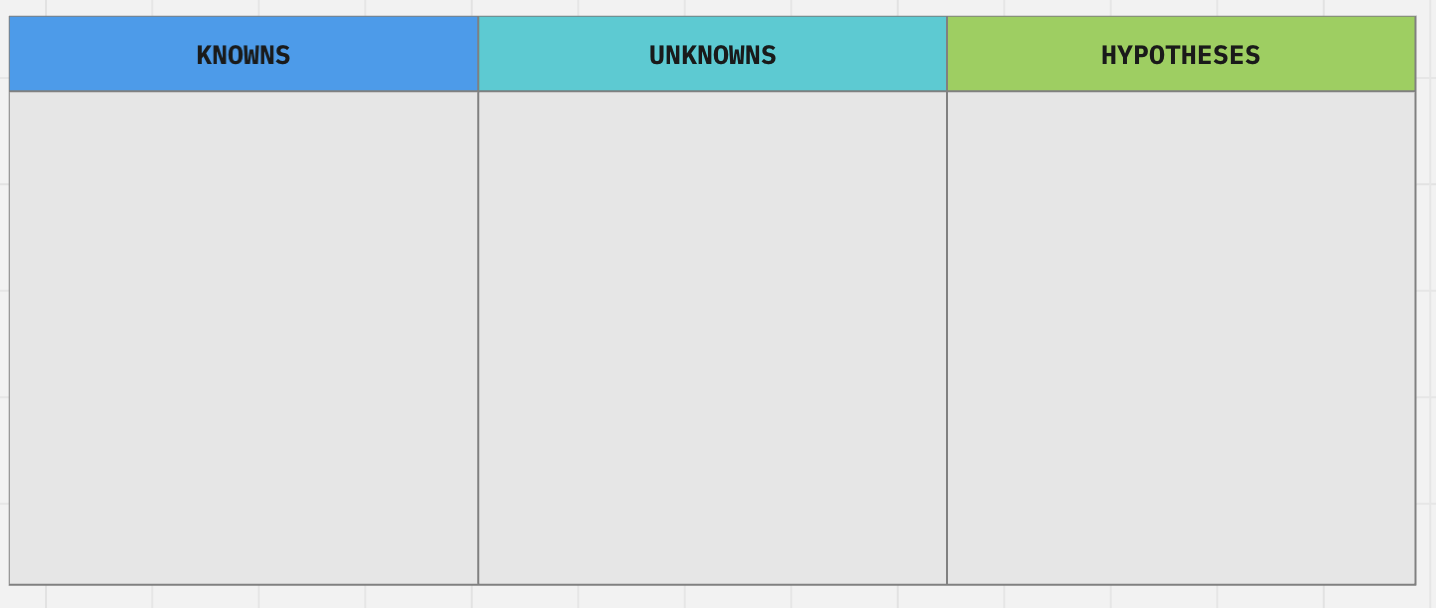
Use a tool of your choice to create a three-column table, as seen below:
#### Step 2: Plot your knowns and your unknowns
Ask the individual or group struggling to make a decision, “What do we know and what do we not know?”
**Knowns are verifiable facts**. These are things like describing how a system works, identifying observable behaviors of a system (linking to data and dashboards as you go), and naming perceived constraints around the problem at hand.
**Unknowns are the things we know we don’t know.** Depending on the context, these might be things like exactly how two systems are connected, the rate limit of a third-party service, or what an unclear error message is trying to tell us.
When working in a group, the process of labeling knowns and unknowns is like building a jigsaw puzzle where we each have some of the pieces. If I only looked at my own pieces and you only looked at yours, we wouldn’t be able to see the whole picture. But when we get all the pieces out side-by-side and start to fit them together, some of what wasn’t clear to either of us before comes into focus.
These settings are a great opportunity to correct assumptions masquerading as “knowns” – what someone believes to be true can sometimes not be!
Conversely, those participants vocalizing what they’re unable to grasp creates an opportunity for others to [share their knowledge](https://leaddev.com/team/how-do-engineers-learn-model-teaching-skills-knowledge-and-wisdom) and turn the unknown into a known – to connect some puzzle pieces together. Once connections are made, the team can move forward to create actionable next steps. Bear in mind that not all unknowns need to be solved, as not all will be relevant to the problem at hand.
#### Step 3: Come up with theories
Once the knowns and unknowns are mapped, [the next step is to generate hypotheses](https://leaddev.com/technical-decision-making/hypothesis-driven-development). The hypotheses are educated guesses – tentative answers to an individual or group's question – that can be tested and either supported or disproved. Depending on the context, the hypotheses might offer insights into why a problem exists or guide decision-making. The group can plot their next steps once the theory is proven or disproved.
#### Step 4: Action your next steps
Finally, assign out any next steps identified in phases two and three. Move unknowns in your table into knowns and prove or disprove hypotheses. By doing this, you can clarify uncertainties and move forward with confidence.
#### When should I reach for this tool?
I find myself using KUH in nearly every outage or incident scenario, especially in distributed systems with multiple teams at play. The outcome is that we swiftly merge context and come to an agreement on a short list of things that might be wrong in the system. Assigning team members to validate or invalidate each hypothesis allows everyone to tackle multiple problems simultaneously, speeding up the troubleshooting process. Ultimately, this reduces the mean time to recovery (MTTR).
KUH can also be used in technical planning conversations, getting a sense of the complexity of a problem and honing in on potential paths to solving it. If you find that a lot of unknowns crop up during these conversations, you will need to decrease the number of unknowns before committing to a project timeline or provide a buffer in the timeline, increasing the overall project length.
KUH is also a useful coaching tool. Oftentimes, I apply the logic in 1:1s to help my reports organize their own thinking on a problem. It helps them get out of unproductive thought patterns and identify what the next best course of action is.
#### How using KUH encourages a healthy culture
Healthy cultures don’t just happen; they grow from the behaviors we demonstrate as leaders and those that we encourage our teams to practice. Some of the bases of a [healthy culture within engineering teams](https://leaddev.com/team/how-bring-about-positive-cultural-change-your-team) are psychological safety, bias for collaboration, bias for action, and data-based decision-making. KUH can encourage each of these cultural qualities in the following ways.
* **Psychological safety**: As leaders, practicing KUH publically models vulnerability. In openly acknowledging the things we don’t know (vocalizing our own unknowns), we facilitate conversations that invite others to safely share without fear of retribution. [This fosters a psychologically safe environment](https://leaddev.com/team/using-psychology-boost-team-performance) built on trust.
* **Bias for collaboration**: KUH also broadcasts that collaboration is essential for problem-solving. It’s a tool that allows us to make forward progress by working with others to fill knowledge gaps and solve problems we wouldn’t be able to on our own.
* **Bias for action**: Applying KUH demonstrates how we can move from a space of stagnation to having clear next steps. By setting a tone that refuses to settle for prolonged indecision and instead commits to moving forward, even in times of uncertainty, we inspire others to adopt the same mindset.
* **Data-based decision-making**: Finally, applying KUH demonstrates data- and logic-based decision-making even in the heat of an incident. By taking a moment to pause and gather concrete information, we can think more clearly and choose the best course of action.
#### Final thoughts
The KUH facilitation technique is a valuable tool for leaders in resolving uncertainty and encouraging forward progress. Try it out the next time you sense stagnancy in a conversation and see how it can help an individual or group reach a resolution!, The Key to Quickly Unblocking Decision-Making, Meg Adams, 01j6yhh69atbtknd88wjj0581d.