The New Jobs AI Will Create
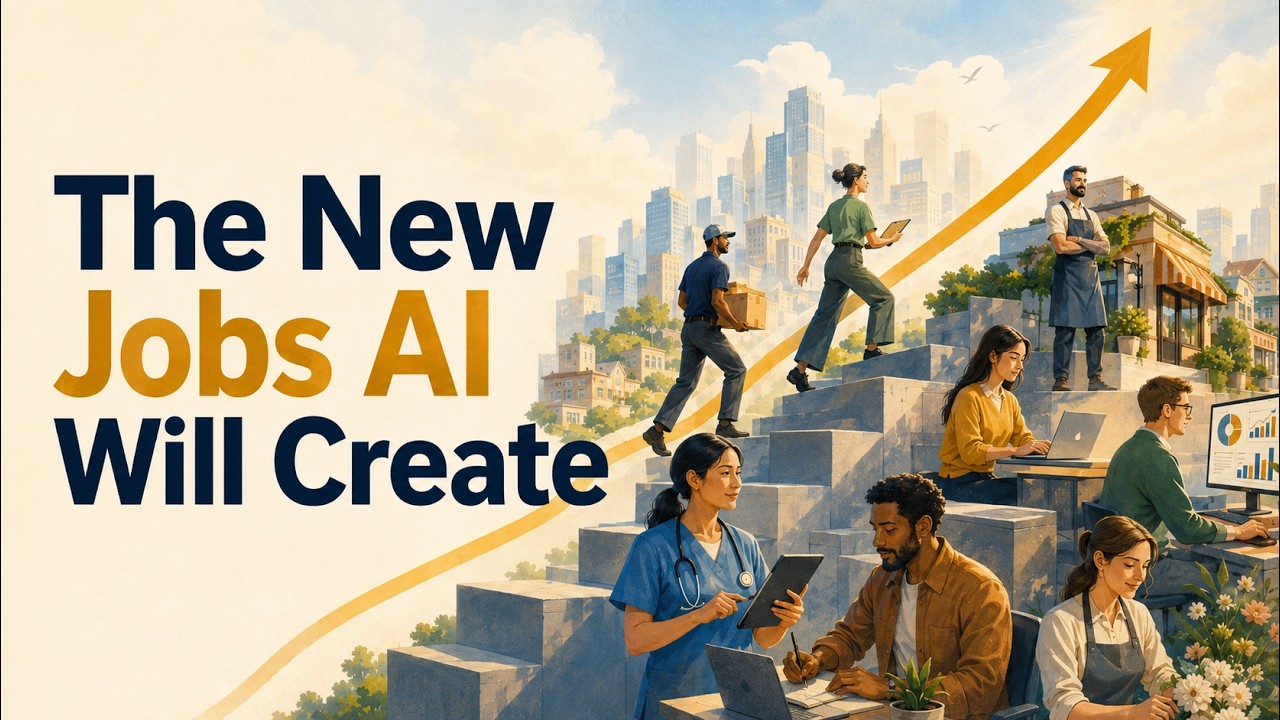
🔗 **Source:** [The New Jobs AI Will Create](https://www.youtube.com/watch?v=WhAAKxPlMhw)
> [!note]+ Document Notes
> ---
> tags: #artificial-intelligence #future-of-work #economic-transformation #job-creation #healthcare #demand-elasticity #human-premium
> author: Nathan Lambert
> source: YouTube
> reference: https://www.youtube.com/watch?v=WhAAKxPlMhw
> date created: 2024-12-19 10:30
> ---
> # 🏷️ Title: The New Jobs AI Will Create
> ## 🧰 Action Inbox
> - [H1] Research demand elasticity patterns in your industry — identify which of the 6 types apply #artificial-intelligence
> - [H2] Map human premium categories to current role — assess which values transfer beyond AI capability #future-of-work
> - [H3] Explore continuous service models in your sector — look for possibility unlock opportunities #economic-transformation
> ## 🧭 Table of Contents
> - [[#📝 Summary]]
> - [[#📖 Main Content]]
> - [[#🗒️ Notes]]
> - [[#📚 References]]
> - [[#🗣️ Paraphrase]]
> - [[#📰 Newsletter]]
> - [[#✅ Action Items]]
> - [[#🧪 Hypotheses]]
> - [[#📊 Methodology]]
> - [[#❓ Questions]]
> - [[#🔮 Future Research]]
> - [[#💡 Implications]]
> - [[#🧠 Learning Styles Assessment]]
> - [[#📊 Accessibility Assessment]]
> - [[#🌍 DEIB Assessment]]
> - [[#✅ Logical Validity]]
> - [[#🛡️ DARVO Analysis]]
> - [[#🎯 Conclusion]]
> ### 🔗 References
> - [AI Daily Brief](https://www.youtube.com/watch?v=WhAAKxPlMhw)
> - [Alex Emas "What Will Be Scarce" Essay](URL)
> ## 📝 Summary
> - Nathan Lambert challenges the AI job apocalypse narrative by arguing AI will create new categories of employment through demand expansion
> - The hidden assumption in job displacement theories is that demand stays constant while AI increases labor supply
> - Six types of demand elasticity explain how AI enables market expansion: price, access, complexity, continuity, personalization, and relational
> - The "human premium" - seven categories of value requiring human delivery - protects many roles from AGI replacement
> - Healthcare case study demonstrates how continuous preventative care could create 276,000 to 1.2 million new jobs
> - Bottom line: AI creates both affordability unlocks (cheaper existing services) and possibility unlocks (entirely new service categories)
> ## 📖 Main Content
> Lambert argues the AI industry has focused almost exclusively on which jobs are at risk rather than exploring what new employment categories will emerge. This represents a fundamental analytical failure that leaves optimists with only vague handwavy arguments about job creation.
> The core flaw in job apocalypse narratives is treating AI purely as a labor supply story - more AI means cheaper labor and displaced workers. This assumes demand remains constant, embodying the "lump of labor fallacy" that there's a fixed amount of work to do.
> Lambert identifies six types of demand elasticity that explain how increased AI-powered supply can actually expand markets: price elasticity (cheaper access), access elasticity (reducing scarcity and barriers), complexity elasticity (making opaque systems navigable), continuity elasticity (enabling always-on support), personalization elasticity (custom solutions), and relational elasticity (human-centered value).
> These elasticities create two types of unlocks: affordability unlocks where existing services reach new buyers at lower prices, and possibility unlocks where entirely new service models become operationally viable for the first time.
> ## 🗒️ Notes
> #### ⏱️ [00:00](https://youtu.be/WhAAKxPlMhw?t=0) — [H1] AI jobs narrative shift beginning
> - Key idea: Subtle movement away from pure job apocalypse thinking
> - Evidence: "More people at least question the premise that AI and agents getting better means people will have less work"
> #### ⏱️ [02:30](https://youtu.be/WhAAKxPlMhw?t=150) — [H2] Industry failure to explore new job categories
> - Key idea: Massive imbalance between risk assessment and opportunity exploration
> - Evidence: "Sheer tonnage of time spent on assessing which jobs are most at risk, compared to the almost zero time exploring what types of new jobs will be created"
> #### ⏱️ [04:15](https://youtu.be/WhAAKxPlMhw?t=255) — [H1] Hidden assumption in job displacement narratives
> - Key idea: AI analyzed only as labor supply increase, not demand expansion
> - Evidence: "All of this rests upon the presumption that demand stays constant"
> #### ⏱️ [06:45](https://youtu.be/WhAAKxPlMhw?t=405) — [H2] Six types of demand elasticity
> - Key idea: Different ways AI-increased supply can expand market demand
> - Evidence: "Price elasticity, access elasticity, complexity elasticity, continuity elasticity, personalization elasticity, relational elasticity"
> #### ⏱️ [09:20](https://youtu.be/WhAAKxPlMhw?t=560) — [H2] Complexity elasticity example
> - Key idea: AI helps navigate opaque systems people avoided
> - Evidence: "Think help with taxes, insurance, immigration, benefits... making opaque systems navigable"
> #### ⏱️ [12:10](https://youtu.be/WhAAKxPlMhw?t=730) — [H2] Small business professional services unlock
> - Key idea: Affordability unlock activates long-tail market
> - Evidence: "If AI reduces the cost of those jobs from 5,000 to 500 and 3,000 to 300, an enormous longtail market activates"
> #### ⏱️ [15:30](https://youtu.be/WhAAKxPlMhw?t=930) — [H1] Possibility unlock vs affordability unlock
> - Key idea: Two distinct ways AI creates new markets
> - Evidence: "Affordability unlock is the same menu at a lower price, the possibility unlock is a new menu entirely"
> #### ⏱️ [18:45](https://youtu.be/WhAAKxPlMhw?t=1125) — [H1] AGI objection and capability vs service design
> - Key idea: Jobs question is not just about AI capability but service delivery requirements
> - Evidence: "Better question I believe is does AI only delivery satisfy the demand?"
> #### ⏱️ [21:00](https://youtu.be/WhAAKxPlMhw?t=1260) — [H1] Seven categories of human premium
> - Key idea: Value that remains attached to human involvement despite AI capability
> - Evidence: "Relationship, embodied presence, trust, accountability, translation, behavior change, provenance and status"
> #### ⏱️ [24:30](https://youtu.be/WhAAKxPlMhw?t=1470) — [H2] Healthcare has every demand elasticity type
> - Key idea: Healthcare demonstrates all six elasticity categories
> - Evidence: "Healthcare has potentially every type of demand elasticity that we discussed before"
> #### ⏱️ [27:15](https://youtu.be/WhAAKxPlMhw?t=1635) — [H2] Continuous preventative care paradigm
> - Key idea: AI enables shift from episodic reactive to continuous preventative healthcare
> - Evidence: "AI enabled version of healthcare that is continuous, preventative and personalized"
> #### ⏱️ [30:00](https://youtu.be/WhAAKxPlMhw?t=1800) — [H2] Continuous care navigator role
> - Key idea: Human layer between patients and AI monitoring systems
> - Evidence: "276,000 jobs in conservative case, 1.2 million in aggressive case"
> #### ⏱️ [34:20](https://youtu.be/WhAAKxPlMhw?t=2060) — [H3] Care plan outcome specialist role
> - Key idea: Human interface for care plan implementation and problem-solving
> - Evidence: "Owns the gap between medical advice and real world execution"
> #### ⏱️ [37:45](https://youtu.be/WhAAKxPlMhw?t=2265) — [H3] Health data operations specialist
> - Key idea: Technical role ensuring reliability of AI-enabled healthcare data
> - Evidence: "20,000, 30,000, 40,000 jobs... owns reliability, integration, governance"
> #### ⏱️ [41:10](https://youtu.be/WhAAKxPlMhw?t=2470) — [H3] Six broad categories of new roles
> - Key idea: Patterns of job creation across industries
> - Evidence: "Navigators, continuous support workers, AI augmented service operators, data and operations specialists, QA safety and compliance, escalation specialists"
> ## 📚 References
> - [AI Daily Brief YouTube Channel](https://www.youtube.com/@aidailybrief)
> - [Alex Emas Research on Relational Economy](URL)
> - [Labor Economics Literature on Technological Change](URL)
> ## 🗣️ Paraphrase
> - AI job discussions focus too heavily on displacement risk and ignore job creation opportunities through market expansion
> - The assumption that demand stays constant while AI increases labor supply is fundamentally flawed and ignores historical patterns
> - Six types of demand elasticity show how AI can expand markets: making things cheaper, more accessible, less complex, continuous, personalized, and more relational
> - Human premium categories like trust, accountability, and relationship preserve job value even when AI can perform underlying tasks
> - Healthcare demonstrates how AI could create hundreds of thousands of new jobs in continuous care, implementation support, and data operations roles
> ## 📰 Newsletter
> **AI's Job Creation Opportunity: Moving Beyond Displacement Fears**
> The AI job debate has been stuck in apocalypse mode, but Nathan Lambert offers a refreshing economic perspective that could reshape how we think about AI's impact on work.
> Lambert argues we've been asking the wrong question. Instead of just "Can AI do this job?", we should ask "Does AI-only delivery satisfy market demand?" This shift reveals how AI creates new employment through demand expansion, not just job displacement.
> Key insight: Six types of demand elasticity show how AI enables market growth - making services cheaper, more accessible, less complex, continuous, personalized, and relationship-focused. Healthcare exemplifies this with potential for 276,000 to 1.2 million new jobs in continuous preventative care.
> The "human premium" - seven categories of value requiring human delivery including trust, accountability, and relationships - protects many roles from AI replacement while creating entirely new job categories.
> **Resources:** [Learn WordPress](https://learn.wordpress.org/), [Developer Docs](https://developer.wordpress.org/), [WP-CLI](https://wp-cli.org/)
> ## ✅ Action Items
> #### DevRel
> - Developer advocacy: Create content on AI-augmented developer workflows, present at conferences on human-AI collaboration in coding
> - Education: Develop workshops on prompt engineering for developers, AI pair programming best practices
> - Developer experience: Research how AI tools can improve documentation, SDK usage patterns
> - Community management: Survey developer attitudes toward AI tools, moderate discussions on AI impact
> #### OSPO
> - Strategic Alignment: Track AI adoption patterns in open source projects, measure impact on contribution models
> - Developer Support: Provide training on AI-assisted development, evaluate AI coding tools for enterprise use
> - Community Engagement: Fund research on AI's impact on maintainer workload, open source sustainability
> #### Community
> - Contributors: Create pathways for AI-assisted contributions, first-issue programs leveraging AI tools
> - Ecosystem: Coordinate cross-project standards for AI tool integration in development workflows
> #### WordPress
> - Core AI: Develop guardrails for AI-generated content, create evaluation frameworks for AI features
> - Training: Design lesson plans for AI-assisted WordPress development, content creation workflows
> - Community: Support meetups on AI tools for WordPress developers, content creators
> - Documentation: Use AI to improve DevHub content generation while maintaining human editorial oversight
> ## 🧪 Hypotheses
> - Industries with high complexity elasticity (legal, healthcare, finance) will see more AI-human hybrid roles emerge than those with primarily price elasticity
> - Roles with multiple human premium categories (trust + accountability + relationship) will be more resistant to AI displacement than those with single premiums
> - Possibility unlocks will create larger employment categories than affordability unlocks in sectors where continuous service models weren't previously viable
> - The transition period between affordability and possibility unlocks will determine whether AI adoption creates net job growth or displacement in specific sectors
> ### 📊 Methodology
> - Industry analysis comparing current service delivery models to AI-enabled continuous models across healthcare, legal, education, and financial services
> - Survey research on consumer willingness to pay for human premium categories in different service contexts
> - Economic modeling of demand elasticity coefficients for professional services at different AI-driven price points
> ### ❓ Questions
> - How do we measure and validate the seven human premium categories across different industries and cultural contexts?
> - What policy interventions could accelerate the transition from displacement to job creation during AI adoption waves?
> - How might the timeline and sequence of AI capabilities development affect which possibility unlocks become viable first?
> ### 🔮 Future Research
> - Longitudinal study tracking job category evolution in early AI-adopting industries like customer service and content creation
> - Cross-cultural research on human premium valuation differences across global markets
> - Economic impact modeling of continuous service paradigms across multiple sectors beyond healthcare
> ### 💡 Implications
> - Practice: Service businesses should identify which demand elasticity types apply to their market and design AI-human hybrid offerings accordingly
> - Policy: Workforce development programs need to focus on human premium skills rather than just technical AI literacy
> - Education: Business schools should teach demand elasticity analysis as core framework for understanding AI economic impact
> - Funding: Investors should evaluate AI startups based on their ability to unlock new demand categories, not just automate existing processes
> ### 🧠 Learning Styles Assessment
> Reading level estimate: Grade 14-15 (College/Graduate level)
> #### 👀 Visual learners
> - Present: Economic frameworks clearly explained with categorization
> - Improve: Demand elasticity diagrams, healthcare system flow charts, job growth visualizations
> #### 🔊 Aural learners
> - Present: Full video presentation with clear verbal explanation
> - Improve: Podcast-style discussion with industry experts on specific sectors
> #### 🗣️ Verbal learners
> - Present: Strong use of analogies (menu metaphors), clear definitions of technical terms
> - Improve: More concrete industry examples beyond healthcare
> #### 🧩 Kinesthetic learners
> - Present: Detailed case study walkthrough with specific calculations
> - Improve: Interactive worksheets for analyzing demand elasticity in different industries
> #### 🧠 Logical learners
> - Present: Systematic framework with numbered categories, clear cause-effect relationships
> - Improve: Economic modeling tools, quantitative analysis templates
> #### 🧑🤝🧑 Social learners
> - Present: YouTube format encourages discussion and community engagement
> - Improve: Discussion guides for industry groups, peer analysis exercises
> #### 🧘♀️ Solitary learners
> - Present: Comprehensive framework for independent analysis
> - Improve: Self-assessment tools for evaluating personal career implications
> #### 🌿 Naturalistic learners
> - Present: Healthcare ecosystem thinking, economic system interconnections
> - Improve: Broader connections to economic ecosystem health, sustainability implications
> ### 📊 Accessibility Assessment
> #### Screen reader semantics
> - Present: Clear verbal presentation in video format
> - Improve: Transcript with proper heading structure, alt text for any visual frameworks
> #### Keyboard navigation
> - Present: Standard YouTube video controls
> - Improve: Chapter markers for easy navigation to specific topics
> #### Contrast and readability
> - Present: Clear audio delivery
> - Improve: High-contrast transcript formatting, readable font sizes
> #### Media and captions
> - Present: YouTube auto-generated captions available
> - Improve: Professional captions with technical term accuracy, downloadable transcript
> ### 🌍 DEIB Assessment
> #### Cultural breadth
> - Present: Economic framework applicable globally
> - Improve: Examples from different cultural contexts, consideration of varying labor market structures
> #### Inclusive language
> - Present: Professional, accessible economic terminology
> - Improve: More diverse industry examples beyond healthcare, varied demographic scenarios
> #### Neurodiversity support
> - Present: Clear logical structure, systematic framework presentation
> - Improve: Multiple format options (audio, text, visual), consistent pacing
> #### Representation
> - Present: Focus on economic analysis rather than demographic specifics
> - Improve: Examples considering different socioeconomic situations, global labor market variations
> ### ✅ Logical Validity
> #### Strong reasoning
> - Deductive strength: Solid logical progression from demand elasticity principles to job creation predictions
> - Inductive strength: Good use of historical precedent regarding technology adoption and job creation
> - Causal reasoning: Clear causal links between AI capability improvements and demand expansion mechanisms
> - Analogical strength: Effective use of menu analogy for understanding affordability vs possibility unlocks
> #### Fallacies
> - Hasty generalization: Healthcare case study generalized to all industries without sufficient evidence for universal applicability, needs more cross-sector validation
> - False dichotomy: Presents AI impact as either displacement or creation, could better address mixed scenarios where both occur simultaneously
> #### Tone of voice
> - Overall tone: Professional and optimistic while acknowledging complexity, uses
> ---
> ## Full Transcript
> [00:00] Today on the AI Daily Brief, the new<br>[00:02] jobs AI will create. The AI Daily Brief<br>[00:05] is a daily podcast and video about the<br>[00:07] most important news and discussions in<br>[00:08] AI.<br>[00:10] All right, friends. One of the big<br>[00:12] points of discussion for this week has<br>[00:13] been the idea that there is this ever so<br>[00:15] subtle shift in the AI jobs narrative.<br>[00:18] It would be going way too far to say<br>[00:20] that this was becoming anywhere near<br>[00:21] mainstream, but you're starting to see<br>[00:23] more people at least question the<br>[00:24] premise that AI and agents getting<br>[00:26] better means people will have less work.<br>[00:28] And yet, even among those who are<br>[00:29] arguing that the AI job apocalypse<br>[00:32] narrative is way overblown, the argument<br>[00:34] tends to be much more backwards looking.<br>[00:36] It's looking at the way that<br>[00:38] productivity has previously impacted<br>[00:39] industries and extrapolating that out to<br>[00:41] the future. That's well and good and all<br>[00:44] of that is important, but I think it is<br>[00:46] a significant failure of the AI industry<br>[00:48] to take the next step and actually start<br>[00:50] to explore the type of jobs that there<br>[00:53] will be in an AI enabled future. The<br>[00:56] sheer tonnage of time spent on assessing<br>[00:59] which jobs are most at risk, compared to<br>[01:01] the almost zero time exploring what<br>[01:04] types of new jobs will be created<br>[01:06] represents one of our great failures and<br>[01:08] leaves people who want to be optimistic<br>[01:10] about the future clinging to vague<br>[01:12] handwavy notions about what those jobs<br>[01:14] might be. Now, from the standpoint of<br>[01:16] sheer epistemic humility, of course, we<br>[01:18] have to be careful about arguing with<br>[01:20] any sort of confidence what specific<br>[01:22] things will be created in the future. In<br>[01:24] other words, the more specific our<br>[01:26] future predictions, the less likely to<br>[01:27] be right they are. But that doesn't mean<br>[01:29] that we can't at least explore from<br>[01:31] first principles how we think the change<br>[01:33] is going to play out if indeed it is not<br>[01:35] going to be the mass destruction of<br>[01:36] white collar work that some are<br>[01:38] promising. So what I'm going to attempt<br>[01:40] today is talk about one the fundamental<br>[01:42] problem and the hidden assumption in<br>[01:44] most of the job apocalypse narratives.<br>[01:46] Two, what opens up when you correct that<br>[01:49] assumption. Three, how to deal with the<br>[01:51] AGI objection. and four, a real walk<br>[01:55] through a specific sector and some jobs<br>[01:57] that I could see very plausibly being a<br>[01:59] part of the future and representing<br>[02:00] meaningful amounts of employment. So,<br>[02:02] let's talk first about that hidden<br>[02:04] assumption. AI is mostly analyzed right<br>[02:06] now as a labor supply story. In other<br>[02:09] words, AI increases the supply of labor,<br>[02:12] so labor gets cheaper and workers get<br>[02:14] displaced. But all of this rests upon<br>[02:16] the presumption that demand stays<br>[02:19] constant. This is another way of framing<br>[02:21] the lump of labor fallacy. the idea that<br>[02:23] there is a set amount of work to do. So<br>[02:25] if technology comes and does some of<br>[02:27] that work, that means that humans aren't<br>[02:29] doing that work, which means that those<br>[02:30] humans don't have any work to do. What<br>[02:32] it doesn't take into account is the<br>[02:34] expansionary nature of economies and the<br>[02:36] ability of demand to expand to absorb<br>[02:38] more supply. Now, I don't want to spend<br>[02:41] a lot of time on the historical<br>[02:42] arguments here. As I mentioned, that's<br>[02:44] the main substance of pretty much all<br>[02:46] other arguments along these lines. Yet,<br>[02:48] it is worth noting, of course, that the<br>[02:49] assumption that demand stays constant as<br>[02:51] the supply of labor increases has never<br>[02:53] held true. And so, if we are just going<br>[02:55] from historical precedent, it is<br>[02:57] unlikely to be true this time either.<br>[02:59] The more important question, if we're<br>[03:01] trying to actually interact with<br>[03:02] people's lives as they're lived now, not<br>[03:04] just provide a history lesson, is to ask<br>[03:07] where demand will expand. Basically,<br>[03:10] what parts of the economy could actually<br>[03:13] grow as AI allows us to produce more?<br>[03:16] And I think what's important to note is<br>[03:17] that demand elasticity actually comes in<br>[03:20] a variety of different forms. The one<br>[03:22] that's most obvious is of course price<br>[03:23] elasticity. I.e. I wanted the thing but<br>[03:26] it costs too much. If AI makes a thing<br>[03:29] cheaper, new buyers can enter the<br>[03:30] market. A second category of demand<br>[03:33] elasticity is access elasticity. I<br>[03:36] wanted it but I couldn't get it. Now,<br>[03:39] whereas AI supported price elasticity<br>[03:41] because it lowered the cost floor, in<br>[03:43] this case, we're talking about AI<br>[03:45] reducing provider scarcity or weight<br>[03:47] times or geographic barriers or other<br>[03:50] types of institutional bottlenecks.<br>[03:52] Basically, instead of it just being<br>[03:54] cheaper, AI makes a good or service more<br>[03:56] readily available. A third type of<br>[03:58] demand elasticity is complexity<br>[04:00] elasticity. I needed it, but the system<br>[04:02] was too confusing. Think help with<br>[04:04] taxes, insurance, immigration, benefits.<br>[04:07] The way that AI supports this type of<br>[04:08] demand elasticity is by making opaque<br>[04:11] systems navigable. You're already<br>[04:13] starting to see this as a major way that<br>[04:15] people are consuming AI, interacting<br>[04:17] with legal ease or contract things or<br>[04:19] even doctor's recommendations they<br>[04:20] didn't really understand before, but now<br>[04:22] have the sherpa and guide that can help<br>[04:23] reduce that complexity. Another category<br>[04:26] of elasticity we'll call continuity<br>[04:28] elasticity. And here perhaps we're<br>[04:30] getting a little bit more abstract, but<br>[04:31] I still think it's worth noting. The<br>[04:33] idea of continuity elasticity is going<br>[04:35] from I get help occasionally to I'd<br>[04:37] benefit from help all the time. So think<br>[04:40] about areas like health or coaching<br>[04:42] where always on monitoring and support<br>[04:44] could become cheap enough to operate at<br>[04:46] scale in a way that wasn't possible<br>[04:48] before. A fifth form of demand<br>[04:50] elasticity we'll call personalization<br>[04:52] elasticity. This is I get the generic<br>[04:55] version now but I'd value something made<br>[04:57] for me. When AI brings the cost and ease<br>[05:00] of production down, it's going to make<br>[05:02] customization cheaper. The last category<br>[05:05] we'll call relational elasticity or<br>[05:07] value elasticity. And the idea is I want<br>[05:10] this thing that I am buying, whether<br>[05:11] it's a good or a service to be more<br>[05:13] human, meaningful or trusted. This is<br>[05:15] what Chicago Booth economist Alex Emas<br>[05:18] wrote about in his what will be scarce<br>[05:19] essay. how the relational sector where<br>[05:22] the provenence of a good or service how<br>[05:24] it was made and who made it and who is<br>[05:26] providing it are actually an integral<br>[05:28] part of the value of the service i.e.<br>[05:30] people deciding that they don't just<br>[05:32] want a coffee, they want an experience<br>[05:33] surrounding that coffee that involves<br>[05:35] interaction with a human and a<br>[05:36] particular quality that comes from some<br>[05:38] sort of human touch. So, we've got these<br>[05:40] different categories of how AI's impact<br>[05:43] on the supply of things in terms of cost<br>[05:45] of production, ease of production, speed<br>[05:47] of production, etc. can interact with<br>[05:49] elasticity of demand to expand demand in<br>[05:52] new and clear ways. And one thing that's<br>[05:54] interesting to look at as we try to<br>[05:56] understand AI's impact on different<br>[05:57] sectors, especially the positive and<br>[05:59] generative impact of AI, is to ask which<br>[06:02] of those elasticities are common in<br>[06:04] those sectors. They're present pretty<br>[06:06] much everywhere, but different sectors<br>[06:08] are going to have different elasticities<br>[06:09] more strongly represented. For example,<br>[06:12] in experiences and travel, that<br>[06:14] relational elasticity and<br>[06:15] personalization elasticity are going to<br>[06:17] be particularly high, but you're not<br>[06:18] likely to see continuity elasticity<br>[06:20] because you're not able to have<br>[06:21] experiences or travel continuously<br>[06:23] throughout your life, as awesome as that<br>[06:24] would be. Meanwhile, on the other end of<br>[06:26] the spectrum, healthcare, I think, has<br>[06:28] every single one of these types of<br>[06:30] elasticity, which is why it shows up as<br>[06:32] our case study in a little bit. Now<br>[06:34] trying to zoom out and consolidate this<br>[06:37] argument, I think we can look at AI as<br>[06:39] expanding the demand frontier in two<br>[06:41] directions at once. It either is<br>[06:44] increasing and democratizing access to<br>[06:46] things that are available now or<br>[06:48] unlocking things that aren't possible<br>[06:49] now. If you go back up to the types of<br>[06:52] elasticity, you'll note that in many of<br>[06:53] these cases, if you were currently rich,<br>[06:56] you could already get access to the<br>[06:58] thing in the way that the people want it<br>[06:59] now under the conditions of the new<br>[07:01] elasticity. If you're rich, your word is<br>[07:03] price sensitive. You could probably pay<br>[07:04] to solve access issues and complexity<br>[07:06] issues. If you're rich enough, you could<br>[07:08] even use money to solve continuity<br>[07:10] issues, and you could probably pay for<br>[07:11] personalization and relational value as<br>[07:13] well. So, the first unlock of AI is the<br>[07:16] affordability unlock. Basically, the<br>[07:18] same menu, but at a lower price. And<br>[07:20] that's most of what you were probably<br>[07:21] thinking about when I was describing<br>[07:22] these six categories of demand<br>[07:23] elasticity. To take one example, let's<br>[07:26] think about small business professional<br>[07:27] services. Right now, the average small<br>[07:30] business owner might not have the budget<br>[07:32] to buy a $5,000 design project, a $3,000<br>[07:35] marketing campaign, a $2,000 legal<br>[07:37] review, and a $1,500 analytics report.<br>[07:40] This obviously does not mean that the<br>[07:41] business doesn't have demand for design,<br>[07:43] marketing, legal, and analytics. It<br>[07:44] means that at the current state, the old<br>[07:47] version of those services was<br>[07:48] unaffordable. If AI reduces the cost of<br>[07:51] those jobs from 5,000 to 500 and 3,000<br>[07:54] to 300, an enormous longtail market<br>[07:57] activates. Millions of small businesses<br>[07:59] that were never agency clients before<br>[08:01] become buyers for the first time. This<br>[08:03] is again what I'm calling the<br>[08:04] affordability unlock where there is net<br>[08:07] new demand for services that already<br>[08:08] exist because the changing cost and<br>[08:10] availability of provision opens up new<br>[08:12] buyers for which that service wasn't<br>[08:13] viable before. The second type of unlock<br>[08:16] I'm calling the possibility unlock. To<br>[08:18] use the menu analogy, if the<br>[08:20] affordability unlock is the same menu at<br>[08:22] a lower price, the possibility unlock is<br>[08:24] a new model entirely. This is where AI<br>[08:26] makes a service model operationally<br>[08:28] possible that could not previously exist<br>[08:31] at scale. The category itself becomes<br>[08:34] possible before anyone can demand it.<br>[08:37] Previewing where we're going to get in<br>[08:38] our case study, an example of this, I<br>[08:40] think, is continuous preventative<br>[08:42] healthare. The vast majority of people,<br>[08:44] not named Brian Johnson, don't currently<br>[08:46] have someone continuously watching their<br>[08:48] health data or tracking their care plan<br>[08:50] or noticing drift or coordinating with<br>[08:52] their pharmacy. And to be clear, people<br>[08:54] aren't demanding this exact service.<br>[08:56] This isn't a normal category because it<br>[08:57] hasn't been operationally viable. But as<br>[09:00] AI collapses the cost of the<br>[09:02] informationational layer around care,<br>[09:04] data collection, monitoring,<br>[09:06] summarization, documentation,<br>[09:08] scheduling, escalation, routing, once<br>[09:10] all of those costs fall and the systems<br>[09:12] around them become viable, a totally<br>[09:14] different healthcare model becomes<br>[09:16] possible. One that is personalized,<br>[09:18] datadriven, preventative, and<br>[09:19] continuous. This is entirely net new<br>[09:23] demand because no one had this before<br>[09:25] because it wasn't possible until AI made<br>[09:28] it possible. When it comes to new jobs,<br>[09:31] the affordability unlock opens up whole<br>[09:33] new categories of providers that cater<br>[09:35] to different parts of the long tale of<br>[09:37] the market. The possibility unlock<br>[09:39] creates entire new markets which entire<br>[09:42] new actors will come into to provide<br>[09:43] those goods and services that are now<br>[09:45] actually possible. But now we have to<br>[09:48] get to the question that stops all of<br>[09:50] these conversations midtrack. I would<br>[09:53] argue that the number one reason that<br>[09:55] people claim this time is different and<br>[09:57] that AI is not a so-called normal<br>[10:00] technology is that they say the people<br>[10:02] that are optimistic about the jobs<br>[10:04] created in the future aren't answering<br>[10:06] the question, won't AGI just eat those<br>[10:09] jobs, too? In other words, for those<br>[10:12] small business professional services, if<br>[10:14] the first wave of AI brings cost down by<br>[10:16] a factor of 10 and makes those $5,000<br>[10:18] jobs into $500 jobs, is that just a<br>[10:21] temporary state on the path to AGI that<br>[10:24] can do those jobs for 50 cents instead<br>[10:25] with no human involved? To be clear,<br>[10:29] from a first principles perspective,<br>[10:31] this is a reasonable question and one<br>[10:33] that again I think AI optimists are<br>[10:35] failing to engage with clarity and good<br>[10:37] faith. For my part, I think that there<br>[10:40] are actually quite clear answers. The<br>[10:43] question that we are asking, which I<br>[10:44] think is the wrong question and the idea<br>[10:46] that is embedded in the assumption that<br>[10:48] AGI will just eat those new jobs too, is<br>[10:51] we think about the question of jobs only<br>[10:53] as a question of can AI perform the<br>[10:55] task. It's a capability question that<br>[10:58] assumes labor demand is grounded<br>[10:59] entirely and only in what humans can do.<br>[11:03] But that's too narrow. A better question<br>[11:05] I believe is does AI only delivery<br>[11:08] satisfy the demand? Here we've moved<br>[11:11] from a capability question to a service<br>[11:13] design question. Many roles exist not<br>[11:17] because of capability gaps but because<br>[11:19] of the constraints of the market's<br>[11:21] expectations in how a service is<br>[11:23] delivered. Things like trust,<br>[11:25] accountability, presence, relationships.<br>[11:27] They are part of the value. And while<br>[11:29] AGI can eat tasks and will eat many<br>[11:32] tasks, it will not automatically eat<br>[11:34] that demand for things like trust and<br>[11:36] accountability. To try to put a name on<br>[11:38] this, I'm calling it the human premium.<br>[11:41] These are seven categories of value that<br>[11:43] do not a priority transfer when you<br>[11:45] remove the human. The human premium is<br>[11:48] the portion of economic value that<br>[11:50] remains attached to human involvement<br>[11:52] even when AI can perform the underlying<br>[11:54] tasks. It is the answer to why doesn't<br>[11:57] AI eat those jobs too. Here are seven<br>[12:01] categories of human premium. The first<br>[12:04] is relationship or relational. Again,<br>[12:06] this is the one that Alex Emos explored.<br>[12:08] The idea that I want this delivered by<br>[12:10] someone who knows me, where there is<br>[12:12] continuity, memory, accumulated trust,<br>[12:15] where the human part of the experience<br>[12:16] actually matters and is integral to the<br>[12:18] experience, where replacing a person<br>[12:21] with an AI makes the service worse<br>[12:23] enough that it actually decreases demand<br>[12:24] for that service. A second kind of<br>[12:27] related category of human premium we'll<br>[12:29] call embodied presence, where the demand<br>[12:32] constraint is I want someone there with<br>[12:34] me. This is where physical presence<br>[12:37] matters. The nurse in the room, the<br>[12:39] trainer correcting form. It's not that<br>[12:42] AI can't do some of the things that<br>[12:44] those people do. It's that the physical<br>[12:47] presence is important enough to many<br>[12:49] that there continues to be demand for<br>[12:51] that human premium of embodied presence.<br>[12:54] A third category of human premium is<br>[12:57] trust. I want to talk to a person before<br>[12:59] I act. Humans are social creatures. We<br>[13:02] value social proof. We value the<br>[13:04] experience of people who have come<br>[13:05] before us. We value understanding the<br>[13:07] context of the personal experience that<br>[13:09] we are trusting of people who came<br>[13:10] before us. As much as AI generates<br>[13:12] recommendations, there are many<br>[13:14] situations in which people will<br>[13:16] absolutely prefer the recommendation of<br>[13:18] a human, even if that human is just<br>[13:20] validating the AI that they're working<br>[13:22] with too. In many circumstances, humans<br>[13:24] will be asked to make AI generated<br>[13:26] recommendations believable, emotionally<br>[13:29] acceptable, and actionable. Which gets<br>[13:31] us to of course the fourth category of<br>[13:32] human premium which is accountability<br>[13:34] where the demand constraint is someone<br>[13:36] has to own this. People want a person<br>[13:39] who signs off, escalates, explains and<br>[13:41] is responsible when things go wrong.<br>[13:44] When I'm taking an experimental new<br>[13:45] peptide regime, which is all the rage<br>[13:47] right now, I don't care if Chat GBT can<br>[13:49] tell me how to titrate things correctly<br>[13:50] at the right ratios. You better believe<br>[13:52] I want someone whose bonafides and<br>[13:54] credentials I can check and who to put<br>[13:56] it crassly I can sue if something goes<br>[13:58] wrong. The questions of legal<br>[14:00] accountability for AIS are going to make<br>[14:02] a lot of lawyers very rich for a very<br>[14:04] long time. But even outside of questions<br>[14:05] of the legal system, there is going to<br>[14:07] be a human premium on accountability for<br>[14:10] sure. A fifth area of human premium is<br>[14:13] translation. AI is interacting with the<br>[14:15] entire accumulated knowledge of the<br>[14:17] world. But some people aren't going to<br>[14:18] know how to ask for what they need. Even<br>[14:20] in a world of AGI, they will want human<br>[14:23] translators. people who can turn messy<br>[14:25] desire and constraint into usable AI<br>[14:27] mediated work. This I think is extremely<br>[14:31] important for the example of small<br>[14:32] business professional services. The AGI<br>[14:35] eats everything answer to this that<br>[14:37] won't it just compress that $500 job<br>[14:39] into a 50cent job eventually that takes<br>[14:41] the job of the intermediary actor fails<br>[14:43] to understand the economic value of this<br>[14:45] translation. A small business owner<br>[14:47] might not want or have time to get good<br>[14:50] enough at using AI for design to take<br>[14:53] advantage of the 50cent cost that AGI<br>[14:55] makes it. The market will find the price<br>[14:58] level at which a human can upsell the<br>[15:00] 50cent AI work in a way that fits better<br>[15:03] with the process and constraints of that<br>[15:05] small business owner. It is a failure of<br>[15:07] economic understanding to assume that<br>[15:09] there is no room for margin on top of<br>[15:11] the underlying cost of goods sold. AI<br>[15:13] might dramatically compress that margin,<br>[15:15] but there will be margin there. A sixth<br>[15:18] category of human premium we'll call<br>[15:19] behavior change. That's where I know<br>[15:22] what to do, but I need help doing it.<br>[15:24] Anyone who has tried to use a chat GBT<br>[15:27] workout plan only to abandon it or at<br>[15:30] least integrate it with a human trainer<br>[15:32] who can help them stay accountable to<br>[15:33] themselves will understand what I'm<br>[15:35] talking about here. Simply put, there<br>[15:38] are certain categories of behavior<br>[15:39] change for which we will listen to a<br>[15:40] human and we will not listen to an AI.<br>[15:43] The last category of human premium we'll<br>[15:45] call provenence and status. This is what<br>[15:47] we were talking about in the relational<br>[15:48] sector that a human made it is part of<br>[15:50] why it matters. This could be arts,<br>[15:52] crafts, custom goods, live performance,<br>[15:54] bespoke services. The human signature is<br>[15:57] part of those products. So with all of<br>[15:59] these concepts in mind, let's look at an<br>[16:01] industry case study in healthcare. I<br>[16:03] want to be very clear. I have no<br>[16:05] expertise in healthcare whatsoever. It's<br>[16:07] not a sector I've worked in. I'm coming<br>[16:09] at this from the perspective of a a<br>[16:11] technologist and b a consumer of<br>[16:13] healthare. But I think it's quite clear<br>[16:15] that healthcare has potentially every<br>[16:17] type of demand elasticity that we<br>[16:19] discussed before. People consume more of<br>[16:21] it if it was cheaper. They would<br>[16:22] probably consume more of it if they had<br>[16:24] easier access like better clinics in<br>[16:26] their hometown. They would certainly<br>[16:27] consume more of it if the complexity was<br>[16:29] reduced or they had better ways to<br>[16:30] navigate that complexity, especially<br>[16:32] when it comes to billing, insurance,<br>[16:33] etc. I think that likely many people<br>[16:35] would want a relational element and a<br>[16:37] personalized element of their healthcare<br>[16:38] rather than just being a number in a<br>[16:39] system. And I think the biggest demand<br>[16:41] elasticity or at least the one that's<br>[16:43] most interesting when it comes to the<br>[16:44] idea of the difference between the<br>[16:45] affordability unlock and a possibility<br>[16:47] unlock is around continuity. My argument<br>[16:51] is that we consume an incredibly small<br>[16:53] part, even a vanishingly small part of<br>[16:56] the amount of healthcare we would<br>[16:57] consume if the labor math underneath it<br>[16:59] made a different kind of healthcare<br>[17:00] possible. Right now, we all live in a<br>[17:03] paradigm of reactive care that is<br>[17:05] episodic by default. Every once in a<br>[17:07] while, we make an appointment. Either<br>[17:08] because it's our annual checkup or<br>[17:10] because there's a thing we're now at the<br>[17:12] age where we have to do once every 3 to<br>[17:13] 5 years or because something stops<br>[17:15] working the way that it's supposed to.<br>[17:17] From there, we have some tests, get a<br>[17:19] diagnosis, which turns into a<br>[17:21] prescription, and then we're left alone<br>[17:22] again to fend for ourselves. At some<br>[17:24] point, a new crisis arises, and the<br>[17:26] whole cycle starts again. There is, I<br>[17:28] believe, an AI enabled version of<br>[17:30] healthcare that is continuous,<br>[17:31] preventative and personalized. It<br>[17:33] involves AI for data collection,<br>[17:35] continuous monitoring and even triage<br>[17:37] and ranking. But in doing so, it creates<br>[17:40] a whole new set of opportunities for<br>[17:42] human roles, net new human roles that<br>[17:45] emerge in this new continuous<br>[17:47] preventative personalized paradigm.<br>[17:49] There's an AI background layer that<br>[17:51] watches the data and a human action<br>[17:53] layer that helps convert that to<br>[17:54] meaning. So for the sake of this episode<br>[17:57] and for coming along this journey with<br>[17:58] me, let's assume that this idea that<br>[18:00] continuous preventative care becomes<br>[18:02] more viable and more normalized. If that<br>[18:05] happens, it will create demand for new<br>[18:07] types of jobs. And these are not AI jobs<br>[18:10] in the narrow sense we think about<br>[18:12] prompt engineers or agent operators. Now<br>[18:14] these are healthcare service jobs that<br>[18:16] the AI layer makes possible. And each of<br>[18:18] them maps to some set of specific human<br>[18:21] premium categories that protect them<br>[18:23] from being eaten by stronger AI. The<br>[18:26] first role I'll call a continuous care<br>[18:28] navigator. This is the human layer<br>[18:30] between a patient and an AI enabled<br>[18:31] monitoring system. They oversee a case<br>[18:34] load of patients in continuous<br>[18:35] monitoring and handle the moments that<br>[18:37] matter such as the pattern having<br>[18:39] changed, the call that has to happen,<br>[18:40] the family that needs reassurance or the<br>[18:42] escalation that has to land. So while an<br>[18:44] AI is doing things like ingesting data<br>[18:47] from devices, labs, patient reports,<br>[18:50] establishing baselines and detecting<br>[18:52] deviations, ranking cases and changes by<br>[18:54] urgency, updating documentation, routing<br>[18:57] escalation, the human, the continuous<br>[18:59] care navigator is doing things like<br>[19:01] reviewing flagged cases, calling<br>[19:03] patients to clarify and ask the<br>[19:05] questions AI didn't know to ask in those<br>[19:07] personal interactions, noticing things<br>[19:09] like fear, shame, avoidance, or<br>[19:11] unexpressed family dynamics.<br>[19:13] coordinating with clinicians to escalate<br>[19:15] things and closing the loop after<br>[19:17] intervention. The human premiums<br>[19:19] involved here include trust,<br>[19:21] accountability, translation, behavior<br>[19:24] change, and relationship. So, how many<br>[19:26] people could the market support? When it<br>[19:28] comes to healthcare, the total<br>[19:30] addressable market is everyone with a<br>[19:31] body. But for the sake of our arguments,<br>[19:34] let's zoom out a decade and take a<br>[19:36] conservative, middle, and aggressive<br>[19:37] case among American adults. We'll call<br>[19:39] conservative 40 million enrolled<br>[19:40] patients, middle 80 million enrolled<br>[19:42] patients, and aggressive 120 million<br>[19:44] enrolled patients. The conservative case<br>[19:46] then is about 14% of US adults enrolled<br>[19:49] with the aggressive being about 43% of<br>[19:51] US adults enrolled. Now, also on the<br>[19:53] conservative end, let's assume that one<br>[19:55] continuous care navigator can handle 150<br>[19:57] patients. If that's the case, you're<br>[19:59] talking about about 276,000<br>[20:02] jobs. On the other end of the spectrum<br>[20:04] where we've got 120 million enrolled<br>[20:06] patients and we're assuming that they<br>[20:08] can only handle a 100 people each,<br>[20:10] you're talking about 1.2 million jobs. A<br>[20:13] couple examples of jobs that are in that<br>[20:15] 267,000 person range include personal<br>[20:18] financial adviserss, loan officers, and<br>[20:21] coaches and scouts. For the 1.2 million,<br>[20:24] that's about the number of high school<br>[20:25] teachers there are. And if you took<br>[20:27] advertising, marketing, promotions, PR,<br>[20:29] and sales manager, they combined come in<br>[20:31] at around that number. meaning that<br>[20:32] we're talking about a ton of people and<br>[20:35] a ton of jobs. The next job in our<br>[20:37] hypothetical example, we'll call a care<br>[20:39] plan outcome specialist. This is the<br>[20:41] person who owns the gap between medical<br>[20:43] advice and real world execution. So, if<br>[20:45] the continuous care navigator is the<br>[20:47] person who's helping assess and escalate<br>[20:49] issues as they come up, the care plan<br>[20:51] outcome specialist is the person on the<br>[20:53] other end of the cycle who helps with<br>[20:55] the implementation layer of healthcare.<br>[20:57] If AI is tracking each patient's care<br>[20:59] plan and milestones and monitoring<br>[21:01] medication adherence, tracking lab<br>[21:03] screenings, etc., and integrating all of<br>[21:05] that into their continuous care plan,<br>[21:06] the care plan outcome specialist is the<br>[21:09] person who can provide a human interface<br>[21:11] for talking with patients about why the<br>[21:12] plan isn't working or help solve<br>[21:14] practical problems like cost<br>[21:15] transportation or fear or family. Now,<br>[21:18] I'll leave it to you to decide whether<br>[21:20] there would be a smaller number of those<br>[21:21] folks as relative to the continuous care<br>[21:23] navigators, but you're still talking<br>[21:24] about potentially hundreds of thousands<br>[21:26] of net new jobs that don't exist today<br>[21:28] that only exist because of the way that<br>[21:29] AI changes the overall healthare system.<br>[21:32] Finally, representing another category<br>[21:34] of role that's likely to be fairly<br>[21:35] ubiquitous is the new type of technical<br>[21:38] roles that will emerge to support the AI<br>[21:40] enabled economy. This one I'm calling a<br>[21:42] health data operations specialist. The<br>[21:45] premise is that continuous healthcare is<br>[21:46] only as good as the data flowing through<br>[21:47] it. Wearables, labs, pharmacy systems,<br>[21:50] patient reported data, insurance<br>[21:51] records. The health data operations<br>[21:53] specialist owns reliability,<br>[21:55] integration, governance, and clinical<br>[21:56] usability of that layer. Now, AI is<br>[21:59] going to be doing a lot of the work<br>[22:00] around data. It's going to pull and<br>[22:01] normalize data across sources. It's<br>[22:03] going to flag anomalies and integration<br>[22:04] failures. It's going to generate<br>[22:06] pipeline diagnostics, audit logs. But<br>[22:08] the human that sits on top of them with<br>[22:10] the premium of accountability, trust,<br>[22:11] and translation is going to do things<br>[22:13] like manage permissions, consent, and<br>[22:15] audit governance. They're going to<br>[22:16] resolve device and integration issues.<br>[22:18] They're going to translate between<br>[22:19] clinical and IT requirements, and<br>[22:21] they're going to act as institutional<br>[22:22] accountability for the data layer. Now,<br>[22:25] it's likely that you'll have this type<br>[22:26] of role be able to support a far larger<br>[22:28] number of people, maybe one specialist<br>[22:30] per thousand or 2,000 patients. But even<br>[22:32] in those scenarios, you're talking about<br>[22:34] net new 20,000, 30,000, 40,000 jobs.<br>[22:38] And I want to be clear again that there<br>[22:40] is no guarantee that this is the way<br>[22:42] that healthcare plays out. There's<br>[22:43] obviously a million factors other than<br>[22:45] just the affordability of the care. But<br>[22:47] I also don't think that this is<br>[22:48] implausible and I do think it is the<br>[22:50] type of change that you're going to see<br>[22:51] AI enable where AI unlocks vast amounts<br>[22:55] of new data, new types of data<br>[22:57] coordination, new types of monitoring,<br>[22:59] access provisioning, and the system will<br>[23:02] over time adapt to accommodate those new<br>[23:05] opportunities. And whether it's these<br>[23:07] jobs or other types of jobs, there will<br>[23:09] be new jobs that support the new shape<br>[23:11] of those industries. Some of them will<br>[23:13] be transitional and eventually done by<br>[23:14] the AGI as well, but others will have<br>[23:16] different categories of that human<br>[23:18] premium and will become a durable,<br>[23:20] integral new role in the new AI economy.<br>[23:22] As AI changes industry paradigms, it<br>[23:25] won't just create individual spot jobs,<br>[23:27] but ecosystems of new roles that come to<br>[23:30] meet the new challenges of those new<br>[23:32] paradigms. Now, I picked healthcare, but<br>[23:35] it doesn't take all that much<br>[23:36] imagination to see similar patterns in<br>[23:38] other sectors. We talked about small<br>[23:40] business professional services, where<br>[23:42] human plus AI service operators could<br>[23:44] deliver smaller, cheaper, more frequent<br>[23:45] professional services to businesses that<br>[23:47] weren't agency clients before. It's not<br>[23:49] hard to imagine that people would<br>[23:50] consume a lot more legal services if<br>[23:52] they were both affordable. And we might<br>[23:54] even see more possibility unlocks around<br>[23:55] things like preventative legal<br>[23:56] maintenance that provides ongoing<br>[23:58] support instead of crisis only<br>[23:59] engagement. Education is another area<br>[24:02] where we could see always on<br>[24:03] personalized learning plus human pathway<br>[24:05] guidance. AI provides content. Humans<br>[24:07] help learners persist, choose paths,<br>[24:09] improve competence, and so on and so<br>[24:11] forth. In mental health, we could see a<br>[24:13] broader support layer between nothing<br>[24:14] and licensed therapy, peer support,<br>[24:16] group facilitation, continuous check-ins<br>[24:17] with clear escalation. Personal finance<br>[24:20] could see once again continuous<br>[24:21] financial life support, taxes, benefits,<br>[24:23] insurance, debt, retirement, family<br>[24:25] finances with AI doing analysis and<br>[24:27] human zoning judgment and followrough.<br>[24:29] elder, child care, family support, where<br>[24:31] AI can solve huge amounts of<br>[24:33] coordination and data issues, but is not<br>[24:35] going to solve putting trustworthy<br>[24:36] people in the room with your children or<br>[24:38] parents. Across all of these, you start<br>[24:40] to see new broad categories of roles.<br>[24:43] Navigators that help people enter and<br>[24:45] move through systems that are too<br>[24:47] complex to face alone. Continuous<br>[24:49] support workers who provide ongoing<br>[24:51] human support around AI monitored<br>[24:53] systems. AI augmented service operators<br>[24:56] who use AI to deliver cheaper versions<br>[24:58] of professional services to new market<br>[24:59] tiers. Data and operations specialists<br>[25:02] who make AI enabled service models<br>[25:04] reliable in real institutional systems.<br>[25:06] QA safety and compliance roles who<br>[25:08] ensure AI mediated services are safe,<br>[25:10] auditable, legal, fair, and reliable.<br>[25:12] And a sixth and final family of roles<br>[25:14] are escalation specialists who handle<br>[25:16] the hardest cases that AI routes upward.<br>[25:19] My argument in a nutshell then is that<br>[25:21] the AI jobs question which is really an<br>[25:23] AI economy question can't be discussed<br>[25:26] only in terms of labor supply. It also<br>[25:28] has to be discussed in terms of demand.<br>[25:30] The second part of my argument is that<br>[25:32] demand stretches. It can stretch because<br>[25:34] of price, access, complexity,<br>[25:35] continuity, personalization and<br>[25:37] relational value. The unlocks that<br>[25:40] stretch demand sometimes fall into the<br>[25:42] affordability category where existing<br>[25:44] services reach new buyers while others<br>[25:46] fall into the possibility category where<br>[25:48] new service models become viable for the<br>[25:49] first time. And as those new<br>[25:51] opportunities come online, the reason<br>[25:53] that AGI doesn't just do it all is the<br>[25:55] human premium. These at least seven<br>[25:57] categories of value that require human<br>[25:59] delivery. Relationship, presence, trust,<br>[26:01] accountability, translation, behavior<br>[26:03] change, and providence. And of course,<br>[26:05] when you combine human premium plus<br>[26:07] those unlocks and new economic systems,<br>[26:09] you get new types of roles. Navigators,<br>[26:12] continuous support workers, AI augmented<br>[26:14] service operators, data and ops<br>[26:16] specialists, QA safety and compliance,<br>[26:18] and escalation specialists. Simply put,<br>[26:21] we are heading to a world where there is<br>[26:23] more AI, which yes does create more<br>[26:25] supply of labor, but as that increased<br>[26:27] supply of labor changes the cost and<br>[26:29] availability structure of other<br>[26:30] industries, it also means more demand.<br>[26:33] and more demand even in a scenario of<br>[26:35] AGI means more human work ahead too. My<br>[26:39] argument when it comes to AI and jobs<br>[26:41] has always been that in the short term<br>[26:43] there are going to be painful<br>[26:45] disruptions that require meaningful<br>[26:47] interventions and that we should not be<br>[26:49] polyianish or unconsidered about but<br>[26:51] that on the other side I think things<br>[26:53] are massively better and even bigger<br>[26:55] than they are today. I hope this episode<br>[26:57] goes a little way to showing what I see<br>[26:59] on the other side and why I'm so<br>[27:01] genuinely bullish about what comes in<br>[27:02] the future. I'm sure this is a theme we<br>[27:04] will continue to explore, but for now,<br>[27:06] that's going to do it for today's AI<br>[27:08] daily brief. Appreciate you listening or<br>[27:10] watching as always and until next time,<br>[27:12] peace.
Unfortunately, Youtube does not provide subtitles for this video, The New Jobs AI Will Create, YouTube, 01krc7s5smg3zpz3htww6j6jwr.