The Open Source Sustainability Crisis

## Metadata
- Author: [[chadwhitacre.com]]
- Full Title: The Open Source Sustainability Crisis
- Category: #articles
- Document Note: ---
tags:
- #OpenSource
- #Sustainability
- #Funding
Author: Chad Whitacre
Source: Blog post
Reference: https://openpath.chadwhitacre.com/2024/the-open-source-sustainability-crisis/?ref=dailydev
date created: 2025-08-23 00:00
---
# Title: The Open Source Sustainability Crisis — Notes and Analysis
## Table of Contents:
- [📚 Introduction](#-introduction)
- [📌 What Is Open Source Sustainability?](#-what-is-open-source-sustainability)
- [🎯 The Hoops Problem](#-the-hoops-problem)
- [🚨 The Sustainability Crisis](#-the-sustainability-crisis)
- [🧭 The Path Lies Through Platforms](#-the-path-lies-through-platforms)
- [🗒️ Notes](#-notes)
- [🗣️ Paraphrase](#-paraphrase)
- [📰 Newsletter](#-newsletter)
- [✅ Action Items](#-action-items)
- [🧪 Hypotheses](#-hypotheses)
- [📊 Methodology](#-methodology)
- [❓ Questions](#-questions)
- [🔮 Future Research](#-future-research)
- [💡 Implications](#-implications)
- [🧠 Learning Styles Assessment](#-learning-styles-assessment)
- [📊 Accessibility Assessment](#-accessibility-assessment)
- [🌍 DEIB Assessment](#-deib-assessment)
- [✅ Logical Validity](#-logical-validity)
- [🔍 DARVO Analysis](#-darvo-analysis)
- [🔍 SEO Evaluation](#-seo-evaluation)
- [🎯 Conclusion](#-conclusion)
### References:
- Chad Whitacre, “The Open Source Sustainability Crisis”
- GitHub Sponsors: https://github.com/sponsors
- Open Collective: https://opencollective.com
- Tidelift: https://tidelift.com
- Thanks.dev: https://thanks.dev
- Liberapay: https://liberapay.com
- Context on Log4Shell (background): https://www.cisa.gov/news-events/cybersecurity-advisories/aa21-356a
## 📝 Summary:
Whitacre defines open source sustainability as a world where any smart, motivated developer can create widely used software and “get paid fairly without jumping through hoops.” He argues we’re in crisis because maintainers are not being paid fairly and are burning out. Security incidents (e.g., Heartbleed/Log4Shell) are adjacent but not the core problem; the core is an “economic value vacuum” where industry relies on a commons that’s underprovisioned. He calls for platform-mediated funding (e.g., GitHub Sponsors, Open Collective, Tidelift, Thanks.dev, Liberapay) and, crucially, societal levers—taxes and social pressure—to open corporate funding “floodgates.”
## 📖 Main Content:
Whitacre frames sustainability as economic dignity for maintainers without requiring unrelated “hoops” (e.g., becoming influencers, consulting). He spotlights top-tier maintainers (e.g., Jordan Harband, Filippo Valsorda, Caleb Porzio) who still face unfair compensation. He estimates the truly sustainable OSS community should be comparable in size to the engineering workforces of major tech firms and offers a progress ladder from “1 sustained” up to “100,000 = success,” asserting “Today we are at zero.”
He differentiates crises:
- Security crisis: grabs attention but is not equivalent to sustainability.
- Diversity crisis: inequality of opportunity (35% of people lack internet) acts as monumental hoops.
- Sustainability crisis: evidenced by widespread maintainer burnout and stories like Marc Grabanski’s “major blessing to a great curse.”
Solution vector: Platforms exist and are easy to spin up, but the hard part is unlocking corporate money. Proposed levers: taxation and social pressure.
### 🗒️ Notes
- Opening thesis: “Sustainability is when people are getting paid without jumping through hoops, and we’re in a crisis because people aren’t and they’re burning out.” (0%)
- Definition: “any smart, motivated person can produce widely adopted Open Source software and get paid fairly without jumping through hoops.” (≈10%)
- Examples: Jordan Harband; income milestones show struggle to reach “entry level software developer salary.” (≈20%)
- Filippo Valsorda; Caleb Porzio: even highly successful maintainers face hoops. (≈30%)
- Scale vision:
- 30M developers globally; sustainable OSS community should be on par with major tech employer scales.
- Progress ladder: 1 → 10 → 100 → 1,000 → 10,000 → 100,000; “Today we are at zero.” (≈30–40%)
- Hoops critique:
- Hoops = subsidization, not sustainability.
- Ideal: self-determined individuals paid proportionally to output, without needing influencer/contract roles. (≈40–50%)
- Crisis framing:
- Security: adjacent, not core; large companies with paid devs still have security issues. (≈60%)
- Diversity/inequality: 35% without internet; structural barriers are “largest hoops.” (≈60–70%)
- Burnout as primary indicator; Log4j maintainers’ sleepless work and public bashing without pay. (≈70%)
- Marc Grabanski anecdote: massive adoption with negligible compensation leading to burnout and exit. (≈80%)
- Path forward:
- Platforms: GitHub Sponsors, Open Collective, Tidelift; rooting for Thanks.dev and Liberapay. (≈90%)
- Core challenge: “opening the corporate floodgates.” Levers: “Taxes and social pressure.” (≈90–100%)
## 📖 References:
- Primary article: https://openpath.chadwhitacre.com/2024/the-open-source-sustainability-crisis/?ref=dailydev
- Funding platforms: GitHub Sponsors, Open Collective, Tidelift, Thanks.dev, Liberapay
- Background on Log4Shell: see CISA advisory above
## 🗣️ Paraphrase:
1) Original idea: Sustainability means any smart, motivated person can build widely used OSS and be paid fairly without hoops.
Paraphrase: True OSS sustainability exists when a capable builder can create popular open software and receive fair compensation automatically, without having to detour into unrelated roles or attention games.
2) Original idea: Security incidents highlight but don’t constitute the sustainability crisis; burnout is the signal.
Paraphrase: While major vulnerabilities draw headlines, they aren’t the heart of the problem. The real crisis is economic underprovisioning that exhausts maintainers—burnout is the clearest proof.
## 📰 Newsletter:
This week in WordPress and open source: If you’re learning web development, remember that “Hello, World!” doesn’t pay the hosting bill—nor the maintainer’s. We’re spotlighting the open source sustainability crisis and how platforms like GitHub Sponsors, Open Collective, Tidelift, and Thanks.dev are helping creators keep the lights on. New to the scene? Try pairing your PHP and JS practice with a small contribution to a plugin you use daily. Community highlights: contributors tackling accessibility tickets across core, a flurry of Gutenberg experiments, and a new crop of tutorials on modern PHP and block dev. Plugin radar: a performance-minded image optimizer update, a CI-friendly deployment tool for WordPress, and a block pattern library drop. Pro tip: set up a Sponsors profile if you maintain a plugin—the best time to plant a funding tree was years ago; the second best is today. Further reading: Chad Whitacre on the “economic value vacuum” in OSS and why corporate funding matters most. Keep building, keep learning, and when in doubt, npm install kindness.
Links:
- Funding platforms: GitHub Sponsors, Open Collective, Tidelift, Thanks.dev, Liberapay
- Article: The Open Source Sustainability Crisis
## ✅ Action Items:
Prompt for alignment with your role (Developer Advocate, GoDaddy; OSS/WordPress; educator; aspiring OSPO director):
“Analyze how this article advances my priorities in:
- Open-source advocacy: Identify the argument’s calls to action for corporate funding, taxation, and social pressure; map them to WordPress ecosystem realities (hosting, agencies, product companies).
- Contributor engagement: Extract tactics to reduce ‘hoops’ for new and existing contributors; propose onboarding paths, mentorship, and recognition that align with automatic, platform-mediated funding.
- Education: Translate key concepts (sustainability vs. security, value vacuum, burnout signals) into curricula and workshops for PHP/JS/HTML/CSS/Git/GitHub learners, including lessons on ethical consumption and contribution of OSS.
- OSPO readiness: Derive policy recommendations for a prospective OSPO (procurement requirements, SBOM-driven giveback, sponsorship budgets tied to dependency graphs, DEIB goals).
- Transparency & inclusivity: Connect the article’s inequality-of-opportunity insights to WordPress prog
- Summary: Open Source sustainability is in crisis because smart, motivated individuals who produce widely adopted Open Source software are unable to get paid fairly without jumping through hoops. This is illustrated by examples of individuals in the Open Source community who are struggling to earn a livable wage. The crisis is not just about security or diversity, but about the economic value vacuum created by the underprovisioning of the common pool resource of Open Source software. Maintainer burnout is a clear indicator of the sustainability crisis. Funding platforms such as GitHub Sponsors and Open Collective are seen as critical to achieving Open Source sustainability, but opening the floodgates of corporate support will require taxes and social pressure.
- URL: https://openpath.chadwhitacre.com/2024/the-open-source-sustainability-crisis/?ref=dailydev
Let’s get [the XKCD reference](https://xkcd.com/2347/) out of the way, shall we?
Okay, now let’s talk about the Open Source sustainability crisis. The purpose of this post is to define terms. What is Open Source sustainability? Why do I say it is in crisis? My answers are that sustainability is when people are getting paid *without jumping through hoops*, and we’re in a crisis because people aren’t *and they’re burning out*.
#### What is Open Source Sustainability?
Open Source sustainability is when any smart, motivated person can produce widely adopted Open Source software and get paid fairly without jumping through hoops.
Consider these four examples:
1. [**Jordan Harband**](https://twitter.com/ljharb) is a smart, motivated person who produces [widely adopted Open Source software](https://github.com/ljharb) and [can’t get paid fairly without jumping through hoops](https://thenewstack.io/open-source-needs-maintainers-but-how-can-they-get-paid/).

[Josh Goldberg 💖](https://twitter.com/JoshuaKGoldberg)
[@JoshuaKGoldberg](https://twitter.com/JoshuaKGoldberg)
My yearly income milestones as an independent open source person:
\* 2022: minimum wage for NYC (~$35k/year)
\* 2023: livable wage for NYC (~$60k/year)
\* 2024 goal: entry level software developer salary (~$100k/year)
goals.
[Posted Dec 19, 2023 at 9:53PM](https://twitter.com/JoshuaKGoldberg/status/1737229604442517902)
3. [**Filippo Valsorda**](https://filippo.io/) is a smart, motivated person who produces [widely adopted Open Source software](https://github.com/FiloSottile) and can’t get paid fairly without [jumping through hoops](https://words.filippo.io/full-time-maintainer/).
4. [**Caleb Porzio**](https://calebporzio.com/) is a smart, motivated person who produces [widely adopted Open Source software](https://github.com/calebporzio) and can’t get [paid fairly](https://calebporzio.com/i-just-hit-dollar-100000yr-on-github-sponsors-heres-how-i-did-it) without [jumping through hoops](https://calebporzio.com/sponsorware).
Those are four people at the top of the Open Source game, clearly illustrating that we have not reached Open Source sustainability yet. We’ve hardly begun. For, sustainability means the opportunity to produce Open Source software and get paid fairly without jumping through hoops is widely available to many, many people.
How many? There are [30 million](https://www.statista.com/statistics/627312/worldwide-developer-population/) developers in the world. The largest tech companies each employ on the order of magnitude of 10,000 to 100,000 of us. The sustainable Open Source community taken as a whole will be roughly the same size. Open Source is [a sleeping tech giant](https://gratipay.news/your-company-should-probably-pay-2000-per-person-for-open-source-9205443e209d).
* 1 person sustained - a glimpse
* 10 people - a glimmer
* 100 - a milestone
* 1,000 - progress
* 10,000 - arrival
* 100,000 - success
Today we are at zero.
#### What’s Wrong With Hoops?
Hoops are boring. We’ve had scarcity-based economic relations for millenia. Open Source is designed for a different world. It presents the first real opportunity in our society to begin to develop a post-scarcity economic model at scale. That likely wants unpacking in a future post. For now, I assert that our creative use of [well-trodden paths](https://twitter.com/eigenjoy/status/862412458517962752) is Open Source *subsidization*, not *sustainability*.

[Nate](https://twitter.com/eigenjoy)
[@eigenjoy](https://twitter.com/eigenjoy)
If you're interested in monetizing your open-source project, I made this handy chart for you:

[Posted May 10, 2017 at 9:02PM](https://twitter.com/eigenjoy/status/862412458517962752)
As I define it, Open Source sustainability means no hoops, no “New Role” in Nate’s chart. Self-determined individuals freely produce Open Source software, and get paid in proportion to their productivity without having to also become tech influencers, or sell contracts, or any other shenanigans. Those can who want to. I envision a world where we don’t have to.
#### What is the Sustainability Crisis?
High-profile security kerfuffles such as Heartbleed and Log4Shell often come to mind when we think about Open Source in crisis. But, while they draw attention to the sustainability crisis, the crisis is not about security. Microsoft pays [100,000](https://devblogs.microsoft.com/engineering-at-microsoft/welcome-to-the-engineering-at-microsoft-blog/) developers and still has [plenty of security issues](https://msrc.microsoft.com/update-guide/vulnerability). Yes, companies and governments should [care about Open Source security](https://openssf.org/), and those efforts can contribute to what I’m calling sustainability, but security is a proxy concern. Let’s call that the Open Source security crisis.
Just as the security crisis is adjacent to the sustainability crisis, so is the [Open Source diversity](https://en.wikipedia.org/wiki/Diversity_in_open-source_software) crisis: Open Source is markedly less demographically diverse than software engineering in general. We have not just inequality of outcome but inequality of opportunity. [35%](https://www.statista.com/statistics/617136/digital-population-worldwide/) of people don’t even have Internet access yet, let alone free time to hack on Open Source projects. Structural inequalities can be thought of as the largest of hoops to jump through in order to get paid fairly for producing widely adopted Open Source software. We should [directly address this wider diversity crisis](https://www.outreachy.org/), and, we should work on resolving the sustainability crisis.
Open Source has created an economic value vacuum. Our society depends utterly on the common pool resource of Open Source software, and this commons is severely underprovisioned. How do we know? The real indicator of the Open Source sustainability crisis as I define it is **maintainer burnout**.

[Volkan Yazıcı](https://twitter.com/yazicivo)
[@yazicivo](https://twitter.com/yazicivo)
Log4j maintainers have been working sleeplessly on mitigation measures; fixes, docs, CVE, replies to inquiries, etc. Yet nothing is stopping people to bash us, for work we aren't paid for, for a feature we all dislike yet needed to keep due to backward compatibility concerns.

[Aleksey Shipilëv](https://twitter.com/shipilev)
[@shipilev](https://twitter.com/shipilev)
Sending hugs to Log4J people. This must be an extraordinarily shitty Friday for them.
[Posted Dec 10, 2021 at 3:26PM](https://twitter.com/shipilev/status/1469327572781744132)
[Posted Dec 10, 2021 at 4:55PM](https://twitter.com/yazicivo/status/1469349956880408583)
We have a long-standing pattern of chewing people up and spitting them out, as youthful idealism and enthusiasm give way to resentment and depression. We see it most clearly when a high-profile vulnerability shines a spotlight, but it plays out much more widely in less visible circumstances. For example, here is how **Marc Grabanski** tells [his story](https://blog.opencollective.com/frontend-masters/):
> I created an open source component that literally every website or piece of software at the time used, and often still do. Go to the WordPress control panel and there’s my date picker. But in 15 years, the only money I ever got for that was $400 from a guy who needed me to add a specific feature. I think I got a handful of change thrown at me through PayPal, like $50 bucks. There was no economic sustainability whatsoever.
>
> There was a long time where I was doing open source almost more time than my full time job, and getting paid nothing. I just burnt out. I stopped writing and contributing to open source. I never built up my GitHub profile when that came around. I just gave up, because what’s the point when all you get is constant issues? You give and give and give, and people just take and take and take.
>
> My open source success went from a major blessing to a great curse. It was one of the darkest times in my life. Something that started out with such hope and light ended up just being about getting thousands of emails.
>
>
There was no viral moment when we collectively realized that we were taking advantage of Marc. We quietly crushed him without ever noticing. [There are many such cases](https://blog.tidelift.com/maintainer-burnout-is-real).
#### The Path Lies Through Platforms
Funding platforms are critical to achieving Open Source sustainability. Maybe you want to classify “join a platform” under “jump through hoops.” It’s not the same, though.

[Nuno Maduro](https://twitter.com/enunomaduro)
[@enunomaduro](https://twitter.com/enunomaduro)
If you are an open-source maintainer, I would recommend creating an account on [@thanks\_dev](https://twitter.com/thanks_dev). I've received $268 in 2 months, and the only thing I did was create an account and click on "withdraw". 👍🏻
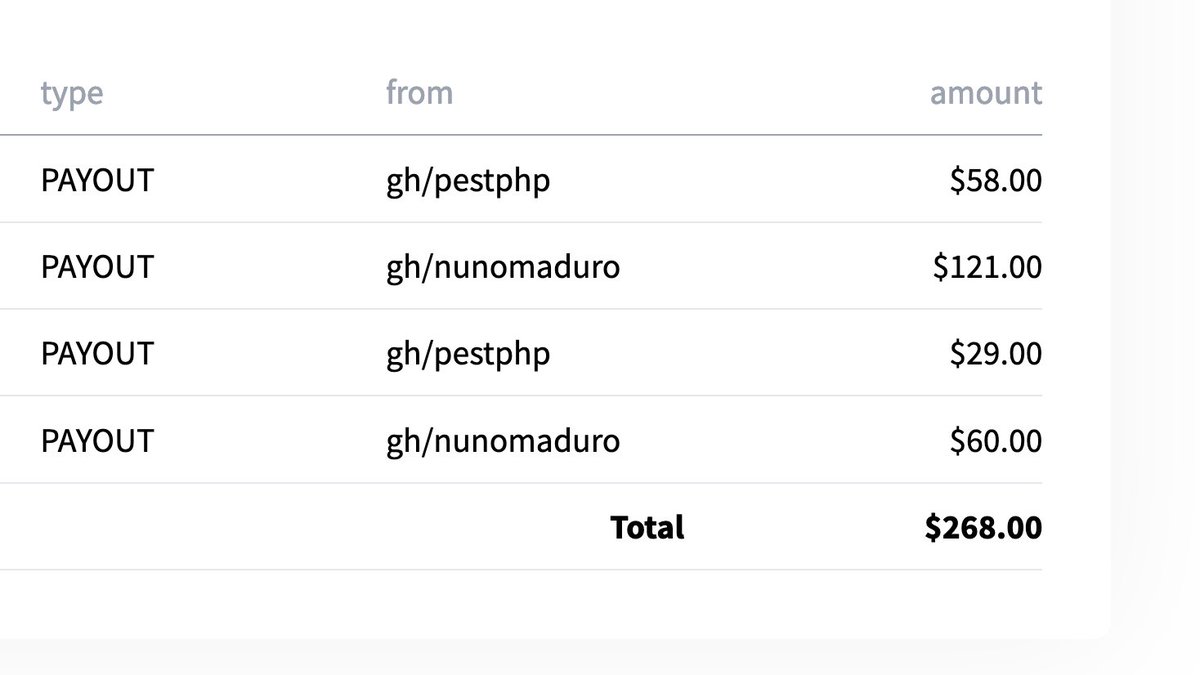
[Posted Dec 29, 2023 at 10:48AM](https://twitter.com/enunomaduro/status/1740686110978687267)
Building platforms and recruiting devs to receive free money is easy. The main options today are [GitHub Sponsors](https://github.com/sponsors), [Open Collective](ttps://www.opencollective.org/), and [Tidelift](https://tidelift.com/). I’m also rooting for [Thanks.dev](https://thanks.dev/home) (they are helping me a lot at Sentry) and [Liberapay](https://liberapay.com/) (they are a fork of Gittip/Gratipay).
What’s hard is opening the corporate floodgates. Companies receive outsized value from Open Source, and companies control nearly all the funds. How do we open the floodgates? *tl;dr* Taxes and social pressure. More on that in a future post., The Open Source Sustainability Crisis, chadwhitacre.com, 01hms08twz7tskfd4hwz8htg0d.