The Simplest Breakdown: Masters and PhD Theses
## Metadata
- Author: [[YouTube]]
- Full Title: The Simplest Breakdown: Masters and PhD Theses
- Category: #articles
- Document Note: ---
tags: [academic_writing, thesis_research, graduate_education]
author: Andy Stapleton
source: YouTube
reference: https://www.youtube.com/watch?v=RRjdbm5mbU0
date created: 2024-12-28 11:30
---
# 🏷️ Title: The Simplest Breakdown: Masters and PhD Theses
## 🧰 Action Inbox
- [H1] Compare thesis requirements for your field — research originality standards #academic_planning
- [H2] Identify external examiner process — understand evaluation criteria #phd_preparation
- [H3] Develop depth analysis skills — practice extracting insights from single data points #research_skills
## 🧭 Table of Contents
- [📝 Summary](#-summary)
- [📖 Main Content](#-main-content)
- [🗒️ Notes](#️-notes)
- [📚 References](#-references)
- [🗣️ Paraphrase](#️-paraphrase)
- [📰 Newsletter](#-newsletter)
- [✅ Action Items](#-action-items)
- [🧪 Hypotheses](#-hypotheses)
- [📊 Methodology](#-methodology)
- [❓ Questions](#-questions)
- [🔮 Future Research](#-future-research)
- [💡 Implications](#-implications)
- [🧠 Learning Styles Assessment](#-learning-styles-assessment)
- [📊 Accessibility Assessment](#-accessibility-assessment)
- [🌍 DEIB Assessment](#-deib-assessment)
- [✅ Logical Validity](#-logical-validity)
- [🛡️ DARVO Analysis](#-darvo-analysis)
- [🎯 Conclusion](#-conclusion)
### 🔗 References
- [Academia Insider](https://academiainsider.com)
- [Andy Stapleton Newsletter](https://andrews.com.au/newsletter)
## 📝 Summary
- PhD theses generate original research and new knowledge, while master's theses typically extend existing knowledge
- External examination distinguishes PhD evaluation from internal master's thesis review
- PhD work requires deeper analysis and generates significantly more personal investment and pride
- Field-specific variations exist but core differences remain consistent
- Both serve different purposes in academic progression and career development
## 📖 Main Content
The fundamental distinction between master's and PhD theses centers on originality and knowledge contribution. PhD dissertations answer original research questions, generating new knowledge publishable in peer-reviewed journals. Master's theses typically extend existing knowledge by applying known techniques to new contexts or combining established methods in novel ways.
Evaluation processes differ significantly. Master's theses serve primarily as internal documents demonstrating competency within university standards. PhD theses undergo external examination by field experts who assess genuine contributions to knowledge advancement.
The depth of analysis represents another crucial difference. While master's work may be shorter and higher-level, PhD research requires comprehensive field exploration, detailed methodology discussion, and extensive analysis of results and implications.
## 🗒️ Notes
#### ⏱️ [00:00](https://www.youtube.com/watch?v=RRjdbm5mbU0&t=0) — [H1] Core Difference: Originality vs Extension
- Key idea: PhD theses answer original research questions while master's theses extend known knowledge
- Evidence: "PhD thesis answer an original research question they are generating new knowledge that can be published in peer-reviewed academic journals"
#### ⏱️ [00:45](https://www.youtube.com/watch?v=RRjdbm5mbU0&t=45) — [H2] Master's Thesis: Known Techniques, New Applications
- Key idea: Master's work applies existing methods to create novel overlaps between known areas
- Evidence: "The techniques and the different chemicals that were used were known but the novelty comes in the overlap of two known things"
#### ⏱️ [01:20](https://www.youtube.com/watch?v=RRjdbm5mbU0&t=80) — [H1] Evaluation: Internal vs External Review
- Key idea: Master's theses receive internal university review while PhD theses undergo external expert examination
- Evidence: "This master's thesis didn't go outside the university only the people who needed to looked at it"
#### ⏱️ [02:10](https://www.youtube.com/watch?v=RRjdbm5mbU0&t=130) — [H2] External Examiner Process for PhD
- Key idea: PhD examination involves field experts from multiple institutions assessing novel contributions
- Evidence: "My phd was examined externally...sent to three one in germany one in the states and one unknown"
#### ⏱️ [02:45](https://www.youtube.com/watch?v=RRjdbm5mbU0&t=165) — [H3] Expert Validation of New Knowledge
- Key idea: External examiners must recognize genuinely new information that advances the field
- Evidence: "This was new information to them or at least it was novel enough for them to take it seriously"
#### ⏱️ [03:15](https://www.youtube.com/watch?v=RRjdbm5mbU0&t=195) — [H2] Revision Process and Standards
- Key idea: PhD theses may require revisions ranging from minor corrections to major overhauls
- Evidence: "Sometimes the thesis actually ends up going back to the original reviewers because they need to see major changes"
#### ⏱️ [03:45](https://www.youtube.com/watch?v=RRjdbm5mbU0&t=225) — [H3] Risk of PhD Downgrade
- Key idea: Insufficient novelty can result in PhD thesis being downgraded to master's level
- Evidence: "I know someone who had their phd thesis downgraded to a masters just because this didn't convince the reviewers"
#### ⏱️ [04:15](https://www.youtube.com/watch?v=RRjdbm5mbU0&t=255) — [H1] Depth vs Length: Analysis Quality
- Key idea: PhD thesis thickness reflects depth of analysis rather than just information volume
- Evidence: "What is more important is the depth of knowledge that each goes into"
#### ⏱️ [04:45](https://www.youtube.com/watch?v=RRjdbm5mbU0&t=285) — [H2] Master's High-Level Reporting
- Key idea: Master's theses provide high-level reports on findings using established techniques
- Evidence: "The introduction the literature review doesn't really deeply go into the field...it's more of a report on the findings"
#### ⏱️ [05:20](https://www.youtube.com/watch?v=RRjdbm5mbU0&t=320) — [H1] PhD Comprehensive Field Analysis
- Key idea: PhD research requires exhaustive exploration of research field including failures and successes
- Evidence: "You need volume to discuss the ins and the outs and the benefits and the cons and where you went wrong"
#### ⏱️ [06:00](https://www.youtube.com/watch?v=RRjdbm5mbU0&t=360) — [H2] Deep Data Analysis Requirement
- Key idea: PhD thesis demands comprehensive analysis extracting maximum insights from each piece of data
- Evidence: "All of the bits of information you can pull from a single graph...really dive deep into what that graph is telling you in every single way possible"
#### ⏱️ [06:45](https://www.youtube.com/watch?v=RRjdbm5mbU0&t=405) — [H1] Emotional Investment and Pride Differential
- Key idea: PhD theses generate significantly deeper personal investment and lasting pride compared to master's work
- Evidence: "I am so much more proud of this massive sort of thing...than this"
#### ⏱️ [07:30](https://www.youtube.com/watch?v=RRjdbm5mbU0&t=450) — [H2] Master's as Procedural Achievement
- Key idea: Master's thesis completion feels more like fulfilling requirements than personal transformation
- Evidence: "This is sort of like ticking a box in the masters process...I was always going to be able to do this"
#### ⏱️ [08:15](https://www.youtube.com/watch?v=RRjdbm5mbU0&t=495) — [H1] PhD as Life-Defining Experience
- Key idea: PhD thesis represents years of struggle, growth, and achievement that shapes identity
- Evidence: "This represents something that I'm very proud of and at times I thought I couldn't actually achieve"
#### ⏱️ [08:45](https://www.youtube.com/watch?v=RRjdbm5mbU0&t=525) — [H2] Vivid Memory Connection to PhD Work
- Key idea: PhD thesis contains vivid memories of laboratory experiences, failures, and breakthroughs
- Evidence: "I can like vividly see the times in the lab the times coming home disappointed the times coming home really excited"
## 📚 References
- [The Simplest Breakdown: Masters and PhD Theses](https://www.youtube.com/watch?v=RRjdbm5mbU0)
- [Academia Insider](https://academiainsider.com)
- [Andy Stapleton Newsletter](https://andrews.com.au/newsletter)
## 🗣️ Paraphrase
- Master's degree research extends existing knowledge by applying known methods to new contexts, while doctoral research creates entirely new knowledge that advances academic fields
- Universities evaluate master's theses internally as competency demonstrations, whereas PhD dissertations undergo rigorous external review by international field experts
- The emotional and personal investment differs dramatically, with PhD work representing transformative life experiences that create lasting pride and identity formation
## 📰 Newsletter
Understanding the fundamental differences between master's and PhD theses can help you make informed decisions about your academic journey and set appropriate expectations for each level of graduate work.
The key insight is that these aren't just different lengths of the same type of work—they serve entirely different purposes. Master's theses demonstrate your ability to competently apply existing knowledge, while PhD dissertations prove you can generate genuinely new knowledge that advances human understanding.
If you're considering graduate school, think carefully about whether you want to extend existing knowledge or create entirely new knowledge. Both paths have value, but they require different mindsets, commitments, and approaches to research.
Resources: [Academia Insider Writing Toolkit](https://academiainsider.com), [Graduate School Planning](https://academiainsider.com), [Research Methodology Guides](https://academiainsider.com)
## ✅ Action Items
#### Community
- Mentorship programs: Connect current students with recent graduates who can share thesis experiences and expectations
- Writing support groups: Create peer review circles for thesis writers at different levels
- Success story sharing: Document and share diverse thesis completion journeys
#### WordPress
- Documentation: Create comprehensive guides comparing different types of academic writing and research documentation
- Training: Develop lesson plans for academic writing workshops that address both master's and doctoral level work
- Community: Support academic WordPress users with specialized themes and plugins for thesis writing
## 🧪 Hypotheses
- Students who understand thesis level differences early make more informed graduate program choices
- External examination processes correlate with higher research quality and innovation in PhD programs
- Emotional investment in research projects predicts long-term academic career satisfaction
- Deep analytical skills developed in PhD work transfer effectively to non-academic professional contexts
### 📊 Methodology
- Longitudinal study tracking graduate students from program entry through thesis completion and career outcomes
- Comparative analysis of thesis quality metrics between internally and externally examined programs
- Survey research on emotional attachment to research projects and subsequent career trajectories
### ❓ Questions
- How do field-specific variations in thesis requirements affect student preparation strategies?
- What role does external examination play in maintaining research quality standards across institutions?
- How can master's programs better prepare students for potential PhD work while maintaining their distinct purpose?
### 🔮 Future Research
- Cross-cultural comparison of thesis evaluation processes and their impact on research innovation
- Investigation of optimal thesis mentoring approaches for different personality types and learning styles
- Analysis of thesis completion predictors and intervention strategies for struggling students
### 💡 Implications
- Practice: Graduate advisors should clearly communicate thesis level expectations and evaluation processes
- Policy: Institutions may need standardized external examination protocols to maintain PhD quality
- Education: Academic writing instruction should differentiate between master's and doctoral level analytical depth
- Funding: Research funding agencies should consider thesis level differences when evaluating early-career applications
### 🧠 Learning Styles Assessment
Reading level estimate: 10th-11th grade (accessible to undergraduate and graduate audiences)
#### 👀 Visual learners
- Present: Clear comparison between physical thesis documents, thickness visualization
- Improve: Flowcharts showing evaluation processes, infographics comparing thesis characteristics
#### 🔊 Aural learners
- Present: Video format with clear narration and personal anecdotes
- Improve: Podcast version, audio summary of key comparison points
#### 🗣️ Verbal learners
- Present: Clear definitions, analogies (Venn diagrams, box-ticking), personal storytelling
- Improve: Glossary of thesis-related terminology, more detailed examples from different fields
#### 🧩 Kinesthetic learners
- Present: Physical thesis examples, hands-on demonstration
- Improve: Thesis planning worksheets, interactive comparison tools, self-assessment checklists
#### 🧠 Logical learners
- Present: Clear structural comparison, systematic evaluation criteria
- Improve: Decision trees for choosing thesis levels, comparison tables, evaluation rubrics
#### 🧑🤝🧑 Social learners
- Present: Comment section engagement, newsletter community building
- Improve: Discussion prompts, peer comparison exercises, mentorship connection guides
#### 🧘♀️ Solitary learners
- Present: Self-reflection on thesis goals, individual assessment of readiness
- Improve: Journal prompts for thesis planning, self-evaluation questionnaires
#### 🌿 Naturalistic learners
- Present: Research process analogies to scientific method and knowledge ecosystems
- Improve: Connections between research contribution and broader knowledge advancement
### 📊 Accessibility Assessment
#### Screen reader semantics
- Present: Clear heading structure, descriptive content organization
- Improve: Better alt text for visual thesis comparisons, more detailed audio descriptions
#### Keyboard navigation
- Present: Standard YouTube video controls accessible via keyboard
- Improve: Timestamped navigation, accessible transcript with jump-to-time functionality
#### Contrast and readability
- Present: Clear video quality and readable on-screen text
- Improve: High-contrast transcript options, adjustable text sizing
#### Text resizing and reflow
- Present: YouTube's built-in accessibility features
- Improve: Dedicated webpage with responsive transcript and navigation
#### Media and captions
- Present: Video content with clear audio
- Improve: Professional captions, downloadable transcript, chapter markers
#### Forms and interactions
- Present: Standard comment and subscription interfaces
- Improve: Accessible feedback forms, better error handling for newsletter signup
### 🌍 DEIB Assessment
#### Cultural breadth
- Present: Focus on research systems common across many countries
- Improve: Examples from different educational systems, international thesis standards
#### Inclusive language
- Present: Generally accessible academic terminology with explanations
- Improve: More diverse examples beyond science/chemistry, clearer jargon definitions
#### Neurodiversity support
- Present: Clear structure, consistent pacing, personal anecdotes aid memory
- Improve: More frequent headings, visual summary cards, processing time allowances
#### Representation
- Present: Single perspective from chemistry/science background
- Improve: Examples from humanities, social sciences, diverse demographic representation
#### Psychological safety
- Present: Encouraging tone, acknowledgment of thesis challenges and failures
- Improve: More explicit support for imposter syndrome, mental health resources
### ✅ Logical Validity
#### Strong reasoning
- Deductive strength: Clear logical progression from thesis definitions to practical differences
- Inductive strength: Personal experience examples support broader claims about thesis types
- Causal reasoning: Links external examination processes to research quality outcomes
- Analogical strength: Effective use of Venn diagram and box-ticking analogies
#### Fallacies
- Hasty generalization: Some claims based primarily on personal experience in chemistry field
- Appeal to emotion: Heavy emphasis on personal pride and emotional investment, though relevant to the topic
#### Tone of voice
- Overall tone: Encouraging, personal, and accessible with appropriate academic credibility through lived experience
### 🛡️ DARVO Analysis
- Deny: No denial patterns present
- Attack: No attacks on accusers present
- Reverse victim/offender: No victim/offender reversal present
- Emotional cues and rhetoric: Positive emotional framing focused on achievement and growth rather than manipulation
## 🎯 Conclusion
Understanding the fundamental differences between master's and PhD theses—originality requirements, evaluation processes, analytical depth, and personal investment—enables better-informed decisions about graduate education paths. Both serve important but distinct purposes in academic development, with master's work demonstrating competency in applying existing knowledge and PhD research proving ability to generate new knowledge that advances fields of study.
The practical next steps involve carefully evalu
- Document Tags: [[phd_preparation]] [[research_skills]] [[academic_planning]]
- Summary: The Simplest Breakdown: Masters and PhD Theses
- URL: https://www.youtube.com/watch?v=RRjdbm5mbU0
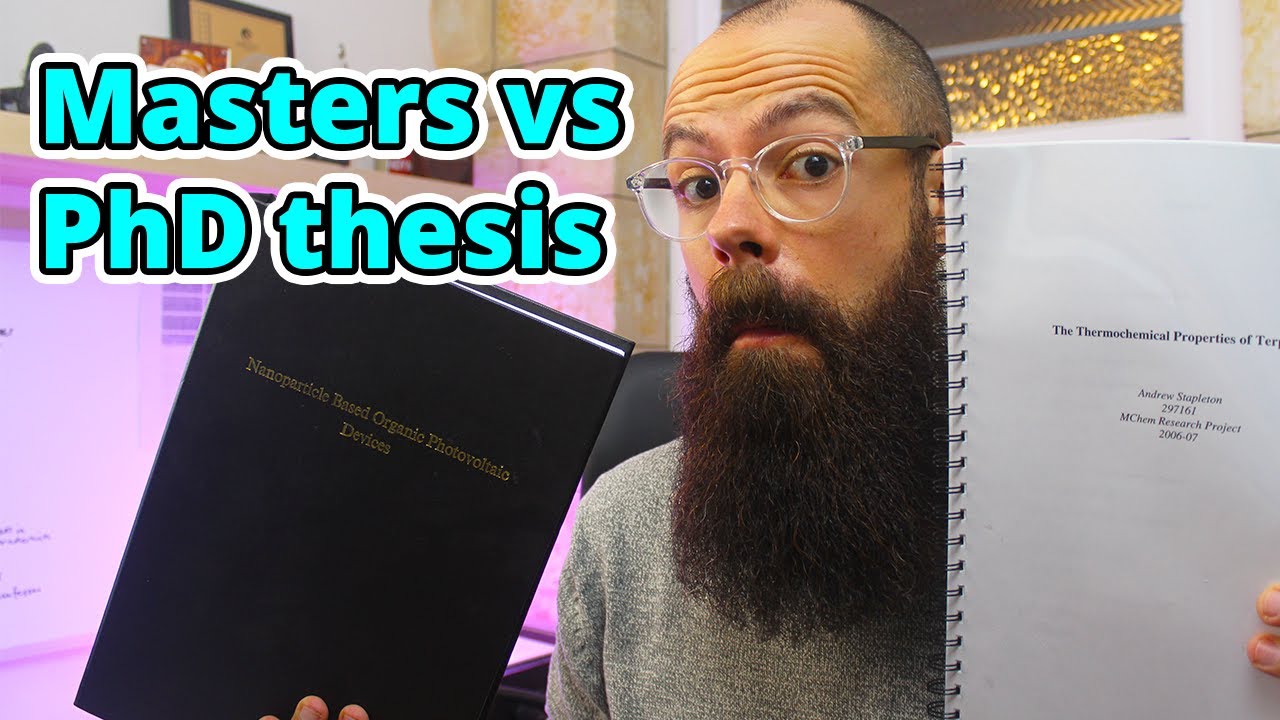
a phd thesis and a master's thesis are similar in so many ways but there are important differences between the two the biggest one and this varies from field to field but ultimately this phd thesis and many phd thesis or dissertations answer an original research question they are generating new knowledge that can be published in peer-reviewed academic journals whereas not always but most of the time a master's thesis is
an extension of something that's already known so for example this thesis the techniques and the different chemicals that were used were known but the novelty comes in the overlap of two known things creating you know like a a venn diagram of unknown in the middle and that was kind of the application of this master's thesis i essentially extended um the research of
a phd student using this thesis so not super new but kind of new whereas this was a hundred percent my own research starting with a seed paper that gave us an indication that you could make solar cells from aqueous dispersions of nanoparticles in terms of the nuts and bolts of a phd thesis and a master's thesis i think one of the biggest differences is who actually looks at it and tells you yes you have got a phd or yes you have got a master's degree so
for my master's thesis this is more used as an internal document to say yes you have satisfied the criteria in this university for a master's qualification this master's thesis didn't go outside the university um only the people who needed to looked at it and they looked at it and you know they probably did a once over read it through and went you know what it's big enough and boring enough to be considered a master's amount of work so there we go andy there
is your degree congratulations um and that's pretty much where it ended the phd students that were doing the same project ended up with a lot more data and their phd was examined differently like mine my phd was examined externally a phd is often if not always sent to um external examiners in the field mine was sent to three one in germany one in
the states and one unknown they decided to keep their identity secret from me but upon reviewing this hefty document of 200 and something odd pages after reading this 229 page thesis the external examiner said yes andy deserves a phd and that's because in this i have demonstrated that i've been able to collect new novel interesting research knowledge that advances the field that i was
researching in so the people who reviewed this the professors that reviewed this they are considered experts in their field and this was new information to them or at least it was novel enough for them to to take it seriously one of the reviewers did say that they recommended that i published the results in this thesis so that the wider community would know about the work that i have done which is always a nice little stamp of of approval from a research examiner and as well another thing they said is that there were to be
minor revisions so minor revisions are annoying little errors typos um some sort of like really light level scientific kind of jousting that goes on between academics and it needs to be addressed in a second edition of this thesis that i then turned into the university it didn't go back out to the reviewers after being sort of reviewed as long as it was changed to the satisfaction of the internal reviewers of the university i could get my thesis sometimes my phd sometimes the thesis
actually ends up going back to the original reviewers because they need to see major changes and they want to have their concerns addressed and i know someone who had their phd thesis downgraded to a masters just because this didn't convince the reviewers that they had generated new novel interesting research that contributed significantly to the field one of the most sort of like obvious things about these two bits of work is its thickness now even though the thickness does sort of like show how
much work is in there what it doesn't show and what is more important is the depth of knowledge that each goes into this one even though it's kind of 50 or 60 62 pages long it's actually quite high level you know the introduction the literature review doesn't really deeply go into the field that i was studying this is more of a report on the findings that i found using sort of known techniques on new molecules and
materials so it's like an extension project you know um it is higher level than this a phd thesis goes into incredible depth this thickness isn't just about the amount of information in there it's about how deeply you go into a field to do a genuine job a genuine deep dive into any sort of research field no matter what the subject you need volume you need volume to discuss
the ins and the outs and the benefits and the cons and where you went wrong and the things that went right and all of the bits of information you can pull from a single graph a single graph is a great anchor point when you're writing your thesis to just sort of like really dive deep into what that graph is telling you in every single way possible and that is why this is so thick it's not necessarily the amount of information but how well that information is analyzed afterwards and
if you want more information about how to write an awesome phd thesis go check out my other video this video is brought to you by my newsletter go check it out at andrews.com dot a u forward slash newsletter the link is in the description when you sign up you'll get five emails over about two weeks everything from the tools i've used the podcasts i've been on the perfect daily schedule and more it's exclusive content only available on that newsletter for free so go check it out one thing that doesn't often get talked about in terms
of the difference between a phd thesis and a master's thesis is how you feel about them when they're done now i was just rereading my acknowledgement section and it almost brought me to tears like i am so much more proud of this massive sort of thing this tome of information that no one will actually read but i'm so much more proud of what this represents in my life than this this is sort of like an extended uh
extended essay a practical an extended laboratory experiment and i was always going to be able to do this this is sort of like ticking a box in the masters process sure it was a little bit challenging sure sometimes you know i didn't really enjoy doing it but i knew i'd get there whereas this represents something that i'm very proud of and at times i thought i couldn't actually achieve
and so when i see this when i actually open it up you know there's years sometimes that go in but go between opening this thesis but every time i do i go immediately to the acknowledgements and i think that's where i've really kind of bonded with this thesis and it's where its effect on my life is really shown and uh i am immensely proud of this phd the three years it took me to get there
and where it's enabled me to go afterwards so that's probably the biggest difference on a personal level between a phd thesis and a master's thesis is that this is really truly representative of a huge chunk of my life and i can like vividly see the times in the lab the times coming home disappointed the times coming home really excited because one of these experiments in here went well i remember when the first experiment went really well and i came
home with a cheap bottle of wine and i was so excited because i knew at that point that my thesis wasn't going to be a complete failure but this one my master's thesis is just like a procedure something i did and i think even though i am proud of it if i had to weigh up the two there's no contest a phd thesis makes you so much more proud of what you've been able to achieve and i think that for me is the biggest
difference between a phd thesis and a master's thesis so there we have it there are the biggest differences between a phd thesis and a master's thesis i'd love to know what you actually feel as the difference you know we know the length we know all that sort of stuff but how does your thesis make you feel i'd love to know let me know in the comments also go check out academiainsider.com that's my project where i've got my ebooks the ultimate academic writing toolkit as well as the insider
no the phd survival guide go check them out they're available for a bundle price at the moment and also i'll see you in the next video, The Simplest Breakdown: Masters and PhD Theses, YouTube, 01ka858t1qp1wvwh6bwrmhx58j.