The Ultimate Guide to Developer Experience

## Metadata
- Author: [[Common Room]]
- Full Title: The Ultimate Guide to Developer Experience
- Category: #articles
- Document Note: ## Summarize:
In this article, we explore the importance of delivering a strong developer experience (DX) for companies whose primary audience consists of developers. DX is essential for making it easier and more enjoyable for developers to build high-quality software. It significantly impacts developer satisfaction and the likelihood of them recommending a product to others. To enhance DX, it is crucial to understand the needs of developers, and their communities can be a valuable resource for gathering insights. The article addresses key questions, such as the definition and significance of DX, elements of a great DX, best practices for improving DX, the role of developer personas, and how DX and DevRel (Developer Relations) programs collaborate to drive business impact.
## Bullet Points:
### What is developer experience (DX) and why does it matter?
- DX encompasses the elements that affect developers' working environment, including tools, platforms, resources, and the organizational culture they work in.
- A great DX leads to higher developer productivity, satisfaction, motivation, and better outcomes for projects or organizations.
- It is crucial for retaining and attracting top tech talent and driving product-led or community-led growth.
### What are the elements of a great DX?
- Concise getting started guides and SDKs/code libraries in preferred languages for easier product adoption.
- Self-serve product sign-up options for developers to evaluate solutions on their own terms.
- Easy-to-find documentation and product changelog/API status information for transparency and trust.
- Sample apps and code to showcase product use cases and help developers learn.
- An active community for support and engagement.
- Inspiring and informative content to encourage problem-solving and skill enhancement.
### What best practices can I use to improve DX?
- Understand the developer journey and identify areas for improvement.
- Provide thorough documentation and leverage community contributors for simpler explanations.
- Empower developers with the right tools that integrate well with their existing workflows.
- Automate workflows to save developers time and improve productivity.
### How do developer personas facilitate better DX design?
- Traditional personas consider roles, technical expertise, and projects, but it's also crucial to understand developers' motivations.
- Examples of motivations include open-source contributions, product usage, career growth, and thought leadership.
- Centering personas around motivations enables more meaningful conversations and community engagement.
### How do DX and DevRel programs work together to drive business impact?
- Developer Relations programs play a vital role in educating, empowering, and enabling developers to maximize their community engagement.
- Aligning DX and DevRel efforts drives business impact by enhancing developer satisfaction, product adoption, and overall growth.
## Paraphrase:
**What is developer experience (DX) and why does it matter?**
Developer experience (DX) refers to the elements that influence developers' working environment, encompassing the tools they use, the platforms they work on, the available resources, and the overall organizational culture. DX is crucial for developers' productivity, satisfaction, and motivation, leading to better software outcomes for projects or organizations. It also plays a vital role in attracting and retaining top tech talent. To achieve growth, companies must prioritize DX, especially in the face of increasing demand for skilled developers.
**What are the elements of a great DX?**
To create a great DX, companies should focus on providing concise getting started guides and offering software development kits (SDKs) or code libraries in the most popular programming languages. A self-serve product sign-up option allows developers to evaluate solutions on their terms. Thorough and easy-to-find documentation, along with a visible product changelog and API status information, build transparency and trust. Sample apps and code showcasing common use cases help developers understand product capabilities. Active communities, inspiring content, and collaboration with developers for content creation foster engagement and success.
**What best practices can I use to improve DX?**
Improving DX involves understanding the developer journey and identifying areas that need enhancement. Thorough documentation, which can be created with the help of community contributors, plays a vital role in helping developers utilize products effectively. To align with developers' preferences, companies should provide tools that integrate seamlessly with existing tech stacks. Automation can reduce manual tasks, allowing developers to focus on more valuable projects and enhance productivity.
**How do developer personas facilitate better DX design?**
Developer personas provide an effective framework for engaging with different types of developers and understanding their desires for a great DX. Beyond traditional roles, it is essential to consider the motivations that drive developers. For instance, some developers seek recognition for their open-source contributions, while others prioritize improving their product usage and career growth. Centering personas around motivations enables companies to engage more meaningfully with their community.
**How do DX and DevRel programs work together to drive business impact?**
Developer Relations (DevRel) programs play a crucial role in educating, empowering, and enabling developers to maximize their community engagement. By aligning DX efforts with DevRel initiatives, companies can enhance developer satisfaction, drive product adoption, and achieve overall business growth. The collaboration between DX and DevRel is pivotal in nurturing a thriving and supportive developer community.
Developer Relations can help a company do well in the market. Thought leader developers want to be seen as good at what they do and be given rewards, like being featured in events or on social media. Career search-driven developers want to upskill and find good jobs. High product usage developers want tools to help them do more without working more hours. Passionate open source developers want to make a difference and be given credit and recognition for their work. Developers like facts, learning by doing, and seeing people use the software they make. Developer experience is about the environment in which developers work and how satisfied they are with a product. Companies need to focus on developers' needs to create a great experience.
This guide serves to answer questions such as what developer experience is and why it matters, what the elements of great DX are, what best practices can be used to improve DX, how developer personas facilitate better DX design, and how DX and DevRel programs can work together. Companies must understand the needs and wants of the developers they serve to build and refine a stellar DX. Common elements of a great DX include self-serve experiences, clear-cut benefits, and active communities. Additionally, DevRel can be used to drive awareness, attract customers, innovate products, and enhance recruitment efforts.
- Summary: Learn the essential elements needed to build a stellar developer experience, why it matters, how to show the impact of DX and DevRel on the business, and the important role community can play.
- URL: https://www.commonroom.io/resources/ultimate-guide-to-developer-experience/
When developers make up your primary audience and customer base, providing a strong developer experience (DX) is of utmost importance. The goal of delivering a great DX is to make it easier and more enjoyable for developers to build, test, and deploy high-quality software.
DX also significantly impacts how satisfied developers are with your product or project and how likely they are to recommend it to their peers. Companies must focus on the needs and wants of the developers they serve to build and refine a stellar DX.
Your user community is a valuable resource for understanding if you’re delivering a great developer experience and how to enhance it further. Meeting these technical users in the places they already hang out online is also a great way to learn more about their professional and personal aspirations, topics of interest, and what they’re looking for in their tech stack.
To help you offer a stronger developer experience and drive greater product adoption or participation in your project, we’ve put together this guide to answer questions such as:
* What is developer experience (DX) and why does it matter?
* What are the elements of a great DX?
* What best practices can I use to improve DX?
* How do developer personas facilitate better DX design?
* How do DX and DevRel programs work together to drive business impact?
To connect directly with peers who are building great developer experiences, [join the Uncommon Community](https://www.commonroom.io/uncommon/) where 1,500+ community and DevRel professionals exchange learnings and best practices.
Developer experience consists of all the elements that affect the environment in which developers work. This includes the tools and platforms they use across planning and production, the resources made available to them, and the culture in which the developers work.
Fostering and delivering a great DX is essential for building and maintaining successful software projects. It can help ensure that developers are productive, satisfied, and motivated, leading to higher quality code, faster development times, and overall better outcomes for developers and their project or organization.
From an organizational standpoint, [a strong developer experience leads to higher satisfaction, engagement, and retention](https://www.techrepublic.com/article/hiring-retention-software-developers/), so cultivating a great DX is a non-negotiable for companies that want to keep their developer team happy and thriving. This is especially vital given the increasing demand for top tech talent: [Job openings for developers](https://codesubmit.io/blog/shortage-of-developers/) are projected to grow 22% year over year through 2030.
For companies offering developer tools, providing a great developer experience is required if you want to activate your user-led flywheel through strategies like [product-led growth (PLG) or community-led growth (CLG)](https://www.commonroom.io/blog/product-led-growth-vs-community-led-growth/). A poor DX will prevent even the most skilled developer from implementing a product or tool, and companies run the risk of losing early users (those using a free tier or trial) before they have a chance to see the full value of a product.
To build tools that developers love using from day one, companies must gain as much insight as possible into how the developers using their offerings think, feel, and work. That’s why [community is an essential ingredient for designing an excellent DX](https://www.commonroom.io/blog/building-open-source-communities-lessons-from-temporal-dev-advocate-rain-leander/), as developers frequently turn to communities to ask questions, acquire new knowledge and skills, and learn more about products and services.
**[Head over here for more information](https://www.commonroom.io/blog/what-is-developer-experience/) about the defining features of the modern developer experience.**
When thinking about the puzzle pieces that need to come together to form a great developer experience, consider the audience you aim to serve and how they like to try, assess, and adopt new tools.
While each individual will have their own opinions, here are a few reminders about the shared preferences of many developers:
* They prefer facts and clear-cut benefits over being “sold to”
* They enjoy self-serve experiences and learning by doing
* They influence decision-makers and drive bottom-up adoption of technology
* They like to see people make use of the software they create
Developers are critical thinkers and independent problem solvers who [live in the world of the tangible](https://cloud.google.com/files/apigee/apigee-developers-hate-marketing-ebook.pdf?__hstc=73240140.cc6bb10e1b2d6e68428f4b228f46c1e3.1677883287761.1677883287761.1677883287761.1&__hssc=73240140.1.1677883287761&__hsfp=646352474). As such, many desire a practical experience focused on helping them enhance their skill set and increase their output to ultimately receive recognition from users of their software and peers for a job well done.
With this in mind, let’s look at some of the essential elements that make up a great developer experience that can help developers achieve these goals.
* **Concise getting started guides** answer the questions that developers are sure to have when getting set up with or evaluating a product, such as, “What programming languages and complementary tools will I need to use the product?” and “How long will it take for me to start using this in my daily work?”
* **Software development kits (SDKs) or code libraries in popular languages** make your product feel “like home” and help developers get familiar with it much more quickly. Support for their preferred language will make them more likely to consider adopting your product.
* **A self-serve product sign-up option** allows developers to get started with your solution on their own to evaluate the tool on their terms and timeline.
* **Easy-to-find documentation** ensures that developers can answer common questions that will likely come up as they experiment with your product.
* **Product changelog and API status** information increases trust among developers by providing transparency around historical uptime and latency. A visible changelog also helps developers understand updates being made to ensure your product is constantly innovating yet secure.
* **Sample apps and code** showcase common use cases of the product and allow developers to clearly see how their application might be built. They are also very helpful for junior developers who can use sample code to learn how to build with your product.
* **A community or place to ask questions** that can be answered by industry peers and your team allows developers to easily receive the support they need while building. It’s important to note that developers want to see [an active community](https://www.commonroom.io/blog/five-steps-for-building-a-thriving-open-source-community/) (regular cadence of conversations, recently answered questions, high engagement) to earn their trust and participation.
* **Inspiring and informative content** helps developers envision new ways to solve their problems, upskill, and see how other devs use your product for maximum success. You can even collaborate with developers to co-author content — devs interested in being a thought leader in the space may find this kind of partnership particularly appealing.
Ultimately, the best way you can empower developers is to ensure they have easy access to these essential elements so they can chart their own course to success. Then if they need additional support, most developers' preferred method to engage with your company’s product and team will be through a community of peers.
Developers will often look to chat apps, forums, and social media first as a way to vet the tool, ask follow-up questions, and search for pre-existing answers. An active community can speak volumes to developers evaluating a product and will help them be more successful while deepening their adoption.
**[Check out this article](https://www.commonroom.io/blog/essential-elements-of-a-great-developer-experience-DX/) for more details on the essential elements that make up an excellent developer experience.**

While the nuances of designing a great developer experience are unique to each audience, certain tried-and-true best practices can be applied to any DX initiative.
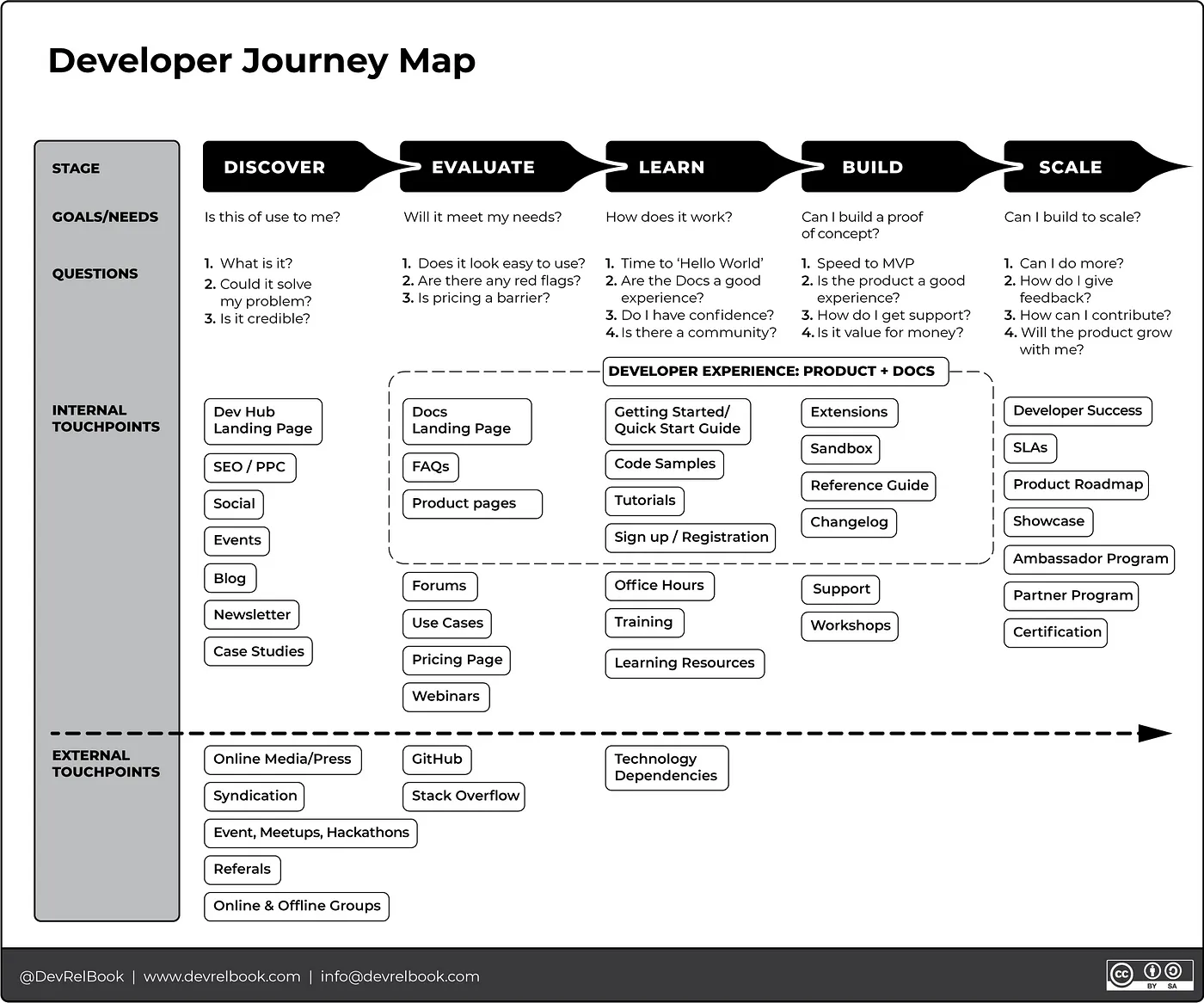
Start by mapping out all of the steps a developer takes when using your product so you can identify areas where the experience can be improved. From setting up the tool to using it to deliver code to production, there are sure to be some friction points that must be smoothed out.
According to *Developer Relations: How to Build and Grow a Successful Developer Program* by DevRel veterans Caroline Lewko and James Parton, the [typical developer journey map](https://medium.com/codex/developer-relations-the-developer-journey-map-36bd4619f5f3) contains five stages. In each stage, the developer has a specific question they are looking to answer about the product.
* **Discover**: Is this tool of use to me?
* **Evaluate**: Will it meet my needs?
* **Learn**: How does it work?
* **Build**: Can I create a proof of concept?
* **Scale**: Can I build to scale?
As you consider the journey for your product, be mindful that the developer must be satisfied with the answer at each stage to move on to the next.
As mentioned above, thorough documentation is vital to making sure developers understand the best way to use your solution for their projects and products. Developers are creatures of habit—turning to documentation is often an instinctual reaction when they want to learn more about a specific feature or product functionality.
If writing comprehensive documentation or building out what you have sounds like a big undertaking, examine some of the overlooked resources that could be leveraged to create simple, digestible documentation for your developers. For example, community contributors and advocates are often some of the most skilled at [explaining how to use your product](https://www.commonroom.io/blog/leverage-your-developer-community-to-deflect-support-requests/), which means their advice and insights could be repurposed into helpful documentation.
##### Empower devs with the right tools and effective technology
To ensure your product is a natural fit for your ideal developer's tech stack, consider the tools your developers are already using and what other technologies might be on their “wish list.” This can provide much-needed context about how they work and how your product can be best integrated into their existing workflows.
For example, you might consult resources such as [Stack Overflow’s Annual Developers Survey](https://survey.stackoverflow.co/2022/) for greater insight into the tools, environments, and collaborators that different types of developers encounter on a regular basis.
Like most people, [developers strongly dislike manual, repetitive tasks](https://blog.zenhub.com/five-factors-that-conspire-against-developer-productivity/) that detract from the work they really want to be doing. That’s why automation presents a valuable opportunity to save developers time and free them up to focus on more interesting and valuable projects.
Tools that automate low-level or tedious tasks are loved by developers because they:
* Allow them to focus on writing elegant code
* Improve productivity for complex projects
* Make it easier for them to debug code
* Enable a faster feedback cycle for application testing
When it comes to community, Common Room enables you to easily manage standard interactions with members through [Workflows](https://www.commonroom.io/blog/announcing-common-room-workflows/). These automated and customizable direct messages help you welcome new members into the community and regularly engage with your community at scale.
[**Head over here to take a deep dive into each of these developer experience best practices.**](https://www.commonroom.io/blog/developer-experience-best-practices/)
When designing or refining your [developer engagement strategy](https://www.commonroom.io/blog/engage-with-developer-communities/), personas are an effective framework that help you thoughtfully interact with the different types of developers and what they’re looking for in a great DX. Personas also enhance your DevRel and community-building efforts by shining a light on developers' wants and needs that aren’t directly related to your product.
Traditional developer personas take into account the developer’s role within the organization, technical expertise, development process, and the type of projects they regularly work on. While these are all important factors you may or may not already have documented, it’s equally important to consider what typically *motivates* different developers beyond their job titles. For example:
* **Passionate open source developers** want to feel like they have carved out a meaningful place in the tech world, one that helps them achieve self-actualization by [contributing to something bigger than themselves](https://www.commonroom.io/blog/building-open-source-communities-lessons-from-temporal-dev-advocate-rain-leander/). Their incentives include things like credit for open source contributions, social recognition for their work, and sponsorship from the communities they participate in.
* **High product usage developers** want to get the most out of their tools and skill set to achieve outsized results (think: [the idea of the 10x developer](https://www.avenga.com/magazine/10x-developer/#:~:text=A%20ten%20times%20developer%20is,developers%20on%20the%20same%20team.)). They have a significant workload and therefore cherish a tool that allows them to do more without having to put in more hours. For these power users of your product, think about incentivizing them with things that allow them to contribute directly to improving DX, such as roadmap reviews and input, beta testing of new features, and access to feedback sessions with your product team.
* **Career search-driven developers** want to find a fulfilling job and increase their earning potential through upskilling, personal brand building, and showcasing their work. They are likely to be both personally and professionally invested in your developer community, which means they are incentivized by things like network introductions and job leads, freelance gigs, and opportunities to help build their portfolio.
* **Thought leader developers** are motivated by industry status and recognition above all else—they want to be acknowledged for being the best at what they do. These developers are likely trying to increase their connections and following on social media, which means they are often active contributors across community channels. Incentives for these developers can include things like public shoutouts, invitations to speak at events or co-create content, and access to exclusive networking opportunities.
When you center personas around motivation rather than titles and responsibilities, you will unlock insights that can be used for more meaningful conversations with members and in the community overall.
**For more insights on developers’ motivations, how they think, and meaningful incentives, [check out this article on how to build developer personas](https://www.commonroom.io/blog/how-to-build-developer-personas/).**
Educating, empowering, and enabling developers to get the most out of your community and product will ultimately drive business results that are sure to receive recognition from key stakeholders and executives—if you can articulate the impact effectively.
Developer Relations can (and should) play a critical role in [supporting a company’s go-to-market initiatives and success](https://www.commonroom.io/resources/video-how-devrel-devex-support-GTM-lee-robinson-vercel/). In order to leverage developer experience to improve customer value and sales outcomes, you have to not only understand key personas and their motivators, as discussed above, you must understand the specific roles community members can play in your organization’s success.
Here are some examples of the ways in which DevRel benefits the business through a great developer experience:
* DevRel **drives awareness that results in more users** by providing organic educational opportunities about the technology and its benefits. Community also provides an avenue for [nurturing developer superfans](https://www.commonroom.io/blog/what-are-developer-super-fans/) who help you attract more customers by advocating for your product with their peers.
* DevRel programs can also **help innovators scale non-developer products** by building upon or improving them. This is especially valuable for [“developer plus” companies](https://devrelbook.substack.com/p/developer-first-and-developer-plus), or businesses that primarily serve a non-developer audience but still allow developers to modify certain products or services. For example, [Notion launched a developer offering](https://www.commonroom.io/blog/how-devrel-programs-drive-business-impact/) to help devs innovate new products and use cases by building on top of their own product.
* DevRel can provide a way to **enhance employee recruiting efforts**, as many companies have successfully leveraged community as a talent pipeline. For example, technical recruiting teams can partner with DevRel to utilize some of the same tactics they use to drive developer user adoption.
When your DevRel program positively influences other parts of the organization, it’s much easier to [earn stakeholder buy-in](https://www.commonroom.io/blog/community-metrics-conversations-cxo/), budget, resources, and support from other departments.
Some of the key business benefits of a strong DevRel program include improvements in:
* Revenue and funding
* Brand recognition and awareness
* User growth and retention
* Developer experience and product innovation
* Customer satisfaction and support deflection
* Technical recruiting and hiring
Use [community metrics and analytics](https://www.commonroom.io/blog/using-metrics-to-understand-community-growth-and-business-impact/) to measure and track your progress against these business-impacting outcomes.
**[Read this expert blog](https://www.commonroom.io/blog/how-devrel-programs-drive-business-impact/) to learn more about how DevRel drives business impact and the activities that winning programs regularly practice.**
An [intelligent community growth](https://www.commonroom.io/blog/what-is-intelligent-community-growth/) platform like [Common Room](https://www.commonroom.io/) is the best way to ensure you’re designing a DX that customers will love to drive developer engagement and improve community-related results.
Common Room combines machine learning-powered insights with powerful reporting tools to help DevRel teams better understand the developers they serve while scaling and measuring program impact. Common Room helps you:
* **Understand your developers' journey**. Engagement data from across your community—like the [topics and trending conversations](https://www.commonroom.io/blog/understand-your-community-activity-with-intelligently-detected-topics/) that are happening in real time—lets you know what’s most important to members and how they’re progressing along their developer journey. [Amplify your champions’ voices](https://docs.commonroom.io/discover-popular-use-cases/build-a-champions-program) to share best practices and quickly engage one-on-one with members who need help to remove friction.
* **Automate repetitive tasks, while keeping it personal**. Common Room enables you to easily scale your interactions with your community with [Workflows](https://www.commonroom.io/blog/announcing-common-room-workflows/)—customizable welcome and engagement messages to connect with members and help them get involved with the community.
* **Know what’s happening across your community so you can take action**. Track the [health and business metrics](https://www.commonroom.io/blog/metrics-to-use-for-community-analytics/) most important to you and your company with pre-built and custom reports.
Ready to intelligently engage and grow your developer community? [Try Common Room for free today](https://www.commonroom.io/) or [request a demo](https://www.commonroom.io/contact/?website_attribution=resources%252Fultimate-guide-to-developer-experience)., The Ultimate Guide to Developer Experience, Common Room, 01gtmt6gchhwqsj5x15mmxdry3.