This Simple AI Process Gets Grants Approved
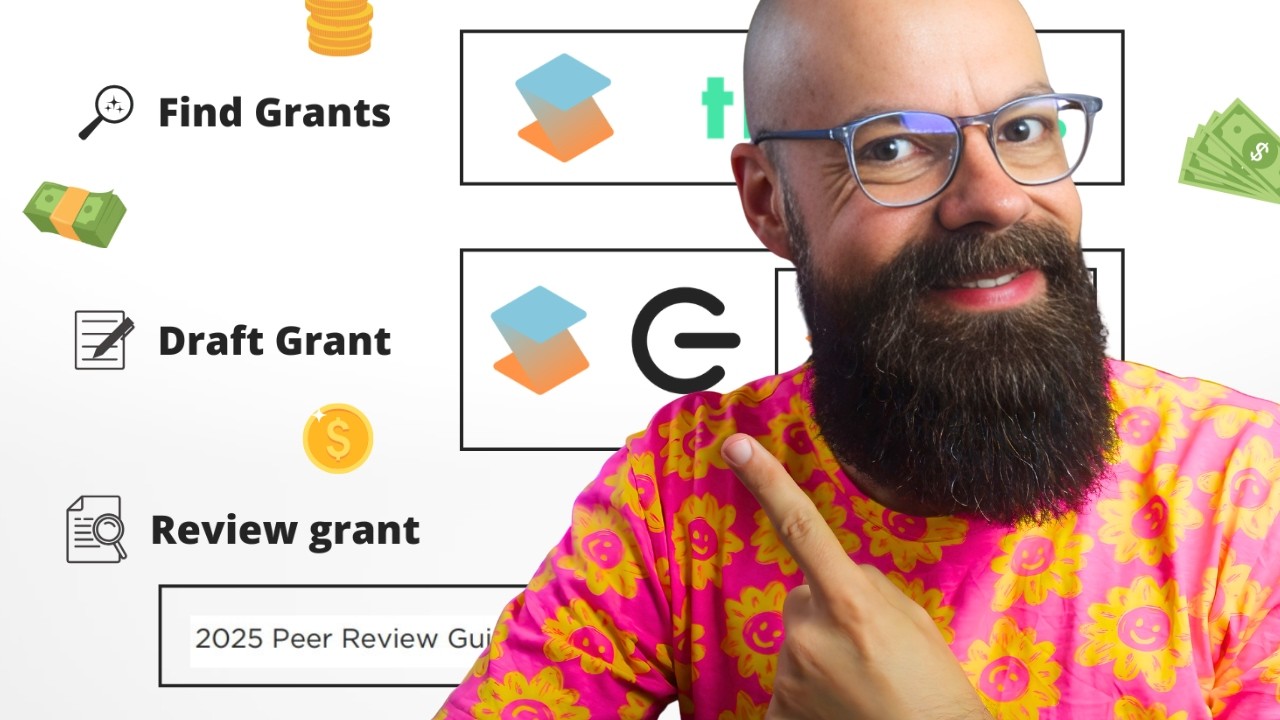
To be able to do research, you need to beg for money. This academic panhandling is called applying for grants. So, this is what I would do if I needed to do it today using AI tools. So, there's three sort of like sections that we need to go through. First of all, we need to find grants to apply for. We need to know who's got the money and when we can actually get it. And then we can uh draft a grant. And there's so many different sections to a grant, but one of the most important things is about finding the literature. And we'll talk about how to do that really easily with
AI tools. And then this is the review grant stage. Oh, I forgot to capitalize that G. Uh, I won't get this grant, will I? Anyway, it doesn't matter. And in this section, we're going to go through all of the things you need to do to make sure that your grant is in tiptop condition and that it's got a higher chance of being accepted with AI tools. So, let's get into it. So, the first thing is finding grants. Now, it's never been easy to find grants. And there's two things I recommend, which is Sispace and Thesify. So, if we head over to
something like Sispace, they have this. Look, I'll talk you through it because it can be a bit complicated. This is what it looks like when you land on their page. And we can go down here to popular tasks used by researchers and view agent gallery. This is where people have made agents to help you do certain academic tasks. Then if we go to search all agents and we type in grants or grant, you can see that this is all of the things that we can do. Look, I would be using this because it's free. You can go on and use it for a certain amount, but ultimately grantable, find grants,
AI grant writer, and down here you can even see you can look for specific types of grants. So overall, this is what I would be using to kind of like have a look to see if there's grants around. But there is a slightly better way and that is using Thesify. So this is Thesify and I've been through this tool a load. I absolutely love it. I think it's a really great tool for academia and research. And the thing about this is once you've uploaded a paper, you get this sort of like feedback on the side. And this feedback gives you all of this feedback digest opportunities, but it's
resources that we really want because then you get these little tabs. You can look at publications, journals, conferences. Oh, what's this? It's a grant button. and click that and it'll tell you the grants that are most likely applicable to this paper and its themes. And look, this is a 76% match. It's got an opening date of this, a deadline. Okay, well that's passed, but that doesn't really matter. And then uh yeah, we can see we've got all of these that are actually available for this grant. Actually, the reason these are behind is I uploaded this ages ago, so you will
get up to date ones. Do not worry. Um, and yeah, you can see all of the grants and their closing deadlines and all of that sort of stuff. You obviously can still use your normal grant databases, but this will give you hopefully another little way of checking to see if there's something out there that you should be applying for. There is another tool that can do it. We'll talk about it in a minute. It's not really sort of like science specific, but we'll get into that in a minute in the next section. Yeah, let's do that. All right, then. See you over there. Bye. Hello, it's me
again. I'm back. So, in this section, we are drafting our grant. There are loads of tools that allow you to actually write a grant with a single prompt. And I'll show you one of my favorites in a moment. But ultimately, there are so many different types of sections in a grant application. It's about you. It's about the university. It's about the project. It's about the funding. It's about the timeline. It's about the outputs. Oh, all of this can be so confusing. But now you can write it super easy. And uh there's two tools that I really recommend. Look at this. Sidepace is back again and grantable.
And then there's this bit. know, no matter what grant you're applying for, you always have to provide a background and introduction. So, finding literature and generating a little sort of like literature review is super easy with these tools. But let's not get ahead of ourselves there, you cheeky little monkeys. Let's make sure that we understand what's going on. Let's have a look at generating a draft grant. Why? Why does that sound weird? Grant draft. Is that better? I don't care. Okay. So, let's head over to size space and we'll
go to this agent thing again. So, this is the agent thing and you can see how it went on the grant writer. When you click on this button here, which is this one, it takes you to this page and then I put here create a well-written and persuasive grant application for the ARC grants. So, that's the Australian Research Council grant. The sort of grants that I would apply for when I was a researcher and then comment on the current state of that and search my name, Andrew Stapen on Google Scholar, and use it to establish my credentials. There's a lot of stuff that you are expecting this agent to do and stay around because you're going to be really
amazed at what it can do. And by stay around I mean we'll talk about it now. All right then. So this is what happened. Now it went through all of these steps and it was just a case of just waiting. So that's easy, isn't it? Now down here you can see it says like agent is on a coffee break. I've exhausted all of my free credits. Yeah. Okay, whatever. It doesn't matter. It gave me what I wanted anyway because this was the final output. And let's have a look at it. Let's see if I can make this one bigger. Okay, there we are. This is as big as it gets. But it went through all of this
these stages. It found me. It found the project. It found uh references. It found a background information. All of that sort of stuff. But you can see this is a really great place to start with your draft grant because here you can see ARC grant application advanced nanom materials for high efficiency stable organic photovoltaic devices. Not a great title, but we can workshop that later. And then look project title. Here it is. And then executive summary. This is the executive summary. You can see it's reference. It's got background in significance. It's got nanomaterial
revolution in the past five years. Witnessed a paradigm shift in OPV device. Like it's a little bit like hyperbolic, but it's pretty darn good if you ask me because if you keep scrolling, look how long it is. It even knows to put stuff like strategic importance for Australia. And then it's got research objectives and innovation. It's generated everything. Look how much I'm scrolling. I'm scrolling. I'm scrolling. Go do this for your research field because why not use this as a template? Take the things you like and
get rid of the things you don't like. Look at this. Look, the research streams and then it's got um advanced characterization capabilities and it's got risk management. And this is where I was really impressed with what it was able to do. There's a couple of Andrew Stapletons out there in the world doing different types of re research, but it knew to find me. Dr. Andrew John Stson brings a unique combination of expertise in nanomaterial synthesis, precision characterization of tube, water processible, blah blah blah. So it knows exactly who I am and what I did from my Google Scholar and wherever it sort of
like stalked me online. Nanomaterials characterization excellence. Oh, don't mind if I do. Water processible OPV pioneer. I'm a blooming pioneer if you'll believe this. And then nanocale imaging nanoructure transparent electrodes publication impact collaborative networks supervision training excellence. So it's got all of these different things that it knew I did and it's got like my uh uh project expertise. It's got the the project application current state of the
research and it it just goes on and on and on. Budget justification. So yeah, it's not perfect. clearly couldn't use this, but it gives you a great starting point. So you don't have to use your meat brain to just kind of, you know, get out this. You can start actually working with real things and use that meat brain for better things, which is like making this better. And agreeing with something is or disagreeing with like stuff is much easier than generating content from zero. So this is
what I love about this. It's even got all the references and it's massive. 8,500 words, contact information. That's me. So overall, look at that. That was a grant application at the click of a button. There's also other tools that do it for you, like this one. All right, then. So, here's Grant. Grantable is probably the only one at the moment that is like also applicable to science and research and innovation. There's a lot of AI grant application tools out there,
but they tend to be for startups, for nonprofits, for government organization. There's a lot of stuff. But Grant has got the ability to write academic stuff. So if you go in, this is what it looks like. Look, I'm not going to go through the whole thing because this could be a whole video in itself, but ultimately complete your organization onboarding and what can I help you with? You can build stuff, you can do research, you can refine things, you can add sources, you can look grant, letter of intent, um you've got budget, narrative, guide, all of these quick actions. Look at that.
It's all just there. Lovely, Jubbly. Love it. Yes. So try it. You can go on and do some stuff for free. It may work, it may not, but this is the best one at the moment. If you do decide to to pay for it as well, it is one of the cheaper ones um at only I think $25 a month or something like that. Uh so overall, this is great. But there is something in here that I think is good but not great for science and research, which is this discover, which is in beta at the moment. And you can see here if I for example wanted to find a grant, um let's put energy. So here we've got or enory.
No energy. There we are. Um, energy, renewable energy. This is where I was. So, I could look at all of these and find things that may be useful for me. Now, it's very US- ccentric because you can apply in different states, but you can choose which country you want to apply in, but it's like I said, it's very US- ccentric at the moment, but ultimately, if you are in the US, look at this. Here's some other stuff you could apply for. Look how much money they got. They're so rich. Oh, these people. Who are those Murdoch charitable
trusts? You're the richest. give me some money. I don't want to apply for it though. Just give it to me. All right. Then in the little like drafting bit, we've also got finding your literature. Now, go check out my other video where I talk about generating literature review. Go check it out here using these sort of tools because it is super valuable. But ultimately, you can you can use sciace. You can use elillicit, consensus, lit maps, research rabbit, connected papers, even good oldfashioned Google Scholar with their new Google Scholar AI labs. You can go and find literature to support your application. And so no
matter what you're doing in the academic world, you're using these at some point to generate this grant application. And it's just so easy to get that first draft. And then it's all about interrogating it, making sure you understand um the strengths, weaknesses, and there's a really easy way to do that. And that is reviewing your grant once you've got a first draft. And I think you're going to like this next little trick because it's a little bit sneaky. All right then. We're reviewing this grant. Here we go. Bonk. This is what I would be doing right now in 2025
going into 2026 is I would be taking the peer-reviewed guidelines and using it in something like chat GPT notebook LM Claude um Gemini to make sure that you are addressing all of the appropriate things in the right way. And the way you do that is super easy. Let's go through it. So, for pretty much every single grant that's ever been produced, you have to find this, which is the grant application assessor or peerreview guide. So, here we are. This is for the Australian government investigator
grants. Now, we can't use this as an actual peer reviewer to review grants with AI. That's not allowed at the moment. And rightly so, I think, but we can use it as someone that's applying for a grant because look, if you scroll down here, yeah, all of this blur, all of this blur, but ultimately they give reviewers a guide on what they should be looking for. And we can use that to our advantage because look, research impact down here, key definitions for the assessment of research impact. So, I'd be putting each one of these tables into
a large language model. In chat, GPT, you put it in a projects folder. in notebook LM you put it in the um sources column it's super easy and then I'd be saying hey have I satisfied these things to get the highest score and then I can be assured that I have made the examiner's life as easy as possible because remember these examiners they're tired they've got maybe hundreds to go through they just want to be able to tick a box if you make it easy for them to be able to say yes I can see these
things here tick tick tick tick tick while they're having a whiskey looking over your stuff. Well, it's going to be to your benefit because it's going to make it easy for them. Look at this types of research impact. So, you want to make sure that you want to directly address these things and you're essentially getting a behind the curtain view of what the peer reviewers and the examiners are looking for. And now we need to make sure our uh grant directly addresses these things. Look at this. We want leadership score of five. So, an
excellent knowledge of health blah blah blah and knowledge. We want to make sure that we've got all of this in our actual grant application because if it's not obvious to the peer reviewer and put up frontont then it will not be recognized. So this is how I would use this. Go and find the peer reviewer and assessor criteria for your grant. Put it into a chat GPT or a large language model alongside with your draft application. H it's never been easier. Get on the front
foot with this guys. And by the way, this was told to me by an actual researcher in a university I've spoken at recently where they were like, I did this and I got the grant. So, I've got proof N of one that this works. Try it and let me know if it works for you. If you like this video, go check out this one where I talk about literature reviews and how to do it in an AI workflow. I think you'll love it., This Simple AI Process Gets Grants Approved, YouTube, 01kd5xneh916bxqjdemvr1f8qt.