Unit Tests for WordPress Plugins

## Metadata
- Author: [[Pippins Plugins]]
- Full Title: Unit Tests for WordPress Plugins
- Category: #articles
- Summary: Now that we have gotten through setting up our unit tests and we know the difference between tests and assertions, it is time to begin writing our actual unit tests for our plugin.
- URL: https://pippinsplugins.com/unit-tests-wordpress-plugins-writing-tests/

Now that we have gotten through setting up our unit tests and we know the [difference between tests and assertions](https://pippinsplugins.com/unit-tests-wordpress-plugins-tests-vs-assertions/), it is time to begin writing our actual unit tests for our plugin. As mentioned in the previous parts of this series, we are going to be focusing on writing tests for my [Restrict Content Pro](https://pippinsplugins.com/restrict-content-pro-premium-content-plugin/) plugin. I prefer to always try and use real plugins and real world applications for examples as it helps provide a more concrete example of how you can apply the tutorial to your own plugins.
The first thing we are going to do is rename the sample test class that WP CLI created for us in [part 2](https://pippinsplugins.com/unit-tests-wordpress-plugins-setting-up-testing-suite/). That sample file is named *tests/test-sample.php* currently looks like this:
```
class SampleTest extends WP_UnitTestCase {
function testSample() {
// replace this with some actual testing code
$this->assertTrue( true );
}
function test_sample_string() {
$string = 'Unit tests are sweet';
$this->assertEquals( 'Unit tests are sweet', $string );
$this->assertNotEquals( 'Unit tests suck', $string );
}
function test_sample_number() {
$string = 'Unit tests are sweet';
$this->assertEquals( 'Unit tests are sweet', $string );
$this->assertNotEquals( 'Unit tests suck', $string );
}
}
```
Let us start by first renaming the file to something more relevant. When I am creating tests for my plugins, I like to separate the tests into multiple files so that they are logically organized around specific parts of the plugin, just like we organize our classes and functions in our plugins. Each file will be considered a “group” of tests.
Restrict Content Pro deals with user accounts a lot, so I will create a group of tests specific to members. RCP also has discount codes and payment tracking, so I will create test groups for each of those as well.
The files I am starting with are:
* tests/test-members.php
* tests/test-discounts.php
* tests/test-payments.php
Each of these files contains an extension of the *WP\_UnitTestCase* class, like this:
```
class RCP_Member_Tests extends WP_UnitTestCase {
function testSample() {
// replace this with some actual testing code
$this->assertTrue( true );
}
}
```
The name of the class does not really matter, just name it something that makes sense.
Now when we run our tests, we will see this:
Let’s go ahead and write a few tests for each of our groups.
For our *members* group, we will write some tests that check whether our status and expiration date functions work properly.
Restrict Content Pro has a function called *rcp\_get\_status().* This function retrieves the status of the specified user ID. The status can be:
* free
* active
* pending
* cancelled
* expired
Each of the statuses refers to the member’s account status. By default, all members are given the *free* status, so the *rcp\_get\_status()* function is supposed to return *free* if the specified member does not have a status assigned to their account. Let’s write a test to check if that happens:
```
function test_get_default_status() {
$status = rcp_get_status( 1 );
$this->assertEquals( 'free', $status );
}
```
This simply retrieves the status of the user account created when PHPUnit runs and checks their status. If the status returned is *free*, the test passes, which it does:
[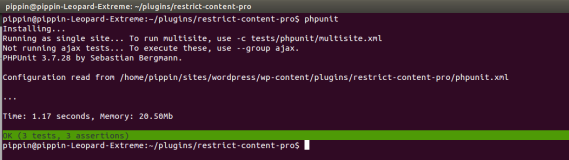](https://pippinsplugins.com/wp-content/uploads/2014/09/Screenshot-from-2014-09-29-105932.png)
Okay, let’s write another test now. Restrict Content Pro has another function for setting the status of member accounts called *rcp\_set\_status()*. This function lets you update a member’s account to have a specific status. To test that this function is working properly, we are going make multiple assertions. We will set the status, then call *rcp\_get\_status()* again to retrieve the status and compare it to what we passed to *rcp\_set\_status()*. If the statuses match, our assertion passes.
```
function test_set_status() {
rcp_set_status( 1, 'active' );
$status = rcp_get_status( 1 );
$this->assertEquals( 'active', $status );
rcp_set_status( 1, 'pending' );
$status = rcp_get_status( 1 );
$this->assertEquals( 'pending', $status );
rcp_set_status( 1, 'cancelled' );
$status = rcp_get_status( 1 );
$this->assertEquals( 'cancelled', $status );
rcp_set_status( 1, 'expired' );
$status = rcp_get_status( 1 );
$this->assertEquals( 'expired', $status );
}
```
We can now run *phpunit* again to see if our tests still pass, which they do:
Now let’s move on and write a couple of tests related to discount codes.
Restrict Content Pro displays a field on the registration form for the customer to enter a discount code, but the field is only displayed if there is at least one active discount available in the database. To determine if there is at least one discount code, Restrict Content Pro has a function called *rcp\_has\_discounts()*. Let’s write a quick test for this.
When first installed, the Discounts table is empty, so *rcp\_has\_discounts()* should return false. Our test will prove that is the case:
```
function test_has_discounts() {
$this->assertFalse( rcp_has_discounts() );
}
```
Does out test pass? Yes it does:
Alright, let’s write one more discount code related test now. We will write one to test that inserting a new discount code works.
To create new discount codes, Restrict Content Pro has a class called *RCP\_Discounts* with an *insert()* method. We will use this in our test:
```
function test_insert_discount() {
$discounts_db = new RCP_Discounts;
$args = array(
'name' => 'Test Code',
'code' => 'test',
'status' => 'active',
'amount' => '10'
);
$discount_id = $discounts_db->insert( $args );
$this->assertGreaterThan( 0, $discount_id );
}
```
This test instantiates the *RCP\_Discounts* class and then calls the *insert()* method to store the discount. The *insert()* method returns the ID of the discount created if successful and *false* if it fails. We can check if it was successful by checking that the return value is greater than 0, which it is:
Restrict Content Pro has many, many, many more functions and class methods that need to have tests written for them, but these will serve as good examples to help get you started with writing tests for your own plugin.
There are still many more areas to cover with unit testing. In the next part of this series, we will look at some of the tools the WordPress unit testing suite provides us with to help making testing easier. One example of this is the “factory”, a tool for creating data to test against., Unit Tests for WordPress Plugins, Pippins Plugins, 01gnmd04rakp7tr8ybcvxmc24f.