Unpacking Notemaking: Concept Modeling With Nick Milo
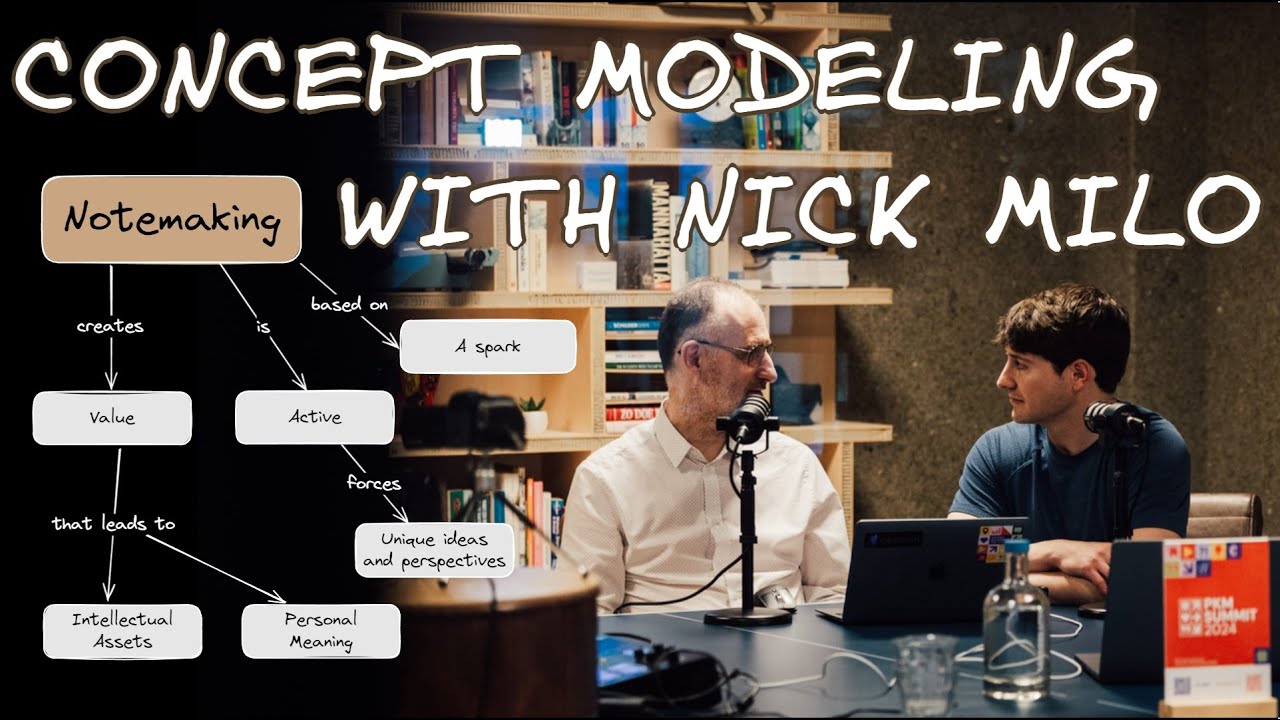
## Metadata
- Author: [[Zsolt's Visual Personal Knowledge Management]]
- Full Title: Unpacking Notemaking: Concept Modeling With Nick Milo
- Category: #articles
- Document Note: ---
tags: [ConceptModeling, NoteMaking, PKMSummit]
- ConceptModeling
- NoteMaking
- PKMSummit
Author: Nick Milo
Source: YouTube Transcript
Reference: [Unpacking Notemaking: Concept Modeling with Nick Milo](https://www.youtube.com/watch?v=ztCup77A77A)
date created: 2024-09-15 18:30
---
# Title: Concept Modeling in Note-Making: An Overview with Nick Milo
## Table of Contents:
1. [📝 Summary](#-summary)
2. [📖 Main Content](#-main-content)
3. [🗒️ Notes](#-notes)
4. [📖 References](#-references)
5. [🗣️ Paraphrase](#-paraphrase)
6. [📰 Newsletter](#-newsletter)
7. [✅ Action Items](#-action-items)
8. [🧪 Hypotheses](#-hypotheses)
9. [📊 Methodology](#-methodology)
10. [❓ Questions](#-questions)
11. [🔮 Future Research](#-future-research)
12. [💡 Implications](#-implications)
13. [🧠 Learning Styles Assessment](#-learning-styles-assessment)
14. [📊 Accessibility Assessment](#-accessibility-assessment)
15. [🌍 DEIB Assessment](#-deib-assessment)
16. [✅ Logical Validity](#-logical-validity)
17. [🔍 SEO Evaluation](#-seo-evaluation)
18. [🎯 Conclusion](#-conclusion)
## 📝 Summary:
In this conversation between Nick Milo and Jolt, they explore the importance of concept modeling as a tool for organizing thoughts and enhancing the process of note-making. Concept modeling allows for a visual representation of relationships between ideas, helping clarify definitions and generate insights. The goal is to transition from note-taking, a passive act, to note-making, an active process that generates value, insights, and intellectual assets.
## 📖 Main Content:
Nick Milo introduces the concept of **note-making** as an active process that leads to deeper intellectual engagement. Through **concept modeling**, users can visually map out ideas by connecting nouns (concepts) and verbs (relationships). This approach is useful for organizing thoughts, developing consistent vocabularies, and ultimately enhancing the clarity of writing and thinking.
- **Concept Modeling**: A visual tool used to clarify relationships between ideas.
- **Note-Making**: A process distinct from note-taking, characterized by active engagement with content.
- **Value Creation**: Note-making helps create intellectual assets, personal meaning, and unique perspectives.
### 🗒️ Notes:
- **Concept Modeling**:
- A diagram with shapes (nouns) and lines (verbs) connecting concepts.
- Helps define terms, organize thoughts, and clarify relationships.
- **Note-Making**:
- Active process, different from passive note-taking.
- Leads to the creation of intellectual assets.
- **Value Creation**:
- Generates new insights and perspectives.
- Builds personal meaning over time.
## 📖 References:
- Nick Milo, [Unpacking Notemaking: Concept Modeling with Nick Milo](https://www.youtube.com/watch?v=ztCup77A77A)
## 🗣️ Paraphrase:
1. Nick describes note-making as an active process, different from note-taking, where you create intellectual assets by engaging with the content. This generates value through insights and personal meaning, making notes more useful in the long term.
2. Jolt explains that **concept modeling** is a visual way of organizing ideas, helping clarify complex relationships between concepts. It's about creating diagrams that link terms and definitions, providing a clearer vocabulary for writing and thinking.
## 📰 Newsletter:
🚀 **Enhance Your Note-Making with Concept Modeling**
If you're looking to take your note-making skills to the next level, consider using **concept modeling**! In this method, you visually map out relationships between ideas, helping you clarify your thoughts and create intellectual assets. This approach, shared by Nick Milo at the PKM Summit, transitions you from passive note-taking to active note-making. Ready to organize your thoughts in a more meaningful way? Learn more about concept modeling [here](https://www.youtube.com/watch?v=ztCup77A77A). 🙌
## ✅ Action Items:
- Explore concept modeling as a tool to enhance the organization of ideas in note-making.
- Use Obsidian’s visual features to create diagrams that map relationships between terms.
- Apply this process to open-source advocacy, using visual thinking to outline project goals and community engagement strategies.
## 🧪 Hypotheses:
- Concept modeling will improve clarity and reduce ambiguity in complex projects by creating visual vocabularies.
- Note-making, as an active process, will generate deeper insights and intellectual assets that passive note-taking does not produce.
### 📊 Methodology:
- Use concept modeling software like Excalidraw to visually map the connections between terms and ideas.
- Evaluate the quality and depth of insights produced through concept modeling versus traditional note-taking.
### ❓ Questions:
- How does the active process of note-making change the way we engage with content?
- Can concept modeling improve collaboration by providing a shared visual vocabulary?
### 🔮 Future Research:
- Investigate how concept modeling can be applied in educational settings to enhance learning outcomes.
- Explore the use of visual tools like Obsidian in project management and team collaboration.
### 💡 Implications:
Concept modeling offers a powerful tool for clarifying complex ideas, creating intellectual assets, and fostering deep engagement. This approach could revolutionize how we organize and communicate ideas, both in individual learning and in collaborative work environments.
### 🧠 Learning Styles Assessment:
1. **Visual Learners (Spatial)**:
- **Present**: The use of diagrams and concept maps supports visual learning.
- **Improve**: Enhance with more detailed infographics or visual aids.
2. **Aural Learners (Auditory-Musical)**:
- **Improve**: Consider adding audio explanations or video content to complement the visual modeling.
3. **Verbal Learners (Linguistic)**:
- **Present**: The detailed explanations of terms and ideas appeal to verbal learners.
- **Improve**: Incorporate more examples and analogies to deepen understanding.
4. **Physical Learners (Kinesthetic)**:
- **Improve**: Suggest interactive exercises, such as building concept maps by hand.
5. **Logical Learners (Mathematical)**:
- **Present**: Concept modeling’s structured relationships appeal to logical learners.
- **Improve**: Add step-by-step problem-solving examples to engage this group further.
6. **Social Learners (Interpersonal)**:
- **Improve**: Encourage collaborative concept modeling sessions where teams build diagrams together.
7. **Solitary Learners (Intrapersonal)**:
- **Present**: The individual nature of note-making supports solitary learners.
- **Improve**: Add reflection prompts to deepen personal engagement with the material.
8. **Naturalistic Learners**:
- **Improve**: Introduce real-world applications or nature-based analogies to connect with naturalistic learners.
### 📊 Accessibility Assessment:
- **Screen Reader Compatibility**: Ensure that diagrams and text are accessible with proper alt-text descriptions.
- **Keyboard Navigation**: Enable keyboard shortcuts for all interactive elements in visual modeling software.
- **Contrast and Readability**: Use high-contrast color schemes in diagrams to ensure readability for those with visual impairments.
- **Text Resizing**: Ensure all text in diagrams is scalable without loss of quality.
### 🌍 DEIB (Diversity, Equity, Inclusion, and Belonging) Assessment:
- **Cultural Relevance**: Introduce diverse perspectives in concept modeling examples to ensure cultural inclusivity.
- **Inclusive Language**: Use gender-neutral and non-exclusionary terms throughout the material.
- **Neurodiversity Support**: Simplify complex diagrams and break them into smaller steps to support neurodiverse learners.
### ✅ Logical Validity:
- **Sound Reasoning**: The relationship between concept modeling and clarity of thought is well-supported by the arguments made.
- **Potential Fallacies**: No fallacies identified; the reasoning is consistent and logical throughout the discussion.
### 🔍 SEO Evaluation:
1. **Keywords**: “Concept Modeling,” “Note-Making,” “Visual Thinking” are integrated effectively.
2. **Meta Description**: In
- Document Tags: [[pkm]] [[visual notes]]
- Summary: I'm sorry, but without the actual text or content from the document entitled "Unpacking Notemaking: Concept Modeling with Nick Milo," I'm unable to provide a summary. If you could provide me with the specific text or details you would like summarized, I would be happy to assist you.
- URL: https://www.youtube.com/watch?v=ztCup77A77A
how do you felt about the process uh well I want to keep going and this is not art this is thinking you know it's really neat to see what I like to do I like the idea of a spark because it has such an energy around it Nick great meeting you here at the PKM Summit in the Netherlands it it's an awesome opportunity and you told me about the book that you're working on yes yeah I'm for yeah it's great to see
you in person jolt finally and I am working on a book at the end of a book proposal and one of the things that I've been trying to get right is not making which I believe is something far different than note taking so that's truly what I'm trying to figure out and because of your visual expertise you mentioned a model that maybe can help yeah so I I thought that concept modeling would be a good first step in terms of if I were writing a book I would definitely
start with creating a concept model so a concept model is a simple visual that consists of some shapes with text in it those are the concepts typically nouns and some lines that connect these Concepts which are typically verbs and so you can see here that concept modeling organizes a vocabulary and creates a glossery of course the glossery is something that clarifies your vocabulary and then concept
modeling is also a diagram and it is about defining terms and definitions it is just a very practical technique in terms of getting the ideas that are in your mind onto paper and crystallizing a consistent clear and ambiguity free vocabulary so I thought maybe this is something that we could do together for a top from your book okay
yeah because I'm really excited to see how the concept modeling approach can do for me because a lot of the terms in this space need a good definition and so especially with something like note making I do feel the need to really nail this down so it can be a definition and an idea that lasts the test of time absolutely so let's give it a try okay what do we do yeah indeed so first of all you want want to create a new excolo
drawing so you will please go ahead you can use the ribbon button right on the left hand side and you just click that and you have a blank drawing now I would recommend turning on the grid because they just helps you organize better so that's a right click and show grid okay and so from here on it's pretty easy going you select a rectangle you create a rectangle somewhere and you typee in your key idea okay so that's your
central idea that you're going to be working on so it's note making okay and then start to think about other terms so maybe even create a parking lot of items so you can if you hold down the option key you can drag this and make copies of this okay and in the parking lot I recommend adding some of the nouns that come to mind in this space and then we start to connect them okay and each one in their own box each one in their own
box and if you want to be stylistically um consistent then typically Concepts have a capital starting letter but yeah that's just I like that so yeah the first thing that comes to mind with Note making is that it is active it's engaged you can't not be active if you're making so it's a the opposite of pass
we have to lean so so we can even yeah I just put lean forward and and so maybe we can already act add active so the way you would create this you mentioned notem is active so I would put active below note making so I would just drag the active and put it below and then I would add an arrow so you can pick an arrow from up there all right and drag it from not making and kind of
hover here ideally yeah or yeah indeed so and just drag it there and then press and enter and type in is oh I see and so this way you define the relationship and typically in a concept map if you follow the arrow and you read the words then it forms a sentence so not making is active so you've created a statement and really
the concept map is the set of statements that interconnect and whichever way you read it you come up with short sentences that explain what you mean by the concept is it okay to take a peek back at the the model okay so we have concept modeling is a technique that enables essentially uh enables understanding analyzing okay uh creates glosser okay okay I'm getting
a sense here so the verbs okay and so how would I would should I just stick with active or whatever I think is the most important descriptor yes so I I think and an important point so I think as with every modeling there's no right or wrong this is about clarifying your ideas and by putting it on paper you're able to reflect on them it is is this ex
this process of externalization and then reflection that will help you refine your ideas and I think doing it visually is just a very efficient way before you get to writing it on paper because then you get your vocabulary right and your writing is going to be much cleaner okay um so I see that this was already effective to do is are there are verbs or what's a good Next Step here as far as where I should
so maybe I would I would still try to capture some of the other nouns that for you are important when you're trying to explain to someone what not making is yeah so one one thing that's important because of notes and this idea of oh so so abstract and everything is to to help people realize you're already doing this thing is probably just in our heads and we need to externalize it and see it and actually create the note but we're we're making notes up here we we say things hm
that's interesting and we we say why something's interesting that's making a note about something and so I want to capture that that's making a note about something um we're already doing it I guess it's probably something about that like already doing it I guess yeah we can always change it yeah so what I was thinking is when you talk about note making probably if I were doing this I would also talk about the in
ingredients ingredients well so what am I making the note about or or what's my input so note making is based on what like something that Sparks are we talking about maybe based on a spark or based on an idea or based on a b um a book highlight based on a a concept uh a purpose I think those are all things that can be based on now okay okay so
let's see here so for sure based on I'm just going keep that there Al so the based on is going to go on your on your arrow so I think a spark is for example yes and then we can even add it maybe this one I would think that goes up there but but again this is a a spatial organization I think is a an important aspect of the whole process because in
the end you're going to remember these things spatially mhm and yeah what's the undo right down there or command command Z but that's on the Y no no no no it's down there yeah okay yeah so the the keyboard layout is in Hungarian but the actual layout is in English so it's super confusing to look at this skateboard well I'm just okay yeah it's because of but don't don't worry that
the lines aren't straight again this is not art this is thinking you know it's really neat to see um I was thinking what I like to do I like the idea of a spark because it has such an energy around it and it feels fundamental it feels Universal there's a spark and and that can take the form of information idea um a highlight from something but I love spark because it's it's General but it has a certain energy around it so yes it can be based on a lot of things but
I'd love to to continue thinking like spark as how how to talk about it okay so not making is active it's based on a spark and um oh yeah yeah yeah so okay this is good so if I remember correctly and I I kind of I was looking back at this to see if I could find any good verbs and I was like okay I love creates is this okay to kind of do you kind of yeah steal with pride so that's always the best solution all right so I know
it's creates and what I'm thinking is okay and one of the things that's really valuable about making a note is that I feel that we're creating a an intellectual asset so we're creating intellectual Capital that we can then use in ways that we can't we can't ex foresee how exactly sometimes we know it's like oh I have to I have this project and it has a conclusion I will make a note and I will create some thoughts around it and then I will communicate that thought other times it's not clear clear and the value of a
note is revealed over time I know that sounds wooy but it happens it's just something that Sparks based on a spark but if we create it it gives us an opportunity to come back to it and then it can inform our work our efforts or projects our experiences So based okay so creates uh value um I don't know exactly that's good I like I because values the kind of
straightforward General and I could say I could get kind of I could you know say intellectual assets let's see how both look and I'm curious what you think which one we should and also you can you can drive this further so as you saw on the example that concept modeling is a technique that enables understanding V visualization sharing so you can also say that note making creates value that is and then you and
value build it like that let's do that so yeah because fun because value is the fundamental aspect so I do like defining it that way initially creates and that's that um um and if you press five that will also give you the arrow so that's that's a shortcut that that just helps you point all right so
it here's a question I could say that leads to is that yeah that's good that leads to intellectual assets I also I'll do it this way I also in very underrated and I always like to end with I think the the deeper meaning M like that creates um deep meaning yeah I might just do p well we could do I'll do personal let me do personal meaning
um yeah personal meaning and then do you do you Branch from here or well so you you can just draw an arrow so press five again and and just start your arrow from the text or you can start from up there you can start from there yeah you can start from there as well okay so that's also a solution excellent probably could I feel like there's another one that we can add okay value that leads to intellectual assets
personal meaning oh okay here's here's a really really important one is that whereas not making is typically how I'd like to Define it excuse me note taking we are taking information we're not doing anything so that's what a a highlight would look like where we're just highlighting from some someone else's work where we're clipping an article but we're just we're just taking it now if we talk about note making in this process of creating value okay what does that mean it's leading to new cool
assets that you can use in fact I I don't want to start with assets so I'll change this in a second um it's generating insights so it's generating insights it's um insights and I kind of want to get I probably need to figure explain why it's generating insights because it's forcing us to have conversations so I'm not sure if I do is active and and um en forces oh
forces H creates value based on is active um I mean I could say encourages to be a little bit um lighter about it but um unique ideas and perspectives
all right so then I can go ahead and do that quick pause do we anything or do we well there is the closing happening right now yeah yeah but maybe we can actually wrap up so I think in sense of so you can also work on this a little and I think we can do to go to a reflection in the end I think talking
through all of this is probably long for a video in terms of in terms of the process and maybe let's then do that wrap up and so yeah Nick how do you how do you felt about the process uh well I want to keep going so yeah I just want to keep going this has been wonderful jolt it's really clarified my ideas and I know I have an artifact I can come back to whenever I need to yeah so and it was a joy it was
also a joy seeing you expand on your ideas so I think great job and I hope you continue the mapping I will and you'll see it in the the book in a couple years linking your thinking hopefully that's the title and it's going to have a huge section on Note making so thank you and now we got to on to the closing session of the conference we got to go to the close we'll see you, Unpacking Notemaking: Concept Modeling With Nick Milo, Zsolt's Visual Personal Knowledge Management, 01hsxv2gg72hp0qn00xk6ewvh9.