Vibe Coding is Gambling | HackerNoon
🔗 **Source:** [Vibe Coding is Gambling | HackerNoon](https://hackernoon.com/vibe-coding-is-gambling)
> [!note]+ Document Notes
> ---
> tags: #ai-assisted-coding #software-development #developer-productivity #machine-learning #coding-practices
> author: Nikolay Girchev
> source: HackerNoon
> reference: https://hackernoon.com/vibe-coding-is-gambling
> date created: 2024-12-19 15:30
> ---
> # 🏷️ Title: Vibe Coding is Gambling
> ## 🧰 Action Inbox
> - [H1] Evaluate current AI coding tool dependencies in development workflow — assess risk/reward balance #ai-assisted-coding
> - [H2] Establish code review practices for AI-generated code — ensure quality and understanding #code-quality
> - [H3] Define guidelines for when to use vs avoid AI coding assistance — strategic decision framework #developer-productivity
> ## 🧭 Table of Contents
> - [[#📝 Summary]]
> - [[#📖 Main Content]]
> - [[#🗒️ Notes]]
> - [[#📚 References]]
> - [[#🗣️ Paraphrase]]
> - [[#📰 Newsletter]]
> - [[#✅ Action Items]]
> - [[#🧪 Hypotheses]]
> - [[#📊 Methodology]]
> - [[#❓ Questions]]
> - [[#🔮 Future Research]]
> - [[#💡 Implications]]
> - [[#🧠 Learning Styles Assessment]]
> - [[#📊 Accessibility Assessment]]
> - [[#🌍 DEIB Assessment]]
> - [[#✅ Logical Validity]]
> - [[#🛡️ DARVO Analysis]]
> - [[#🎯 Conclusion]]
> ### 🔗 References
> - [HackerNoon Article](https://hackernoon.com/vibe-coding-is-gambling)
> - [GitHub Copilot](https://github.com/features/copilot)
> - [Claude for Coding](https://claude.ai)
> ## 📝 Summary
> - **What happened**: Developer argues that "vibe coding" with AI tools creates gambling-like dependency risks
> - **Why it matters**: AI-assisted coding tools are rapidly becoming standard in development workflows
> - **Key stakeholders**: Software developers, engineering teams, product managers, tech companies
> - **Risks and tradeoffs**: Productivity gains vs. skill atrophy, code quality concerns, over-dependence on AI
> - **Bottom line takeaway**: AI coding assistance requires intentional, strategic use to avoid negative consequences
> ## 📖 Main Content
> The author, Nikolay Girchev (Product Lead and Architect), argues that using AI coding tools without strategic intent creates a "gambling" dynamic where developers become dependent on unpredictable AI outputs. This "vibe coding" approach—relying on AI suggestions based on intuition rather than deliberate problem-solving—can lead to skill degradation and reduced code comprehension.
> The article explores how tools like GitHub Copilot, Claude, and other AI assistants can create productivity illusions while potentially undermining fundamental coding skills. Girchev suggests this mirrors gambling behavior where intermittent reinforcement (successful AI suggestions) creates addictive usage patterns.
> Key concerns include the erosion of debugging skills, reduced understanding of code architecture, and over-reliance on AI for problem-solving that developers should understand deeply.
> ## 🗒️ Notes
> *Note: This article appears to be text-based rather than a video, so timestamp sections are not applicable. The content analysis is based on the available article text.*
> #### Main Argument — [H1] AI coding creates gambling-like dependency
> - Key idea: "Vibe coding" with AI tools mirrors addictive gambling behavior
> - Evidence: Intermittent reinforcement from AI suggestions creates dependency patterns
> #### Developer Impact — [H2] Skill atrophy from AI over-reliance
> - Key idea: Excessive AI assistance can degrade fundamental coding abilities
> - Evidence: Reduced debugging skills and architectural understanding
> #### Quality Concerns — [H3] AI-generated code lacks human oversight
> - Key idea: AI suggestions may introduce subtle bugs or suboptimal patterns
> - Evidence: Need for careful review and validation of AI contributions
> ## 📚 References
> - [Vibe Coding is Gambling - HackerNoon](https://hackernoon.com/vibe-coding-is-gambling)
> - [GitHub Copilot Documentation](https://docs.github.com/en/copilot)
> - [AI-Assisted Coding with Tabnine](https://hackernoon.com/ai-assisted-coding-with-tabnine)
> ## 🗣️ Paraphrase
> - AI coding tools can create dependency patterns similar to gambling addiction through intermittent reinforcement
> - Over-reliance on AI assistance may lead to skill degradation and reduced code comprehension
> - Strategic, intentional use of AI tools is necessary to maintain developer competency while gaining productivity benefits
> ## 📰 Newsletter
> **The Double-Edged Sword of AI-Assisted Coding**
> As AI coding tools become ubiquitous, a thoughtful developer perspective emerges on the risks of "vibe coding"—the unreflective use of AI suggestions. While tools like GitHub Copilot can boost productivity, they may also create dependency patterns that undermine core development skills.
> **Key Takeaway**: Use AI coding assistance strategically, not as a crutch. Maintain your debugging skills and code comprehension even as you leverage AI for efficiency gains.
> **Practical Applications**:
> - Set boundaries around AI tool usage in your workflow
> - Always review and understand AI-generated code before committing
> - Practice coding without AI assistance regularly to maintain skills
> Resources: [WordPress Coding Standards](https://developer.wordpress.org/coding-standards/), [Learn WordPress Development](https://learn.wordpress.org/), [WP-CLI Commands](https://wp-cli.org/)
> ## ✅ Action Items
> #### DevRel
> - Developer advocacy: Create content about responsible AI coding practices, balanced perspectives on AI tools
> - Education: Develop workshops on AI-assisted coding best practices, maintaining core skills
> - Developer experience: Provide guidelines for AI tool integration in development workflows
> - Developer marketing: Position human expertise as complementary to AI assistance
> - Community management: Facilitate discussions about AI coding tool experiences and best practices
> #### OSPO
> - Policy & Governance: Establish guidelines for AI-generated code contributions and licensing
> - License Compliance: Review AI tool training data and output licensing implications
> - Security Management: Assess security risks of AI-generated code, establish review processes
> - Software Inventory: Track AI tool usage and dependencies in projects
> - Developer Support: Training on AI coding ethics and responsible usage
> - Community Engagement: Participate in discussions about AI's impact on open source development
> - Strategic Alignment: Measure impact of AI tools on code quality and developer productivity
> #### Community
> - Maintainers: Provide guidance on reviewing AI-generated contributions
> - Contributors: Educate on responsible AI tool usage in open source contributions
> - Sponsors: Consider funding for AI coding literacy and skill maintenance programs
> - Ecosystem: Coordinate standards for AI tool usage across projects
> #### WordPress
> - Core: Establish policies for AI-assisted contributions to WordPress core
> - Core Performance: Analyze impact of AI-generated code on performance optimization
> - Core AI: Develop ethical guidelines for AI integration in WordPress itself
> - Community: Share best practices for AI tool usage in WordPress development
> - Training: Create curriculum balancing AI assistance with fundamental WordPress skills
> - Documentation: Update coding standards to address AI-generated code review
> - Plugins: Provide guidance for plugin developers using AI coding tools
> - Themes: Establish review criteria for AI-assisted theme development
> #### The WPCC
> - Programs: Fund research on AI's impact on WordPress development practices
> - Projects: Support initiatives promoting responsible AI coding in the WordPress ecosystem
> - Funding: Consider grants for AI coding literacy programs in underserved communities
> #### FAIR
> - Technical independence: Ensure AI tool dependencies don't compromise project autonomy
> - Policies: Develop transparent guidelines for AI tool usage and contribution attribution
> - Governance artifacts: Create charters addressing AI's role in open source development
> ## 🧪 Hypotheses
> - Developers using AI coding tools without strategic guidelines show decreased debugging proficiency over time
> - Teams with AI coding policies maintain higher code quality than those with unrestricted AI tool usage
> - Regular practice of coding without AI assistance correlates with better problem-solving skills
> - AI-generated code contributions have higher bug rates when not properly reviewed by experienced developers
> ### 📊 Methodology
> - Longitudinal study tracking developer skill metrics before/after AI tool adoption
> - Code quality analysis comparing AI-assisted vs. human-only contributions
> - Survey research on developer dependency patterns and skill confidence levels
> ### ❓ Questions
> - How can development teams optimize AI coding tool usage without creating skill dependencies?
> - What metrics best measure the balance between AI productivity gains and skill maintenance?
> - How should code review processes evolve to account for AI-generated contributions?
> ### 🔮 Future Research
> - Long-term studies on AI coding tool impact on developer career progression
> - Analysis of AI coding patterns across different programming languages and domains
> - Investigation of optimal training approaches for AI-assisted development workflows
> ### 💡 Implications
> - Practice: Need for intentional AI tool usage policies and developer skill maintenance programs
> - Policy: Potential requirements for AI contribution disclosure and review processes
> - Security: Increased importance of human oversight for AI-generated code security implications
> - Education: Curriculum updates needed to balance AI assistance with fundamental coding skills
> - Funding: Investment in AI coding literacy and responsible usage training programs
> ### 🧠 Learning Styles Assessment
> Reading level estimate: 10-12 (College level)
> #### 👀 Visual learners
> - Present: Article structure with clear headings and topical organization
> - Improve: Add flowcharts showing AI coding decision trees, dependency risk diagrams
> #### 🔊 Aural learners
> - Present: Audio version available on HackerNoon platform
> - Improve: Podcast discussion format, developer interview perspectives
> #### 🗣️ Verbal learners
> - Present: Technical terminology with context, clear analogies (gambling comparison)
> - Improve: Glossary of AI coding terms, more concrete examples and case studies
> #### 🧩 Kinesthetic learners
> - Present: Actionable insights about development workflow changes
> - Improve: Step-by-step guides for implementing AI coding policies, hands-on exercises
> #### 🧠 Logical learners
> - Present: Clear argument structure, cause-and-effect reasoning
> - Improve: Data visualization of AI tool impact, decision matrices for tool usage
> #### 🧑🤝🧑 Social learners
> - Present: Community discussion prompts in comments section
> - Improve: Team exercise guides, collaborative policy development frameworks
> #### 🧘♀️ Solitary learners
> - Present: Individual reflection opportunities on personal coding practices
> - Improve: Self-assessment rubrics, personal development planning tools
> #### 🌿 Naturalistic learners
> - Present: Ecosystem thinking about AI tool impact on development environment
> - Improve: Broader technology trend analysis, industry evolution perspectives
> ### 📊 Accessibility Assessment
> #### Screen reader semantics
> - Present: Clear heading hierarchy, descriptive article structure
> - Improve: Add ARIA landmarks, enhance alt text for any embedded media
> #### Keyboard navigation
> - Present: Standard web navigation patterns
> - Improve: Skip links, focus management for interactive elements
> #### Contrast and readability
> - Present: HackerNoon's standard contrast ratios
> - Improve: Verify 4.5:1 minimum contrast, check color-only information conveyance
> #### Text resizing and reflow
> - Present: Responsive design supports zoom
> - Improve: Test at 200% zoom for content clipping
> #### Media and captions
> - Present: Audio version with controls available
> - Improve: Transcript availability, audio description if visual elements present
> #### Forms and interactions
> - Present: Basic comment form functionality
> - Improve: Enhanced error handling, clearer form labels
> #### Standards reference
> - Review against WCAG 2.2 AA guidelines for any identified gaps
> ### 🌍 DEIB Assessment
> #### Cultural breadth
> - Present: Global perspective on development practices
> - Improve: Multi-regional examples of AI coding adoption, international development contexts
> #### Inclusive language
> - Present: Professional tone, technical focus
> - Improve: Define technical jargon more explicitly, avoid gaming metaphors that may not translate culturally
> #### Neurodiversity support
> - Present: Clear section breaks, logical information flow
> - Improve: Bullet point summaries, consistent formatting patterns
> #### Representation
> - Present: Author from diverse technical background
> - Improve: Include perspectives from developers with varying experience levels and backgrounds
> #### Psychological safety
> - Present: Balanced critique without attacking AI tool users
> - Improve: Acknowledge benefits alongside concerns, validate different approaches
> ### ✅ Logical Validity
> #### Strong reasoning
> - Deductive strength: Logical progression from AI dependency patterns to skill degradation risks
> - Inductive strength: Uses gambling addiction analogy effectively to explain behavioral patterns
> - Causal reasoning: Clear connections between unreflective AI usage and potential negative outcomes
> - Analogical strength: Gambling comparison provides useful framework for understanding dependency risks
> #### Fallacies
> - False dichotomy: Slightly presents AI usage as either completely beneficial or harmful, could acknowledge more nuanced middle ground
> - Slippery slope: Implies inevitable skill degradation from AI usage without sufficient evidence of causation
> #### Tone of voice
> - Overall tone: Cautionary but balanced, professional and experience-based rather than alarmist
> ### 🛡️ DARVO Analysis
> - Deny: No significant denial patterns present
> - Attack: Author critiques AI tool usage patterns without attacking users personally
> - Reverse victim/offender: No victim/offender reversal present
> - Emotional cues and rhetoric: Uses measured concern rather than fear-mongering, gambling analogy provides relatable framework
> ## 🎯 Conclusion
> The article presents a thoughtful cautionary perspective on AI-assisted coding, arguing that unreflective "vibe coding" can create dependency patterns similar to gambling addiction. While the concerns about skill atrophy and over-dependence are valid, the piece would benefit from more empirical evidence and acknowledgment of successful AI integration strategies. The core message—that AI coding tools require intentional, strategic use—is valuable for the development community as these tools become increasingly prevalent.
> Key takeaway: Developers and teams should establish clear guidelines for AI coding tool usage that maximize productivity benefits while maintaining core programming competencies and code quality standards.
> ## 🧱 Refactor Appendix
> ### 📚 Literature Split Pad
> Purpose: Stage CEE units that become Literature notes.
> Split level: H3
> ### [H1] AI coding tools create gambling-like dependency patterns
> > [!quote] [Vibe Coding is Gambling](https://hackernoon.com/vibe-coding-is-gambling) by [[Nikolay Girchev]] via [[HackerNoon]]. Published 2026-05-02. Accessed 2024-12-19.
> > "Vibe coding with AI tools creates gambling-like dependency through intermittent reinforcement patterns."
> Applies to developer workflow optimization and AI tool policy development.
> [view highlight](https://hackernoon.com/vibe-coding-is-gambling#H1) #xref #articleseed ID:rw_ai_coding_gambling
> ### [H2] Strategic AI usage prevents skill degradation
> > [!quote] [Vibe Coding is Gambling](https://hackernoon.com/vibe-coding-is-gambling)
> > "Intentional AI tool usage maintains developer competency while capturing productivity benefits."
> Context for balancing AI assistance with skill development.
> [view highlight](https://hackernoon.com/vibe-coding-is-gambling#H2) #xref ID:rw_strategic_ai_usage
> ---
> ### 🔖 Atomic Split Pad (Zettel Candidates)
> Purpose: Promote reusable claims into Atomic notes.
> Split level: H4
> #### [Z1] Intermittent reinforcement drives AI tool dependency
> - Applies when AI suggestions work unpredictably but frequently enough to encourage continued use
> - Reference to gambling addiction research parallels
> - Links: [[Behavioral Psychology]] [[Developer Productivity]] [[Tool Dependency]]
> #### [Z2] Code review processes must evolve for AI contributions
> - Scope limited to AI-generated or AI-assisted code contributions
> - Requires human oversight and validation standards
> - Links: [[Code Quality]] [[AI Integration]] [[Development Workflow]]
> ---
> ### ✏️ Fleeting Queue
> Purpose: Capture quick actions for Fleeting notes.
> - [F1] Research empirical studies on AI coding tool impact — find data to support/refute claims #fleeting #inbox
> - [F2] Compare WordPress coding standards with AI tool best practices — identify gaps #fleeting #inbox
> - [F3] Survey developer community about AI tool dependency experiences — gather real-world perspectives #fleeting #inbox


*AI-assisted development can feel like engineering, until the reward loop starts driving the workflow itself.*
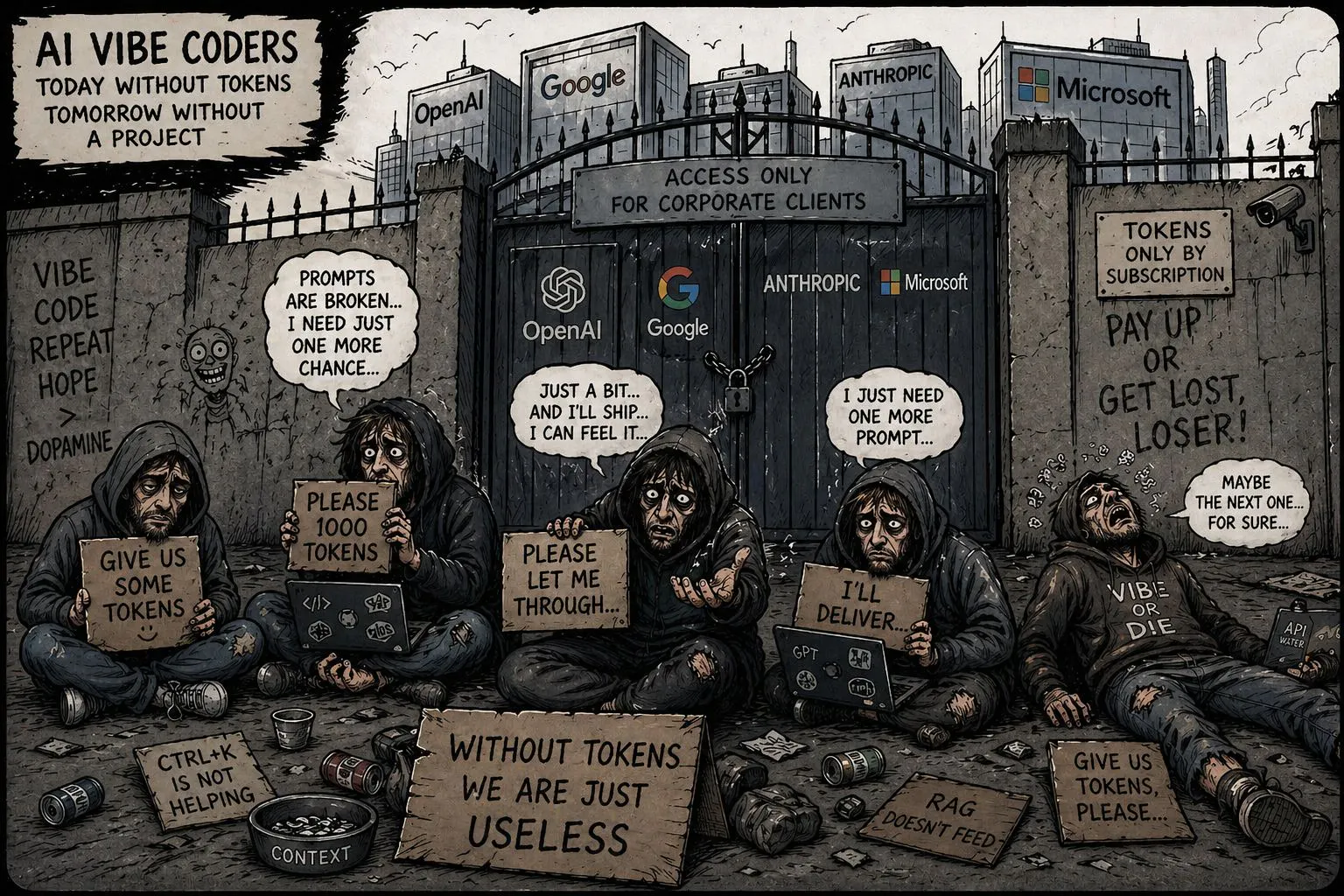
Watching AI move into both work and home life, I keep catching myself on a simple thought: writing code by myself is getting harder, and delegating it to AI is getting easier. AI providers also keep encouraging us to spend more tokens. Managers are pushing teams to use AI more actively. On social media, I regularly see joke videos about CEOs telling people to consume tokens for the sake of consuming tokens. And in large companies, there is already an unspoken competition going on: who uses AI tools more, who automates more, who can show faster that "we are in the game too."
The title makes it obvious where I am going. But I do not want to talk about AI hype, or about fear of AI. I want to talk about the more mundane, engineering-related, and unpleasant side of it: vibe coding very easily turns into gambling.
`<cut />`
#### A bit of background
I started my pet project, [open-daimon](https://github.com/NGirchev/open-daimon?ref=hackernoon.com), a couple of years ago because I wanted my own Telegram bot. It was private, had a different name, and performed a very limited set of tasks for me. When Copilot appeared, I decided to continue working on it so I could get better at working with AI, since proper AI access was not expected anytime soon in the enterprise project I was working on at the time.
Eventually, it grew into a framework for routing between local models and OpenRouter models depending on the use case. Now it is turning into something like a Java AI agent from 2023. I already use it in another private pet project of mine, but that is not the point here. The important thing is that its second purpose, learning how to work with AI, has been fulfilled. I have gone all the way from the AI-assistant approach to full-on vibe coding.
#### What I found out
I found out two things:
* Copilot is still mostly smart autocomplete.
* Claude and Codex are full-fledged AI tools for everyday work and life. They are powerful enough for most tasks, sometimes so powerful that they can feel autonomous.
Using the latter did not merely speed me up. I also started noticing that the code I write myself is harder for AI to maintain, while code written by AI is much easier for AI to maintain. By now, this is probably not news to many people, but it gradually restructures your entire workflow.
At first, you are still the one planning the architecture, while the AI only writes boring mappings for you. Then it starts finding bugs for you. Then you realize that AI can write an entire feature better than you do and cover it with tests. You are surprised by how quickly it did it and by the fact that everything works right away, even in a complex project.
And then you start trusting it with architectural decisions. It suggests what is best for you. It becomes harder and harder to force yourself to read everything it writes, to review all the code. And then it reviews the code itself.
I will not focus here on practical rules for vibe coding or AI-assisted development. I also want to leave for later the other things I have noticed while vibe-coding with different models. For example, recently Opus 4.7 praised its own code in a review where that code was not even being called. Right now, I simply want to restate an idea that other authors were already expressing a year ago: vibe coding is gambling in its purest form.
I recommend reading Addy Osmani's article, [Vibe Coding is not the same as AI-assisted engineering](https://medium.com/%40addyosmani/vibe-coding-is-not-the-same-as-ai-assisted-engineering-3f81088d5b98?ref=hackernoon.com). It is still relevant. Osmani does not directly call vibe coding gambling, but he describes it as the mode of "This isn't engineering, it's hoping": fast, exciting, full of progress signals, but without enough quality control.
Dopamine is tied not just to winning, but to anticipation and reward prediction. You can read about this, for example, in Wolfram Schultz's paper [Updating dopamine reward signals](https://pmc.ncbi.nlm.nih.gov/articles/PMC3866681/?ref=hackernoon.com). That is why, every single time, you are sure that this time it will finally do the task you asked for 10 prompts ago, even though you only have five hours left to sleep.
I started my pet project without AI, and even back then it already looked monstrous. When I unleashed AI on it, my goal was to check how viable this would be for a real enterprise production project. On my relatively small project, AI does not create features faster than I do. I also spend a lot of time fixing things that used to work. In total, I do not see a speed gain in this particular mode of work.
The article I linked above explains which mode of working with AI is where it really shines. But what matters to me is this: with AI, I continue the project because of the dopamine loop. On my own, I would have abandoned it long ago. AI has also proved useful as a rubber duck that helps me understand what to do next. So there is a non-obvious upside to the dependency.
#### The cheap first dose
This apparent simplicity and acceleration are real. That is why we change our processes to benefit from them. But what worries me more is the dependency on companies.
It is no secret anymore that, right now, we are getting AI at very low prices. When it becomes more expensive, many of us will feel withdrawal. Writing code ourselves will already feel difficult, while using AI may become more expensive than hiring a real person. In other words, companies are hooking us with a cheap first dose. We get used to it, and then quitting becomes hard.
This is not only a developer problem. The goal of companies is to get everyone hooked on new capabilities, and that will happen. Sooner or later, those who know how to use AI will displace those who do not. This has already happened with other technologies and professions.
An accountant who knew how to work with Excel and accounting systems became more productive than one who continued calculating everything manually. A lawyer who knew how to quickly search case law in legal databases and Google outpaced one who relied only on paper reference books. A marketer who mastered analytics, CRM systems, and ad platforms displaced one who continued working "by gut feeling."
But with Google, we did not experience similar emotions. Or did we?
In a 2012 paper, [Internet Addiction: A Brief Summary of Research and Practice](https://pmc.ncbi.nlm.nih.gov/articles/PMC3480687/?ref=hackernoon.com), the authors relied on earlier work going back to 1995. People were already worried then about new technologies and how they could cause addiction. The article leads to the idea that internet addiction resembles other behavioral addictions: loss of control, excessive use, symptoms similar to withdrawal, an increase in "dose" resembling tolerance, and harm to studies, work, or relationships.
And now, in South Korea, basic mobile internet is being introduced as a [right to connectivity](https://koreajoongangdaily.joins.com/news/2026-04-09/national/socialAffairs/SK-Telecom-KT-LG-U-subscribers-to-have-access-to-basic-data-on-phones-after-monthly-limit-expires/2564763?ref=hackernoon.com).
So are we about to see the same cycle of development again? Or will large corporations gain even more influence this time and charge us for tokens rather than kilobytes, with the price being even higher?
#### Epilogue
It feels as though AI is already everywhere. The data partially supports this, but with an important caveat: mass awareness has already happened, while mass habit has not.
According to [Pew Research](https://www.pewresearch.org/short-reads/2025/06/25/34-of-us-adults-have-used-chatgpt-about-double-the-share-in-2023/?ref=hackernoon.com), in 2025, 34% of American adults had used ChatGPT, and among people under 30, the figure was 58%. Gallup shows a similar picture at work. In [Q1 2026](https://www.gallup.com/workplace/704225/rising-adoption-spurs-workforce-changes.aspx?ref=hackernoon.com), 50% of U.S. employees used AI at least a few times a year, 28% used it a few times a week or more, and 13% used it daily. Among remote-capable employees, the gap is more noticeable: Gallup's [Q4 2025 data](https://www.gallup.com/workplace/701195/frequent-workplace-continued-rise.aspx?ref=hackernoon.com) showed 66% had used AI, 40% used it frequently, and 19% used it daily.
And that is before we even mention that the internet itself is still not available everywhere. In 2025, roughly 6 billion people used the internet, about 74% of the world's population. Around 2.2 billion people were still offline. These are figures from the [International Telecommunication Union](https://www.itu.int/itu-d/reports/statistics/2025/10/15/ff25-internet-use?ref=hackernoon.com), the UN agency for communications.
In the end, I still want to believe in a bright future rather than cyberpunk, although the cyberpunk scenario already seems to have practically materialized in some countries even without AI. Whether we want it or not, we will continue using AI and accelerating until something radical happens.
And that does not necessarily have to be something bad. Perhaps, with increased efficiency, people will still learn something. It seems we did learn something from the emergence of the internet. Maybe the world became a little more educated after all., Vibe Coding is Gambling | HackerNoon, hackernoon.com, 01kqmts953xmz63q4z0mkysm3p.