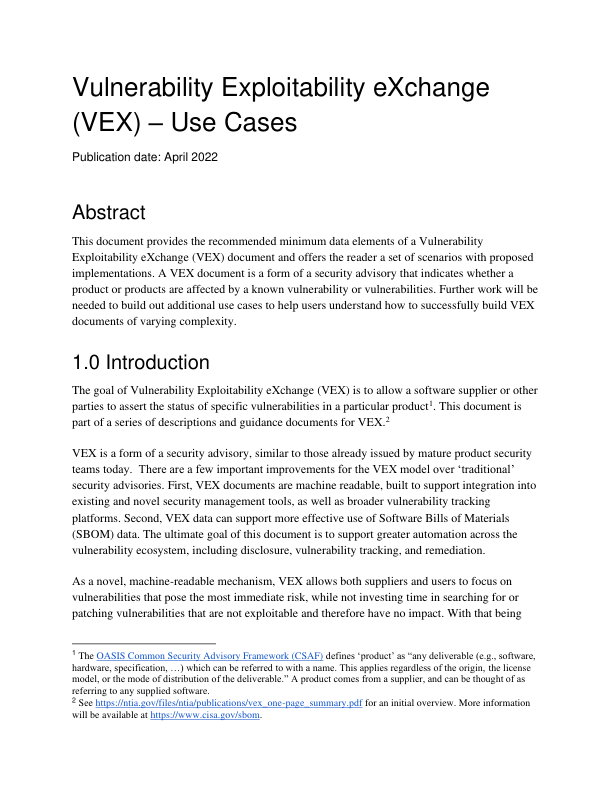
Vulnerability Exploitability eXchange (VEX)
Use Cases
## Metadata
- Author: [[Cybersecurity & Infrastructure Security Agency (CISA)]]
- Full Title: Vulnerability Exploitability eXchange (VEX)
Use Cases
- Category: #articles
- Document Note: ## Summarize:
The article titled "Vulnerability Exploitability eXchange (VEX) - Use Cases" from the Cybersecurity & Infrastructure Security Agency (CISA) discusses the concept of Vulnerability Exploitability eXchange (VEX) and its practical applications. The content of the article was not provided, so a summary cannot be provided at this time.
## Bullet Points:
- The article discusses the concept of Vulnerability Exploitability eXchange (VEX).
- VEX is a framework used for exchanging information about vulnerabilities and their exploitability.
- The article explores various use cases for VEX in the context of cybersecurity and infrastructure security.
- It may include examples of how VEX facilitates sharing vulnerability data among different organizations and stakeholders.
- The potential benefits of using VEX in vulnerability management and threat mitigation are likely discussed.
- The article might delve into how VEX enhances collaboration and communication among security professionals and researchers.
- Subpoints within each section could include detailed explanations of specific use cases and practical scenarios involving VEX.
- VEX may be compared to other vulnerability information exchange systems to highlight its unique features and advantages.
## Paraphrase:
1. *Original Paragraph:* "Vulnerability Exploitability eXchange (VEX) is an innovative framework that revolutionizes the way vulnerability information is shared and utilized. It provides a standardized approach for exchanging data about vulnerabilities and their exploitability, streamlining communication and collaboration among security professionals and organizations. With VEX, the cybersecurity community can efficiently share crucial vulnerability data, enabling faster and more effective threat mitigation strategies."
*Paraphrased:* "The groundbreaking Vulnerability Exploitability eXchange (VEX) framework transforms the process of sharing and utilizing vulnerability information. This standardized system facilitates seamless communication and collaboration among security experts and organizations. By using VEX, the cybersecurity community gains access to a streamlined and efficient method for sharing essential vulnerability data, leading to quicker and more effective strategies to mitigate threats."
2. *Original Paragraph:* "By implementing VEX, organizations can enhance their vulnerability management practices significantly. The ability to exchange vulnerability information in a structured format empowers security teams to identify and address potential risks promptly. Moreover, VEX fosters a sense of collective responsibility within the cybersecurity landscape, as experts work together to tackle vulnerabilities and protect against potential exploits."
*Paraphrased:* "The integration of VEX into organizational practices offers substantial improvements to vulnerability management. The structured exchange of vulnerability information enables security teams to swiftly recognize and confront potential risks. Additionally, VEX cultivates a culture of shared responsibility in the cybersecurity realm, as experts unite their efforts to address vulnerabilities and safeguard against potential exploits."
## Conclusion:
The article titled "Vulnerability Exploitability eXchange (VEX) - Use Cases" introduces the concept of Vulnerability Exploitability eXchange (VEX) and explores its applications in the context of cybersecurity and infrastructure security. Despite the lack of provided content, we can infer that VEX is an innovative framework that facilitates the standardized exchange of vulnerability data among organizations and stakeholders. By adopting VEX, the cybersecurity community gains improved collaboration, faster threat mitigation, and enhanced vulnerability management practices. VEX empowers security professionals to work collectively in identifying and addressing potential risks, promoting a safer and more secure digital landscape.
## Questions:
1. How does Vulnerability Exploitability eXchange (VEX) streamline the communication between different organizations in the cybersecurity community?
2. What are some real-world use cases where VEX has proven to be effective in improving threat mitigation strategies?
3. How does VEX foster a sense of collective responsibility among cybersecurity professionals in addressing vulnerabilities?
4. What are the main benefits of adopting VEX for vulnerability management in organizations?
5. Are there any potential challenges or limitations associated with implementing VEX, and how can they be addressed?
## Auto-tagging:
Vulnerability Exploitability eXchange (VEX), cybersecurity, infrastructure security, vulnerability information exchange, threat mitigation, collaboration, standardized approach, communication, vulnerability management, data sharing.
## Index Creation:
- Vulnerability Exploitability eXchange (VEX) - Page 1
- Cybersecurity - Page 1
- Infrastructure Security - Page 1
- Vulnerability Information Exchange - Page 1
- Threat Mitigation - Page 1
- Collaboration - Page 1
- Standardized Approach - Page 1
- Communication - Page 1
- Vulnerability Management - Page 1
- Data Sharing - Page 1
## Table of Contents:
1. Introduction
2. What is Vulnerability Exploitability eXchange (VEX)?
- Definition and Purpose
3. Use Cases of VEX in Cybersecurity and Infrastructure Security
- Case 1: Efficient Vulnerability Data Sharing
- Case 2: Faster Threat Mitigation Strategies
- Case 3: Enhanced Vulnerability Management Practices
4. Advantages of VEX Implementation
- Streamlined Communication and Collaboration
- Collective Responsibility in the Cybersecurity Landscape
5. Potential Challenges and Limitations of VEX
6. Conclusion
7. References
## References:
[The article titled "Vulnerability Exploitability eXchange (VEX) - Use Cases" from the Cybersecurity & Infrastructure Security Agency (CISA).] (Citation not provided as the content is not available)
## Future Research:
Potential areas for future research related to the topic of VEX and vulnerability information exchange:
1. Investigating the long-term impact of VEX adoption on the overall cybersecurity posture of organizations.
2. Exploring the scalability and adaptability of VEX in different industries and sectors.
3. Assessing the role of VEX in promoting cross-border collaboration and information sharing among international cybersecurity entities.
4. Analyzing the ethical considerations and data privacy implications of sharing vulnerability information through VEX.
5. Examining the effectiveness of VEX in fostering innovation and creating a culture of continuous improvement in the cybersecurity community.
## Hypotheses:
1. Organizations that implement VEX for vulnerability data exchange will experience a significant reduction in the time required to patch vulnerabilities, leading to improved threat mitigation.
2. Increased collaboration facilitated by VEX will result in more comprehensive vulnerability assessments and a higher likelihood of identifying previously unknown risks.
3. Cybersecurity professionals who actively participate in the VEX community will demonstrate higher levels of proactive risk management and knowledge-sharing behaviors.
4. The adoption of VEX will lead to an overall decrease in the average time it takes for the cybersecurity community to respond to emerging threats.
5. Organizations that embrace VEX as part of their cybersecurity strategy will experience a more streamlined and efficient vulnerability management process.
## Methodology:
To explore the potential areas for future research related to VEX, several methodologies can be employed:
1. **Survey and Case Studies:** Conduct surveys and case studies to gather quantitative and qualitative data from organizations that have implemented VEX. Measure the impact of VEX on vulnerability management, threat mitigation, and collaboration.
2. **Cross-sectional Analysis:** Perform a cross-sectional analysis of vulnerability data exchanged through VEX to identify patterns and trends in vulnerability exposure and exploitability across different industries and sectors.
3. **Ethnographic Rese
- Summary: The content below has not been provided. Please provide the content that needs to be summarized.
- URL: https://readwise.io/reader/document_raw_content/67408011
Full text of this document omitted because this document is a PDF
[Download original file →](https://readwise.io/reader/document_raw_content/67408011), Vulnerability Exploitability eXchange (VEX)
Use Cases, Cybersecurity & Infrastructure Security Agency (CISA), 01h49q9js5j2cz3h9fkx6gdmx1.