We Found Jesus’s Crucifixion Sign?
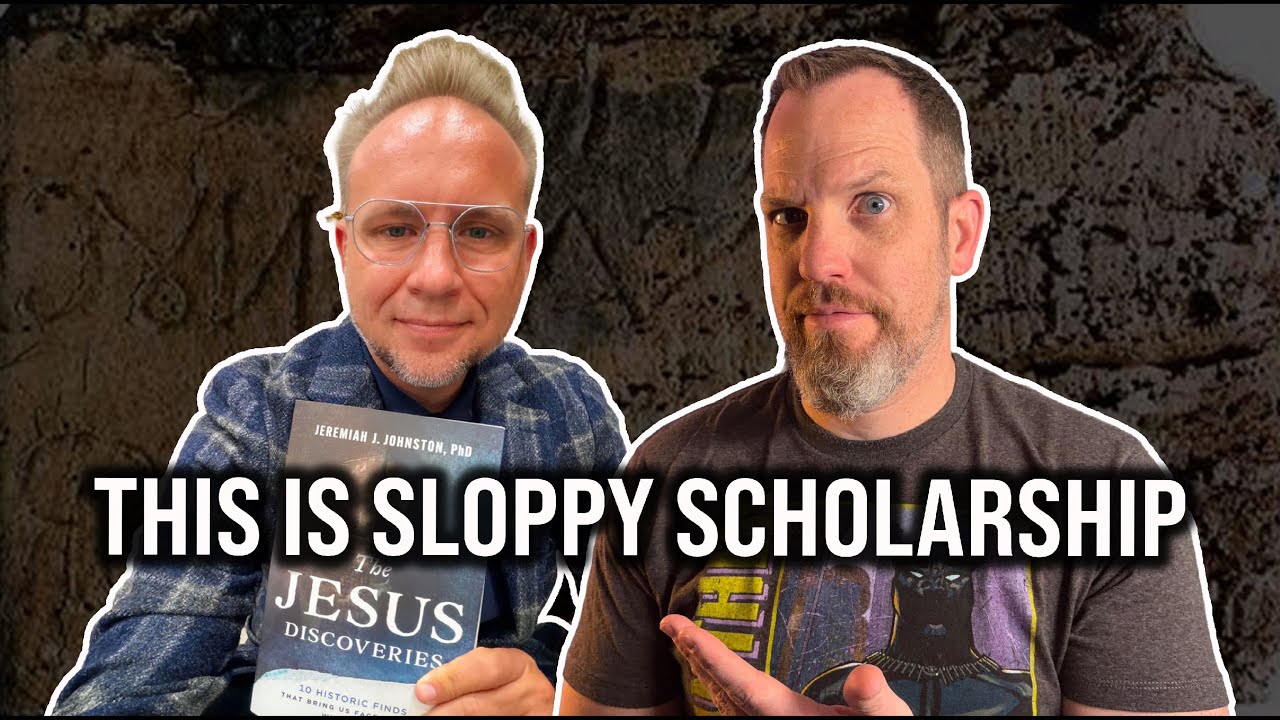
🔗 **Source:** [We Found Jesus’s Crucifixion Sign?](https://www.youtube.com/watch?v=bLcWxb-3CNY)
> [!note]+ Document Notes
> ---
> tags: [titulus-crucis, biblical-archaeology, relic-authentication, radiocarbon-dating, citation-verification]
> author: Dan McClellan
> source: Dan McClellan
> reference: https://www.youtube.com/watch?v=bLcWxb-3CNY
> date created: 2026-09-08
> ---
> > [!info] Generated analysis — not the author's words. Sections below are machine-written
> > from the captured source. Only text inside `> [!quote]` blocks is verbatim from the author.
> > Do not quote or attribute any other line to the named author.
> # 🏷️ Title: We found Jesus's crucifixion sign?
> ## 🧭 Table of Contents
> - [🔗 References (in-page)](#-references-in-page)
> - [📝 Summary](#-summary)
> - [📖 Main Content](#-main-content)
> - [🗒️ Notes](#-notes)
> - [📚 References](#-references)
> - [🗣️ Paraphrase](#-paraphrase)
> - [📰 Newsletter](#-newsletter)
> - [✅ Action Items](#-action-items)
> - [🧪 Hypotheses](#-hypotheses)
> - [📊 Methodology](#-methodology)
> - [❓ Questions](#-questions)
> - [🔮 Future Research](#-future-research)
> - [💡 Implications](#-implications)
> - [🧠 Learning Styles Assessment](#-learning-styles-assessment)
> - [📊 Accessibility Assessment](#-accessibility-assessment)
> - [🌍 DEIB Assessment](#-deib-assessment)
> - [✅ Logical Validity](#-logical-validity)
> - [🛡️ DARVO Analysis](#-darvo-analysis)
> - [🎯 Conclusion](#-conclusion)
> - [🔄 Refactor Appendix](#-refactor-appendix--we-found-jesuss-crucifixion-sign)
> ### 🔗 References (in-page)
> - [Radiocarbon dating segment](#️-000054-httpswwwyoutubecomwatchvblcwxb-3cnyt54s-facebook-post-and-first-image-review) — the C14 evidence
> - [Craig Evans citation-check segment](#️-000828-httpswwwyoutubecomwatchvblcwxb-3cnyt508s-footnotes-3-and-8-trace-to-craig-evans) — the misattribution catch
> - [Artist reproduction / vav segment](#️-001344-httpswwwyoutubecomwatchvblcwxb-3cnyt820s-the-hebrew-mem-ligature) — separate from Johnston critique
> - [🎯 Conclusion](#-conclusion) — bottom line on the title claim
> ## 📝 Summary
> - **What happened.** Dan McClellan reviews a viral Facebook post (account "Verified Bible") claiming archaeologists found the actual wooden sign hung over Jesus during the crucifixion — the Titulus Crucis, inscribed in Hebrew, Greek, and Latin. He shows the object in question was radiocarbon-dated in a 2002 journal article to roughly 900–1150 CE, centuries after the crucifixion, so it cannot be the 1st-century original. He then pivots to a #1 New York Times bestseller, Jeremiah J. Johnston's *The Jesus Discoveries*, and traces its chapter on the Titulus back to its own footnoted source (Craig Evans, *Jesus and the Manuscripts*) to check whether the citations hold up.
> - **Why it matters.** This is a case study in checking a viral relic claim against the actual dating literature, and checking a bestselling popular book's footnotes against the scholar it cites, rather than trusting either at face value.
> - **Key entities.** Facebook account "Verified Bible"; the Titulus Crucis fragment held at the Basilica di Santa Croce in Gerusalemme, Rome; the 2002 *Radiocarbon* journal article "14C dating of the Titulus Crucis"; Jeremiah J. Johnston and *The Jesus Discoveries* (10 Historic Finds That Bring Us Face to Face with Jesus); Craig Evans and *Jesus and the Manuscripts*; an unnamed artist who gave Johnston a reproduction of the titulus.
> - **Risks and tradeoffs.** The video is strong where it quotes primary sources directly (the 2002 dating article, Evans' actual pages) and weaker where it reconstructs Johnston's drafting process from internal textual evidence alone — that section is explicitly framed as inference, not proof.
> - **Bottom line.** No, the artifact in the Facebook post is not the sign from Jesus's crucifixion. It is a medieval object, independently dated on physical (radiocarbon) grounds well outside the 1st century.
> ## 📖 Main Content
> The video's own audio has the presenter introduce himself at 0:06; the auto-generated transcript renders the name as "Dan Mlelen," which doesn't match any known Bible scholar. The phrase that follows immediately — "a scholar of the Bible and religion" — is the tagline Dan McClellan uses on his own channel, and the video's method (tracing a viral claim to its source, then tracing a book's footnote to its cited scholar) matches his known content. This note credits the video to Dan McClellan on that basis; the identification is inferred from context, not read literally off the transcript, and is flagged here rather than stated as certain.
> The video makes two separate arguments, and it's worth keeping them apart the way the presenter does.
> **Argument 1 — the Facebook post is demonstrably false.** The post claims archaeologists found the sign placed over Jesus's head, describes it as bearing part of "Jesus of Nazareth, King of the Jews," and says it preserves the same three languages John's gospel names. The presenter identifies the object as the Titulus Crucis fragment kept in Rome and cites a 2002 article in the journal *Radiocarbon*, "14C dating of the Titulus Crucis," which reports two independent AMS sample ranges: 996–1023 CE and 980–1146 CE. Wood that was alive around 1000 CE cannot carry an inscription older than the wood itself — a straightforward terminus post quem — so the object is a medieval artifact, roughly 800–1000 years old rather than roughly 2000. Whether it's a deliberate forgery or a devotional copy of something older isn't settled by the dating alone, but authenticity as the 1st-century original is ruled out by it.
> **Argument 2 — a bestselling book mishandles its own citations on this same object.** Jeremiah J. Johnston's *The Jesus Discoveries: 10 Historic Finds That Bring Us Face to Face with Jesus* devotes a chapter to the Titulus. The presenter reads the chapter's own text acknowledging "no authentic or even plausibly authentic artifact has been discovered," then shows the chapter nonetheless discussing "the artifact" and "the reproduction" before it has introduced any discovery — a structural inconsistency he reads as evidence of a chapter written when the author still thought the relic might be genuine, then only partially revised after learning it's medieval. He traces two of the chapter's footnotes (3 and 8) to their cited source, Craig Evans's *Jesus and the Manuscripts*, and finds a mismatch: Johnston says the inscription was written in Aramaic, Greek, and Latin and cites Evans for it; Evans's own pages say Hebrew, Latin, and Greek four times and never say Aramaic, except once in a footnote referencing another publication's title. On dating, Evans's own stated range ("no earlier than the 12th century") is also, per the presenter, an oversimplification of the actual C14 window (10th–12th century), and Johnston repeats Evans's version rather than the primary article's.
> **A separate, smaller point** concerns a modern reproduction of the titulus an artist gave Johnston as a gift, later posted to Instagram — not part of the book. The presenter flags two issues: the Greek lettering uses lowercase, breathing marks, accents, and word spacing, none of which existed in 1st-century Greek (written in capitals, unspaced); and the Hebrew includes an extra letter (a vav) before the word for "king" that has no basis in the parallel Greek text (which reads appositionally — "Jesus the Nazarene, [who is] also king of the Jews" — not as a four-word acrostic). The presenter explains the added vav lets the first letters of four words spell a form of the divine name, and calls that unsupported. He's explicit that he's never seen Johnston himself make this specific claim — the criticism targets the artist's choice, not the book.
> ### 🗒️ Notes
> #### ⏱️ [00:00:00](https://www.youtube.com/watch?v=bLcWxb-3CNY&t=0s) Facebook post and first image review
> - The "Verified Bible" Facebook post claims archaeologists found Jesus's actual crucifixion sign, describes it as the Titulus Crucis, carrying Hebrew, Greek, and Latin.
> - At t=54s a clearer photo shows the Greek and Latin written backwards (mirror-reversed) except one Greek letter (zeta).
> #### ⏱️ [00:01:26](https://www.youtube.com/watch?v=bLcWxb-3CNY&t=86s) Why it isn't the authentic titulus
> - "Primarily, the fact that it was carbon dated to no more than about a thousand years ago."
> - Cites
Has the actual sign placed over Jesus's head during his crucifixion been found? Hey everybody, I'm Dan Mlelen. I'm a scholar of the Bible and religion. And the other day I ran across this post on Facebook posted by an account called Verified Bible. And the description, which you're probably not going to be able to read here, says, "Archaeologists have examined what appears to be the actual sign placed above Jesus during his crucifixion. Known as the titulus crucus, the wooden relic carries part of the inscription Jesus of Nazareth, King
of the Jews, and preserves traces of the same three languages named in John's gospel, Hebrew, Greek, and Latin. Roman authorities were also known to display a condemned person's charge during executions, matching exactly what the Gospels describe. Preserved in Rome for centuries, it remains one of the most extraordinary relics ever connected to the crucifixion. And here's a slightly clearer photograph of this fragmentaryary wooden relic where we can see inscribed in the wood at the top
some downward strokes that could be Hebrew or a Semitic language. And then we have Greek under that and Latin under that. And here's a clearer image so you can see the letters better. And you can see that the Greek and the Latin are actually written backwards except for the zeta of the Greek there in the middle. Now, we know this is not the authentic titulus that was hung over Jesus's head for a few different reasons. Primarily, the fact that it was carbon dated to no more than about a
thousand years ago. In this 2002 article from the journal radioarbon 14C dating of the titulus crucus, we can see in the red box the conclusion the experimental confirmation of the known historical dates of the control samples indicates a good operation of the analytical system and validates the calculated age of the titulus crucus. In the bottom right you can see two different ranges from two different samples. One 996 to 1023 CE, the other 980 to 1146
CE. So this wood was alive just a little more than a thousand years ago, which means the inscription cannot have been executed until shortly after the wood stopped living around 800 to a,000 years ago, give or take a few decades. So it's definitely a medieval artifact. Whether or not it's a forgery or maybe a copy of something that pre-existed, this is
definitely not the authentic titulus cruis. So, the claim from that Facebook post is demonstrabably false. But I want to go on. I want to talk a little bit about this book by Jeremiah J. Johnston. and I've talked about him before and his rather sloppy scholarship and his assertion of false claims on podcasts recently, but this book, The Jesus Discoveries, 10 historic finds that bring us face to face with Jesus, has become a number one New York Times best seller. And he talks about the titulus
cruisy number six is the King of the Jews inscription face to face with the first written words about Jesus. But we've not discovered an authentic artifact related to the titulus crucus. So is this chapter just going to be about this medieval forgery? Well, it starts by talking about the inscription, what happened down at the bottom. These were not random words. They formed the first known inscription that identifies
Jesus and declared even if mockingly his royal identity. With this discovery, we'll explore its historical, theological, and archaeological significance and what it reveals about the Roman world, Jewish expectations, and the earliest Christian proclamation. What's discovery? No authentic or even plausibly authentic artifact has been discovered. And then we go on to the next page. Talks a little bit about the background. Down at the bottom, what the gospels record. We
have what we have in Matthew. We have what we have in Mark. And then I'm going to pause briefly on what we have in John 19-21. Gives the most detail. Pilate wrote the title himself, affixed it to the cross, and included the name Jesus of Nazareth. It was written in Aramaic, Latin, and Greek. Three languages that symbolized religion, empire, and culture. And then we have a footnote marker for footnote number three, and we're going to get to that later. But obviously that footnote
marker should point us to scholarship that establishes either that it was written in Aramaic, Latin, and Greek or that those three languages symbolize religion, empire, and culture. But parenthetically after that, Jeremiah adds, "In some Bible translations, Hebrew is substituted for Aramaic, although they're two different languages." And then we go on, "This multilingual inscription was no accident." Blah, blah, blah. We have Roman practice and precedent. And then we get to a page that has an image on it of something. And I want to read in the
red box. You'll notice reversed script on the titulus reproduction shown here. I mentioned that the titulus crucus, the medieval forgery, has reverse script. So now we have reverse script on a reproduction of the titulus down at the bottom. And it's actually not just reverse script. The image is upside down in the publication. Whoever approved these proofs, which would have been Jeremiah,
neglected to realize that the image is entirely upside down. So, we have to flip it over to see the Hebrew on the top. By the way, not Aramaic, Hebrew. And then we see the reversed Greek and the reversed Latin. and you would have to flip it over to see the Greek and the Latin being written in the correct direction. But anyway, getting back to what Jeremiah has to say, it could be because the letters were transferred or impressed onto another surface,
preserving the text in mirror form, not as intentional symbolism. When pigments or surface residue are transferred, the text appears mirror reversed, much like a seal impression, a wax stamp, a cloth imprint, a parallel often noted with shroud studies. This explains why some letters are reversed while others appear uneven. Exactly what we see on the artifact. What artifact? We've not discussed any artifact whatsoever. We've discussed what the gospels have to
say about the titulus, but we've not discussed the discovery of any artifact. We're in a chapter that should be discussing some kind of discovery of some kind of artifact. and we've suddenly brought up a reproduction of a medieval forgery, but we've not actually discussed that medieval forgery itself. What on earth is going on here? We get on to the next page, the inscription as apologetic witness. And about halfway down the third paragraph on this page,
in the basilica de Santa Crochce in Jerusalem in Rome, a wooden fragment claimed to be part of the original titulus has been preserved, rediscovered in 1492. It bears a partial Latin inscription. We have the abbreviation I, Nazerinos Rex Udeorum. While some defend its authenticity, carbon 14 testing dates the relic to no earlier than the 12th century. This is not true. no earlier than the 10th century, no later than the 12th century, at least
according to the window that the C14 dating gave us. Despite this, the inscriptions paleography is remarkably consistent with Roman era Latin. And then we have footnote marker number eight, and we're going to talk about that in a moment. But I just want to point out that on the page before this, we made reference to the artifact and we showed a reproduction of the artifact. And it was a reproduction of the fragmentaryary titulus crucus, but we
did not discuss the quote unquote rediscovery of that medieval artifact until the next page. So we're going out of order here. But also, we're in a chapter that's supposed to be discussing a discovery that brings us face to face with Jesus. And so far, the only thing that has been discussed out of order is the discovery of a medieval forgery. But let's get to those footnotes. Both footnote three in
reference to the Aramaic, the Greek, and the Latin, and footnote 8 in reference to the inscription being remarkably consistent with first century Latin. We have Craig Evans, Jesus and the manuscripts. And this is the first of two pages in that book that discuss the crucifixion titulus and are the two pages that are referenced in those footnotes. And I want to point out on this page, the only relevant part is that Evans identifies the three
languages as Hebrew, Latin, and Greek. And then on the next page, again, three different times, Evans identifies the inscription as Hebrew, Latin, and Greek. then Greek, Latin, and Hebrew, and then Greek, Latin, and Hebrew letters. Evans never says that the inscription has anything at all to do with Aramaic. In fact, the only time the word Aramaic appears anywhere in this section is in a footnote where Evans is referring to a publication that uses the word Aramaic in the title, something Evans didn't
write. So, Jeremiah said it was written in Aramaic, Greek, and Latin, and cited Craig Evans in support of that. And Craig Evans doesn't say that. Craig Evans four times says it was written in Hebrew, Greek, and Latin. And there's a debate about whether the Greek term Hebrew could refer to Aramaic or Hebrew. But Jeremiah is being incredibly sloppy by citing in support of a statement, a scholar who directly refutes that
statement. but also regarding the fits of the paleography into 1st century CE Latin. Down at the bottom there is in Rome's Basilica de Sante Crochi in Jerusalem an old wooden fragment apparently rediscovered in 1492 that supposedly contains part of the wording of the inscription. Then we have the inscription. Although its authenticity has been vigorously defended in recent years and the paleography is remarkably well done, carbon 14 dates the relic to
a period no earlier than the 12th century. And here Evans is wrong. It's not no earlier than the 12th century. The window is from the 10th to the 12th century. So no earlier than the 10th century. So it sounds like Jeremiah just basically copied what Evans had to say about the titulus crucus, about the medieval forgery, but tried to make it sound like it was more authentic than it was by saying the paleography lined up remarkably well with first century Latin, which is not what Evans says.
Evans says the paleography was remarkably well done by whoever did it in the 10th to 12th century. And then Evans gets the window of dating wrong. And so obviously Johnston gets the window of dating wrong. So it seems to me that what's going on here is that Johnston thought he had the actual titulus crucus and started writing this chapter about the discovery of this and
initially discussed the discovery earlier on in the chapter and then later on talked about the reproduction and the reverse writing and how this is what we would expect from an authentic thing. this is what we find in the artifact. And then at some point stumbled upon the fact that no, this is demonstrabably a medieval forgery and went, "Oh crap. Well, I don't want to get rid of the chapter, so I'm just going to rearrange things a little bit." Put the medieval forgery later in the chapter and just
mention it as, "Oh, yeah, there's this thing." and then did not carefully enough edit what was left over and had references to the artifact and the reproduction prior to the discussion of the discovery of the artifact that is being referenced in the earlier part of the chapter and decided not to point out by the way there is no such artifact we have no discovery that brings us face to face with Jesus we're just talking about
what the New Testament has has to say about this and oh by the way discovered this thing. I've been talking about it as if it's actually authentic, and I'm still going to fudge the sources a little bit to make it sound like it still could be kind of authenticish. Uh, but it's not a discovery that brings us face to face with Jesus. So, this is remarkably sloppy scholarship, but that's kind of what you get with Jeremiah J. Johnston. And I just want to point to one other thing. It's actually not criticism of Johnston himself, but
of somebody who gave him something. Here's a photo that Johnston uh put on Instagram of a reproduction of the titulus that an artist made and gave to him. That's a very cool gift. Uh, as you can see, you have Hebrew on the top. Again, not Aramaic. Aramaic would be very different. And then Greek in the middle, and you've got lowercase with capitals at the beginning of words, and it has the breathing marks, and it has the accents. That's not how Greek was written in the first century. It would have been written in all caps and it
probably would have been written altogether without spaces between the words. But that's not what I want to focus on. I actually want to focus in on the word mel in Hebrew because there's a liature. There's this third descending stroke on the mem. It shouldn't be there which indicates that this artist has placed a vav before the word melc. There's no vav plausibly in the rendering of the Hebrew. Uh it would have to mean Yesu
the Nazerite and king of the Jews. But that's not what the Greek says was written in Hebrew. The Greek very clearly has it appositional. Jesus the Nazerite that is king of the Jews or also king of the Jews. It's in opposition. There's no vav there. The reason people arbitrarily add a vav, which is not supported by anything ever said anywhere in the New Testament, is because that allows you to then say that we have four words. And if you take the first letter of each of the four words,
it is yode vave. Spells out the divine name, the tetred grammaton, Adoni. Identify Jesus as Adonai. And that would be cool if it did not require that you just arbitrarily throw a vav in there with absolutely no support whatsoever for the presence of that vav. Um, now again, I've never seen Jeremiah make that claim. I'm not saying that Jeremiah is saying this, but the artist who made this for Jeremiah very clearly is throwing the vav in there to support that little falsehood that is used to
jin up faith in folks and belief that Jesus is recognized as Adonai in the New Testament, which he most definitely is not. But the point here is no, we did not find the actual sign that was hung above Jesus's head. And take Jeremiah J. Johnston's scholarship with a grain of salt because it tends to be incredibly sloppy., We Found Jesus’s Crucifixion Sign?, Dan McClellan, 01m21czcxz6bbw706mg63jydr9.