What Is Agentic AI?
## Metadata
- Author: [[Deepti Jain]]
- Full Title: What Is Agentic AI?
- Category: #articles
- Document Note: ---
tags:
- #agenticAI
- #marketingautomation
- #conversionoptimization
Author: Deepti Jain
Source: Invesp Blog
Reference: https://www.invespcro.com/blog/what-is-agentic-ai/
date created: 2025-09-15 00:00
---
# Title: What is Agentic AI?
## Table of Contents:
- [🧭 Overview](#-overview)
- [🔁 How Agentic AI Differs From Generative AI](#-how-agentic-ai-differs-from-generative-ai)
- [🧱 Core Components of Agentic AI](#-core-components-of-agentic-ai)
- [🗂️ Goal Decomposition & Planning](#-goal-decomposition--planning)
- [⏱️ Prioritization by Impact/Urgency](#-prioritization-by-impacturgency)
- [🔄 Dynamic Adaptation](#-dynamic-adaptation)
- [🧠 Memory (Short-term + Long-term)](#-memory-short-term--long-term)
- [👁️ Perception & Context Awareness](#-perception--context-awareness)
- [🧮 Decision-making & Reasoning](#-decision-making--reasoning)
- [🏃 Action & Execution](#-action--execution)
- [📈 Self-Monitoring & Evaluation](#-self-monitoring--evaluation)
- [✅ Conclusion: Why It Matters for Growth](#-conclusion-why-it-matters-for-growth)
- [❓ FAQs](#-faqs)
- [📚 References](#-references)
### References:
- McKinsey research on AI-driven decision systems ROI (mentioned in-article)
- AutoGPT and Devin (AI agent frameworks, referenced conceptually)
- HubSpot Breeze AI, Google AI Mode, Smartly.io, Madgicx, Evolv AI (product examples)
## 📝 Summary:
The article defines agentic AI as autonomous systems that plan, act, learn, and adapt toward goals with minimal human input. Unlike generative AI, which responds to prompts, agentic AI initiates tasks, prioritizes actions, perceives real-time context, reasons about trade-offs, executes changes, and self-evaluates. Real-world examples include ad optimization (Smartly.io, Madgicx), automated experimentation (Evolv AI), and ecommerce purchasing flows (Google AI Mode). The piece argues agentic AI reduces monitoring and repetitive tasks, enabling teams to focus on strategy and creativity, especially in CRO.
## 📖 Main Content:
Agentic AI moves beyond prompt-response models by chaining capabilities: goal understanding, decomposition, prioritization, perception, memory, reasoning, and autonomous execution with feedback loops. In marketing and CRO, it can detect conversion anomalies, hypothesize causes, spin up experiments, and continuously reallocate resources. Case studies show automatic pausing of underperforming ads, budget shifts, and faster experimentation cycles. The article stresses human strategic oversight remains essential.
Personal insight:
- For WordPress/OSS ecosystems, agentic AI can automate triage (issues, PRs), safeguard CI budgets, and run continuous UX experiments on documentation sites, while humans curate governance and inclusivity.
- The progression from “assistive” to “agentic” mirrors DevOps automation maturity: telemetry → inference → remediation.
### 🗒️ Notes
- Definition:
- Agentic AI: plans, acts, adapts toward goals with minimal human intervention. “Figure out what to do next,” self-check, and adjust.
- Difference vs. Generative AI:
- Generative: responds to prompts.
- Agentic: initiates, sequences, executes, adapts.
- Core components:
- Goal decomposition: turns “launch a campaign” into sequenced tasks (research → copy → A/B test → monitor); tools: AutoGPT, Devin.
- Prioritization: orders tasks by impact/urgency (tracking before creative); examples: HubSpot Breeze suggests “next best action.”
- Dynamic adaptation: responds to changing conditions; example: Google AI Mode price-watch → cart → autofill → purchase with user control.
- Memory: short-term (Siri/Alexa) vs. evolving long-term (ChatGPT/Claude memories) to maintain context across sessions.
- Perception: continuous signals from structured/unstructured sources (CRMs, analytics, emails); scenarios in ecommerce, marketing, support.
- Decision-making: weighs trade-offs, confidence-based prioritization; McKinsey: +10–20% marketing ROI potential; reflection loops (AutoGPT/Devin).
- Action & execution: closes the loop by making changes autonomously; Smartly.io auto-optimizes creative and budgets; Madgicx pauses losers, scales winners.
- Self-monitoring: real-time evaluation halts losing variants; Evolv AI halves time-to-insight.
- Outcomes:
- Reduced wasted spend, faster learning cycles, proactive remediation.
- Humans focus on strategy/creative; AI handles monitoring/ops.
- CRO emphasis:
- Detect drop-offs, generate hypotheses, auto-reallocate to winners; pair AI with expert CRO practices.
## 📖 References:
- What is Agentic AI? (Invesp): https://www.invespcro.com/blog/what-is-agentic-ai/
- McKinsey on AI-driven decision systems increasing marketing ROI (as referenced in-article)
- Example tools: Smartly.io, Madgicx, Evolv AI, Google AI Mode, HubSpot Breeze, AutoGPT, Devin
## 🗣️ Paraphrase:
1) Original idea: “Agentic AI refers to autonomous systems that can plan, act, learn, and adapt... figure out what to do next, take the steps, check its own work, and adapt...”
Paraphrase: Agentic AI comprises autonomous systems that set objectives, devise and execute plans, absorb feedback, and continuously adjust. Instead of waiting for detailed directions, it decides the next move, carries it out, verifies results, and iterates.
2) Original idea: “With agentic AI, the whole sequence—detecting the underperformer, shutting it off, and shifting budget—happens automatically... Smartly.io… Madgicx…”
Paraphrase: In an agentic setup, the system identifies weak ads, pauses them, and reallocates spend to stronger performers without manual intervention. Platforms like Smartly.io and Madgicx demonstrate this by autonomously refreshing creatives and optimizing budgets for better conversion outcomes.
## 📰 Newsletter:
This week in web dev and open source: we’re seeing a shift from “assistive” to “agentic” AI—tools that not only suggest, but also act. If you’re building with WordPress, imagine agents that detect performance dips, open issues, and propose pull requests while you focus on architecture and accessibility.
- Learning: Refresh your fundamentals with modern PHP and vanilla JS patterns that make agent orchestration safer and testable. Revisit Git workflows—agents thrive when branching and CI rules are clear.
- Updates: Google’s “AI Mode” shows end-to-end flows (price-tracking to checkout) with user-in-the-loop controls. In marketing, Smartly.io and Madgicx auto-pause losers and scale winners; Evolv AI accelerates experimentation by reallocating traffic in real time.
- Community: Contributor onboarding sprints next month—bring a newcomer and pair on your first good-first-issue. We’ll cover inclusive documentation, code of conduct basics, and funding models for maintainers.
- New Plugins: Keep an eye on observability and audit log plugins—perfect companions for agentic automations in WordPress. Strong logging = safer autonomy.
Links:
- What is Agentic AI? (Invesp): https://www.invespcro.com/blog/what-is-agentic-ai/
- AutoGPT overview for task decomposition: https://github.com/Significant-Gravitas/AutoGPT
- Devin background: https://www.cognition-labs.com/
Punchline: Let AI do the busywork; we’ll do the meaningful work—teaching, mentoring, building resilient OSS.
## ✅ Action Items:
Prompt for alignment with open-source advocacy, contributor engagement, education, and OSPO trajectory:
“Analyze the provided article through the lens of an open-source, WordPress-focused Developer Advocate aspiring to lead an OSPO. Map insights to:
- Contributor Experience: Identify where agentic AI can automate contributor triage, issue labeling, PR checks, and mentorship pairing while preserving human review and inclusive onboarding.
- Governance & Transparency: Propose guardrails (audit logs, consent, explainability, rollback) and public policies for agent actions in repos, forums, and documentation sites.
- Education: Derive curricula modules (PHP/JS/HTML/CSS/Git) teaching safe agent orchestration, testing, observability, and ethics. Include hands-on labs for CI/CD policy enforcement and content experiments.
- Community Funding: Suggest sustainable models (sponsor tiers, grants) linking agent-driven productivity gains to
- Summary: Discover what agentic AI is, how it differs from generative AI, and real examples of tools and use cases in 2025.
- URL: https://www.invespcro.com/blog/what-is-agentic-ai/
Most people still think of AI as a tool that reacts to prompts: you ask, it answers. But a new class of systems is emerging that doesn’t just wait for instructions. Instead, it sets goals, makes plans, takes action, and learns from outcomes.
This is Agentic AI.
Instead of you logging in every morning to check reports, pause bad ads, or set up the next test, agentic AI systems do that work for you. They notice when conversions dip, figure out why, and take corrective action, often before you even know there’s an issue.
Today, we’ll learn “what is agentic AI,” how it differs from generative AI, and the core components that make it tick. You’ll also see real-world tools already putting these ideas into practice across ecommerce, marketing, and beyond.
Agentic AI refers to autonomous systems that can plan, act, learn, and adapt to achieve objectives with minimal human intervention. These systems think and execute functions independently, rather than just reacting to prompts.
Basically, it’s an AI system that can figure out what to do next, take the steps, check its own work, and adapt without you telling it every move.
##### How Agenctic AI Differs From Generative AI
Unlike generative AI, which waits for a prompt and produces an output (like text, code, or images), agentic AI takes initiative.
For instance, where a chatbot might give you headline ideas when you ask, an agentic system will notice that your checkout abandonment spiked, pull in session replays, cluster the pain points, draft a hypothesis, and even prepare an A/B test setup.
In other words, **Generative AI responds while agentic AI acts.**
Here’s what makes Agentic AI different from traditional automation and generative AI.
| | | | |
| --- | --- | --- | --- |
| | **Traditional Automation** | **Generative AI** | **Agentic AI** |
| **Trigger** | Pre-set rules | User prompt | Goal or condition |
| **Scope** | Repeats exact steps | Generates content/answers | Plans, executes, adapts |
| **Adaptability** | None | Low | High (learns from results) |
| **Example in CRO** | Schedule a daily funnel report | Write a headline idea | Can detect a checkout drop → pull heatmaps → draft fix → create A/B test setup |
#### Core Components of Agentic AI
With the [rise of marketing automation](https://www.invespcro.com/blog/marketing-automation/), you hear a lot about Artificial Intelligence (AI). But Agentic AI is distinct.
Strip the buzzwords away, and agentic AI comes down to a handful of core building blocks. Think of these as the “organs” that let the system act with initiative, not just respond on command.
##### 1. Goal orientation and planning
Agentic systems don’t merely take inputs; they actually understand objectives and map steps toward them.
In practice, this means:
###### Breaking big goals into smaller tasks:
Agentic systems don’t just take inputs. They understand objectives and map out the steps needed to achieve them.
For example, if you tell an AI, *“launch a campaign.”*
Instead of waiting for you to spell out every detail, it creates the work plan for you:
* First audience research
* Then draft copy
* Then set up an A/B test
* And, finally, monitor the results.
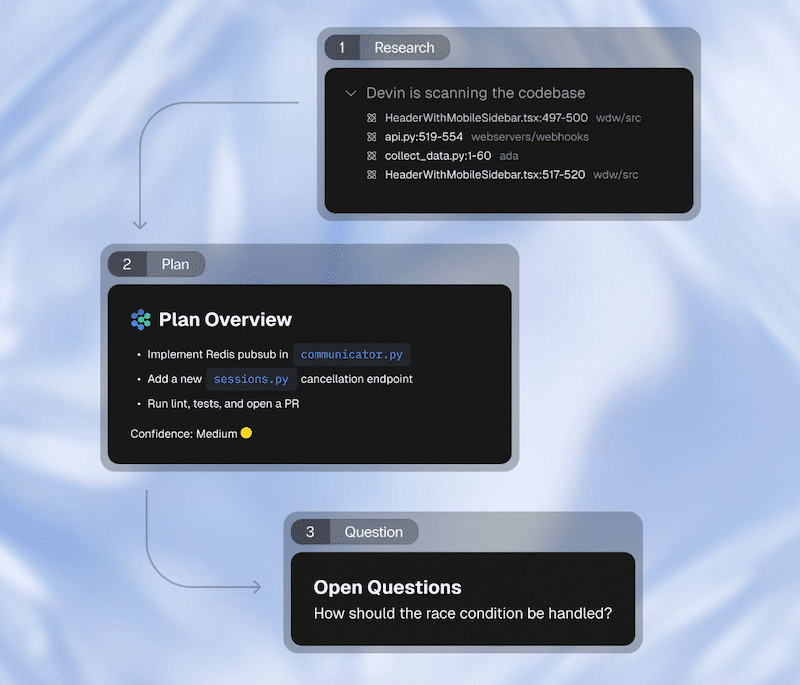
That’s not hypothetical since tools like [**AutoGPT**](https://agpt.co/) and [**Devin**](https://devin.ai/) already do this today in their own domains by taking one instruction and breaking it down into a checklist of tasks the system can work through.
Here’s how Devin, an AI software agent, takes a high-level instruction and automatically turns it into a sequenced plan with subtasks, priorities, and open questions.

*Imaging showing Devin AI breaking down a coding task into research, a step-by-step plan, and open questions (*[*Source*](https://devin.ai/)*)*
Instead of you manually building a project board, the system does it for you.
###### Prioritizing actions based on impact or urgency:
Goal orientation and planning aren’t only about listing tasks. A capable agent does not spend time on low-impact busywork. Instead, it identifies the steps that carry the most weight for success and tackles them first.
Take campaign setup as an example. Writing ad copy is essential, but it comes second to tracking. If tracking is not in place, you cannot measure performance, optimize spend, or prove ROI. An agent understands this dependency and makes sure the tracking work is completed before the creative work begins.
The same logic applies when deadlines are involved. If a product launch is tied to a fixed event date, the agent will shift resources toward time-sensitive tasks to make sure everything is ready on schedule.
This means the system is not simply moving through tasks in the order they were given. It ranks tasks based on impact and urgency, ensuring high-value work is completed first and nothing critical slips through the cracks.
This is what tools like [**HubSpot’s Breeze AI agents**](https://www.hubspot.com/products/artificial-intelligence/breeze-ai-agents) are starting to handle in marketing: they surface the “next best action” rather than just giving you a laundry list.
###### Adapting plans dynamically in response to new data:
Goal orientation and planning aren’t a one-time exercise. A capable agent keeps adjusting as things change, instead of sticking to a static checklist.
Take checkout. Traditionally, if a shopper wanted to wait for a price drop on a specific pair of shoes, they’d set a reminder, keep checking back, and manually complete the purchase later. [Google’s new AI Mode](https://search.google/intl/en-IN/ways-to-search/ai-mode/) changes that.
Shoppers set preferences like size, color, and budget, and the AI monitors listings across the web.
When a match appears at the right price, it can:
* Send a price drop notification
* Add the item to the retailer’s cart
* Auto-fill purchase details
* Complete the transaction securely with Google Pay
*Google AI Mode adapts dynamically: from price tracking → ‘Buy for me’ → automated checkout completion (*[*Source*](https://blog.google/products/shopping/google-shopping-ai-mode-virtual-try-on-update/)*)*
Importantly, the user stays in control, which means AI does the heavy lifting, but the shopper reviews the details before confirming the purchase.
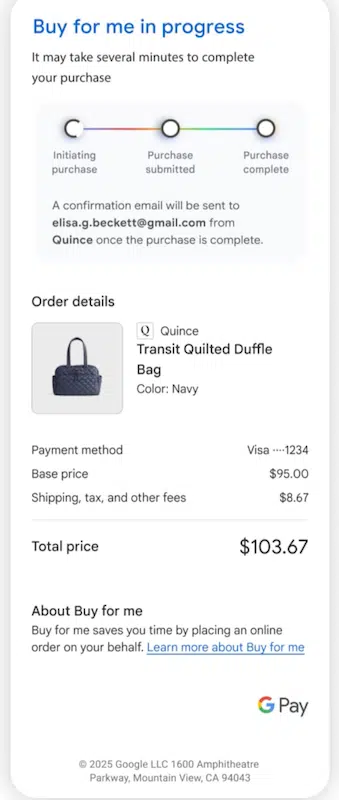
*Example of Google AI Mode executing the purchase once conditions are met, while keeping the shopper in control (*[*Source*](https://blog.google/products/shopping/google-shopping-ai-mode-virtual-try-on-update/)*)*
This is a real example of dynamic adaptation in action: the “plan” (buy this product when conditions are met) evolves automatically in response to live price and availability data.
##### 2. Memory (short-term + long-term)
Memory is what separates a “clever parrot” from a true assistant. There are three kinds:
* **Short-term memory only (Apple’s** ***Siri*** **or Amazon’s** ***Alexa)*****:** They can follow what you just asked in the current session (“Play jazz music… actually make it Miles Davis”), but once you close the app or start a new day, they don’t remember that context.
* **Some long-term memory (*****Google Assistant*****):** It can remember things like your home address or a preferred nickname, and it uses that across interactions. But it’s still limited in “learning” beyond predefined fields.
* **Evolving toward long-term memory (*****ChatGPT):*** *with memory enabled* or *Anthropic’s Claude with memory*. These assistants can recall what you’ve told them in past sessions (like your tone preference, favorite restaurants, or business priorities), and adapt over time, making them more like a real personal assistant who learns your habits.
The key difference is that Siri feels like you’re “resetting” every time, while ChatGPT with memory feels like a secretary who remembers last week’s meeting notes and brings them up.
For example, when I asked ChatGPT to pick up my Japan itinerary, it remembered all the details from previous sessions: the budget, hotels, restaurant shortlists, even pending tasks like “fit dining into Tokyo days” or “map wards to Delhi references.”
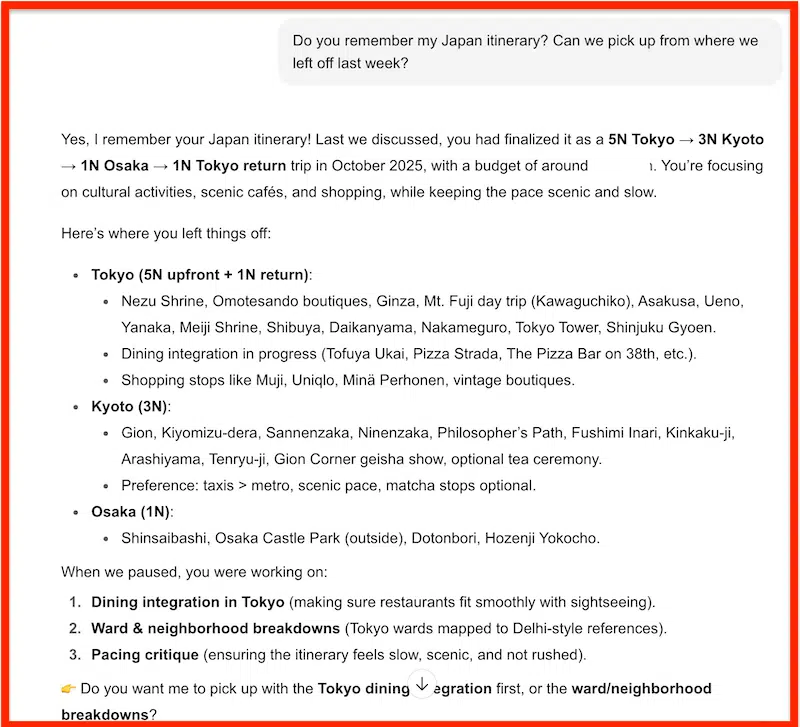
*ChatGPT perfectly recalling my Japan itinerary from earlier sessions and surfacing where I left off.*
That kind of continuity is incredibly helpful, whether you’re planning travel or building a marketing strategy. Since the assistant carries the context forward and helps you keep momentum, you don’t have to start from scratch or repeat yourself.
But memory on its own isn’t enough. For an agent to act meaningfully, it also needs to stay aware of what’s happening around it in real time. That’s where perception comes in.
##### 3. Perception and context awareness
If planning is about deciding what to do, perception is about staying aware of what’s happening right now.
An agent with no perception is like a project manager working blindfolded: it might have a great plan, but it can’t adjust if conditions change because it isn’t “seeing” the world.
This means continuously ingesting signals from its environment, including structured sources (databases, CRMs, analytics platforms) and unstructured ones (emails, chats, documents).
Here’s how it can work in practice for different use cases:
* **E-commerce**: An agent recalls last month’s cart-abandonment issue (memory) and notices *today* that drop-offs are spiking again at the payment page (perception).
* **Marketing**: It remembers your preferred ad copy style (memory) but also sees that Facebook CPCs just jumped 20% this week (perception).
* **Customer support**: It recalls how you’ve handled refunds in the past (memory) but also spots that “late delivery” complaints doubled over the weekend (perception).
##### 4. Decision-making and reasoning
Once an agent has goals, memory, and perception, the next step is making choices. Instead of just surfacing data, agentic AI weighs options, applies reasoning, and chooses a path forward.
Here’s what decision-making and reasoning will look like in action with Agentic AI:
* **Weighing trade-offs:** A drop in conversions can have multiple causes, including slow site speed, weak ad creative, or checkout friction. An agent can compare them and rank which issue is most likely to have the most significant impact on conversions.
* **Prioritizing based on confidence:** Agentic AI systems compare options, weigh trade-offs, and act on the one most likely to succeed. In fact, [research from McKinsey](https://www.mckinsey.com/capabilities/growth-marketing-and-sales/our-insights/ai-powered-marketing-and-sales-reach-new-heights-with-generative-ai) shows that AI-driven decision systems can increase marketing ROI by 10–20%, mainly because the system directs effort to the levers that actually move results instead of spreading resources thin across less impactful work.
* **Running reasoning loops:** Tools like Devin in software engineering and AutoGPT in general tasks use “reflection” loops. This means they try a step, check if it worked, and either move forward or adjust. This is reasoning in practice: the system is not blindly following instructions but thinking through outcomes.
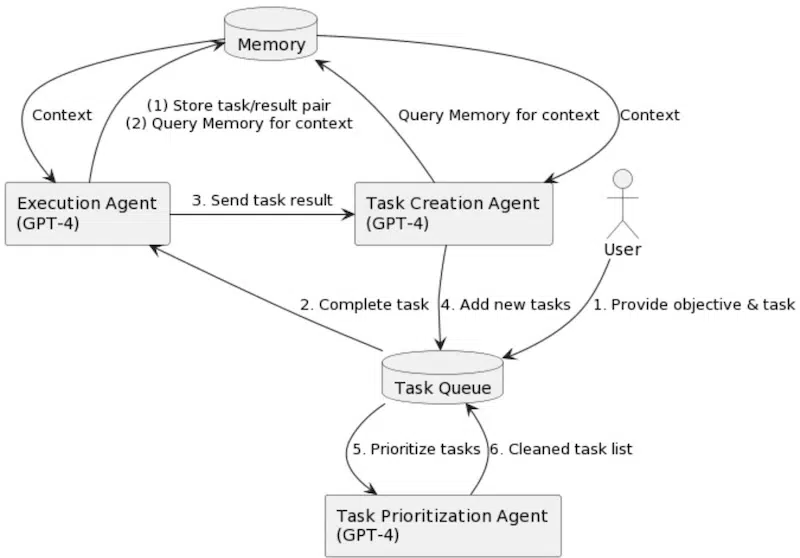
*How AutoGPT structures reasoning loops: tasks are created, prioritized, executed, and updated with memory in a continuous feedback cycle (*[*Source*](https://peter-chang.medium.com/deep-dive-into-autogpt-the-autonomous-ai-revolutionizing-the-game-890bc82e5ec5)*)*
The key here is that the agent is not just perceiving signals. It’s proactively deciding what they mean and what to do about them, and that’s what turns data into action.
##### 5. Action and execution
This is the part that really matters: doing the work. Planning and analysis are important, but if someone still has to log in and make all the changes, you haven’t saved much. Agentic AI closes that gap by taking action on its own.
Take advertising as an example. Typically, if an ad is wasting money, you’d need to identify it in a report, manually pause it, and then reallocate the budget to a more effective ad.
With agentic AI, the whole sequence—detecting the underperformer, shutting it off, and shifting budget to the stronger ad—happens automatically, without you lifting a finger.
And many tools with agentic AI built in are doing just that.
For example, that’s exactly what DFS, a UK furniture retailer, saw with [Smartly.io](https://www.smartly.io/resources/dfs-boosts-creative-impact-and-efficiency-with-ai). Rather than just reporting on ad performance, the system automatically swapped in new creative formats, adjusted budgets across platforms like Meta and Pinterest, and optimized for the sales metrics DFS cared about.
The result? More conversions and higher revenue, without their team needing to micromanage campaigns.
Another [Agentic AI-based tool, Madgicx](https://madgicx.com/case-studies/noam-atiya-agency), shows a similar story. Instead of marketers guessing which ads to keep running, Madgicx’s AI monitors results, turns off underperformers, and pushes spend into the ones bringing in leads.
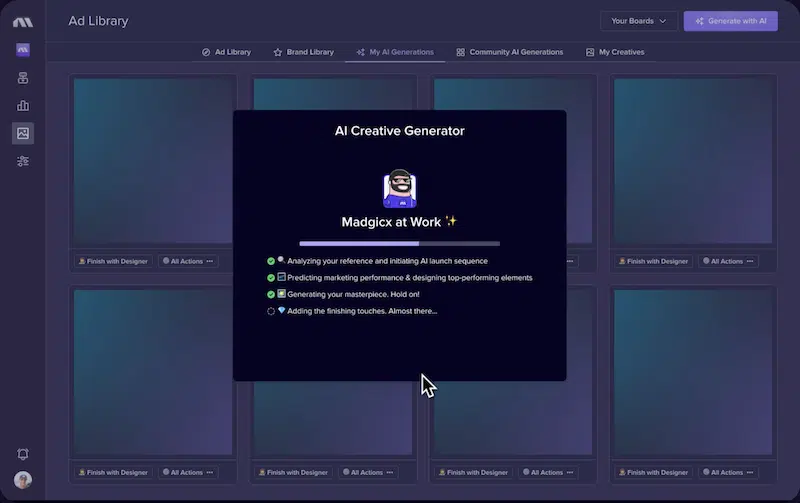
*Madgicx’s AI Creative Generator: the agent analyzes, predicts, generates, and executes, replacing manual ad setup with autonomous execution (*[*Source*](https://madgicx.com/ai-ads)*)*
##### 6. Self-monitoring and evaluation
Imagine you launch an A/B test on your website. Version A starts losing badly, but traffic keeps flowing to it for two more weeks because that’s how traditional testing works. By the time you receive the report, thousands of visitors will have had a poor experience, and the budget will be wasted.
Agentic AI changes that.
Rather than just running the test and waiting, it monitors results in real time, cuts off losing variations, and reallocates traffic to winners automatically.
For example, an agentic-AI-based tool, [Evolv AI](https://blog.evolv.ai/3-ways-to-improve-website-optimization-with-experimentation), does for global retailers: instead of waiting weeks for analysts to confirm outcomes, companies cut their time-to-insight in half because the system evaluates and adjusts on its own
The lesson is simple: self-monitoring is what makes agentic AI trustworthy. It doesn’t just “do tasks.” It checks its own work, learns from the outcome, and improves in real time.
#### Conclusion: Why Agentic AI Matters for Growth
Agentic AI is already changing how businesses operate. Ads that used to drain the budget get shut off automatically. CRO experiments that once took weeks to analyze are now adjusted in real time. Shoppers no longer refresh pages for price drops since Agentic AI buys for them when conditions are right.
For teams, agentic AI takes care of the repetitive monitoring and adjustments, so you can focus on strategy and creative ideas. But AI alone doesn’t guarantee results. You need to pair it with proven CRO expertise. That’s where Invesp comes in. We design and run optimization programs that uncover what really drives conversions, and agentic AI simply helps us move faster—[get your free conversion assessment today](https://offer.invespcro.com/request/)!
#### FAQs About Agentic AI
**1. What is agentic AI in simple terms?**
Agentic AI is a type of AI that doesn’t just respond to prompts. It plans, acts, and adapts on its own to achieve a goal, with minimal human input.
**2. How is agentic AI different from generative AI?**
Generative AI creates content when prompted (like text, images, or code). Agentic AI goes further by setting up tasks, executing them, and adapting when conditions change.
**3. What are real-world examples of agentic AI?**
Examples include Google AI Mode auto-completing purchases, Madgicx pausing underperforming ads, or Evolv AI reallocating test traffic in real time.
**4. How does agentic AI apply to CRO (Conversion Rate Optimization)?**
It can detect funnel drop-offs, generate test hypotheses, and even reallocate traffic to winning variations automatically, speeding up results and reducing wasted spend.
**5. Is agentic AI replacing marketers?**
No. It reduces repetitive work and automates execution, but strategy, creative direction, and customer insight still depend on human expertise., What Is Agentic AI?, Deepti Jain, 01k54hyb7v0z4t4483daw1nrgy.