What is an OKR? Definition and Examples

## Metadata
- Author: [[What Matters]]
- Full Title: What is an OKR? Definition and Examples
- Category: #articles
- Document Note: ## Summarize:
This article introduces the concept of OKRs (Objectives and Key Results), a powerful goal-setting and leadership tool used by leading organizations. OKRs are collaborative and effective in communicating ambitious goals with measurable results. They are structured with an Objective at the top and 3-5 supporting Key Results below it. Objectives define what is to be achieved, while Key Results monitor progress toward achieving the objective. The article discusses various examples of OKRs, including organizational, personal, and team-specific goals. It explains the three types of OKRs: committed, aspirational, and learning. The benefits of using OKRs include enhanced clarity, communication, alignment, commitment, tracking, and the ability to set stretching goals. The article also highlights common mistakes to avoid when writing OKRs and provides insight into different methods of grading them.
## Bullet Points:
- OKRs (Objectives and Key Results) are a goal-setting and leadership tool used by leading organizations for effective communication and measurable results.
- OKRs consist of an Objective and 3-5 supporting Key Results.
- Objectives define what is to be achieved, while Key Results monitor progress toward achieving the objective.
- Examples of OKRs include organizational, personal, and team-specific goals.
- Types of OKRs are committed (expected to have a passing grade), aspirational (stretch goals), and learning (focus on learning something new).
- The benefits of OKRs include clarity, communication, alignment, commitment, tracking, and stretching goals.
- Common OKR mistakes to avoid include aiming for change instead of maintaining the status quo, understanding the difference between OKRs and KPIs, and avoiding sandbagging (assuming success).
- OKRs can be graded using methods such as a simple "yes" or "no," a "Red, Yellow, Green" system, or a percentage scale (0.0 - 1.0).
## Paraphrase:
1. "OKRs are an effective goal-setting and leadership tool used by top organizations to communicate ambitious objectives with measurable results. They consist of Objectives and Key Results, where Objectives define what needs to be achieved, and Key Results track progress towards achieving the objective. OKRs can be used at various levels within a company and even for personal goals. They come in three types: committed, aspirational, and learning, each serving different purposes. Committed OKRs are like commitments with an expectation of success, while aspirational OKRs are stretch goals that push boundaries. Learning OKRs focus on acquiring new knowledge during a cycle. The benefits of OKRs include enhanced focus, alignment, commitment, tracking, and the ability to set goals beyond the norm. However, writing effective OKRs requires skill and practice, and organizations should avoid common mistakes like settling for business as usual, confusing OKRs with KPIs, and assuming success without effort."
2. "The origin of OKRs can be traced back to Intel, where Andy Grove developed the methodology and later taught it to John Doerr. The name 'OKRs' was coined by Doerr, who introduced the philosophy to Google's founders in 1999. Google adopted OKRs as their management framework and achieved remarkable success using them. OKRs consist of Objectives and Key Results, with Objectives stating what needs to be achieved, and Key Results providing measurable benchmarks. Committed OKRs are those expected to succeed, aspirational OKRs are stretch goals, and learning OKRs focus on acquiring new knowledge. The benefits of using OKRs include enhanced focus, alignment, commitment, tracking, and the ability to set ambitious and meaningful goals. Grading OKRs can be done using various methods, such as a simple 'yes' or 'no' approach, a 'Red, Yellow, Green' system, or a percentage scale. Overall, when used properly, OKRs equip organizations with the power to achieve high output management in all their business goals."
## Conclusion:
OKRs (Objectives and Key Results) are a powerful and collaborative goal-setting methodology used by leading organizations. They involve defining ambitious Objectives and measurable Key Results to track progress and ensure alignment. OKRs can be applied at various levels, from organizational to individual goals, and they come in three types: committed, aspirational, and learning. Committed OKRs are expected to succeed, while aspirational ones are stretch goals that push boundaries. Learning OKRs focus on acquiring new knowledge during a cycle. The benefits of OKRs include enhanced focus, alignment, commitment, tracking, and the ability to set ambitious and meaningful goals. However, it is essential to avoid common mistakes when writing OKRs and to choose an appropriate grading method to measure success.
## Questions:
1. How can organizations effectively implement OKRs to enhance goal-setting and alignment within their teams?
2. What are some real-world examples of companies or individuals successfully using OKRs to achieve significant results?
3. How do committed, aspirational, and learning OKRs differ in their impact on team performance and motivation?
4. What are some potential challenges that organizations might face when transitioning to an OKR-based goal-setting approach, and how can they overcome these challenges?
5. In what ways can individuals utilize OKRs to drive personal growth and achievement of their long-term aspirations?
## Auto-tagging:
Goal-setting, Leadership, Objectives, Key Results, Collaboration, Measurement, Organizational Strategy, Progress Tracking, Aspirational Goals, Learning Objectives
## Index Creation:
- OKRs: Objectives and Key Results, goal-setting methodology, collaboration, measurement, organizational strategy, progress tracking, commitment, alignment, grading
- Committed OKRs: expected success, passing grade
- Aspirational OKRs: stretch goals, pushing boundaries, long-term goals
- Learning OKRs: focus on acquiring new knowledge
- Benefits of OKRs: clarity, communication, commitment, tracking, stretching goals
- Common OKR Mistakes: avoiding business as usual, differentiating OKRs and KPIs, avoiding sandbagging
- Grading OKRs: methods include "yes" or "no," "Red, Yellow, Green" system, percentage scale
## Table of Contents:
1. Introduction to OKRs
2. Understanding Objectives and Key Results
3. Types of OKRs: Committed, Aspirational, and Learning
4. Benefits of OKRs in Organizations
5. Common Mistakes in Writing OKRs
6. Grading OKRs: Methods and Approaches
7. Real-world Examples of Successful OKR Implementations
8. Personal Goal Setting with OKRs
9. Tools for Tracking and Managing OKRs
10. Conclusion and Key Takeaways
## References:
1. "Measure What Matters" by John Doerr
2. "OKRs 101 course" - Online course on OKRs
3. "High Output Management" by Andy Grove
## Future Research:
1. Investigate the long-term impact of implementing OKRs on organizational performance and employee motivation.
2. Conduct a comparative study between organizations that use OKRs and those that use traditional goal-setting methods to understand the effectiveness of each approach.
3. Explore the relationship between the type of OKRs (committed, aspirational, or learning) and the level of employee engagement and satisfaction.
4. Investigate the role of leadership and management support in successful OKR implementation within organizations.
5. Analyze the factors that contribute to the achievement of aspirational OKRs and how they affect innovation and organizational growth.
## Hypotheses:
1. Organizations that adopt OKRs will experience higher levels of
Abstract:
This article provides an overview of OKRs (Objectives and Key Results), a goal setting strategy used by companies such as Google, Twitter and LinkedIn. It explains the definition of OKRs and provides examples of how they can be used to measure progress and encourage collaboration. The article also covers the benefits of OKRs, such as greater alignment of goals and improved communication between teams. Finally, it discusses how OKRs can be used to define and track success for both individuals and organizations.
Bullet List:
- Definition of OKRs:
- Objective
- Document Tags: [[kpi]] [[metrics]] [[okr]]
- Summary: "OKR" stands for "Objectives and Key Results." OKRs are a goal-setting tool for communicating what you want to accomplish and how to measure progress.
- URL: https://www.whatmatters.com/faqs/okr-meaning-definition-example
**Summary**
*“OKR” stands for **Objectives and Key Results**. OKRs are an effective goal-setting and leadership tool for communicating what you want to accomplish and what milestones you’ll need to meet in order to accomplish it. OKRs are used by some of the world’s leading organizations to set and enact their strategies. In this article we’ll define an OKR, look at how they’re used and provide some examples of OKRs.*
OKRs stand for **Objectives and Key Results**, a collaborative goal-setting methodology used by teams and individuals to set challenging, ambitious goals with measurable results. OKRs are how you track progress, create alignment, and encourage engagement around measurable goals.
Whether talking about [office operations](https://www.whatmatters.com/faqs/office-operations-okr-examples), [software engineering](https://www.whatmatters.com/faqs/okr-examples-for-software-engineers), [nonprofits](https://www.whatmatters.com/faqs/non-profit-okrs-examples) or more, OKRs work the same for setting goals throughout many company levels. They can also work for [personal goals](https://www.whatmatters.com/faqs/okrs-for-personal-life-goals-examples) and can even be used by individuals to get things done [at places where senior leadership doesn’t use them](https://www.whatmatters.com/stories/how-to-use-okrs-alone).
*Want to get started on creating OKRs for yourself or your organization? [Take our OKRs 101 course!](https://www.whatmatters.com/get-started/)*
#### What are the components of an OKR? Objectives and Key Results
**The OKR Formula**
OKRs are typically written with an Objective at the top and 3-5 supporting Key Results below it. They can also be written as a statement:
*I will (Objective) as measured by (Key Results).*
For example, “I will fix the website for the vast majority of people as measured by 7 out of 10 people being able to get through, a 1-second response time, and a 1% error rate.”
**Objectives**
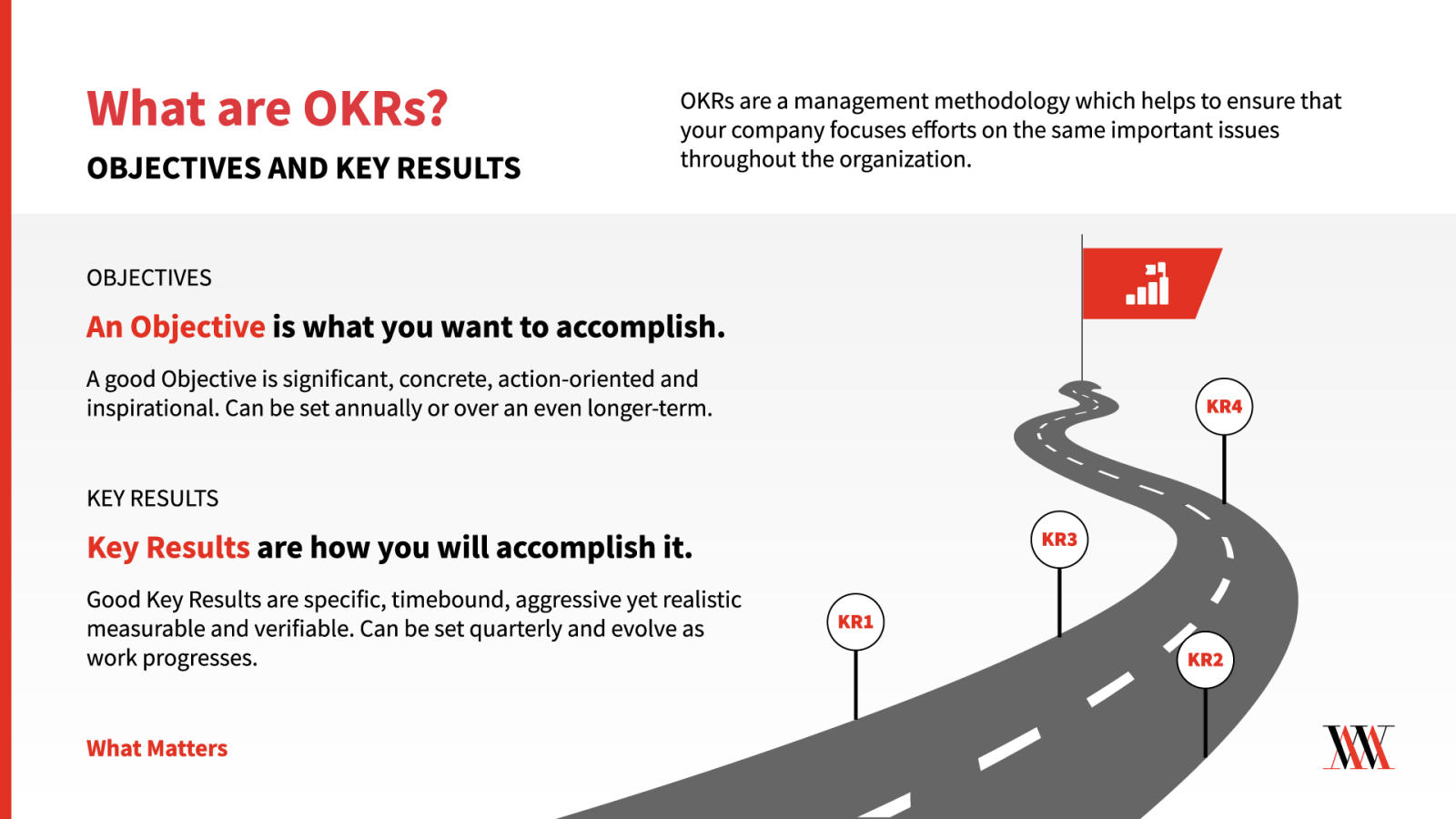
An **Objective** is simply what is to be achieved, no more and no less. By definition, Objectives are significant, concrete, action oriented, and (ideally) inspirational. When properly designed and deployed, they’re a vaccine against fuzzy thinking and ineffective execution.
**Key Results**
**Key Results** benchmark and monitor how we get to the Objective. Effective KRs are specific, time-bound, and aggressive yet realistic. Most of all, they are measurable and verifiable. You either meet a Key Result’s requirements or you don’t — there is no gray area, no room for doubt. At the end of the designated period, [typically a quarter](https://www.whatmatters.com/resources/a-typical-okr-cycle), we do a regular check and [grade the Key Results as fulfilled or not](https://www.whatmatters.com/faqs/how-to-grade-okrs).
Where an Objective can be long lived, rolled over for a year or longer, Key Results evolve as the work progresses. Once they are all completed, the Objective is achieved.
#### Who created the OKR methodology?
The OKR methodology was [created by Andy Grove at Intel](https://www.whatmatters.com/stories/the-origin-story) and taught to John Doerr by him. Since then, many companies have adopted them, including [Google](https://www.whatmatters.com/resources/google-okr-playbook/), [Allbirds](https://www.whatmatters.com/stories/okrs-mission-statement-allbirds-sustainability), [Apartment Therapy](https://www.whatmatters.com/stories/apartment-therapy-okrs-digital-publisher), Netflix, and inspiring nonprofits like [Code for America](https://www.whatmatters.com/stories/code-for-america-okrs-local-government).
In the book [*Measure What Matters*](https://www.whatmatters.com/book#section-3I7GxXaT60o0WaEumma4YK), John Doerr writes about “MBOs,” or Management by Objectives. MBOs were the brainchild of Peter Drucker and provided Andy Grove a basis for his eventual theory of OKRs. In fact, Grove’s name for them originally was “iMBOs,” for Intel Management by Objectives. Despite the original name, Grove created some key differences between the two which he passed along to Doerr.
Grove rarely mentioned Objectives without tying them to “Key Results,” a term he seems to have coined himself. Other key [differences between MBOs and OKRs](https://www.whatmatters.com/resources/okr-and-mbo-difference-between) are that the latter are quarterly, not annual, and they are [divorced from compensation](https://www.whatmatters.com/stories/okrs-separate-pay-compensation-bonuses).
Doerr was the one who crafted the name “OKRs.” He introduced the philosophy to Google’s founders in 1999. Gathered around a ping-pong table which doubled as a boardroom table, Doerr presented a PowerPoint to the young founding team, which included Larry Page, Sergey Brin, Marissa Mayer, Susan Wojcicki, and Salar Kamangar.
Doerr’s Objective and Key Results for the PowerPoint presentation were this:
Google then set its company strategy with this management framework and the rest is history.
#### OKR Examples
What are some other high-level OKR examples?
The city of [Syracuse, New York recently set this Objective](http://dashboards.syrgov.net/): to “achieve fiscal sustainability.” Fiscal sustainability is a great goal, but it has to be measurable. That’s why Syracuse uses Objectives and Key Results.
When written out, Syracuse’s OKR looks like this:
Let’s look at another example of OKRs.
Allbirds is a popular clothing company known for their sustainable footwear. They have a mission to “make better things in a better way.” As a part of their commitment to sustainability, they decided they wanted their shoes to be carbon neutral. [So they wrote this OKR](https://www.whatmatters.com/articles/okrs-mission-statement-allbirds-sustainability/):
OKRs can work throughout an entire organization and don’t need to be top-level. Let’s look at an example of a team-specific, departmental OKR.
Say that the development team at a museum is looking to grow its membership base. They’ve realized that the ways they have been approaching membership are outdated and don’t appeal to a new generation of museum-goers. They could use this OKR:
Some people have even found success setting personal OKRs. Here’s an example written by someone who wants to run a 10K:
Learn more about [setting personal OKRs](https://www.whatmatters.com/articles/how-to-be-a-better-leader/).
#### What are the types of OKRs?
OKRs can be three things: committed, aspirational, or learning OKRs.
Committed OKRs are like their name suggests — commitments. When graded at the end of a cycle, a committed OKR is expected to have a passing grade.
Aspirational OKRs are sometimes called stretch goals, or “moonshots.” The pathway to an aspirational OKR is expected to be forged, since no one else has gotten there before. They also may be long-term and live beyond an OKR cycle, or even be transferred between team members to stretch employee engagement.
[Learning OKRs](https://www.whatmatters.com/faqs/learning-okr/) are for when learning something new is the most valuable outcome for the cycle. If a team isn’t sure how to proceed, they could set a learning OKR that answers, “What is the most important thing we’re trying to learn in the next 90 days?” The results can then inform a related committed or aspirational OKR in the next cycle.
Learn more about [committed and aspirational OKRs](https://www.whatmatters.com/faqs/committed-aspirational-okrs-examples-difference).
#### The Benefits of OKRs
OKRs provide many benefits, including clarity, enhanced communication and a coherent, transparent organization-wide strategy. John Doerr always talks about the **F.A.C.T.S.** when describing the benefits of OKRs. F.A.C.T.S. stands for:
* **Focus:** OKRs allow a team to rally behind a small set of carefully chosen priorities.
* **Alignment:** OKRs provide a method for an entire organization to align its goals at every layer with its top-level priorities and with its ultimate purpose.
* **Commitment:** OKRs demand a level of collective commitment from the parties involved to choose and stick to agreed-upon priorities.
* **Tracking:** OKRs allow a team or organization to track their progress toward a goal and know earlier when to change tactics.
* **Stretching:** OKRs empower teams to set goals that stretch beyond BAU — or “business as usual” — and make significant, meaningful change.
Learn more about [the benefits of OKRs](https://www.whatmatters.com/faqs/benefits-of-okrs/) and each one of the F.A.C.T.S.
#### Common OKR Mistakes
Writing OKRs is a skill that takes practice and time to develop. Every set of OKRs should incorporate feedback from within the organization and undergo multiple checks and drafts.
There are a few common mistakes to avoid when writing OKRs:
* [**Avoid Business as Usual:**](https://www.whatmatters.com/series_entries/s2-3-okrs-bau-business-as-usual/) OKRs should aim for change above maintaining the status quo.
* [**OKR vs. KPI:**](https://www.whatmatters.com/resources/difference-between-okr-kpi/) OKRs are more than just KPIs (Key Performance Indicators). They’re measures for change, whereas KPIs are measures of health.
* [**Sandbagging:**](https://www.whatmatters.com/faqs/sandbagging-under-promise-deliver-okrs/) OKRs are meant to stretch a team and their success shouldn’t be a given.
Learn more about [the most common OKR mistakes](https://www.whatmatters.com/faqs/common-okr-mistakes/).
#### What OKR tools are available?
Some of the best OKR tools are free, such as Google Docs and Google Sheets, or even good, old-fashioned pen and paper. If you’re looking for some OKR tools to help you set ambitious goals, look at these [OKR-tracking tools for personal goals and smaller teams](https://www.whatmatters.com/faqs/best-free-okr-tools-software) and [these tools for larger enterprises](https://www.whatmatters.com/faqs/best-paid-okr-tools-software).
#### How do you grade OKRs?
OKRs are meant to be tracked regularly and graded at the end of a cycle. There are multiple methods for grading (or “scoring”) OKRs.
The Andy Grove method of grading OKRs is a simple “yes” or “no” approach. Did you meet it? Or did you not? Most organizations prefer a bit more detail in their grading, so they’ll use a “Red, Yellow, Green” system where red means “we failed,” yellow means “we made progress,” and green means “we met our goal.”
Google’s grading method provides the most detail, using a percentage scale (0.0 - 1.0) to give each Key Result a number score at the end of the cycle. They average the scores of the Key Results to determine that Objective’s overall score.
Learn more about [how to grade OKRs](https://www.whatmatters.com/faqs/how-to-grade-okrs).
#### Where can I get more information?
This system is deceptively simple, but when used properly, [good OKRs](https://www.whatmatters.com/faqs/okr-examples-and-how-to-write-them) will equip your organization with superpowers to create high output management in all your business goals. Learn more by reading [*Measure What Matters*](https://www.whatmatters.com/the-book/) or exploring our [FAQs](https://www.whatmatters.com/faqs), [Resources](https://www.whatmatters.com/resources), and [Stories](https://www.whatmatters.com/stories).
Ready to get started with OKRs? Learn the basics of OKRs in our [free OKR course for beginners](https://www.whatmatters.com/get-started/).
Already using OKRs? Tens of thousands of people have found our [OKR email newsletter](https://mailchi.mp/7ef0fedeab1a/audacious-by-measure-what-matters-archive) useful and inspiring. We’ll send regular real world stories about OKRs and leadership, as well as OKR cycle reminders!
Ryan Panchadsaram ([@rypan](https://twitter.com/rypan)) is the co-founder of [WhatMatters.com](http://WhatMatters.com) and is the technical advisor to John Doerr at Kleiner Perkins., What is an OKR? Definition and Examples, What Matters, 01gtw6vkzk6n18zkdyg6ja3zah.