What the Hell Is an mVDP?

## Metadata
- Author: [[maciekpalmowski.dev]]
- Full Title: What the Hell Is an mVDP?
- Category: #articles
- Document Note: ---
tags:
- #softwarearchitecture
- #designpatterns
- #mvdp
- #webdevelopment
- #javascript
Author: Maciek Palmowski
Source: https://maciekpalmowski.dev/blog/what-the-hell-is-an-mvdp/
Reference: [Online article, accessed 2025-05-26]
date created: 2025-05-26 11:20
---
# Title: What the Hell Is an MVDP?
## Table of Contents:
- [📝 Summary](#-summary)
- [📖 Main Content](#-main-content)
- [🗒️ Notes](#-notes)
- [📖 References](#-references)
- [🗣️ Paraphrase](#-paraphrase)
- [📰 Newsletter](#-newsletter)
- [✅ Action Items](#-action-items)
- [🧪 Hypotheses](#-hypotheses)
- [📊 Methodology](#-methodology)
- [❓ Questions](#-questions)
- [🔮 Future Research](#-future-research)
- [💡 Implications](#-implications)
- [🧠 Learning Styles Assessment](#-learning-styles-assessment)
- [📊 Accessibility Assessment](#-accessibility-assessment)
- [🌍 DEIB Assessment](#-deib-assessment)
- [✅ Logical validity](#-logical-validity)
- [🔍 DARVO Analysis](#-darvo-analysis)
- [🔍 SEO Evaluation](#-seo-evaluation)
- [🎯 Conclusion](#-conclusion)
### References:
- Palmowski, Maciek. "What the Hell Is an MVDP?" https://maciekpalmowski.dev/blog/what-the-hell-is-an-mvdp/, accessed May 26, 2025.
## 📝 Summary:
This article demystifies the term "MVDP" — Model View Data Presenter — a design pattern variation inspired by MVC (Model-View-Controller) but focused on front-end development complexities. It breaks down the roles of Model, View, Data, and Presenter, emphasizing the separation of concerns and clarity in code organization. The author illustrates the pattern’s utility in modern JavaScript applications, aiming to reduce confusion around component responsibilities and improve maintainability.
## 📖 Main Content:
The author begins by addressing common confusion over MVC and its many variants in web app architecture, particularly in front-end code. He introduces MVDP as a practical approach to explicitly separate UI (View), business logic (Presenter), and data handling (Model/Data) with a clearer delineation than traditional MVC.
- **Model**: Represents the business data and logic, similar to classical MVC, but with emphasis on being purely data-centric without UI concerns.
- **View**: Handles rendering and user interaction events but does not contain logic beyond UI concerns.
- **Data**: A distinct concept here, focusing on raw data structures, sometimes cached or processed, separated from business logic.
- **Presenter**: Acts as the mediator handling logic between View and Model/Data, processing inputs, and preparing data for presentation.
The article uses examples in JavaScript, showing how the pattern enables modular, testable, and understandable code. Palmowski points out that while naming conventions can vary and overlap, explicitly understanding these roles reduces the entanglement that often plagues front-end development.
He further critiques the overuse and ambiguity of MVC, suggesting MVDP helps bring clarity. The tone is casual, conversational, and lightly humorous, appealing to developers familiar with frontend complexity.
## 🗒️ Notes
- **Introduction**
- MVC is overloaded and confusing in frontend contexts.
- MVDP introduced to clarify responsibilities in code.
- **Model**
- Holds business logic and persistent data.
- Does not manage UI or interaction.
- **View**
- Renders UI.
- Listens to user events but delegates handling.
- **Data**
- Pure data structures or caches.
- Sometimes conflated with Model but distinguished here for clarity.
- **Presenter**
- Central logic layer between View and Model/Data.
- Processes user input, updates Model, and prepares View updates.
- **Benefits**
- Clear separation reduces bugs and complexity.
- Facilitates unit testing.
- Encourages modular, maintainable code.
- **Criticism of MVC**
- Too broad and ambiguous.
- Leads to tangled code if not carefully implemented.
- **Practical Application**
- JavaScript examples clarify concepts.
- Emphasis on explicit roles over buzzwords.
- **Tone and Style**
- Casual, witty, conversational.
- Uses humor to engage readers.
- Avoids jargon overload but assumes technical background.
## 📖 References:
- N/A (blog post is self-contained; references to general MVC concepts implicit)
## 🗣️ Paraphrase:
1. *Original*: "If you look around the web, you’ll find as many MVC variants as there are frameworks — each twisting the classic roles into unrecognizable shapes. This creates confusion about who should handle what, especially in front-end code."
*Paraphrased*: Across the internet, MVC is adapted so differently by various frameworks that the original roles get warped, causing developers to struggle figuring out responsibility boundaries, particularly in client-side programming.
2. *Original*: "Presenter takes the center stage: it’s where all the business logic lives. It listens to the view’s events, interacts with the model or data, and tells the view what to show next."
*Paraphrased*: The Presenter acts as the core orchestrator, containing business logic. It reacts to user actions from the View, manipulates the Model or data accordingly, and directs the View on how to update the interface.
## 📰 Newsletter:
🚀 *Frontend Architecture Clarity Alert!* Ever felt tangled in the endless MVC variants? Maciek Palmowski's latest blog post breaks down MVDP — a fresh spin on the classic design patterns — clearly separating Model, View, Data, and Presenter roles for your JavaScript apps. This practical approach cuts through confusion, making your UI code modular, testable, and easy to maintain. If your frontend feels like a spaghetti junction, this read might just be the GPS you need. Check it out: https://maciekpalmowski.dev/blog/what-the-hell-is-an-mvdp/
## ✅ Action Items:
- Use this article as a resource for educating WordPress and open-source communities on front-end architectural best practices.
- Develop workshops or talks explaining MVC variants and promote MVDP concepts for clean JavaScript and React component design.
- Advocate for clear role definitions in front-end contributor onboarding, reducing cognitive load and improving contribution quality.
- Align this with my OSPO director aspirations by framing MVDP as a sustainable approach to scalable open-source front-end projects.
- Integrate this pattern in open-source WordPress-related JS projects or demos, documenting benefits and usage guidelines.
- Encourage inclusivity by producing accessible learning content based on this pattern, supporting diverse learner types.
## 🧪 Hypotheses:
- Explicitly defining the roles of Model, View, Data, and Presenter in front-end apps improves code maintainability and reduces bugs.
- Front-end teams using MVDP over traditional MVC variants will experience faster onboarding and lower code churn.
- Teaching MVDP leads to better contributor retention in open-source JavaScript projects.
- MVDP can serve as a standard pattern for future WordPress front-end plugin architecture, enhancing sustainability.
### 📊 Methodology:
- Conduct comparative codebase analyses of projects using MVC vs. MVDP patterns for maintainability metrics.
- Run surveys and interviews with developers about onboarding experiences related to architectural clarity.
- Implement MVDP in sample WordPress JS projects and measure contributor engagement and issue rates over time.
- Use mixed methods combining quantitative bug tracking and qualitative user feedback.
### ❓ Questions:
- How does MVDP improve front-end architectural clarity compared to MVC in practical terms?
- Can MVDP be standardized across various JS frameworks used in WordPress development?
- What challenges might teams face when transitioning from MVC to MVDP?
- How can education around MVDP be tailored to support diverse learning styles and inclusivity?
### 🔮 Future Research:
- Explore the adoption rates of MVDP in open-source projects over time.
- Investigate automated tooling support for enforcing MVDP roles in code.
- Study the cognitive load differences among developers working with MVC versus MVDP patterns.
- Analyze MVDP’s impact on performance and scalability in complex front-end systems.
### 💡 Implications:
- Widespread ado
- Summary: Lately, I changed my role at Patchstack from Security Community Manager to mVDP Growth Manager. Apart from congratulations, I got a lot of questions
- URL: https://maciekpalmowski.dev/blog/what-the-hell-is-an-mvdp/

Lately, I changed my role at Patchstack from Security Community Manager to mVDP Growth Manager. Apart from congratulations, I got a lot of questions "what is mVDP?". I think it's time to explain what it is and why you should be probably interested in it.
#### M is for Managed
Let's start with the definition of Vulnerability Disclosure Program:
> A VDP is a structured framework for hackers to document and submit security vulnerabilities to organizations. VDPs help organizations mitigate risk by supporting and enabling the disclosure and remediation of vulnerabilities before hackers exploit them. VDPs usually contain a program scope, safe harbor clause, and remediation method. VDPs generally cover all publicly accessible, internet-facing assets. Publicly posted VDPs suggest that the organization is unlikely to be an easy target.
>
>
While VDP is just a set of security-related rules, the mVDP is a service that helps with everything mentioned above. This is great because disclosing and managing vulnerabilities isn't simple, especially if security is not your field of expertise.
#### What will I get?
There are many mVDPs out there, but I will share what you can get by signing into the [Patchstack's mVDP](https://patchstack.com/for-plugins/).
##### Triage - no more beg bounties
One of the nightmares today is dealing with **beg bounties** - beg bounties are nothing else than attempts to get money using scare tactics. If you're not experienced, you might fall for it and lose some money. And believe me, even we are bombarded with bounty attempts daily.
On the other hand, you can't ignore them completely, because among all those bogus reports, there might be a valid report. That's why it's important to have someone experienced on your side to verify if the report is legit or not. Imagine wasting an hour daily verifying this.
Apart from beg bounties there will be a lot other cases when having another pair of eyes to verify a report will be very useful.
##### One more step into CRA-compatibility
The **Cyber Resilience Act** is a very important EU regulation regarding security. These new regulations will change a lot in terms of how companies handle security. The main requirements of CRA are as this:
* Set up a Vulnerability Disclosure Policy (VDP)
* Share data with the EU vulnerability database
* Notify users about vulnerability exploits
* Provide security updates (separately)
For more information, you should read [this article](https://www.cyberresilienceact.eu/the-cra-explained/) to understand the CRA better. But I think you can already see that having an mVDP will help you.
You have time until **December 2027** to make sure you meet the requirements.
##### Making sure your patch is good enough
Vulnerabilities happen. There is no shame in this if you take it seriously and try to patch it as soon as possible.
On the other hand, especially if you're not experienced enough, it would be cool to have someone who knows a thing or two about security to validate if your patch is good enough. And here's where Patchstack's mVDP can help you. Our triage team will make sure that everything is fine.
##### Everything in one place
Imagine - you have quite a lot of plugins, and every plugin has a different owner. Chaos can creep in very quickly, you'll have too many places that you should check for security reports. As a result, at one point, you will miss one critical report.
It would be great to have a universal form and a portal, from which you could manage everything, right? Good news - you can.
And believe me, we saw too many cases of missing emails, not working forms, or not working domains.
##### Bonuses for security researchers
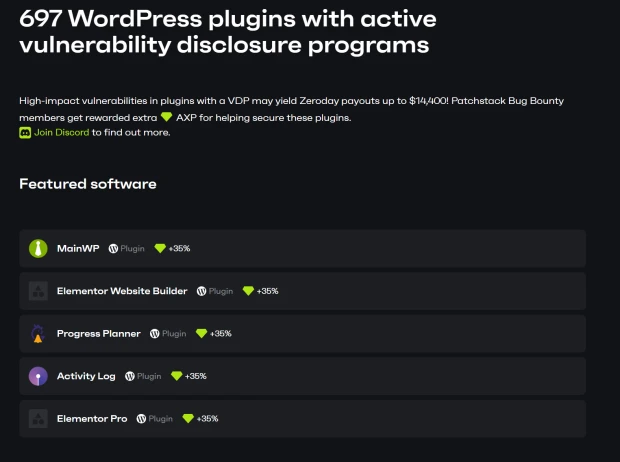
Another cool bonus you'll get is a bonus for security researchers. This means that they will be more interested in checking such plugins. By default, they will get at least 15% extra points if they discover a vulnerability.
Does this mean that they might find more vulnerabilities - yes. And that's a good thing. If they do, you will be able to fix your plugin and make it more secure. We've already seen quite a few scenarios like this, but I think that [LiteSpeed Cache](https://patchstack.com/articles/handling-plugin-security-interview-with-litespeed-cache-hai-zheng/) was the best example - they had a series of critical vulnerabilities, but after fixing those, they didn't have a severe vulnerability for around a year.
#### So, this means my plugin is 100% secure, right?
Hell no. Having an mVDP is just an indicator that you are probably taking security more seriously. The rest is up to you. You still have to:
* Creating secure code
* Providing patches
* Informing the users about vulnerabilities
* Doing all of this on time
But it's still a great start. Setting up everything and thinking about this means you are a step ahead.
#### OK, how much?
It's free - seriously. And I can promise that what I described above will always be. If you're wondering where the catch is, there isn't. For our plugin to protect users against vulnerabilities, we have to work closely with vendors and know about vulnerabilities.
At some point, there will be paid tiers with extra features. But this won't affect the basic tier. And the basic tier will already help you in most cases.
#### Interested?
That's great - as a plugin or theme developer, you should. Now, you should visit [this link](https://patchstack.com/for-plugins/) and add your plugins and/or themes. It works both for premium and free. And the whole process is as easy as filling out one form and adding one link to your plugin or theme's readme.
And if you have any questions, just leave a comment or send me an [email](mailto:
[email protected]) - I'm sure I will be able to help.
Subscribe to my newsletter and stay updated.
Get an weekly email with news from around the web
Get updated about new blog posts
No spam
#### Share your thoughts, What the Hell Is an mVDP?, maciekpalmowski.dev, 01jw6k79q34b3x0dv8s3hbtyj1.