When AI Becomes What You Run
🔗 **Source:** [When AI Becomes What You Run](https://www.youtube.com/watch?v=o4lcSekNfRk)
> [!note]+ Document Notes
> ---
> tags: [open-channels-news, wordpress-news, open-weight-ai, ai-policy, agent-sprawl, ai-governance, ai-audit-trails, halo-record, open-source-ai, shadow-it, enterprise-ai, robert-jacobi, news-roundup]
> author: Open Channels News
> source: youtube.com
> reference: https://www.youtube.com/watch?v=o4lcSekNfRk
> date created: 2026-09-02 08:40
> ---
> > [!info] Generated analysis — not the author's words. Sections below are machine-written
> > from the captured source. Only text inside `> [!quote]` blocks is verbatim from the author.
> > Do not quote or attribute any other line to the named author.
> > [!warning] Short news broadcast, auto-captioned, sponsored
> > 7:46 video, ~1,400 transcript words, dated in-show September 1, 2026. Host is Robert Jacobi (ASR renders "Robert Jacobe"). Sponsors read in the open: Automattic ("Automatic"), InMotion Hosting ("Inotion Hosting"), and a third the captions render as "Omnisense" — most likely Omnisend; unverified. Other ASR artifacts: "Techraar"/"Techrator" = TechRadar; "Work Auto" = Workato; "Asians" = agents; "polycy" = policy; "help uh Net Security" = Help Net Security; "Halo Record" = halo-record. Source verification done for this note: (1) WordPress News, "WordPress Signs the Open Weights and American AI Leadership Letter," 2026-08-27, with a Mary Hubbard quote; (2) TechRadar Pro, "How to solve agent sprawl," by Derek Thompson of Workato; (3) Help Net Security, "Halo-record: Open-source audit trails for AI agents," 2026-08-31 — the show says "today," off by one day. The broadcast doesn't link its sources; none of the three is a WordPress-specific story except the first. Automattic sponsors a show that leads with a WordPress-project story — noted, not alleged to have shaped it.
> # 🏷️ Title: When AI Becomes What You Run
> ## 🧭 Table of Contents
> - [📝 Summary](#-summary)
> - [📖 Main Content](#-main-content)
> - [🗒️ Notes](#️-notes)
> - [📚 References](#-references)
> - [🗣️ Paraphrase](#️-paraphrase)
> - [📰 Newsletter](#-newsletter)
> - [✅ Action Items](#-action-items)
> - [🧪 Hypotheses](#-hypotheses)
> - [📊 Methodology](#-methodology)
> - [❓ Questions](#-questions)
> - [🔮 Future Research](#-future-research)
> - [💡 Implications](#-implications)
> - [🧠 Learning Styles Assessment](#-learning-styles-assessment)
> - [📊 Accessibility Assessment](#-accessibility-assessment)
> - [🌍 DEIB Assessment](#-deib-assessment)
> - [✅ Logical Validity](#-logical-validity)
> - [🛡️ DARVO Analysis](#-darvo-analysis)
> - [🎯 Conclusion](#-conclusion)
> ### 🔗 References
> - Source: https://www.youtube.com/watch?v=o4lcSekNfRk
> - Story 1 (verified): https://wordpress.org/news/2026/08/open-weight/ — "WordPress Signs the Open Weights and American AI Leadership Letter," 2026-08-27
> - Story 2 (verified): https://www.techradar.com/pro/how-to-solve-agent-sprawl — Derek Thompson (Workato), TechRadar Pro
> - Story 3 (verified): https://www.helpnetsecurity.com/2026/08/31/halo-record-open-source-ai-agent-audit-trail/ — Help Net Security, 2026-08-31; project repo appears to be github.com/bkuan001/halo-record
> - No links in the captured transcript; the video description wasn't captured.
> ## 📝 Summary
> **What this is.** A single-host news broadcast from Open Channels News (OCN), host Robert Jacobi, dated September 1, 2026. Three stories stitched into one thesis: "If AI is going to be everywhere, how do we keep it open without losing control of it?" The framing device is the title — AI moving from "something you simply use" to "something you actually operate."
> **Story 1 — WordPress signs the open-weights letter.** WordPress joined "more than 270 companies organizations" as a signatory to the Open Weights and American AI Leadership letter, asking US policymakers not to impose "premature restrictions" on open-weight models. Jacobi's gloss: open-weight models are ones "you can download, inspect, modify, and run on infrastructure you control," which is the open-source argument WordPress has made for twenty years, "extending that philosophy one layer deeper to the intelligence running alongside that software." He lists the letter's asks — compute access for startups and researchers, public datasets and evaluation tools, competition between open and closed models, and not treating distillation-style techniques "as theft." Verified against the WordPress News post of 2026-08-27; the asks match.
> **Story 2 — Agent sprawl.** From TechRadar Pro, Derek Thompson of Workato: after server, cloud, and SaaS sprawl comes "agent sprawl" — "rapid uncoordinated deployment of AI agents across different departments, often using different models, different rules, different tools, and different security controls." Jacobi's line: "we have reinvented shadow IT, except now shadow IT can make decisions." The proposed fix is an orchestration layer. His own distinction: the goal isn't trusting every agent, it's trusting "the system governing those agents," and the security question shifts from "was this request malicious" to "what did this agent actually do?"
> **Story 3 — halo-record.** From Help Net Security: an open-source project that creates "hash chain logs that the vendor running the AI can generate but cannot quietly reroute later without breaking verification," ingesting from OpenTelemetry, LangChain, MCP servers, and gateway logs. Jacobi's summary of the shift: agents don't follow predefined code paths, so "You don't just want the final answer. You want the receipts."
> **The stitch.** Openness (WordPress) → proliferation (sprawl) → accountability (verifiable logs). Closing aphorism: "openness without visibility creates chaos. Control without openness creates dependency. The interesting infrastructure is going to live somewhere in between."
> **Bottom line.** An accurate, well-sourced eight-minute roundup whose value is the editorial thread, not the reporting — all three stories are secondhand and correctly attributed once you correct the captions. The thread is a good one: it puts a WordPress policy signature in the context of what happens after the policy wins.
> ## 📖 Main Content
> **The framing.** Jacobi opens with a category shift — AI as a thing you *run*, not a thing you *use*. That's the same shift WordPress users made when they moved from hosted platforms to self-hosting: you gain control and inherit operations. The three stories are chosen to walk that arc: the right to run (open weights), the mess of running many (sprawl), the duty to prove what ran (audit trails).
> **Story 1 in detail.** The WordPress post (2026-08-27) is quoted-in-spirit rather than verbatim. Jacobi's paraphrase of the letter's asks is accurate: expanded compute access, public datasets and evaluation tools, preserving multiple kinds of models, and not treating common development practices "such as using one model's output to improve another" as theft. He adds the twenty-years framing himself; the WordPress post makes the same point ("For more than 20 years, WordPress has run on the idea that the people using a technology should be free to shape it"). What he leaves out: the post is signed by Executive Director Mary Hubbard, and WordPress is one signatory among 270+, not an organizer. He also doesn't say whether "WordPress" here means the Foundation, the project, or WordPress.org — the post itself is on wordpress.org/news and speaks as "WordPress."
> **Story 2 in detail.** The sprawl lineage (server → cloud → SaaS → agent) is Thompson's; the "shadow IT that can make decisions" line and the "trust the system, not the agent" distinction read as Jacobi's own. The distinction is worth keeping: it reframes agent security as governance-layer design rather than per-agent vetting, which is the same move WordPress made when it stopped trying to vet every plugin's code and instead built capability checks, nonces, and a review process around them.
> **Story 3 in detail.** Jacobi gets the mechanism right — hash-chained logs the operator can't silently rewrite — and the ingestion surfaces. The Help Net Security piece carries a nuance he skips: a chain the operator holds "cannot prove that every record was written" ("Delete the embarrassing Tuesday, re-seal the chain, and the file stays internally consistent"); closing that hole needs an external witness, a
[music] [music] Welcome to Open Channel's News with your host Robert Jacobe. Today's news is
brought to you by Automatic Inotion Hosting and Omnisense. Three companies that get it [music] and are passionate about what is going on in the open-source ecosystem. Good day and welcome to OCN, the open channels news broadcast. Today is September 1, 2026 and I'm your host, Robert Jacobe. [snorts] Today we're looking at what happens when AI stops
being something you simply use and becomes something you actually operate. WordPress is backing openweight AI. Enterprises are already confronting something called agent sprawl, maybe a new word for the week. And a new open- source project wants to give AI agents something they badly need. A tamper evident paper trail for your database geeks. Transaction logs. [snorts] Three stories, but really one question. If AI is going to be everywhere, how do we keep it open without losing control of it? Our first story,
we begin with WordPress because this is really the starting point for everything else in today's broadcast. WordPress has signed the open weights and American AI leadership letter joining more than 270 companies organizations asking US polycy makers not to impose premature restrictions on openweight AI models. Openweight [snorts] models are models you can download, inspect, modify, and run on infrastructure you control. If that sounds familiar to anyone in open source, it should. WordPress makes
essentially that argument itself. The ability to inspect technology, change it, run it yourself, and build something new on top of it is a large part of what made open source software success successful in the first place. WordPress says the same principle should apply to AI. The letter goes further. Signitories are asking policymakers to expand access to compute for startups and researchers, invest in public data sets and evaluation tools, preserve competition between open and closed models, and avoid automatically treating techniques
such as using one model's output to improve another as theft. And that matters because the AI conversation is increasingly becoming an infrastructure conversation. Who owns a model? Who can inspect it? Where does it run? and who gets to build on top of it. Word has spent WordPress has spent more than 20 years arguing that users should control the software they publish with. Now it's extending that philosophy one layer deeper to the intelligence running alongside that software. But there is a catch. The easier AI becomes to access
and deploy, the easier becomes to deploy a lot of it. And that brings us to agent sprawl. Techraar Pro reports today that businesses may already be repeating one of enterprise IT's greatest hits. First we had server sprawl, then cloud sprawl, then SAS sprawl. Now we have agent sprawl. Techrator contributor Derek Thompson of Work Auto describes agent sprawl as the rapid uncoordinated deployment of AI agents across different
departments, often using different models, different rules, different tools, and different security controls. Sales builds one, marketing builds another, developers have three or four or 30, someone in finance has one nobody in IT knew existed. Congratulations, we have reinvented shadow IT, except now shadow IT can make decisions. The individual agents may even work quite well. That's the problem. Every department has a perfectly rationable
rationable rational reason to deploy its own automation. But eventually the organization discovers that nobody has a complete picture of what is running, what data those agents can reach, whether two teams have built the same thing or whether any of it actually connects to a measurable business outcome. The proposed answer is orchestration, a common layer controlling how agents are deployed, how they access tools and data, what security rules apply, and how their performance is measured. And I think there's an important distinction here. The goal isn't necessary to trust
every individual agent. It's to create an environment where you can trust the system governing those agents. And that's a very different way of thinking about AI security. Because once an agent can read a database, call an API, change a record, generate code, of course, trigger other agents, the interesting security question is no longer simply was this request malicious. It becomes what did this agent actually do? What did this actually agent actually do? Which brings us to our final story
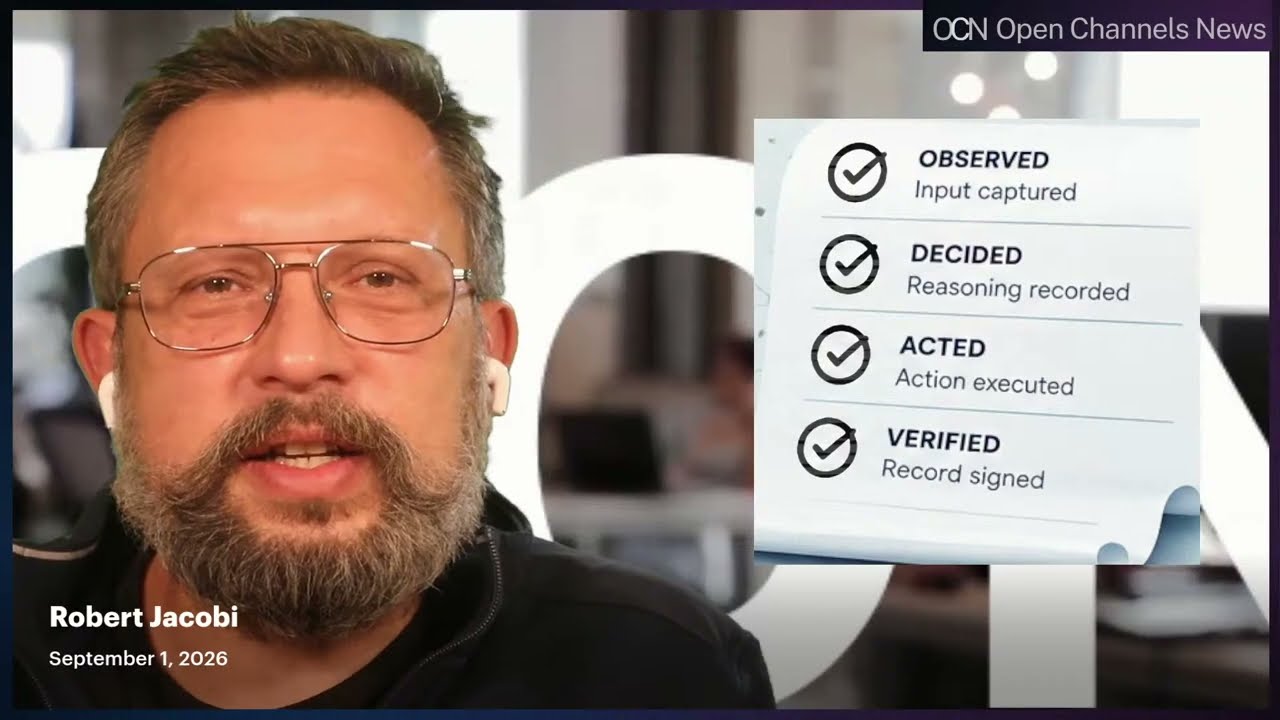
of the day. help uh Net Security reports today on Halo Record, a new open- source project assigned to create verifiable audit trails for AI agents. The idea is surprisingly simple. When somebody asks what an AI agent did with their data, the answer shouldn't be, "Trust us." It should be here's the record, check it for yourself. Halo record creates hash chain logs that the vendor running the AI can generate but cannot uh quietly
reroute later without breaking verification. According to help net security, the project can ingest records from existing systems including open telemetry [snorts] uh lang chain MCP servers and gateway logs. That is important because AI auditing is rapidly becoming different from traditional application logging. An application usually follows predefined code paths. An agent can reason, can choose tools, read multiple systems, generate an intermediate result, hand that result to
another system, and continue. You don't just want the final answer. You want the receipts. What did it read? Which tool did it call? What happened next? And did anyone after that uh do something with those uh records? Halo records answer is essentially to make the evidence independently verifiable rather than asking customers to trust the same organization whose system is being audited. And that may become one of the most important plat uh patterns in agent security. Not
preventing every mistake, not pretending agents will behave deterministically uh but making sure that actions are observable, attri attributable and provable. And these three stories fit together more tightly than they might initially appear. WordPress is arguing that AI should remain open enough for people to download it, inspect it, modify it, and build with it. Techraar is showing us what happens next. Once organizations can build Asians easily, they build lots of them, and suddenly governmentance
becomes a problem. And Halo record represents the next layer. When autonomous systems are acting across your infrastructure, you need more than access control. You need evidence. That may be the emerging bargain around open AI. Keep the models open. Keep the e ecosystem innovative but make the actions accountable because openness without visibility creates chaos. Control without openness creates dependency. The interesting infrastructure is going to live somewhere in between. And that's OCN for
September 1, 2026. Be open and stay secure., When AI Becomes What You Run, Open Channels News, 01m1h1fyvst5v0y7cc20sdgv31.