Why Christianity Is True
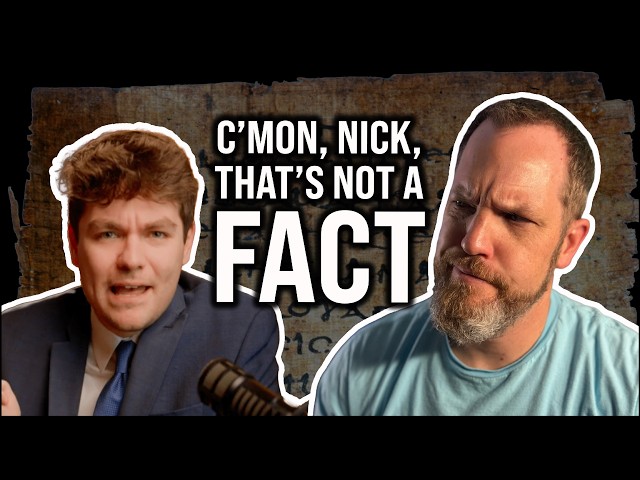
🔗 **Source:** [Why Christianity Is True](https://www.youtube.com/watch?v=OPAX6xV6LEs)
> [!note]+ Document Notes
> ---
> tags: [biblical-scholarship, christian-apologetics, historical-jesus, resurrection-claims, misinformation-tactics]
> author: Dan McClellan
> source: Dan McClellan (YouTube)
> reference: https://www.youtube.com/watch?v=OPAX6xV6LEs
> date created: 2026-09-28 09:05
> ---
> > [!info] Generated analysis — not the author's words. Sections below are machine-written
> > from the captured source. Only text inside `> [!quote]` blocks is verbatim from the author.
> > Do not quote or attribute any other line to the named author.
> > [!warning] Auto-caption artifacts. "Martyred" renders as "martyed" throughout. "Agrippa"
> > renders as "Agria." "Clement" is lowercased and unpunctuated ("first clement"). "Acts
> > 12:1-2" renders as "Acts 12:es 1-2." "Infamous" renders as "inf famousamous." The closing
> > line "that's it for this video, this has been [name]" renders as "the fit for this video,
> > it's been Bishop" — the sign-off name is unresolved and does not match any name in the
> > video description. Verify names and citations before quoting.
> # 🏷️ Title: Why Christianity is true
> ## 🧭 Table of contents
> - [📝 Summary](#-summary)
> - [📖 Main content](#-main-content)
> - [🗒️ Notes](#️-notes)
> - [📚 References](#-references)
> - [🗣️ Paraphrase](#️-paraphrase)
> - [📰 Newsletter](#-newsletter)
> - [✅ Action items](#-action-items)
> - [🧪 Hypotheses](#-hypotheses)
> - [📊 Methodology](#-methodology)
> - [❓ Questions](#-questions)
> - [🔮 Future research](#-future-research)
> - [💡 Implications](#-implications)
> - [🧠 Learning styles assessment](#-learning-styles-assessment)
> - [📊 Accessibility assessment](#-accessibility-assessment)
> - [🌍 DEIB assessment](#-deib-assessment)
> - [✅ Logical validity](#-logical-validity)
> - [🛡️ DARVO analysis](#-darvo-analysis)
> - [🎯 Conclusion](#-conclusion)
> - [🔄 Refactor Appendix](#-refactor-appendix--why-christianity-is-true)
> ### 🔗 Quick reference
> - Source: https://www.youtube.com/watch?v=OPAX6xV6LEs (Dan McClellan, 8:43, published 2026-09-27)
> - The transcript never names the person in the clip McClellan is reacting to. McClellan characterizes them, later in the video, as someone "well known indeed inf famousamous for spreading idiotic conspiracy theories" — McClellan's characterization, not an independently sourced identification.
> - Named in the transcript: James the son of Zebedee, John, Herod Agrippa (captioned "Agria"), Peter, and a reference to "first clement" (1 Clement).
> - A second, unrelated announcement closes the video: a members-only livestream with Data Overdogma podcast co-host Dan Beecher, Sunday September 27 at 7pm Mountain.
> ## 📝 Summary
> - **What happened.** Dan McClellan, on the host's own YouTube channel, plays and responds line by line to a clip of someone arguing that Christianity is historically true. The video runs 8:43 and was published 2026-09-27.
> - **The claim.** The clip's speaker makes three separate arguments for the historicity of Christianity: (1) 11 of the 12 apostles were martyred by Rome for preaching the resurrection and Christ's divinity, (2) the gospel accounts of the crucifixion and resurrection are not fiction, so they are substantially true, and (3) the resurrection belief could not have spread as far as it did unless it were true, because "hundreds and hundreds of people" witnessed the risen Christ.
> - **Why it matters.** Each claim is a common apologetic argument circulated well beyond this one clip. McClellan's response distinguishes what can be dated to early sources from what appears only in later apocryphal or legendary material, which is the actual point of dispute among historians rather than a binary "did it happen or not."
> - **Key stakeholders.** McClellan (a biblical scholar reacting on the host's channel), the unnamed clip speaker, and viewers weighing apologetic claims against historical-critical scholarship. Also the Data Overdogma podcast, referenced only for an unrelated livestream announcement.
> - **Risks and tradeoffs.** McClellan's own numbers ("2nd through 6th century CE," "nine of the 11") are stated without on-screen citation; McClellan's credentialed authority is doing real work here that a viewer cannot independently check from this video alone. McClellan's language toward the clip's speaker ("idiotic," "asinine," "the foggiest idea") is also strong enough that it risks reading as personal attack rather than argument, even where the underlying point is sound.
> - **Bottom line.** The video is a scholar's rebuttal of three stock apologetic arguments, sourced to McClellan's own expertise rather than to on-screen citations, delivered in sharply critical language toward an unnamed target.
> ## 📖 Main content
> - **Claim 1: apostolic martyrdom as evidence.** The clip speaker asserts that 11 of the 12 apostles were martyred by the Roman Empire specifically for preaching the resurrection and Christ's divinity, offered as support for Christianity's truth. McClellan's rebuttal turns on dating: nine of the eleven traditional martyrdom accounts appear only in apocryphal narratives from the 2nd through 6th centuries CE, material McClellan says is "very clearly ahistorical" on its face and that even the person citing it would reject as history elsewhere. McClellan allows two exceptions as "historically plausible to likely": James the son of Zebedee, whose death by Herod Agrippa is recorded in Acts 12, and Peter, whose martyrdom is only suggested by a passage in 1 Clement and not discussed in detail until 2nd-to-4th-century sources. McClellan's conclusion is that calling this a "fact" is choosing to assert dogma, since even the two plausible cases aren't explicitly tied in the sources to preaching the resurrection specifically.
> - **Claim 2: the gospels aren't fiction, so they're true.** The clip speaker argues the gospel narratives could not simply be invented fiction. McClellan agrees with the narrow claim and disagrees with what it's used to prove: McClellan says almost no historian claims the gospels are pure invention, and separately, the crucifixion is about as settled as ancient history gets. The actual point of scholarly dispute, McClellan says, is narrower and specific: the resurrection, for which McClellan says there is no good historical evidence. McClellan's account of *why* resurrection belief exists rests on early followers interpreting dreams, hallucinations, or other experiences as visitations by the risen Jesus, with the supernatural elements accreting onto a historical core as tradition and legend.
> - **Claim 3: the belief couldn't have spread that far unless it were true.** The clip speaker's third argument treats geographic spread itself as evidence of truth, backed by a claim that Christ "appear[ed] to hundreds and hundreds of people" after the resurrection. This is where McClellan's tone sharpens. McClellan calls it "the most asinine part of this entire video," characterizes the speaker as someone "well known indeed inf famousamous for spreading idiotic conspiracy theories," and argues the underlying logic requires a "metaphysical property of veracity" that listeners could supposedly detect intuitively — which McClellan rejects outright. McClellan's counter-model: stories spread because they're interesting, useful, or meaningful, independent of whether they're true, and McClellan generalizes this to false claims spreading "all the time."
> - **Who the target is, and what isn't established here.** The transcript gives no name for the clip's speaker. McClellan's claim that this is a known, "infamous" spreader of "idiotic conspiracy theories," and McClellan's reference to "the movements of which they are a part," are McClellan's own characterization inside this video — nothing in the transcript itself independently verifies who this is or confirms the characterization. McClellan's closing line about "naive white Christian nationalists" describes an audience McClellan believes this content targets, not a claim made by the clip's speaker.
> - **Uncertainties and unsourced numbers to flag.** "11 out of the 12 apostles" (the clip speaker's figure), "hundreds and hundreds of people" (the clip speaker's figure for resurrection witnesses), and McClellan's own "nine of the 11," "2nd through 6th century CE," and the count of
It's more I would say this is >> all right let's see it >> supported by the fact that 11 out of the 12 apostles were martyed by the Roman Empire defending the resurrection of Christ and his divinity. >> So in absolutely no sense whatsoever is this a fact. Nine of the 11 ostensibly martyed original disciples of Jesus don't have any good historical evidence for martyrdom. The best evidence actually comes from 2nd through 6th
century CE apocryphal narratives that are very clearly ahistorical and they don't really talk about these martyrdoms as being a direct result of their preaching the resurrection of Jesus or his divinity. There are two of the original 12 disciples whose martyrdoms are historically plausible to likely. The most likely is probably one that was not killed by the Roman Empire. That would be James the son of Zebedee and the brother of John whose martyrdom is
recorded in Acts 12:es 1-2. And it was Herod Agria who is said to have put James to death. And it doesn't say anything about that martyrdom being a direct result of preaching about the resurrection or Jesus's divinity, but it's certainly a plausible inference. Peter is the only other one whose martyrdom is likely. But we don't really have a good discussion of that from anywhere near the time period of Peter's
actual death. We have a statement in first clement that is suggestive of a martyrdom. But we don't really get discussions about how exactly Peter was martyed until we get to later 2nd and then 3rd and fourth century CE authors. And again, apocryphal narratives that are overwhelmingly and very clearly not historical. So really, if you want to say 11 of Jesus's original disciples were martyed by the Roman Empire for
preaching the resurrection and the divinity of Christ, you're just choosing to assert as historical facts traditions found in texts that are full of very clearly not historical claims. claims that you're going to reject yourself. You're just choosing to accept a dogmatic position and then asserting that dogmatic position as a fact. So, we can't really say any of these things are historical facts. We can say it's likely
that James and Peter were martyed. I think that's fair. None of the other nine of the 11 of the 12 original disciples have a decent case to make for any kind of martyrdom, much less a martyrdom at the hands of the Roman Empire specifically because of their testimony of the resurrection and the divinity of Jesus. That's just a dogma. >> So historically, I just I don't think it makes sense that all the gospel stories are made up, that the crucifixion,
resurrection was made up, that it it was all this elaborate work of fiction. There are very few people who would say all of the gospel stories and the crucifixion and the resurrection are all an elaborate work of fiction that never happened. What most people who have any competent grasp of how history works would say is that the gospel stories are mostly tradition and legend and some of it is likely rooted in some kind of historical event, but we can't really be
sure about where it is based in actual history and where it is based in later developed traditions. And the crucifixion seems to be real. There are very few people who actually deny that and even fewer among actual expert historians. It is the resurrection that is the primary point of contention where we don't really have any good evidence that it happened. There are obviously all kinds of apologists who are trying to construct increasingly sophisticated
arguments for finding the resurrection if not plausible than probable or in some cases something about which we can be certain which is nonsense. That's really the only part of this that most people say is an elaborate work of fiction. Although it is probably itself rooted in early followers of Jesus thinking that they have seen Jesus either because of dreams that they had or maybe hallucinations that they had or
more likely just interpretations of experiences or events as Jesus having visited them after his death which must mean he resurrected and then those stories spread. That's what most likely happened. There is likely a historical core to a lot of what's going on here. But all of the supernatural stuff, all of the miracles, that's all tradition and legend that has accreted to the historical core of the historical Jesus
whom we cannot reconstruct with anything remotely approximating a significant degree of accuracy and confidence. >> And I also don't think it could have spread that far if it wasn't based on the truth. that people didn't witness the resurrection because Christ did appear to hundreds and hundreds of people after the resurrection and um so I I believe it's history. So this is perhaps the most asinine part of this entire video. This is an individual who is well known indeed inf famousamous for
spreading idiotic conspiracy theories far and wide without the basic competency to much less the interest in verifying or confirming any of these stories. And the claim here seems to be that the tradition of Jesus's life, death, and resurrection could not have spread far and wide unless there were some metaphysical property of veracity that was attending the telling of these
tales whenever and wherever and however they occurred. And the idea must be that the hearer somehow had some metaphysical access to this property and just intuitively realized it was true. And that was the enhancer or the catalyst that allowed it to be spread further. And that's just asinine. Stories spread because people find them interesting or useful or meaningful. And veracity doesn't really have to be a
part of the equation. False claims spread all the time. This individual is a significant purveyor of false claims. and the movements of which they are a part albeit a kind of tertiary fringe part uh is also built on the spreading of false and indeed absolutely idiotic claims. So no, stories don't have to
have some kind of metaphysical property of veracity to trigger some kind of intuition in the minds of hearers which allows the story to spread farther and wider. That is just asinine. And this person doesn't have the foggiest idea what they're talking about. They're just trying to exploit the gullibility of a lot of naive white Christian nationalists out there in the English-speaking world. And they need to do so much better. and they will not. And the fit for this video, it's been
Bishop. Hey everybody, wanted to drop back in and let you know about a special event that's taking place the evening of Sunday, September 27th. Now, the video you just watched was released on the morning of Sunday, September 27th. So, if you're watching it on some other day, this has already happened. But if it's still Sunday, September 27th, then tonight at 7 p.m. Mountain time, my Data Overdogma podcast co-host Dan Beecher and I will be going live together on YouTube. And this is not a public live stream. This live stream is going to be
accessible to two specific groups of people. One, patrons of the Data Overdogma podcast Patreon, and two, members of the Data Overdogma YouTube channel. That's not subscribers, it's members. If you go to the data overdogma YouTube channel, you'll see the subscribe button and next to it there should be a join button and that's this new membership thing that YouTube is doing. So that will keep this live stream a little smaller, a little more intimate. Hopefully we will be able to
have better and longer conversations. So if you would like to come hang out with my data overdogma podcast co-host Dan Beecher and me tonight, Sunday, September 27th, starting at 700 p.m. Mountain time. If you are not already either a subscriber to our Patreon or a member of our YouTube channel, go ahead and sign up and we will see you all tonight. Thanks so much for watching everybody., Why Christianity Is True, Dan McClellan, 01m3m1etnpwcjw88kv65ynew2z.