Why Notes, Why Diary?
## Metadata
- Author: [[Martin Boss]]
- Full Title: Why Notes, Why Diary?
- Category: #articles
- Document Note: ---
tags:
- #note-taking
- #journaling
- #personal-development
Author: Martin Boss
Source: Personal blog article
Reference: https://martinboss.com/why-notes-why-diary/
date created: 2025-08-21 00:00
---
# Title: Why Notes, Why Diary?
## Table of Contents:
- [🧭 Overview](#-overview)
- [📉 Before Notes and Diary: Drift and Disconnection](#-before-notes-and-diary-drift-and-disconnection)
- [💥 The Crises: Identity, Collapse, and Reckoning](#-the-crises-identity-collapse-and-reckoning)
- [📓 The Diary: Preserving Life, Choices, and Small Wins](#-the-diary-preserving-life-choices-and-small-wins)
- [🗂️ Notes: Capture, Organize, Retrieve, and Act](#️-notes-capture-organize-retrieve-and-act)
- [🧰 Tools and Practices](#-tools-and-practices)
- [🧵 Limits and Realism](#-limits-and-realism)
- [🗒️ Notes (Bullet Outline)](#-notes-bullet-outline)
- [📖 References](#-references)
- [🗣️ Paraphrase](#-paraphrase)
- [📰 Newsletter](#-newsletter)
- [✅ Action Items (Advocacy, OSPO, and Education Alignment Prompt)](#-action-items-advocacy-ospo-and-education-alignment-prompt)
- [🧪 Hypotheses](#-hypotheses)
- [📊 Methodology](#-methodology)
- [❓ Questions](#-questions)
- [🔮 Future Research](#-future-research)
- [💡 Implications](#-implications)
- [🧠 Learning Styles Assessment](#-learning-styles-assessment)
- [📊 Accessibility Assessment](#-accessibility-assessment)
- [🌍 DEIB Assessment](#-deib-assessment)
- [✅ Logical validity](#-logical-validity)
- [🔍 DARVO Analysis](#-darvo-analysis)
- [🔍 SEO Evaluation](#-seo-evaluation)
- [🎯 Conclusion](#-conclusion)
### References:
- Tiago Forte’s PARA system (contextual mention): see Forte’s writing on PARA for background.
- Evernote Web Clipper and tagging are discussed as core tooling choices.
## 📝 Summary:
The author explains why he keeps a diary and takes notes: to remember what matters, avoid repeating life-ruining mistakes, and continue improving in an “infinite game.” After early failures with habit formation driven by shallow reasons, two identity crises forced a reckoning. A diary combats memory compression and depressive distortions by preserving events, feelings, and tiny wins; note-taking enables capture, retrieval, and organization of information to support deliberate self-improvement. Tools like Evernote, Web Clipper, and a tag-centric system underpin the workflow, but journaling and notes are framed as tools—not cures—for mental health or life’s complexity.
## 📖 Main Content:
The narrative contrasts performative self-optimization with meaning-driven practice. Initially, note-taking and diaries were perfunctory or academic; efforts fizzled because the “why” wasn’t internalized. A second, more severe identity crisis dismantled a fragile, aspirational self-image, highlighting that without honest self-confrontation, “faking it” fails. A diary solves three problems: life compression (lost richness of experience), fading rationales behind decisions (risking repeated mistakes), and depressive filtering (discarding positives). Notes handle two domains: information (capture and retrieval) and life organization (from lists to project tracking). The author transitions from notebook silos to a tag-based Evernote approach, emphasizing highlights and retrieval for projects, and augments book/audiobook retention via iPad note-taking. He closes with humility: these practices transformed his life but are not universal cures.
### 🗒️ Notes
- Purpose
- “I take notes to remember things… to hold on to the important things in life… to keep playing the infinite game.”
- Early attempts and failures
- School/college notes as compliance; low retention and long-term value.
- Mid-20s identity wobble spurred Evernote, PARA; became a graveyard of clippings without reuse.
- Habits failed due to lack of meaning and identity alignment.
- Insight: Missing “why”
- Disconnected initiatives don’t last; habits must be integrated into identity.
- The crises
- Post-20s: social extroversion and entrepreneurship masked unresolved insecurities.
- Early 30s collapse of business, finances, relationships, mental health; perceived identity disintegrated.
- Key realization: dishonesty with self prevents growth; workarounds ≠ solutions.
- Diary as intervention
- Counters life compression: preserves richness beyond a few flashes.
- Captures decision rationales: prevents “was it really that bad?” amnesia.
- Records tiny wins to fight depressive all-or-nothing narratives.
- Simple start: Evernote daily bullets (+ got out of bed, + brushed teeth, + sunny outside).
- Notes as system
- Reasons: remember; organize; get things done.
- Capture: articles, videos, thoughts, events, course notes.
- Organize: lists, checkboxes, planners, tasks/dates for projects.
- Evolution: from bookmarks-in-notebooks to tags-first architecture in Evernote; heavy use of Web Clipper and in-app highlighting.
- Reading retention: iPad note-taking improved audiobook/book integration.
- Limits
- Journaling/note-taking are tools, not silver bullets; individuality matters.
- Maintain a current, organized “toolbox.”
## 📖 References:
- Martin Boss, “Why Notes, Why Diary?” https://martinboss.com/why-notes-why-diary/
- Background concepts alluded to:
- Tiago Forte’s PARA method for organizing information
- Evernote features: Web Clipper, tagging, highlights
## 🗣️ Paraphrase:
1) Original idea: The diary combats life compression and forgetfulness that lead to repeating mistakes; snapshots of thought preserve rationales.
- Paraphrase: Our minds condense years into a few snapshots, blurring emotions and reasons behind choices. A journal creates a timestamped record of what we felt and why we decided, so later we can’t hand-wave away hard-won lessons or slip back into old errors.
2) Original idea: Tiny wins matter in depression; logging them exposes the brain’s lie that “everything is bad.”
- Paraphrase: During depression, the smallest victories are invisible to the brain’s negativity filter. Listing simple positives—getting out of bed, brushing teeth, seeing sunlight—builds factual counterevidence that the day wasn’t a total loss.
## 📰 Newsletter:
Learning web development? This week we’re doubling down on sustainable learning habits that outlast the latest JavaScript framework. Quick wins:
- Recent updates: New open-source docs templates for PHP, JS, and Git training—optimized for contributor onboarding and clarity.
- Community highlights: Two first-time WordPress contributors shipped their first patches after following our journaling + notes workflow. Proof that capturing what you learn accelerates what you ship.
- New plugins: Exploring a tagging-first content library using Evernote + Web Clipper for research capture, paired with a WordPress knowledge base. If you prefer OSS alternatives, check out “Joplin Web Clipper” and “Hypothesis annotation” for highlights.
Why it matters: Consistent note-taking and a daily dev diary help you remember concepts, debug faster, and avoid relearning the same painful lessons. Your future self will thank you.
Links:
- “Why Notes, Why Diary?” by Martin Boss for mindset and method: https://martinboss.com/why-notes-why-diary/
- Joplin Web Clipper: https://joplinapp.org/clipper/
- Hypothesis annotation: https://web.hypothes.is/
Keep shipping. Keep notes. And don’t forget to celebrate the tiny wins—like finally taming that CSS specificity monster.
## ✅ Action Items (Advocacy, OSPO, and Education Alignment Prompt):
Use the following prompt each time you analyze an article:
“Analyze how this article can advance open-source advocacy, contributor engagement, and education in the WordPress ecosystem. Identify:
- Advocacy: Which arguments or narratives support sustainable OSS funding, transparent governance, or inclusive community norms? Map them to OSPO priorities (policy, compliance, engagement, metrics).
- Contributor Onboarding: Extract concrete practices we can convert into contributor tasks, mentor scripts, or first-issue guides. Propose a tagging schema for contributor notes and project knowledge.
- Education/Instructional Design: Translate key concepts into teachable modules (learning objectives, practice tasks, assessment
- Summary: I was faking it till I made it. Except that I didn't make it.
- URL: https://martinboss.com/why-notes-why-diary/
I take notes to remember things.
Well duh. Why else?
Alright, I got a more detailed answer:
* I had to start keeping a diary to never again forget the lessons life taught me and to stop repeating the same life-ruining mistakes.
* I had to start taking notes to keep track of what I read, what I think, and what I do, and [not to let](https://i.imgur.com/o8uP11q.jpg) the existential dread set in.
Whew. Such heavy.
Maybe let's just stick with "remembering things" now that I think of it, haha.
But really, the tldr; version of this is simple:
**I take notes and keep a diary to hold on to the important things in life. This lets me keep improving and keep playing the infinite game.**
And here's the longer version:
##### Notes and diaries weren't really a thing for me
Taking notes was not something I did in my life, and I was never a diary guy either.
Sure, there was school with lesson notes, and there was college with lecture notes, and there were all kinds of assorted courses. My notes were purely academic back then. It wasn't something I did because I wanted to, it was what I was expected to do. As a student, you take notes. Even if you couldn't care less. Even if you'll never again in your life take a single look at your notes.
Rings a bell? I'm sure I'm not the only one!
I still have a stack of notebooks from school and college gathering dust in my closet. My crude sketches are probably the most valuable part of it:
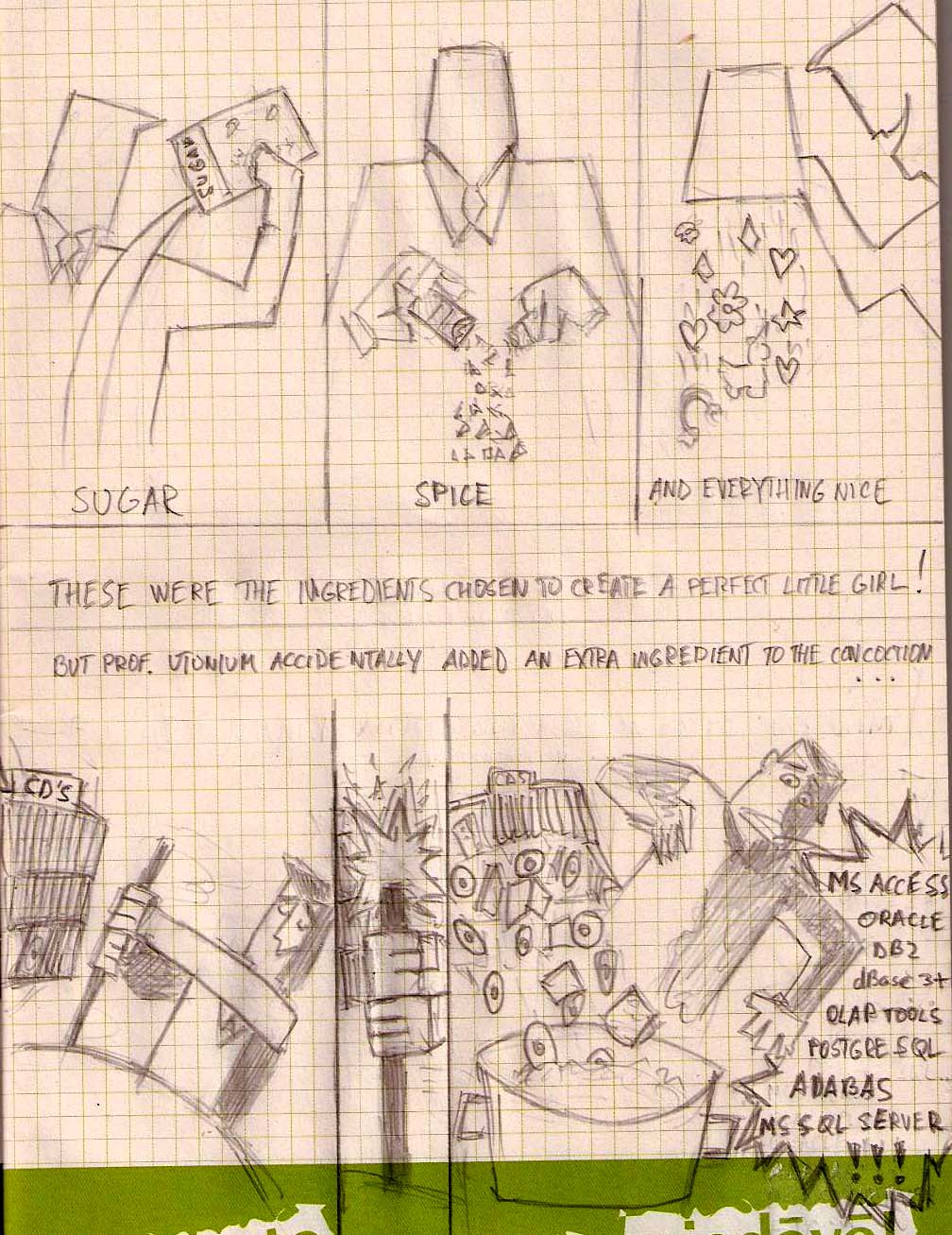The Database Girls, apparently. I used to sketch dumb stuff back then.
Other than that, it's a waste of time and paper. These kinds of notes don't matter in the long run, and they aren't a great way to retain information in the short term.
There are better ways to study than to take lecture notes.
This changed somewhat after my first identity crisis in my mid-20s. I'll share the full story later, but the gist of it was two-fold:
* It was the first time I became consciously aware of my own thoughts and the world around me. I stopped living on autopilot, the fog of life has cleared.
* I also became painfully aware of the gap between my real and my perceived identities. I faced my inadequacy as an adult for the first time.
There were many flaws that I noticed in myself. The lack of life management skills was one of the more obvious flaws. I just didn't have my shit together.
So I attempted to get it together and become a better organizer. I signed up for Evernote, I started taking all kinds of notes and even got excited about [Tiago Forte's PARA system](https://fortelabs.co/blog/para/) for a while. It felt good, but it didn't last long. A few months later, I had an Evernote full of random websites and articles that I never looked at. Eventually, I just stopped doing it.
This was a pattern for most of my early attempts to become better at life. Within a year or so, I failed at a few other potentially life-changing habits:
* I tried keeping a diary of my life, but that fizzled out.
* I started using an expense tracker, but it didn't last more than a few months.
* I started reading books, but never retained more than a few core ideas.
I slowly drifted back into complacency and into my pre-crisis mindset.
"Don't think, just keep doing."
These outcomes made sense to me back then. I had always considered myself too impulsive and impatient to stick to something for long enough. So why would this time be different? "I'm just not great at this habits thing."
In retrospect, this was [a load of barnacles](https://www.youtube.com/watch?v=Ir9LhF01KtA). **It wasn't the lack of patience that was my problem, it was the lack of meaning.**
I hadn't asked myself "why" enough to find the underlying reasons to stick to my new habits. The identity crisis gave me the ability to see the world around me, but I didn't learn to see the world inside me. I started interacting with the world, but not with myself.
And thus, my reasons for doing things were all superficial. Why save the websites I like, why keep a diary, why track my expenses. Because that's what adults do, I guess? Whatever.
These were all disconnected initiatives, and disconnected initiatives never last long. If you want to stick to new habits in the long run, you need to [make them part of your identity](https://martinboss.com/book-notes-atomic-habits/).
And I didn't have an identity, I had the lack of it.
Years later, I would find it.
The hard way.
##### Reality hits you hard, bro
The next five years were a mixed bag for me.
On the one hand, I finally learned to interact with the world around me. And to have fun. I became more extroverted. I made great friendships. I got a skydiving license, I started a few businesses, I traveled, and tried living my best life.
Sound good?
Yet I never closed the gap between my real and my perceived identities. I never faced my insecurities. Never addressed my flaws. I kept living my life as if I was already perfect. As if I didn't have any problems.
**I was faking it till I made it. Except that I didn't make it.**
The unraveling came in my early 30s. It started with my business falling apart. That immediately took my already flimsy finances with it. Then came the relationships and my mental health.
My perceived identity was tied into these things, and it disintegrated overnight.
Fundamentally, it was an identity crisis. My own Great Depression. I was once again confronted by the fact that I'm a fake:
* Prior to my first crisis, I had no well-defined identity.
* Prior to the second one, I had an identity that wasn't grounded in reality.
I was living as if I was *a successful and confident business owner serial entrepreneur CEO-type* capable of doing anything he puts his mind to. You know, Elon Musk, Jeff Bezos, and the likes.
Successful and confident business owner serial entrepreneur CEO-types.
In reality, I haven't changed that much as a person in the last five years. Martin was still an ordinary guy pretending to be someone he wasn't. With an inferiority complex and a whole bunch of insecurities and other problems.
**I was a fake, and I was afraid to admit this even to myself, let alone to the world around me.**
The worst part of being afraid to admit your weaknesses?
It's that you deny yourself the chance to get better. You can try faking it till you make it all you want, but you won't make it if you're being dishonest with yourself. No one else can fix your shit but yourself, and it sure as hell ain't fixing itself. You might stumble upon a workaround if you're (un)lucky, but it won't be a solution.
I kept thinking in terms of workarounds. "How can I achieve my goals without changing myself?" And fortunately, there was no workaround for me.
The most painful realization was that I'd just wasted five years of life. I had struggled with these same identity challenges five years ago and ended up sweeping them under the rug being unable to face and overcome them.
And since I didn't keep notes, the gravity of my first crisis has faded over the years:
**What had once been "My whole world is crashing down and I'm not sure I'll survive this" has slowly turned into "I struggled with a really bad depression" and eventually became "I had a pretty bad time but I got over it".**
Not exactly helpful if you plan to never again repeat the mistakes that had led to this. \*Record scratch freeze frame\* Yep, that's how I once again ended up at the bottom five years later.
And once again, I had two options to choose from:
* I could face my fears, finally admit that I was doing it wrong, and slowly but surely try to start getting my shit back together, or...
* I could try to rebuild my shell and my fake identity, bottle it all back up, and keep living my life as if nothing happened.
Except that this time, the latter option wasn't really an option.
I knew that doing it would mean another crisis down the road, and that one might in fact end me. I've seen it happen to people close to me. It never ends well.
Long story short, I admitted that I was wrong. And that I need help. I faced my fears, anxieties, and flaws head-on. It took me months of therapy, medication, new habits, and being surrounded by friends to start getting back on track.
Keeping a diary was one of the new habits that helped.
Here's how it came to be.
##### The story of my diary
I started keeping my diary shortly into my Great Depression.
At that moment, I saw a few things very clearly:
* **My brain was compressing my life.** Years of thoughts and events got reduced to a handful of flashes. This was sad enough. My life is more than that, you stupid brain!
* **This made me repeat the same mistakes.** Not learning. Making all the wrong moves.
* **And now my depression was making me see life in solid black.** My brain was discarding everything remotely positive, no matter how small.
If I wanted to pull through, I had to find a way to deal with these things.
Take the life compression problem.
The previous five years of my life hadn't all been great. And some years were crappier than the others. But I've had plenty of experiences, good and bad.
Yet I couldn't remember more than a handful of them. These past years were reduced to "yeah, I traveled a few times, I tried skydiving, I started a business, and I failed". This reduction makes it easy to see your life as a monotone, joyless existence, and see yourself as a failure.
Logging your life in a diary preserves the richness of it.
Now, having your life compressed is not the end of the world. It's sad, but it's part of life. That's how memory works. You can't realistically remember everything. But that causes the next problem.
Just like the events and memories in your life, your thoughts also get compressed and fade with time. And your feelings, and your decisions. That's a problem if you want to keep moving in the right direction in life.
**Forgetting your reasons for making certain decisions makes you more likely to repeat these decisions in the future.**
When a series of poor decisions lead you to a bad place in life, you might be thinking "this is the worst thing to happen to me, it's terrible". But give it some time, and you might start asking yourself "was it really that bad?".
A snapshot of your thoughts at any given point in time is a piece of evidence you can use to reassess your feelings. It's hard to argue with a diary line saying "today's the worst day of my life, and here's exactly why".
By the time I've run into my second identity crisis, I could barely remember the first one. I knew the gist of it, but I couldn't bring back the feelings I had felt, the thoughts I had thought, and the takeaways I had taken away from it. So it's unsurprising that I had found myself dealing with the same issues all over again years later.
Finally, the tiny things.
When you're depressed, the tiny things matter. It also happens that when you're depressed, it's the tiny good things that your brain discards by default.
That's exactly what I had experienced. I would spend days trying to be more mindful and noticing the small things while struggling to get out of bed and dealing with panic attacks. And all that my brain had to say was "Everything in your life is shit. And you're shit, too. Stop trying."
But it was a lie! Managing to get out of bed was a good thing. Brushing my teeth was a good thing. Seeing the sun outside was a good thing. Yet to the brain, it didn't matter.
And that's when I decided to start my diary.
At first, it was a single Evernote note where I'd log the little things:
*December 16
+ got out of bed
+ brushed my teeth
+ the smell of coffee
+ haven't had a panic attack in the morning
+ it's sunny outside*
It became more advanced over the years, but that was the best I was capable of at the moment.
But even seeing these few simple bullet points at the end of the day was a powerful reminder of the fact that my ways weren't "all shit". I haven't "wasted another day of your worthless life, you good for nothing piece of shit". I survived it. And that's often an achievement in itself.
My diary was my reminder that the reality wasn't as miserable as my brain was trying to paint it.
My life wasn't a dull joyless existence.
I wasn't a complete failure.
##### And then there were notes
In contrast to the diary, the art of note-taking wasn't really on my radar back then.
What's your reason for taking notes?
Perhaps it's something like this:
* To capture, store, and retrieve information. To remember things.
* To organize your life. To get shit done.
The storage and retrieval part is relatively straightforward. It's capturing everything you deem worthy of saving:
* Things you come across online and offline, e.g. articles, videos.
* Things that make up your life, e.g. your thoughts, ideas, life events.
* Things you create and learn, e.g. your course notes and other notes.
The organizational part is a little different:
* You can use simple notes just to write things down, e.g. a grocery list.
* You can use notes with checkboxes to act as a simple daily/weekly planner.
* You can use notes with tasks and dates to track more complex projects.
And that's what I ended up using Evernote for eventually.
It took me a few months to get through the worst of my Great Depression and find a job, but it took me another year to get my self-improvement mindset back. A year later, I felt like I'm slowly starting to sink back into the rut. And I knew it wasn't a good sign.
It was time to get back to deliberate self-improvement:
* I started practicing a proper 10-finger typing method to up my speed.
* I decided to learn more about investing money and to level up a bunch of other skills I was missing, such as speech, presentation, video editing, and others.
This took time and effort, so I started using Evernote to make it more manageable.
Initially, I just kept notes from my courses and my research. At some point, I created a simple daily and weekly planner to keep track of my tasks and habits. This was me organizing my life, but it took me another six months until I found a way to use Evernote to efficiently store and retrieve information.
And as it turns out, information capture is where Evernote really shines.
In the past, I used Evernote just like I used my browser's bookmark manager. That is, by saving a bookmark into Evernote, sticking it into one of my hundred notebooks, and forgetting about it forever.
Then I discovered tags, and it changed everything. I nuked my clumsy notebook structure, recreated it in tags, and am living with Evernote happily ever after.
Today, I exclusively use Web Clipper to save stuff from the internet:
* I capture blog posts and articles I've read or plan to read.
* I save the newsletters that I find interesting.
* And generally, I save everything I think I might need in the future.
Whenever possible, I read and highlight this stuff directly in Evernote. The next time I'm working on a project of any kind, it's easy to pull up all of my highlighted articles related to the topic.
Eventually, I started taking notes from the books I was reading or listening. I've been struggling with not retaining information from audiobooks for a long time. Just like I hated forgetting my life and my thoughts, I also hated forgetting the great ideas I've been picking up from books.
A few months ago, I've finally discovered a solution that works for me: taking notes using an iPad. It completely changed the way I read. If you're curious, I'm telling that story in a lot more detail [in my article on note-taking and audiobooks](https://martinboss.com/taking-notes-audiobooks-podcasts/).
Just like the diary transformed the way I think and remember, my notes transformed the way I work with information.
##### And one more thing
So that's why I keep a diary and take notes.
These simple acts completely transformed my life, and I truly believe everyone can benefit from doing these things to some extent.
But it's not a silver bullet. It would be nonsense to say that journaling and note-taking "cured my depression", or whatever. We're all different and unique.
Just like everything else, these things are tools. And it's up to you to decide which tools work best for you, and whether or not you need any tools at all.
What I'm saying is, keep your toolbox up to date, organized, and at hand.
<div pseudo="-webkit-input-placeholder" id="placeholder" style="display: block !important;">Add a comment</div><div></div>
**M ↓** Markdown, Why Notes, Why Diary?, Martin Boss, 01gy7ve7hd0crvn0q2txj7dxmt.