Why Prophetic Movements Need an Echo Chamber
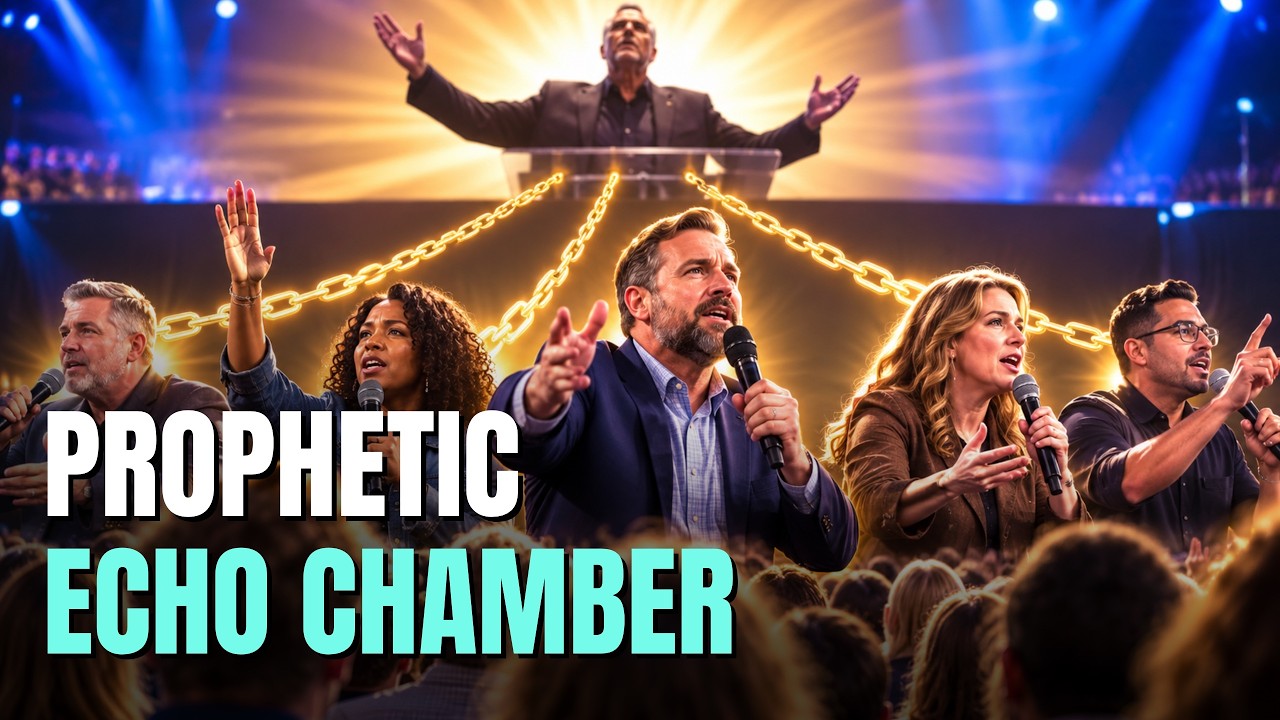
🔗 **Source:** [Why Prophetic Movements Need an Echo Chamber](https://www.youtube.com/watch?v=GkPyavgwJcw)
> [!note]+ Document Notes
> ---
> tags: [religion, movement-dynamics, epistemology, authority, accountability, media-literacy]
> author: YouTube
> source: https://www.youtube.com/watch?v=GkPyavgwJcw
> reference: Why Prophetic Movements Need an Echo Chamber
> date_created: 2026-07-22
> ---
> # 🏷️ Title
> Why Prophetic Movements Need an Echo Chamber
> ## 🧭 Table of Contents
> Summary; Main Content; References; Paraphrase; Newsletter; Action Items; Hypotheses; Methodology; Questions; Future Research; Implications; Learning Styles; Accessibility; DEIB; Logical Validity; DARVO; Conclusion; Refactor Appendix; Template Library.
> ## 🔗 References
> - [Source video](https://www.youtube.com/watch?v=GkPyavgwJcw)
> - The transcript refers to biblical tests of prophecy and several people and networks, but it doesn't supply a bibliography or links that independently document those claims.
> ## 📝 Summary
> The speaker argues that prophetic movements depend on a middle tier of validators who repeat, interpret, and distribute a top leader's claims. This layer makes an eccentric claim feel socially confirmed, carries it from revival settings into local churches, and can shield vague predictions from direct testing. The central insight is about network structure: authority spreads through trusted intermediaries, not only through a charismatic leader. That matters to religious communities, researchers, journalists, moderators, and safeguarding teams because accountability must examine who transmitted a claim, what evidence they supplied, and whether failure changed their standing. The source is a critical commentary, not a neutral history. Its named allegations and movement map require independent documentation. Bottom line: treat repetition as a social mechanism, not as proof, and preserve dated predictions so they can be tested.
> ## 📖 Main Content
> ### 🗒️ Notes
> - 00:00–01:31 — The speaker uses an unusual claim about names to illustrate how a secondary figure can introduce an idea that the audience later associates with a senior figure.
> - 01:32–02:28 — He states the main thesis: the middle tier distributes the major message and trains the audience to accept repeated claims.
> - 02:29–04:03 — He describes intermediaries as connective tissue between revival events, apostolic networks, and local churches.
> - 04:04–05:07 — He answers the “guilt by association” objection by distinguishing mere contact from active validation and repeated distribution.
> - 05:08–07:11 — He argues that missing archives make it hard to test secondary figures' prophecies even though those figures helped establish senior leaders' credibility.
> - 07:12–08:23 — He criticizes vague symbolic language and escape clauses that make a prediction hard to falsify.
> The useful analytic model is leader → validator network → local audience. Each step changes the status of the message: a leader's assertion becomes a validator's confirmation, then an audience's perceived consensus. The source is strongest when it asks for dated, specific, testable records. It is weaker when it moves from examples to a broad account of an entire movement without showing sampling rules or primary documents.
> ## 📚 References
> - Primary source: the linked video and its transcript.
> - Primary evidence needed: dated prophecy recordings, books, newsletters, event programs, organizational records, and correction statements.
> - Comparative research needed: scholarship on charismatic authority, social proof, network diffusion, group polarization, and failed-prediction response.
> ## 🗣️ Paraphrase
> The opening says a surprising idea can gain force when a secondary speaker plants it before a senior leader uses it. The next section argues that repeated validation reduces independent scrutiny and turns intermediaries into distribution channels. The speaker then describes these figures as bridges between events and local churches. He rejects the idea that criticism rests only on association: the relevant conduct is public endorsement and message repetition. He closes by calling for records that let communities compare a prediction made beforehand with what later happened, while noting that vague identities and conditional clauses can prevent a fair test.
> ## 📰 Newsletter
> Authority rarely travels alone. This short video asks readers to watch the middle of the network: the people who repeat a leader's claims, translate them for local audiences, and make repetition look like confirmation. The practical takeaway isn't “trust nobody.” It's “keep receipts.” Date the claim, preserve the exact wording, identify the validator, and record what happened when the claim failed. That habit serves churches, newsrooms, communities, and any organization where status can outrun evidence. [Watch the source](https://www.youtube.com/watch?v=GkPyavgwJcw).
> ## ✅ Action Items
> - DevRel: teach the difference between endorsement, evidence, and independent reproduction.
> - OSPO: require traceable sources for claims repeated in project channels.
> - Community: preserve exact claims, dates, amendments, and outcomes; create safe correction paths.
> - WordPress teams — Core: retain decision records; Core Performance: publish reproducible benchmarks; Core AI: label model-derived claims; Core Program Team: track ownership; Mobile: capture device context; Playground: provide reproducible demos; Community: train organizers on verification; Training: teach source evaluation; Marketing: separate testimony from evidence; Support: avoid repeating unverified fixes; Design: expose provenance; Documentation: link primary records; Photos: retain consent and context; TV: preserve dates and transcripts; Polyglots: flag meaning-changing translations; Accessibility: document user evidence; Meta: keep moderation audit trails; CLI: make output reproducible; Hosting: publish test conditions; Tide: show scan methods; Openverse: preserve attribution; Themes: document compatibility claims; Plugins: document security and performance claims.
> - The WPCC: fund research and reporting that maps claim transmission without treating association alone as culpability.
> - FAIR: encode provenance, dates, and correction history so records remain findable and reusable.
> ## 🧪 Hypotheses
> 1. Claims repeated by several mid-status validators gain acceptance faster than the same claim stated only by a senior leader.
> 2. Specific, time-bounded predictions receive more corrections after failure than symbolic predictions with open conditions.
> 3. Communities with public prediction archives show less retrospective reinterpretation.
> 4. Independent social ties outside a movement correlate with greater willingness to question internal consensus.
> ## 📊 Methodology
> Build a dated corpus of claims and endorsements from recordings, newsletters, and books. Code specificity, conditions, validator count, audience reach, later outcome, and correction behavior. Compare matched claims with different levels of repetition. Add network analysis to identify bridges between central speakers and local groups. Interview participants with trauma-aware protocols, and publish coding rules and uncertainty. Do not infer misconduct from network proximity alone.
> ## ❓ Questions
> - Which intermediaries independently checked claims, and which only repeated them?
> - What happened to status and access after a failed prediction?
> - Were corrections distributed as widely as the original claim?
> - How did audiences distinguish spiritual discernment from empirical prediction?
> - What records would allow the named examples to be verified fairly?
> ## 🔮 Future Research
> Compare prophetic, political, wellness, investment, and technology communities to test whether the same validator pattern appears. Study how platforms reward repeated certainty, how private doubts differ from public endorsement, and whether public archives change leader or audience behavior.
> ## 💡 Implications
> Practice: record claims before outcomes and separate source, endorsement, and evidence. Policy: create correction and safeguarding processes that cover influential intermediaries. Security: treat coordinated repetition as a possible trust-amplification path. Education: teach falsifiability and source tracing without ridiculing belief.
When I began to leave this movement and start to enter Christian churches, Christian churches could care less if their pastor had seven names in the last name of his his given name. So, why why why this? Why would you have something so incredibly absurd? The only reason is because of the power of taking something you're saying as a major prophet, but not quite saying it, instead having
it reaffirmed by the second tier. If the second tier can introduce the audience to this concept and say, "We have this concept that God is giving this unusual blessing of seven letters in someone's name." Well, the the audience will then make the connection whenever the major prophet says what the minor prophet, or in this case the fivefold minister, is saying because it's an anointed saying by God. That's the thing to
understand. The second tier are speaking things that are so so absurd, yet at the same time so anointed that the audience must be receptive to take it. In other words, the audience had to be trained to shut off all critical thinking because nobody in their right mind is going to say that seven letters makes you more spiritual than Billy Graham. But, that is exactly what happened and it's all because of that second tier. It's very important to
understand. A movement like this cannot survive unless you have that second tier of people who are echoing what the top tier is saying. And in fact, Bob Scott mentions this frequently, that there are people in the movement who do nothing but echo and Bob's always asking, "Why is this? Why would you just echo? Why not go find out for yourself?" Well, when you understand the hierarchy of these tiers, you begin to understand that it is an
indoctrinated, trained experience. It's not something that people just naturally do. You naturally won't do this kind of thing. So, the minor prophets are actually more important than the major prophets because they become the distributors of the major message. Without the middle tier, that top tier's message is not that important. But, because of that second tier, these become the distributors of the major message. The weird problem that exists with this,
if you go down the lineup of names of people who did not become the major prophets in the movement, there's some really weird and strange and unusual people. We've had many discussions on Bob Jones, and if you take his the adultery, the um predatorial things out of the picture and just look at the man and his message and his predictions and his prophecies and how weird all of that is, and you really would never just go follow Bob Jones of IHopKC. There's no way that
you would do it. But, he was a distributor of Mike Bickle's message. He was the one in that middle tier who is making Mike Bickle's themes become established. Then, once they're established, he doesn't matter anymore. He has already laid all the groundwork. So, another way to say it, this middle tier [clears throat] of individuals, this is the connective tissue between what is the revivals and and the local
church. They're the ones who are taking the concept and these conventions, these auditoriums back in the tent revivals from the tents. These are the people that would go to the local churches and help spread the message that we're affirming what our major prophet is saying. He's too busy to come see you, but we're going to affirm it. And what they're doing is they're laying the groundwork or the bridging between all of the apostolic networks that eventually form the New Apostolic
Reformation. So, if you're a person who is sympathetic to the New Apostolic Reformation or the charismatic movement in general, you're probably asking, "Okay, so John, what's so wrong with this? What does it mean if somebody is just simply backing somebody else and that the person that they're backing turns out to be wrong?" We can't blame the people in the tier below because that's guilt by association. >> [laughter] >> In fact, I get that challenge all the
time. People [clears throat] will say, "You can't You can't do this, John, because this one person was preaching heresy or turned out to be a predator or whatever is the case. Because this other person is connected to them, you can't say that there's a that there's a problem here. All you can say is this is guilt by association, and John, that's wrong." But you have to understand that's not the way this works in this type of movement. There is There's a bigger problem here that really can't be overlooked. So,
here for In my opinion, here are some examples of why this is wrong. You have this middle tier of people, some of whom claim to be a prophet. Yet at the same time, we don't have many of their prophecies. My examples were limited to what [clears throat] we have with Ana Shrada just because I have one of her books. But think of all of the others. We do have people like um What's a good
example? Bill Britton. >> [clears throat] >> Steve Montgomery and I when we talk about converging a prophecy, we'll always go back to people like Bill Britton because we do have their works. Point is this, other than just a select few, we don't even have their prophecies. So, the biblical instruction for a prophet is to tell if it's a prophet by God, we need to evaluate and see did the thing that they said before the event happen
happen correctly as they stated. If not, this is not a prophecy from God. It's that pure, plain, and simple. But, the problem is the movement has by and large forgotten this middle tier. There are few handfuls, yes. I've I've looked at them. Some of them like Sam Fife. I think he might be considered a middle tier prophet. Well, he spun off into his own movement. And so, we do have some of his prophecies. That much is true. But, how about Anna Schtrader? Where are
you going to go and find all of her many prophecies? I found one book on Amazon. I can't find them all. These people validated the major prophet. So, if you're claiming the guilt by association card, it's more than just that because they're the ones who are re-emphasizing and making They're echoing what the what the major prophet says. They're making it suddenly feel like a move of God. And it's less like a lone eccentric heretic
person. It They're giving credibility, I think is the best way to say it. And that's really for me, that's one of the strongest arguments against this type of thing. And second, if you really go deep into what these prophecies are because they're so very vague. I read through some of the Anna Schtrader prophecies and you can do it, too. You can buy her book on Amazon cheaply. I did. You can go through this and you see that
they're very vague. And they're always in this format. They're going to use Bible names instead of the real names, which means I can apply this a prophecy to anybody. And I can't really prove that it fail because they'll just say, "Well, that's not the Elijah. That's not the Ahab and Jezebel I was talking about. It's this new person." And then when that one fails, it's the person after that. You can just go down the line because it's not specific. The other thing that I noticed as I'm reading through, there's always an out.
They "Yay, I say unto you Ahab and Jezebel this, that, and the other unless this, that, and the other." And so, how can you prove the prophecy failed? They'll just say, "Well, the unless part. You missed the unless part." And >> [clears throat] >> even though some of the details may be vague, some of them even if they don't [music] come to pass, there's no way to prove it., Why Prophetic Movements Need an Echo Chamber, YouTube, 01ky5rrskk8ztb69djbd1sq1ab.