Why Your Notes Don't Last.
## Metadata
- Author: [[YouTube]]
- Full Title: Why Your Notes Don't Last.
- Category: #articles
- Document Tags: [[video-notes]] [[youtube]]
- Summary: Why Your Notes Don't Last.
- URL: https://www.youtube.com/watch?v=cCoaug12x8Y
I recently found a very old journal ofmine. It was filled with notes about allsorts of things. But after a while, Irealized something really weird. Ididn't understand what half these noteswere about anymore. I didn't know whatthey meant. Make sure to call G. 19.5 isthe best setting. Today was a reallyhard day. Who is G? What did I need tocall them about? The best setting forwhat? What made this day so hard? Itfelt like I was reading the notes of astranger. Hi, I'm Ryder, founder of theBullet Journal Method—a simple life OSthat has helped people from around theworld write a better life.
In the last video in this series, I showed you a fewways to futureproof your thinking.Today, it's about future proofing thenotes we use to capture that thinking soyou can get the most out of what youwrite down for years to come. Let's divein.
Let's start from the outside in. Whetherit be digital or analog, the first wayto future proof your notes is to committo where to take notes. Without a clearcommitment, many of us fall victim tonote creep. Over time, you begin to takesome of your notes on post-its, othersIn notebooks, others in journals, andsome in the shiny new note-taking app ofthe week. Note creep causes two issues.
One is small, but the other one ispotentially catastrophic. The firstproblem is having to decide over andover again where to take notes. Thiswastes energy and leads to the realproblem: not knowing where to findimportant notes again later. That hascost me a lot of stress, money, time,not to mention really important ideas.
To solve note creep, define a source oftruth. Pick one place where you’ll takeall your notes. Maybe for you, thatsource of truth will be an app likeObsidian or Notion. For me, that’s mybullet journal. Whether my notes arepersonal or professional, all of thembegin there. Now, to be clear, once youhave a source of truth, you can stillmove your notes around. For example, Ioften move some of my reading notes,which I take in my notebook, into myObsidian database so I can use them invery long-term or super complexprojects. That said, I never have towonder about where the first place iswhere I wrote something down, so I canalways find my notes again later.
Why do I use a notebook? For manyreasons, but here are two mainconsiderations that also apply if youare a digital notetaker: obsolescenceand ownership. One of the perceivedbenefits of digital note-taking is howeasy it is to link your resources fromaround the web. However, studies showthat just after a few years, asignificant percentage of those linksbecome dead ends, taking all thereferenced information with them. Thisphenomenon is known as link rot, wherelinks to websites, articles, and resourcesgradually break down over time. Andthat’s only the beginning. The
bigger vulnerability is ownership. Whenyour source of truth is a digital app,its features and functions depend oncompany priorities. So just when youhave a perfect setup, some update breaksa key part of your system. That, ofcourse, is if you can still access theapp at all. When you don’t own thecontainer for where your notes live,your notes can suddenly disappear or belocked behind a barrier or major pricehike without notice. This recentlyhappened with a popular note-taking appthat’s been around for over a decade.
Where a customer's bill allegedly wentfrom $60 a month to $1,000 a month withminimal notice. Online note-takingservices, especially those funded by BCor private equity, don't always last, orthey don't stay the same. That's thenature of business. Business modelschange, companies get acquired, and productsget folded in or sunset. To fight thisand to futureproof your notes, you cando two things here. You can capture yournotes in a format that is open-sourcedand you can capture those notes on aphysical medium that you control. Whenit comes to apps, this often boils downto file formats like Markdown and beingable to store those files locally. Andif that doesn't mean anything to you,you can ask, "Can I take notes offline?"and "Can I open those notes in otherprograms with no problems?" If theanswer is no to either, you likely don'thave enough control over where yournotes live. Let me know in the commentsdown below if you want me to do a deeperdive into that. With a notebook, none ofthis really matters. What does matter,though, is the quality of the materials.
Most notebooks on the market are made bycompanies that produce countless otherProducts, and it shows. They feel likeafterthoughts. My suggestion here is tobuy notebooks from companies that focuson making notebooks. For example, when Icreated the official bullet journalnotebook, I reached out to a companythat’s been making notebooks for over ahundred years. I was a customer before Iwas a collaborator. You can learn moreabout the official bullet journalnotebook here. Cheap notebooks are proneto falling apart. Pages tear out,bindings break, the ink bleeds throughthin pages, making your entriesdifficult to read. Each notebook canhelp us better understand and navigateour work, our world, and ourselves, butonly when the content of our notes makesany sense. So, now we just talked aboutwhere to put our notes, which brings usto the next consideration, how to takefuture-proof notes.
Without a structure, your notes canbecome an incoherent swamp of randomto-dos, ideas, insights, andinformation. Once you commit to asource of truth, it’s time to implementa system keeping that source organized.Otherwise, your future self may have noidea where to find what.
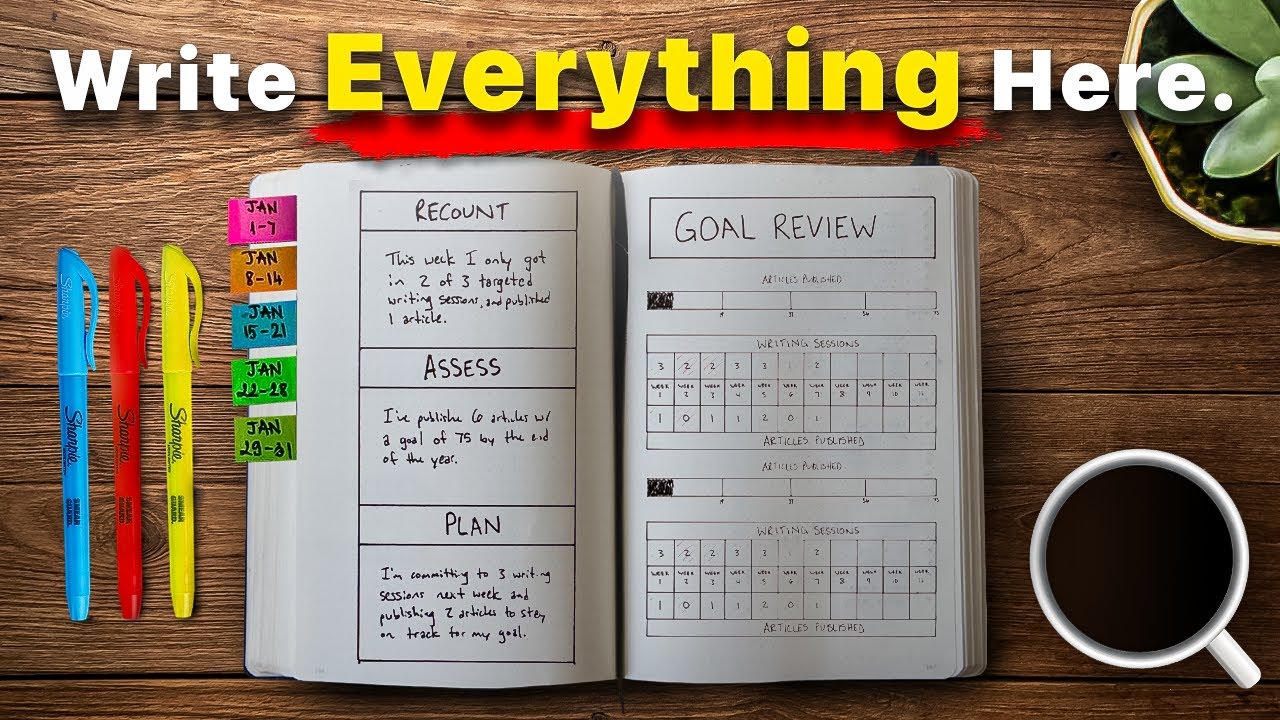
The bullet journal method comes intoplay. Here are three simple ways thebullet journal method can help youfuture-proof your notes. One is to have anindex. This functions like an addressbook for your notes. It allows you toboth quickly find your notes in thefuture, as well as give you a bird's eyeview of what you were paying attentionto during the lifespan of that notebookor folder. Yes, you can bullet journaldigitally. The second is collections.You populate that index withcollections. These are dedicated pagesthat aggregate all notes related tospecific topics that matter to you, likefamily memories, projects, careerinsights, or therapy notes, for example.
Simply by taking related notes in thesame place, you provide them withgreater context, which helps tofuture-proof them. The bullet journal isreally a life operating system forwriting a better life. It helps youprocess the past, organize the present,and author your future. That's why thereal magic happens with the rituals.Regular practices of reflection help youprocess and curate your notes.In short, Bujo's rituals help you refineAnd cultivate notes worth your attentionwhile pruning the ones that aren't. Whatyou're left with is a clean record ofwhat was most alive for you at the time,which is critical for your future selfto derive value from your notes. If youwant to learn more about how to bulletjournal or join our live planningrituals, you can scan this code here.
Okay, so the last consideration is areally strange trick that's helped mefuture-proof my notes, and that is youhave to stop taking notes for yourself.This may sound strange, so let meexplain. When we take notes, we usuallythink about our current or immediatefuture self. By doing this, we tend totake a lot of shortcuts because weassume that we will remember theunwritten context around the note. Andthat's mostly true for a time.Eventually, time will rob our notes andmemories of that context, rendering thenote useless. For example, you may knowwho CS is right now, but you won't aweek from now. Though you may know whatit means to call your doctor for anappointment now, you may not a monthfrom now.
Though you may know whatdinner was really fun and romantic means.
Now, you probably won't remember a year from now.You get the point. The best trick that Ihave for this is to take notes for astranger. Why? Because in time, ourfuture self will have less and less incommon with who we are right now. Theywill not share the same conditions,concerns, and yes, even the samememories. When we write for a stranger,we tend to write much more clearly. How?Just by adding a touch of context. Youcan think of it as taking notes foran intern. For example, "Call CC remake."I would write, "Call Catherine C for herto pick up cake for Mark S's August26th, 2025 birthday party." This is still
just one sentence, but it'ssignificantly more future-proof. Rapidlogging, another bullet journaltechnique, directly helps with thisproblem by labeling each sentence with asymbol to categorize each note quickly.Rapid logging breaks entries down intofour categories: notes, actions, moods,and events. It helps us name ourexperience. Each is a single sentencejournal entry paired with a symbol. Whenused together, you can quickly create alot of context for future-proofing ournotes.
It's bad because RP left, which would meanvery little to my future self; probablyit doesn't mean much to you right now. Arapid log version of this would looklike this: The event, today was RoshaP's last day. The thought, it's hard onus, probably harder on her. Mood,feeling sad, I'm grateful. Action, sendflowers and a note of appreciation.
In just four simple sentences, I was ableto create notes that are greater thanthe sum of their parts. It provides morethan enough context for a stranger likeyou to understand a personal experienceof mine. The whole point of writingthings down is because our mindstruggles to hold on to even the mostimportant thoughts.
The strategies Ijust laid out in this video will help toensure that you're not just collectinginformation, but that you're holding onto and benefiting from your hard-wonwisdom for the rest of your life. In thenext video in this series, I'm going tobe talking about future-proofing ourgoals, because what's the point of takingnotes about things that ultimately don'tmatter? So, be sure to subscribe to thischannel to be notified when that'sready. Thank you for taking the time.
Happy bullet journaling, and I'll see youin the next one., Why Your Notes Don't Last., YouTube, 01k9fwy8874htpfszjdczzpwa0.