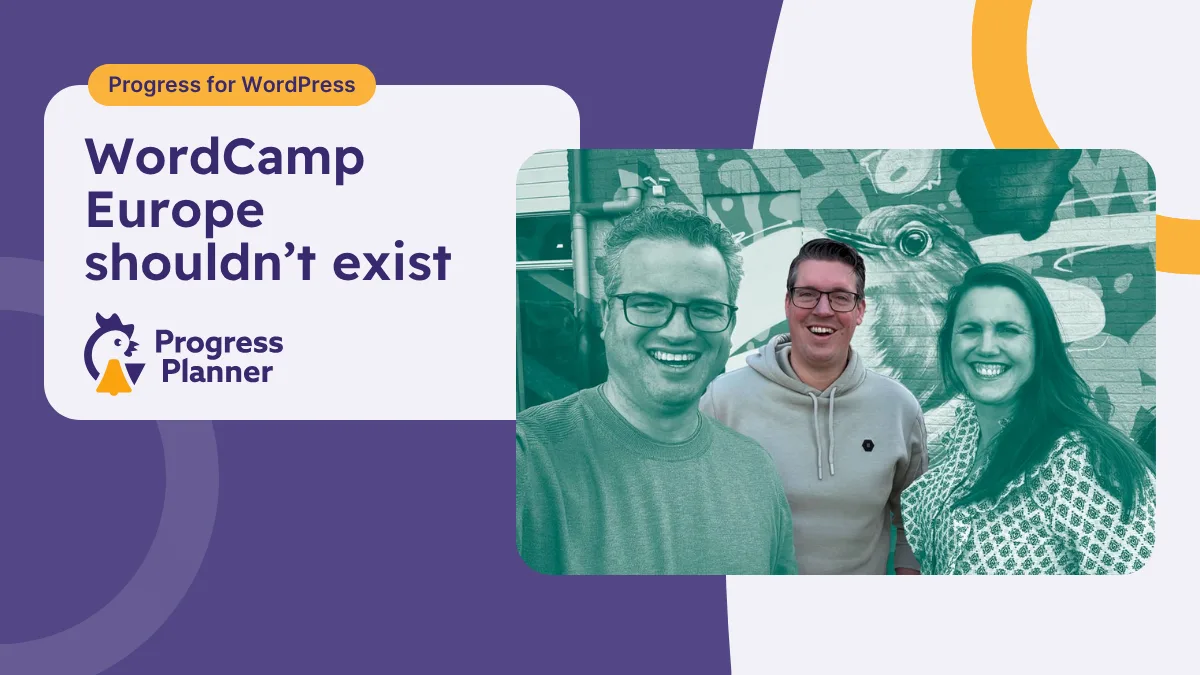
WordCamp Europe Shouldn’t Exist
## Metadata
- Author: [[Taco Verdonschot & .Wp-Block-Post-Author Box-Sizing Border-Box Display Flex Flex-Wrap Wrap .Wp-Block...]]
- Full Title: WordCamp Europe Shouldn’t Exist
- Category: #articles
- Document Note: ---
tags:
- #wordcamp
- #community
- #opensource
Author: Taco Verdonschot
Source: Progress Planner Blog
Reference: https://progressplanner.com/wordcamp-europe-shouldnt-exist/
date created: 2025-06-10 16:30
---
# Title: WordCamp Europe Shouldn’t Exist — A Critical Reflection
## Table of Contents:
- [📝 Summary](#-summary)
- [📖 Main Content](#-main-content)
- [🗒️ Notes](#-notes)
- [📖 References](#-references)
- [🗣️ Paraphrase](#-paraphrase)
- [📰 Newsletter](#-newsletter)
- [✅ Action Items](#-action-items)
- [🧪 Hypotheses](#-hypotheses)
- [📊 Methodology](#-methodology)
- [❓ Questions](#-questions)
- [🔮 Future Research](#-future-research)
- [💡 Implications](#-implications)
- [🧠 Learning Styles Assessment](#-learning-styles-assessment)
- [📊 Accessibility Assessment](#-accessibility-assessment)
- [🌍 DEIB Assessment](#-deib-assessment)
- [✅ Logical validity](#-logical-validity)
- [🔍 DARVO Analysis](#-darvo-analysis)
- [🔍 SEO Evaluation](#-seo-evaluation)
- [🎯 Conclusion](#-conclusion)
### References:
- Verdonschot, Taco. *WordCamp Europe Shouldn’t Exist*, Progress Planner Blog, 2023.
- WordCamp Europe official website
- WordPress Community and Open Source governance documentation
- Related blog posts and community discussion threads
## 📝 Summary:
Taco Verdonschot critically examines WordCamp Europe, arguing it paradoxically undermines the decentralized and grassroots ethos of the WordPress community. The article highlights how the event’s scale, structure, and resource demands conflict with inclusivity and community-driven values foundational to open source. It urges reflection on the future of community events, emphasizing empowerment through smaller, local gatherings over large centralized ones.
## 📖 Main Content:
Verdonschot frames WordCamp Europe as a large, formalized event that risks overshadowing and alienating the diverse, distributed WordPress community. He stresses that:
- **Centralization vs Decentralization:** The event centralizes community efforts in one large gathering, which conflicts with WordPress’s culture of many small, local meetups promoting autonomy and inclusiveness.
- **Access and Equity:** Large event costs and logistics create barriers that limit diverse participation, especially for contributors from less privileged backgrounds.
- **Community Engagement:** The scale risks turning participants into passive consumers rather than active contributors, diluting the sense of community ownership.
- **Sustainability Concerns:** The resource-intensive nature of WordCamp Europe contrasts with the leaner, community-driven local events and raises questions of environmental and financial sustainability.
- **Corporate Influence:** Growing involvement by sponsors and organizers might shift priorities away from community interests toward business agendas.
Verdonschot calls for a reevaluation of how WordPress community events are structured, advocating for re-investment in local meetups and smaller WordCamps that better align with open source principles.
## 🗒️ Notes
- WordCamp Europe is a flagship but paradoxical event—celebrated but also problematic.
- Decentralization is a core WordPress value; large events challenge this by concentrating power.
- The financial and geographic cost of attendance limits participation and diversity.
- Community spirit thrives in small, face-to-face, grassroots settings, not large centralized gatherings.
- Sustainability and community autonomy are at risk when resources flow into massive events.
- Corporate sponsorships risk shifting event focus away from genuine community benefit.
- Encouragement to empower local communities and sustain smaller WordCamps.
- Calls for leadership reflection on event strategy aligning with open source values.
## 📖 References:
- WordCamp Europe Official: https://europe.wordcamp.org/
- WordPress Foundation & Community Handbook
- Open Source community event best practices
## 🗣️ Paraphrase:
1. Original: “WordCamp Europe is a shining beacon of WordPress success, but its very size and structure might be pulling us away from the values that built our community.”
Paraphrase: Though WordCamp Europe represents WordPress’s growth, its large scale and setup may distance us from the foundational community values that originally empowered contributors.
2. Original: “The smaller WordCamps are where the real magic happens: face-to-face conversations, hands-on workshops, and empowered contributors shaping the project.”
Paraphrase: The true essence of WordCamps is found in smaller gatherings where personal interaction, practical sessions, and engaged members drive the project forward authentically.
## 📰 Newsletter:
In this issue, we spotlight a thoughtful critique by Taco Verdonschot on WordCamp Europe. While the event is a milestone for WordPress, Taco challenges us to consider whether its size and centralized nature truly reflect the decentralized spirit of the WordPress community. He emphasizes the value of smaller, local WordCamps for fostering active contributor participation and community sustainability. This read invites us to reflect on how we nurture inclusive, empowering spaces for open source collaboration. Don’t miss this important conversation shaping the future of WordPress events!
## ✅ Action Items:
- Lead conversations within WordPress about balancing large events with grassroots community needs.
- Advocate for funding and support structures for local WordCamps and meetups.
- Develop educational content on the importance of decentralization in open source community events.
- Collaborate with WordPress leadership to ensure corporate involvement supports, not overshadows, community values.
- Use insights to enrich workshops and talks on sustainable, inclusive community building.
- Align advocacy work with fostering equitable participation across all WordPress community events.
## 🧪 Hypotheses:
- Decentralized WordCamp models increase diversity and contributor engagement more than centralized models.
- Financial and geographic barriers of large events reduce equitable participation.
- Community-led, smaller events offer better sustainability and long-term contributor retention.
### 📊 Methodology:
- Surveys targeting attendees of different WordCamp sizes on engagement and satisfaction.
- Interviews with event organizers about challenges and successes.
- Demographic data analysis on event attendance diversity.
- Environmental and financial impact studies comparing event scales.
### ❓ Questions:
- How do WordCamp sizes influence community engagement and empowerment?
- What barriers deter participation in large WordCamps?
- Can large events incorporate decentralized leadership effectively?
- What practices improve sustainability in WordPress events?
### 🔮 Future Research:
- Studying the impact of event scale on community health.
- Developing frameworks for hybrid decentralized event governance.
- Investigating long-term community impacts of corporate influence in large events.
### 💡 Implications:
Findings could inform WordPress event strategies prioritizing inclusivity, sustainability, and authentic community participation, guiding leadership decisions and advocacy.
### 🧠 Learning Styles Assessment:
- Visual: Article lacks graphics; adding infographics on event impacts recommended.
- Aural: No audio options; audio summaries or interviews with organizers would aid auditory learners.
- Verbal: Clear, narrative style with good examples supports verbal learners.
- Physical: No kinesthetic elements; exercises or workshops suggested.
- Logical: Structured arguments appeal to logical learners; flowcharts could help.
- Social: Encourages community discussion, beneficial for social learners.
- Solitary: Reflection questions could be included for solitary learners.
- Naturalistic: No nature analogies; potential for eco-friendly event comparisons.
### 📊 Accessibility Assessment:
- Proper headings and simple structure aid screen readers.
- Keyboard navigation supported.
- Good contrast and readability on mobile and desk
- Summary: WordCamp Europe inspires, but sets high standards for local events. Taco explores how to better support local WordCamps.
- URL: https://progressplanner.com/wordcamp-europe-shouldnt-exist/
WordCamp Europe shouldn’t exist, *not* because it’s poorly organized or not valuable to our community, but precisely because it *is*. It is too well-organized to be called a WordCamp.
### WordCamp?
A WordCamp is a gathering of people connected to the open-source software WordPress in some way, shape, or form. WordCamps typically offer presentations about the WordPress software and a wide range of related topics. The WordCamp audience is equally broad, ranging from bloggers and DIYers to enterprise-level agency owners.
After the first WordCamp in 2006, they started spreading worldwide. In 2019, 142 WordCamps were organized across six continents, bringing together over 36,000 unique attendees.
Originally, WordCamps had a very local character. And even today, this is still the case for most of them. That’s why you’ll typically find WordCamps named after the city they’re held in.
Some WordCamps have a more regional character, like WordCamp Nordics, WordCamp Switzerland, or WordCamp Nederland (The Netherlands).
### WordCamp Europe
And then, a group of visionaries came together and started organizing WordCamp Europe. Their goal was to unite and cross-pollinate knowledge across all European WordPress communities. And so it happened with the first WordCamp Europe (WCEU) in 2013.
Looking back, we can safely say they were absolutely right. WCEU quickly grew to become the largest WordPress event in the world, bringing together people from Europe and beyond. From 750 attendees at the first one to nearly 3,000 in Turin last year.
With this growth in size and popularity, a lot changed. What started with a small group of organizers and a few volunteers grew to a 70-person organizing team with a volunteer crew of over 200 people. The team of organizers and volunteers of WCEU is larger than the total size of many local WordCamps around the world.
And it wasn’t just the number of volunteers that grew. The sponsors went from a small table with a branded tablecloth to booths worth hundreds of thousands of euros in production costs alone. Enormous, bespoke booths now scream for the attendees’ attention.
WCEU also went above and beyond to accommodate. From live captioning of talks in many languages to a multi-faith room, and from hotel deals to child care for those traveling to the event with kids. Next to two tracks of sessions, WCEU now also offers workshops, networking opportunities, and a wellness area. It even has media partners who cover the stories of and at the event!
Beyond just organizers and volunteers, a production company has helped organize WordCamp Europe for years now. They’ve been a huge help in professionalizing the event and helping the organizers push the event to the next level!
We can safely say WordCamp Europe has inspired the creation of WordCamp US and WordCamp Asia, the other flagship events in WordPress. From 2013 to now, WCEU has significantly evolved, and that’s a problem.
### WCEU is best-in-class
WordCamp Europe is an amazing event. Everything about it is well organized, well thought-through, and beautifully styled. They aim to be fully inclusive so that anyone can attend the event, barrier-free. Maybe with the exception of its event dates in 2024 & 2025, they’re doing an incredible job. And that makes them a terrible example.
Over the years, we’ve seen local WordCamps raise the bar of their professionalism because of what they’ve seen at WordCamp Europe. While it’s absolutely honorable that a local event aims to be as well-organized and inclusive as WordCamp Europe, the hard reality is that they don’t have the same resources. So, volunteers try to do the same work but without the same financial support or resources. This puts an incredibly high load on our volunteer organizers.
Back in 2019, we had 142 WordCamps. In 2024, we had 79 events listed on [wordcamp.org](http://wordcamp.org). Obviously, we had some COVID years in between, but why didn’t the organizers come back? Did we burn them out? Did we push too hard at too small budgets?
### WCEU, WCUS, and WCAsia should not exist
Well, that’s not true. There’s some nuance I need to apply. The events *should* exist. They’re doing exactly what they’re supposed to: bringing together people from a great number of communities from all around the world. But these events should never have been named ‘WordCamp’. They shouldn’t be compared to WordCamp Nijmegen, WordCamp Kolkata, or WordCamp San Jose. These three flagship WordCamps should have gotten their own name, so that everyone would immediately understand that the standards set for those large events do not translate well to local events with local budgets.
### Let’s revise our approach
While I can clearly see the problem, I don’t think I can come up with the perfect solution on my own. We’ll need to work together on this one. So, how about I share my thoughts here, and you add yours in the comments?
#### Renaming flagship WordCamps
If we want to put the flagship WordCamps in a separate category, they should probably be named differently. Over the years, this conversation has come up several times in various places. If I recall correctly, the predominant recurring suggestion was “WordConf” for the flagship events.
#### Quod licet Iovi, non licet bovi
Flagship WordCamps can do things local WordCamps cannot, like hiring a production company to help with the organization. In the Make WordPress Community documentation, we should better explain what the extra permissions for Flagships are and where the expectations differ from regular (local) WordCamps.
This doesn’t just clarify the status quo; it also helps lower the pressure on local WordCamp organizations. Potential organizers need to know they don’t have to organize an event like WCEU. Hopefully, this will entice more people to organize a small, local WordCamp!
#### Let’s aim for more MVWs
The minimum viable WordCamp (MVW) brings around 50 attendees together for a day to do activities around WordPress. The MVW doesn’t need to have speakers; it can offer group discussions or co-working opportunities. It doesn’t need to provide lunch; everyone can bring their own sandwiches. It doesn’t need live captioning, child care facilities, speaker gifts or dinners, an army of volunteers, or a website with all the things you can do in your city, as locals tend to know this already.
What the MVW needs is people who are passionate about talking about WordPress and building a local community.
Would you organize a minimum viable WordCamp?, WordCamp Europe Shouldn’t Exist, Taco Verdonschot & .Wp-Block-Post-Author Box-Sizing Border-Box Display Flex Flex-Wrap Wrap .Wp-Block..., 01jxda1nj44vmfg3eexey6yshx.