WordPress MCP
🔗 **Source:** [WordPress MCP](https://chriscoyier.net/2026/10/05/wordpress-mcp/)
> [!note]+ Document Notes
> ---
> tags: [wordpress, mcp, ai-agents, pressable, claude-code, content-workflow]
> author: Chris Coyier
> source: chriscoyier.net
> reference: https://chriscoyier.net/2026/10/05/wordpress-mcp/
> date created: 2026-10-05 14:11
> ---
> > [!info] Generated analysis — not the author's words. Sections below are machine-written
> > from the captured source. Only text inside `> [!quote]` blocks is verbatim from the author.
> > Do not quote or attribute any other line to the named author.
> # 🏷️ Title: WordPress MCP
> ## 🧭 Table of contents
> - [📝 Summary](#-summary)
> - [📖 Main content](#-main-content)
> - [🗒️ Notes](#️-notes)
> - [📚 References](#-references)
> - [🗣️ Paraphrase](#️-paraphrase)
> - [📰 Newsletter](#-newsletter)
> - [✅ Action items](#-action-items)
> - [🧪 Hypotheses](#-hypotheses)
> - [📊 Methodology](#-methodology)
> - [❓ Questions](#-questions)
> - [🔮 Future research](#-future-research)
> - [💡 Implications](#-implications)
> - [🧠 Learning styles assessment](#-learning-styles-assessment)
> - [📊 Accessibility assessment](#-accessibility-assessment)
> - [🌍 DEIB assessment](#-deib-assessment)
> - [✅ Logical validity](#-logical-validity)
> - [🛡️ DARVO analysis](#️-darvo-analysis)
> - [🎯 Conclusion](#-conclusion)
> - [🔄 Refactor appendix](#-refactor-appendix--wordpress-mcp)
> ## 📝 Summary
> This is a descriptive reading of a short personal blog post. Chris Coyier published "WordPress MCP" on chriscoyier.net on 2026-10-05. The captured text runs 15 paragraphs and 321 words. It is first-person opinion and experience, not reporting or documentation.
> - **What happened.** The author says all their WordPress sites are still on Pressable, lists five things they like about the host (¶2-¶6), and highlights a "one-clicker" setting (¶7). With that setting on, the author says they can authenticate an agent such as Claude Code that supports MCPs and connect it (¶8). The author then describes asking the agent to draft a blog post and to review this post for anything odd about elephants (¶9-¶11).
> - **The claim.** The author's position is that light, rote automation of blog editing is worth having: Title Case headers, formatting that matches a style guide (¶12). They suggest pairing the connection with a SKILL.md file that holds the style guide and guardrails (¶13). They say they have no interest in automating AI slop writing (¶14).
> - **Author's own experience versus general claims.** Nearly every sentence is the author's own experience or preference: "I think they do a good job," "the things I specifically like," "I appreciated," "I think I'm more likely to use this." The only broad statements are the list of what a host should do ("everything you'd expect a WordPress host to do," ¶1) and the framing of the author's own history as "one billion blog posts" (¶15), which reads as hyperbole.
> - **Commercial relationship.** The post praises one named host and a feature of that host. The captured text contains no disclosure of a sponsorship, partnership, affiliate link, or free service. The absence of a disclosure in the captured text doesn't show whether a relationship exists. The author's other roles are outside the source and this analysis asserts none. The post does say the author is a Pressable customer in the present tense ("I've still got all my WordPress sites on Pressable").
> - **Why it matters.** It is a concrete first-person account of the workflow: toggle a host setting, authenticate an agent, give it a narrow editing job, and constrain it with a skill file.
> - **Key stakeholders.** The author, Pressable, Claude Code (named as an example agent), Jetpack and WordPress.com (named as a presumed reason the setup works), and anyone who edits blog posts for a living.
> - **Risks and tradeoffs.** The post does not say what the setting does technically, what permissions the agent receives, or how the author limits what the agent can touch beyond the proposed skill rules. The author's own caveat is that the skill would say "only ever touch draft blog posts" (¶13).
> - **Bottom line.** A satisfied-customer note that treats agent access as a way to automate small editing chores. It reports one working try (the elephants check, ¶11) and gives no measurements.
> ## 📖 Main content
> **Why the author stays on Pressable (¶1-¶6).** The post opens with the author's current state: every WordPress site is still on Pressable, and the author is happy. The author lists what they specifically like: fast, good customer support that includes free movement of sites; deploying from a GitHub repo as "a first-class citizen"; "perfectly good" DNS management; no need for extra security, performance, or update plugins; and behavior that goes "with-the-grain" of the WordPress ecosystem. All six are the author's judgments, with no numbers (no response times, no prices, no uptime figures).
> **The one-click setting (¶7-¶8).** The author singles out "this little one-clicker" under the last point. The captured text ends the sentence with a colon and shows no content after it, so the setting itself, its name, and its location are not in the capture. The next paragraph says that "with that on," and "presumably because I also use Jetpack and thus WordPress.com," the author can authenticate an agent that supports MCPs and connect it. The word "presumably" marks the cause as the author's guess. This analysis does not verify what the setting does technically.
> **The workflow as the post gives it (¶8-¶11).** The post describes four steps, listed under Methodology as the author's own sequence. First, the setting is on. Second, the author authenticates an MCP-capable agent such as Claude Code and connects it. Third, the author tells the agent to make a draft blog post about something they're thinking about, so they don't forget it. Fourth, as a joke on being "meta," the author has the agent read this blog post and check that nothing weird is said about elephants. The author reports the agent "easily caught" them (¶11). The post doesn't say what the elephant slip was.
> **Where the author expects value (¶12-¶15).** The author expects to use it for "very rote tasks": Title Case headers and formatting that matches a style guide. They propose a SKILL.md file as "home-base" for that style guide, with example rules in quotation marks: only touch draft posts, label code blocks by language, self-host images, and check that links look correct and are valid. The author states a strong preference against AI-written prose ("I friggin' hate AI slop writing") and says the interest is limited to "intelligent automation of certain rote tasks," drawn from long experience authoring and editing posts.
> ## 🗒️ Notes
> #### 📄 ¶1-¶6 Why Pressable
> - The author keeps all WordPress sites on Pressable and says "they do a good job" (¶1).
> - Five likes follow: support that is fast and includes free site movement (¶2), GitHub deploys (¶3), DNS management (¶4), no extra security, performance, or update plugins (¶5), and fit with the WordPress ecosystem (¶6).
> - All six statements are preference or experience. None carries a number or a source.
> #### 📄 ¶7-¶8 The one-click setting and agent connection
> - ¶7 introduces the "little one-clicker" under the ecosystem-fit point. Nothing follows the colon in the capture.
> - ¶8 says that with it on, the author can authenticate an agent like Claude Code that supports MCPs.
> - "Presumably because I also use Jetpack and thus WordPress.com" is the author's own hedge, not an established cause.
> #### 📄 ¶9-¶11 First uses
> - The author can tell the agent to make a draft blog post "so I won't forget about it" (¶9).
> - ¶10 has the agent review this very post for weird statements about elephants.
> - ¶11: "it easily caught me." One reported success, no detail on what was caught.
> #### 📄 ¶12-¶13 Rote tasks and a SKILL.md
> - ¶12 expects use on rote tasks: Title Case headers, formatting matched to a style guide.
> - ¶13 proposes a SKILL.md as home-base for the style guide, with four sample rules: only touch draft posts, label code blocks, self-host images, check links.
> - The "only ever touch draft blog posts" rule is a stated guardrail.
> #### 📄 ¶14-¶15 Limits on what to automate
> - ¶14 says the author hates AI slop writing and wants no automation around it.
> - ¶15 frames th
I’ve still got all my WordPress sites on [Pressable](https://pressable.com/) and happily so; I think they do a good job! They do everything you’d expect a WordPress host to do. The things I specifically like are:
* Customer support is good/fast, including free movement of sites
* Deploying from a GitHub repo is a first-class citizen
* Perfectly good DNS management
* No need for extra security, performance, or update plugins
* Things are generally with-the-grain of the WordPress ecosystem
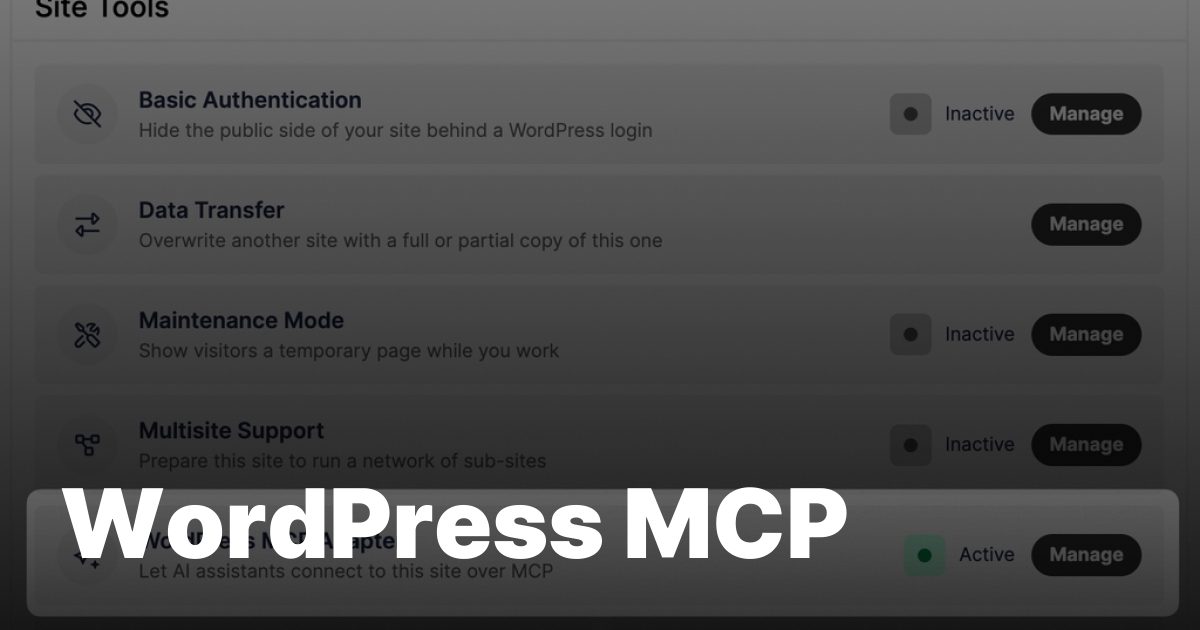
On that last point, I appreciated this little one-clicker:
Screenshot of a site management dashboard displaying various site tools including Basic Authentication, Data Transfer, Maintenance Mode, Multisite Support, and an active WordPress MCP Adapter option.
With that on (and presumably because I also use Jetpack and thus WordPress.com?), I can auth an agent like Claude Code that supports MCPs and get it connected.
Screenshot of a command line interface displaying the management of MCP servers, highlighting project, local, and user MCPs along with associated tools.
Now I can, for instance, tell my agent to go make a draft blog post quick about something I’m thinking about, so I won’t forget about it.
Just to be meta, I’ll have it look at this blog post and make sure I don’t say anything weird about elephants.
A screenshot of a WordPress post editing interface, showcasing a sidebar with plugin options and a command line interface open with text about elephants and a color-coded project management structure.
And it easily caught me!
Screenshot of a text editor showing a draft from WordPress with notes regarding elephants and a code connector.
I think I’m more likely to use this for very rote tasks like making sure my headers are Title Case, and things are formatted like I want them to be, matching a style guide.
I think it pairs nicely with having a “SKILL.md” file for it, which can be home-base for a style guide like that. The skill could have stuff in it like “only ever touch draft blog posts”, “make sure blocks of code are labelled for what type of code they are”, “make sure images are self-hosted”, “make sure anything I’m linking to looks correct and the link is valid”.
I friggin’ hate AI slop writing, so please know I have no interest in automating anything around that.
But as someone who has authored and edited one billion blog posts, some intelligent automation of certain rote tasks is appealing., WordPress MCP, Chris Coyier, 01m46m5cb1mfq0afts9ya4qjr7.