WordPress: The Drama Continues

## Metadata
- Author: [[Eric Mann]]
- Full Title: WordPress: The Drama Continues
- Category: #articles
- Document Note: ---
tags: [#WordPress, #ACF, #open-source, #plugins, #drama]
Author: Eric Mann
Source: Eric Mann’s Blog
Reference: [WordPress: The Drama Continues](https://eric.mann.blog/wordpress-the-drama-continues/)
date created: 2024-10-15 21:45
---
# Title: WordPress: The Drama Continues
## Table of Contents:
- [📝 Summary](#-summary)
- [📖 Main Content](#-main-content)
- [🗒️ Notes](#-notes)
- [🗣️ Paraphrase](#-paraphrase)
- [📰 Newsletter](#-newsletter)
- [✅ Action Items](#-action-items)
- [🧪 Hypotheses](#-hypotheses)
- [📊 Methodology](#-methodology)
- [❓ Questions](#-questions)
- [🔮 Future Research](#-future-research)
- [💡 Implications](#-implications)
- [🧠 Learning Styles Assessment](#-learning-styles-assessment)
- [📊 Accessibility Assessment](#-accessibility-assessment)
- [🌍 DEIB Assessment](#-deib-assessment)
- [✅ Logical Validity](#-logical-validity)
- [🔍 SEO Evaluation](#-seo-evaluation)
- [🎯 Conclusion](#-conclusion)
## 📝 Summary:
This article addresses the controversy around the WordPress.org team forking the Advanced Custom Fields (ACF) plugin, following a legal dispute with WP Engine. It explores both perspectives—WP Engine's claim of unfair treatment and the WordPress.org team's justification for prioritizing user security.
## 📖 Main Content:
The dispute began as WP Engine sued WordPress co-founder Matt Mullenweg over trademarks. WP Engine's ban from WordPress.org repositories led to forking ACF into a new "Secure Custom Fields" plugin. The article highlights challenges with user communication and the legal complexities surrounding trademarks. While acknowledging the controversy, Eric Mann ultimately supports the WordPress.org team’s decision, emphasizing the importance of end-user security.
### 🗒️ Notes:
- **Context:** ACF was forked into "Secure Custom Fields" due to WP Engine's ban from WordPress.org.
- **Fork Justification:** Ensures continuous security updates for users.
- **Challenges:** Legal disputes over trademark usage complicate the situation.
- **Personal Insight:** Mann, despite disagreements with Mullenweg, supports the decision from a security standpoint.
## 📖 References:
- [Eric Mann Blog](https://eric.mann.blog/wordpress-the-drama-continues/)
## 🗣️ Paraphrase:
1. Mann acknowledges that while forking is controversial, user security outweighs the politics. He notes that informing users about the fork is a challenge, especially given the non-technical nature of many WordPress users.
2. Despite legal tensions, Mann suggests that the WordPress team’s move to fork ACF was necessary to prevent potential vulnerabilities due to WP Engine's restricted ability to push updates.
## 📰 Newsletter:
🚀 **WordPress Plugin Drama – ACF Forked**
Big news from the WordPress world! WordPress.org has officially forked the popular ACF plugin into "Secure Custom Fields" amid a legal dispute with WP Engine. While some see the move as heavy-handed, it ensures critical security updates for users. WP Engine’s legal battle complicates things, but the fork ensures continuity. Dive deeper into the story and how it impacts WordPress developers [here](https://eric.mann.blog/wordpress-the-drama-continues/).
## ✅ Action Items:
- Assess how the fork impacts plugin support workflows at GoDaddy.
- Explore opportunities for fostering community transparency through newsletters or forums.
- Monitor the security response from the new plugin team to ensure alignment with GoDaddy’s open-source practices.
## 🧪 Hypotheses:
1. Forking a popular plugin improves user security but might reduce community trust.
2. Legal disputes in open-source ecosystems discourage collaboration and innovation.
### 📊 Methodology:
- **Data Sources:** Track updates and user feedback across social media and forums.
- **Research Design:** Analyze plugin adoption metrics before and after the fork.
- **Analysis:** Use sentiment analysis on relevant discussions to gauge community reactions.
### ❓ Questions:
- How can WordPress balance community transparency with security concerns?
- Will the forked plugin retain the same level of community support?
### 🔮 Future Research:
- Investigate how forks impact user trust and plugin adoption.
- Explore strategies for mitigating legal conflicts in open-source communities.
### 💡 Implications:
Research into forking dynamics could inform policies on open-source project management and user security protocols.
### 🧠 Learning Styles Assessment:
- **Visual Learners:** Lacks diagrams; recommend adding infographics on the legal context.
- **Aural Learners:** Provide audio summaries for non-developers.
- **Verbal Learners:** Strong narrative format with anecdotal insights.
- **Physical Learners:** Suggest real-world exercises on forking and plugin management.
- **Logical Learners:** Well-structured argumentation on balancing security and legality.
- **Social Learners:** Encourage community discussions on similar issues.
- **Solitary Learners:** Offers reflections for independent learning.
- **Naturalistic Learners:** No environmental or sustainability elements to enhance.
### 📊 Accessibility Assessment:
- **Screen Reader Compatibility:** Ensure alt-text for plugin-related visuals.
- **Keyboard Navigation:** Optimize any interactive elements for accessibility.
- **Contrast and Readability:** Use high-contrast themes for articles.
- **Text Resizing:** Ensure responsive design.
### 🌍 DEIB Assessment:
- **Cultural Relevance:** Limited diversity—introduce more community voices.
- **Inclusive Language:** Use simplified terms for non-technical readers.
- **Neurodiversity Support:** Break text into more digestible sections.
- **Representation:** Add examples from diverse backgrounds.
- **Psychological Safety:** Include a disclaimer acknowledging varied viewpoints.
### ✅ Logical Validity:
- **Strengths:** Clear causal reasoning linking forking to security concerns.
- **Weaknesses:** Lacks detailed legal evidence for claims.
- **Suggestions:** Provide case studies on successful plugin forks to support arguments.
### 🔍 SEO Evaluation:
- **Keywords:** Use more specific long-tail keywords like "WordPress plugin fork."
- **Meta Description:** Add a concise summary with relevant keywords.
- **Headers:** Utilize H2s to improve readability.
- **Internal Links:** Link to related WordPress community resources.
- **Social Sharing:** Optimize Open Graph tags for social media visibility.
## 🎯 Conclusion:
Eric Mann’s article sheds light on the nuanced dynamics of forking within WordPress, balancing legal disputes and security priorities. Despite differing opinions, the WordPress team’s decision to fork ACF highlights the importance of prioritizing user safety.
---
- Document Tags: [[acf]] [[Matt Mullenweg]] [[wordpress]] [[wpdrama]] [[wp engine]]
- Summary: The WordPress.org team has forked the Advanced Custom Fields plugin amidst a legal dispute with WP Engine, raising concerns about user awareness and security updates. Were they right to do so? It's complicated, but likely yes.
- URL: https://eric.mann.blog/wordpress-the-drama-continues/

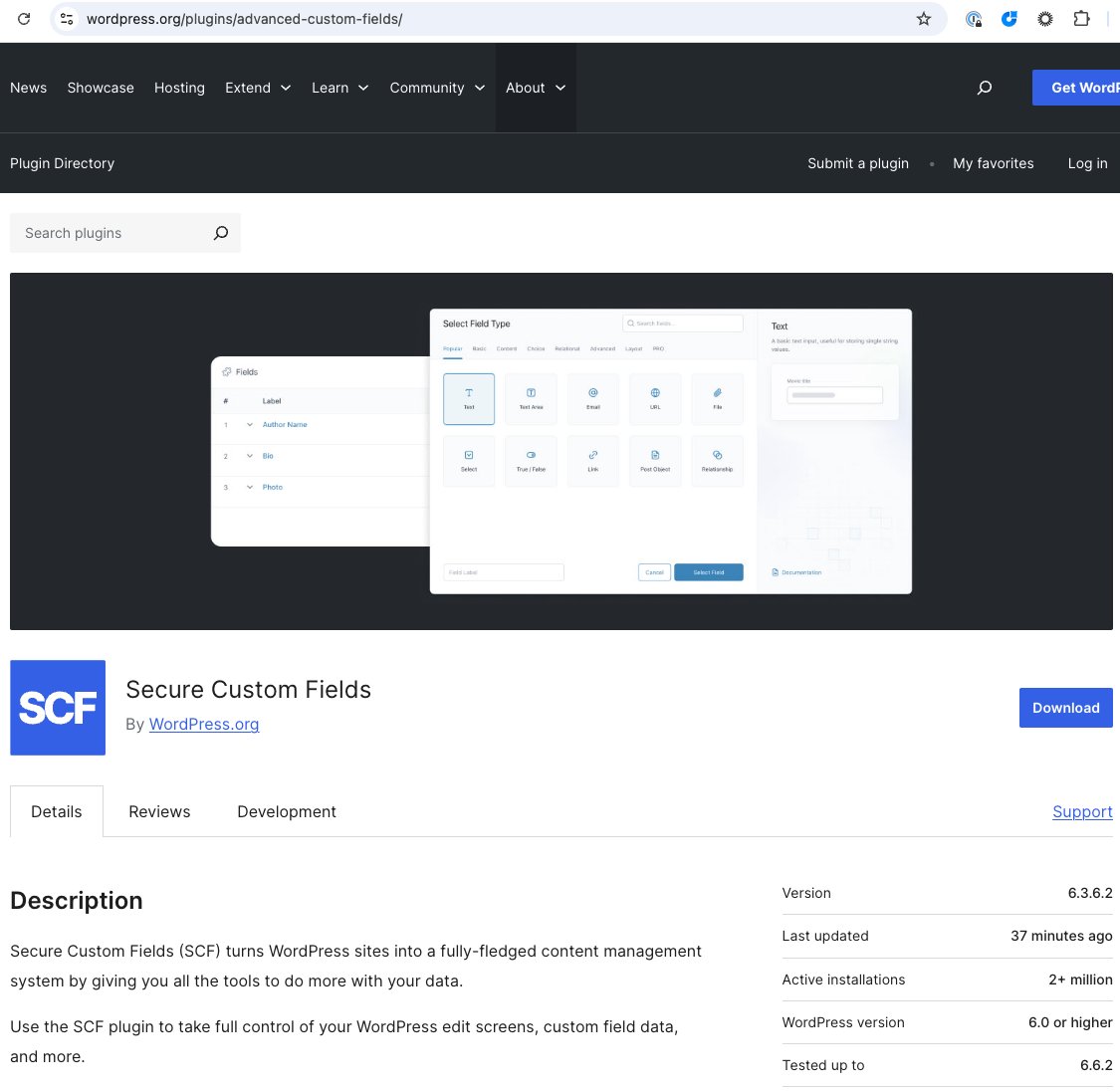
Over the weekend, [the WordPress.org team officially forked](https://wordpress.org/news/2024/10/secure-custom-fields/) the popular [Advanced Custom Fields](https://www.advancedcustomfields.com/) plugin. Anyone with the plugin installed will get the new Secure Custom Fields plugin maintained by the WordPress.org team instead.

[Advanced Custom Fields](https://twitter.com/wp_acf)
[@wp\_acf](https://twitter.com/wp_acf)
We have been made aware that the Advanced Custom Fields plugin on the WordPress directory has been taken over by WordPress dot org.
A plugin under active development has never been unilaterally and forcibly taken away from its creator **without consent** in the 21 year history of WordPress.
[Posted Oct 12, 2024 at 6:27PM](https://twitter.com/wp_acf/status/1845169499064107049)
This is the latest change in [the ongoing battle](https://eric.mann.blog/wordpress-drama-from-the-sidelines/) between WP Engine (the authors of Advanced Custom Fields, aka ACF[1](javascript:void(0))) and Matt Mullenweg (co-founder of the WordPress project, leader of the project, and CEO of [Automattic](https://automattic.com/)). It wasn’t the most popular move.
#### Disclaimers
Before delving into any analysis or opinions, let me lay a few things out.
* I am not a lawyer. My opinions are informed not through intense legal education or review but from lived experience working in this space and my own personal feeling and sense of ethics.
* I do not now nor have I ever worked for either WP Engine or Automattic, though I did at one time *apply* to work for the latter. I have previously hosted both my own sites and clients sites with both parties but currently [choose to *self-host*](https://eric.mann.blog/the-great-wordpress-migration/) all of my projects.
* I have no economic ties to any of the players in this current battle. Nor do I even work professionally with WordPress today – while I did work with and volunteer within the community for over a decade, I’ve been focused on other endeavors for the past ~8 years and merely use WordPress *personally*.
* What follows are my opinions. I reserve the right to change them on the availability of new information. You have no obligation to agree with me; I have no obligation to engage with any disrespectful disagreement.
#### (At Least) Two Sides
Few disagreements are ever truly binary. For simplicity, though, I’m only covering two specific angles.
On one side is a team who’s built and maintains a wildly popular freemium plugin[2](javascript:void(0)) for WordPress alleging outright theft of their project by Matt and the WordPress.org team.
On the other is the cofounder of the WordPress project, who directly owns and manages the WordPress.org domain and its projects, forking a popular plugin in the name of security.
Many on Twitter, Slack, and even Reddit have jumped up to declare the latter to be the villain in this story. While it’s easy to cast blame on an individual, the reality is not so easy.
#### Repository Bans and End Users
[Since last month](https://wordpress.org/news/2024/09/wp-engine-banned/), WP Engine has been banned from leveraging the free resources available on WordPress.org – a domain and project owned directly by Matt Mullenweg, who they are currently suing. This means they cannot leverage the free plugin and theme repositories on their sites. It also means their team cannot update and maintain any plugins or themes they’ve contributed.
Which leaves end users – many of whom are entirely unaware of this ongoing drama – in a hard spot. They are potentially exposed to vulnerabilities should they arise as the team can’t actually fix the issues and push out updates.
The right thing to do is to fork the plugin – Matt and his team can provide ongoing updates and WP Engine can go a different way.
Creating and maintaining a fork raises several tricky issues:
* How will the team inform and educate end users about the fork? Remember, most *users* of WordPress aren’t developers in the first place. Just explaining a fork is tricky – also explaining the politics behind why the fork exists is harder still.
* Given the active legal dispute began over trademark misuse, how can Matt and his team continue to provide updates (even if just for security) to ACF users without risking a further legal battle over potential misuse of ACF’s trademarks?
My preference would be for either a friendly fork or for the WordPress.org team to float security patches back upstream to ACF. Given the enmity of the legal battle at play, neither of those seem possible at the moment. So seeing the creation of a renamed fork[3](javascript:void(0)) was equal parts a surprise and an acceptable conclusion.
#### Right and Wrong
At least one person reached out to me over the weekend to ask if I was “still supporting Matt” after the plugin fork. To answer as succinctly as possible: yes.
We’ve disagreed about many things over the years. Sometimes publicly. More often in private. We’ve held impassioned debates on Trac, vehemently argued on Twitter, at least once debated in person at a WordCamp. At the end of the day, we agree on far more than we disagree.
Had our situations been reversed, I would not have employed the same tactics. But seeing from the outside where things started and how they’ve progressed, I can neither find fault with them either.
* 1Both Advanced Custom Fields and ACF are trademarks registered (pending) by WP Engine and are used in this article to refer to the plugin and the team that builds it.
* 2The core ACF plugin is free, but attempts to up-sell users to a paid “Pro” version supported by WP Engine external of the otherwise free community repository.
* 3The Secure Custom Fields plugin is using the same *slug* as ACF used previously to force end users from one plugin to the other. Ideally this will change down the road to remove all uses of “acf” from the plugin, but that’s up to the development team., WordPress: The Drama Continues, Eric Mann, 01ja6pzxx8fbzvrn04w6x2aq2w.