WordPress in 2026
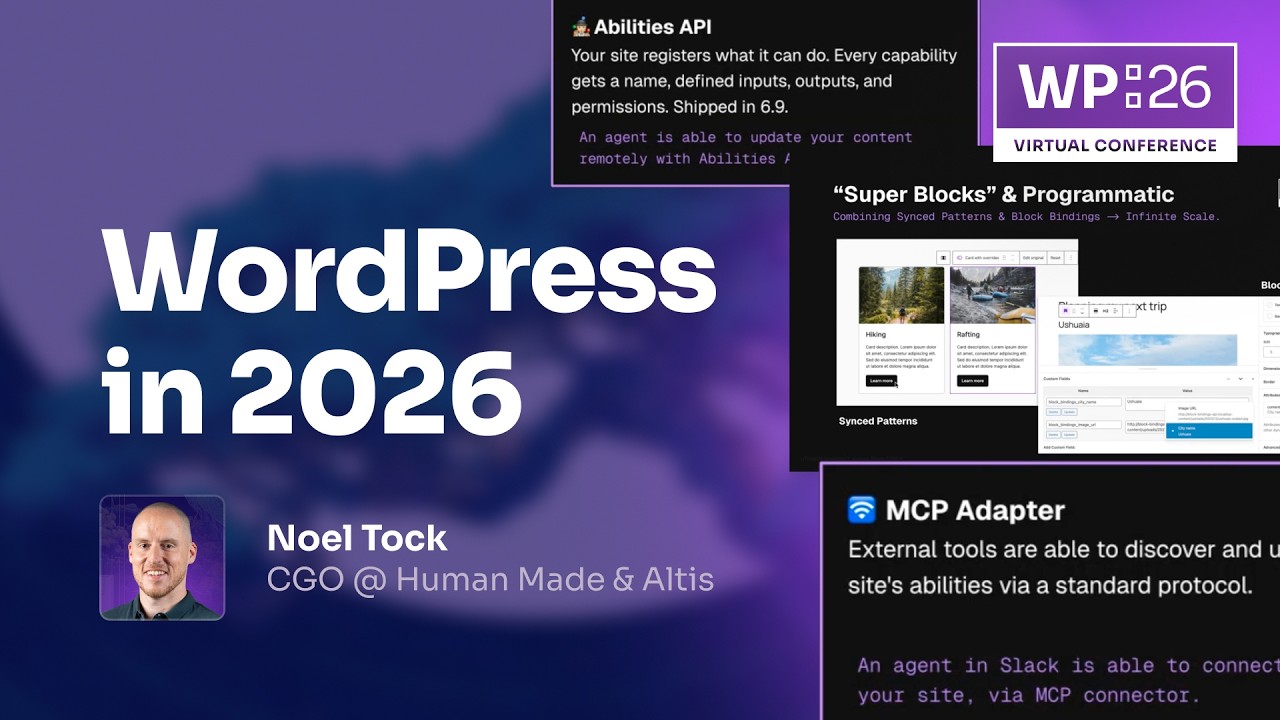
Hello everyone and uh welcome. We are live from WP26 most recent uh humanmade event. Um thank you so much for being here today wherever in the world you're uh joining from. Um my name is Petia and it's my absolute pleasure to be your host for today. We're going to go through all the
sessions together. Um, this is the second year we're staging uh this event and last year was really really good. Um, it was a blast, but this year's lineup I think might be one of the best that we've ever put together at the humanmade event. So, I'm really excited for you to be meeting uh everybody. So, what is this event about? Um, this event is not a retrospective. It's uh um also
not a celebration of where WordPress has been, but it's a focused honest conversation about where it is going right now in 2026 and what that means for the teams and organizations building on the platform every day. So we're living as you all know in unprecedented really volatile times both in our jobs in tech and in a wider sense in the world and with what's happening everywhere. Things are uncertain and
they're changing very quickly. Um it's exciting to an extent but also quite overwhelming isn't it? So today we're going to lean into both sides of all of this change. There are sessions designed to paint a vision of where we're headed and there are sessions designed to offer guidance and advice about how to react and plan for the future. Also fair
warning, we're going to be discussing everything in the context of artificial intelligence. There are going to be quite a lot of discussions. If you're here and hoping for not another AI discussion topics, you might be a little bit disappointed, but I really hope you're not going to be. Um, okay. So, a few themes for today. Um, what are we going to be focusing on? The agentic CMS and some amazing new ways of
using WordPress. It's definitely one theme. uh the new frontier of search and how we all need to adapt with AI transforming how people discover content. Um another big topic is going to be accessibility and how accessibility is affected by change and uh how the wider internet might be affected. Um we'll be hearing from some amazing brands and what they're plotting and how they're plotting their way through the confusing picture in our uh
panel discussion at the end as well. So stay tuned until the end. Right, speaking of amazing brands and really cool people, uh who are you going to be hearing from today? Um we have an extraordinary group uh of voices joining us today from companies uh running ahead of the curve and paving the new ways of working in our industry. You'll be hearing from the teams at News UK uh and
PMC Turn WordPress VIP uh all of whom are making serious and considered uh bets on WordPress in 2026. Um Yellow Pantheon and of course Human Made are also going to be prominently featured. Uh not entirely sure what happened here. Let's do it this way. Um, so a little bit of housekeeping before
we move on to our first session. Um, we love audience interaction. You're all already chatting. Uh, so please use the chat uh for any questions that you might want to ask our speakers. We're going to make sure that we uh keep some time for questions at the end of each session. Um, so the Q&A tab is a better is a better one to use for that. You can also post questions in the chat. We're going to be monitoring that as well. Uh, between
each session, there will be a quick pause. Um, but there's absolutely nothing that you need to do. We'll be pulling you automatically into the next session starting. Uh, so you know, you don't have to jump across sessions. If for any uh reason you experience some connectivity issues, um a like quick word of advice, a refresh of the Crowdcast uh tab is likely going to solve uh solve the confusion. Um
what else? Um, oh, if you accidentally navigate away from a session, you can find relevant links links to each talk on the left side of the screen in the event. And finally, um, all these sessions are being recorded and, uh, for everybody that is attending, we're going to be sending sessions to the links tomorrow. Um, all right, I think that is it for
uh, the time being from me. Uh I'm going to pass uh torch to null uh no talk our keynote speaker for today our chief uh growth officer here at humanmade is going to be setting out how we see the future of WordPress. Um no um over to you. >> Hey do you hear me?
>> Yes we do. >> Amazing. Cool. Uh I feel like every talk is a keynote talk. Um so I'm quite excited about everything that's uh coming today. Uh let me just get my screen up and I'm going to share this window here and that should work. Very cool. Okay. Cool. So um I have uh had the the great joy of spending the entire week in
Singapore uh between meeting our clients uh between uh two-day martekch conference which is right down the CMS alley um and really just a lot of just interacting with I don't know just as many enterprise stakeholders and buyers as I could imagine about CMS AI and all the topics and it has been quite eye opening. Um you know some of these things are assumptions that you may have
uh but then to have them confirmed also sets the tone uh in many ways. Um, one of the sort of larger things I've seen in the last couple days is that the entire concept around AI budgets has really just graduated, right? It has moved from this experimental phase to previously to this kind of proof of concept one and now it's really about how do we get ROI in production and the expected payback period is relatively
short. uh that can be really just months which is a very different uh posture than I'd say last year when you saw a lot of experiments and a lot of small projects here and there but now the budget is really dominating that and second there's you can really feel this tension around or rather this demand this need for things that just work from an AI perspective uh and that you really
is packaged, governed, ready to deploy, which again is very different than the AI conversation two years ago, 3 years ago where anything that was even promoted as semi package was still 90% consulting. And now we're seeing vendors trying to flip that on its head and have as much out of the box as they can. And this sort of off-the-shelf approach and instant ROI
don't usually go hand in hand, but maybe there are some windows of opportunity while various companies are at different stages of adoption. Um, so some companies may be trying to exploit that advantage and just be first to market within certain features or categories. But today I want to show you that WordPress is probably to your surprise better
positioned for this than you may think and that the beauty of this is that your current WordPress installations can get a significant bump from what's shipping right now. Also interesting is that WordPress may actually have an edge on other CMS's here and not because it ships the most polished AI features out of the box. quite the opposite actually. Uh it's because it ships some of the most comprehensive foundations out there. Open models, open abilities, open
protocols. Uh but we'll get to that. So let me start with the the content layer just to have um a bit of background because this is a WordPress in 2026 uh event. uh it's not mandatory on the agentic side of things but because we're talking about WordPress in 2026 um they are worth noting. So the first thing that I want to highlight is sync patterns and sync patterns are not
new to to this year. Um but they are in combination with other things very important and they do control design right uh and uh and and once you add a or you turn a block into a sync pattern uh you use it everywhere you edit it once and it's instance uh updates across your site which is great but the real gamecher I think in connection with this is a relatively new feature called block bindings uh and that is what you can
almost imagine as the counterpart to design and that's data. So block bindings allow you to inject dynamic content into the design from your database um uh Google sheets whatever it is just external APIs doesn't really matter uh wherever your source of truth lives can be connected into blocks um so you have one design template you have data injected dynamically um this scales to
thousands of pages and when combined It essentially creates programmatic content which I think is not necessarily the first thing we should all be building but that you can go to that extent very quickly is very powerful in my opinion and when AI generates content validates content or translates a block it it's operating on this structured bindable surface um and
having that available will make some of our lives easier when it comes to Agentic. And if you already use the block editor today, this is already accessible to you. Um, so it's really just a incremental change as opposed to some kind of huge revamp. Now, uh, the fun stuff. Let's talk about the AI layer. WordPress has essentially four things that you need to keep in the back of your mind, um, that in my
opinion together will change the future of WordPress. And even if that's not visible today, I'm quite sure it will become a lot more apparent over the coming weeks. I wrote a newsletter edition maybe 2 months ago where I was trying to predict the future in like 2030 and the exact workflows I sort of predicted then are now achievable. So the the rate of change is um rather stunning. Um, but let's let's dive in to
these primitives. Uh, because I think um once you're able to grasp these, it will make your lives a lot easier in trying to understand how you're going to solve certain pain points or build entirely new value. Now, the first one is something that's quite universal in the agentic space, and that is the MCP adapter. And that essentially allows your agent, your uh AI harness to connect uh to external uh
APIs, data sources, uh whatever that may be. Uh so in this case you may have an MCP adapter inside of uh claw code um or any other sort of solution and that allows you if you use the WordPress MC adapter uh MCP adapter to connect to your WordPress site and then have uh various abilities avail uh available to you and that is the second piece here
that is the abilities API. I sort of look at the abilities API as a a gentic evolution of the REST API. Um, that's probably the best way I think about it. And it's it you're you're essentially registering the inputs, outputs, permissions of what sort of capabilities or rather I mean as the name uh implies uh abilities
are available to agents uh working with your website. So something like um a very simple one would be uh you use the MCP to connect from Slack uh to or you connect your agent from Slack to your WordPress site. You send a command through to edit content. Uh I'm not saying this is an exact use case you would use, but that editing content would then be calling an abil uh an ability endpoint.
The third one is an extension of the abilities API and this is the workflows API. And what that essentially allows you to do is connect multiple abilities in a sequence as well as having agentic nodes between them. And if you want to pack or package all of that into a single ability, you can
do that, too. Now that is uh not yet in um WordPress. So the MCP adapter um and abilities API are already released. Uh but the workflows API and then the um fourth piece the uh WordPress AI client are things that are um coming very soon. And this last piece uh as you can see I've changed the color a bit is is not mandatory by any means
but essentially means that you can run your agents from your own WordPress installation. So instead of um accessing your WordPress site from an external point like cloud code um you access it from within uh the WordPress site and that may be like your chron jobs your uh your workflows that run on a on a on uh a certain schedule. Uh but all of that runs through uh the WPAI client and that
allows you to uh connect your own keys, connect your own models. uh and that is as we love it completely open. Now to give you some examples of how these things tie together um a good example I'd like to look at um for one which I think you know happens quite often is we see a lot of our clients that have multilingual multi-reion will have a lot of content and it's quite painful to go through the
entire process of creating translations for example. So here if we were to try and break this out into the agentic workflow um which is basically possible today already if I'm not mistaken um you may run your own model or run you know you may have open AAI set up uh through uh your own uh website uh you may then run a schedule to identify posts that have missing translations in my example
I'm saying this finds 137 posts um these then need to be translated to German, French and Dutch. Um which then result in 411 posts that then need to be reviewed for brand tone. Now the interesting thing about brand tone is that you're not going to necessarily extrapolate or extend a single brand tone that was meant for English into every region and language. So already here you may start
splitting into uh the regional nuances or language nuances uh for the different um um domains that you want to be able to uh translate for. And then going on from there, once you have that content all set, you may then want to update the SEO for all of this. Um, I do not believe that Yoast SEO has an abilities API uh set up yet, but I I' I'd imagine it's
pretty close. Um, and then depending on how you run governance, you may want to have manual review of everything. You may want to have a more pragmatic approach. Um, and then that is a summary that is then reviewed after the fact. And then lastly, um I think a very important part of all of this will be to have a complete audit trail, which is really who initiated the action, what was the action, which model did it run on, when did it run. Now, this would have to be created manually for now, but
I would assume that someone uh maybe you know humanade or someone else uh creates something to help support uh agentic audit trails. Now that is one example. Another would be um I've already hooked up uh our our plug-in uh accelerate into uh open claw and different places. So I I have a bit of experience with this but ultimately this idea of self selfoptimization I
think is is a big territory that we'll we'll land in. Um, and in my particular example here, um, it's really about trying to identify blocks that have a lot of traffic, uh, on any given website. Uh, potentially creating multiple variants, uh, for that block. And we don't have the variance um, we don't have the create variance uh, ability endpoint yet for accelerate, but that's coming soon. Um then potentially this pipes into Slack or somewhere else
to notify that the agent has identified an opportunity and has created multiple uh variants to test. Um after some time we may show the winner of such an experiment in Slack. Uh the agent may then se automatically select the winner to then revert to a regular block because that is the highest performing block. Uh and then again uh have an audit trail uh full log of all these actions.
So to zoom out a bit and to understand where WordPress sits in all of this, I've mapped out a bunch of what are essentially the point features of proprietary CMSs. Uh and you can see the ones that I've pulled out here which are largely around Adobe Experience Manager, Psychore, Contentful. And these may be around governed generation, brandaw aware AI, a lot of bulk
operations, um, agentic analytics, um, and then table stakes or what have become table stakes such as, uh, MCP tool access. And all of this is constructible on WordPress using the same primitives I just showed you. And I'm not going to walk you through every row. I I I feel like the the visual density of this is kind of the point, but the difference is in the assembly. An Adobe or Psychore or Contentful will
ship a finished product and WordPress ships the building blocks for enterprise teams with very specific requirements. I realize that it doesn't solve the offtheshelf need, but honestly, I think it's how you get exactly what you need. And I understand that this out of the box solution may be a great thing in the moment because it may drive ROI. It's
simply not sustainable over the long term. And I'll show you why. So part of the part of the ch there's there's a number of challenges here but I this is where I think that WordPress especially will flex a lot of its strength as time progresses and some of that comes back to proprietary CMS's racing to market to release some kind of point feature
whilst WordPress has spent a lot of time building a great foundation and as this race continues we may I'll see a lot of exponential growth on the WordPress side. But specific to the proprietary versus WordPress uh argument, I think one of the things I'm I'm really looking to communicate to the buyers and people I talk to um is a number of the items here. So, one of the challenges with proprietary CMS's is that they may uh
enforce their own model um or their own approach to which model should be used. Um, and that means that for potentially creating content, you don't have a choice of model, which I would personally struggle with because I use at least five or six models from three different providers and over time these models change from week to week or month to month. Bringing your own keys, uh, a lot of that is about um cost management. Um, if
you are being resold, uh, API credits, uh, sorry, AI credits, AI tokens, whatever it may be, uh, that may come out of markup, especially if it's coming through third party vendors. And again, you want that flexibility when models change. And it it's I mean if anything is constant in this market is that everything is just changing at lightning speed. There is no such thing
as a couple weeks of peace. So you may want to always change to the model that best suits your needs. And that may be the difference between having a solution that kind of works and one that really works very well. Now this is the big one uh in my opinion is that a number of these point features are not a proprietary version of the abilities API. They are a
set of features or abilities. Let's just call them abilities for now. Uh there are simply set in stone per featur uh per release. And that is extremely limiting when your business has a couple of differences that are just that may not just fit inside of this um pre-created ability very well. For WordPress, the ability layers will be
across core, will be across select plugins. So, wherever plug-in authors decide to release abilities. Um, and if they don't choose to do so, maybe other plug-in authors will will create extensions for those plugins. And then where I find a lot of the opportunity is essentially for you to create abilities on top of your own homegrown plugins for your website. And that is I I find just genius compared to being limited to a
handful of um tools essentially. Same with the workflows. Um, this is where it it really starts flexing because this is where you may want to have a very specific combination of abilities that are just not going to be covered by uh a proprietary CMS because of the default recipes or workflows it hands you.
And lastly, just having the full visibility, right? Um, some of these features may be sort of blackboxed in that you can't really debug what's going on on the model side, on the LM side, on the agentic side. Um, and here you're able to debug at every step, which is exactly what we need when we're trying to figure out how to get the most out of any agentic work. And lastly, this is more enterprise focused, but procurement is a huge issue. Um, you
want to be able to move quickly between models. You want to be able to not be locked into specific features. Uh, especially as quickly as this market changes. Okay. So, let me bring this together. Um, I I started by telling you what I've been hearing all week uh about the AI budgets graduating pressure to deliver uh the tension between wanting things now and then also uh needing to prove your agentic advantage. Um, but what
I've shown you is that WordPress already has four open primitives that let you build very similar capabilities to what proprietary vendors are already shipping. And that's really just the beginning of WordPress without the whole ecosystem coming behind it. But these are real APIs and real building blocks. And the difference here is that proprietary venders, proprietary vendors give you essentially what are their choices and WordPress gives you the
ability to uh choose yours and that's a huge difference. Uh I hear someone coming on. Peta, are you giving me the time? Is that what's happening? >> I I'm giving it a time. >> Okay. By by scratching your microphone. It's a little bit passive aggressive. >> I'm so sorry. >> I'm joking. Um, but I I will I'll um I'll wrap up on a note to say that if you want to start anywhere, um, just pick one ability to try and exploit. And
that may well be to do a self-healing audit whereby an agent just works through your website to augment your SEO, your current SEO to then be more in line with GEO and AEO uh, best practices. And that could be your first closed loop. and everything after that just compounds. So, I'm going to leave it there. Uh, thank you very much for listening and I'll pass it back to um Peta. >> Do you want to answer a couple of quick
questions? No, there are a couple of questions that have been asked in the audience. >> Yeah. All right. >> Let me close my thing. >> All right. So, uh, first question. How does the WP AI development compare to the work that Drupal has been building over the last two years in their uh AI recipe has been >> I don't know u I I I from I haven't looked at the Drupal stuff in a little while but my my understanding from it
when I last looked at the Drupal stuff is quite similar it's about creating the foundational pieces um and I mean it's I I don't know if I try to compare these two because they're so closely aligned, it's probably a lot more worthwhile to try and compare open source projects and their approach versus proprietary. >> Do you have an opinion on how open source projects are doing versus proprietary? I I I think uh yeah, I mean I think this
is the the the sheer fact that what is what has already been released is already coming very close to what proprietary solutions are offering on point features and package solutions. I think means that WordPress still has a lot of gas in the tank as soon as uh plug-in vendors start releasing as soon as we start maturing uh the foundational pieces and the primitives. Um I and then as soon as we start having contents and guides so uh I am writing a uh an
agentic guide for WordPress. Um so definitely follow humanmade on LinkedIn to see that first. >> Nice. Thank you. Awesome. All right. Um another question. Uh so James is asking, "My site already uses accelerate. What are the steps to hook that up with open claw? What do I need to do?" Oh, I love it. Choosing violence. That's great. Um
>> Um so this I'm going to try to keep it simple. Um you can always ping me otherwise. Uh but the steps are you need the MCP adapter. Um you then need to uh connect your site to um your sorry you need to connect your Agentic sort of MCP to your WordPress site. Make that work. Uh there's a whole sort of um authentication there. And then from there um you need to enable um
the abilities API in the Accelerate plugin. Uh that's on the settings page. Um so you just got to turn that on and then you should be essentially able to pull the abilities that exist. So if you want to copy paste all the abilities and the sort of documentation that exists already on the accelerate like docs page for AI, um you can then turn that into a skill and then leverage that skill uh inside of claw code or any other tool to
then run pretty sturdy queries that give you that data back. >> All right, cool. Uh so unfortunately we don't have time in the session for any more questions. No null there are two more questions in the Q&A session. If you want to maybe answer them in the session chat you can you can you can stay in uh the session otherwise everybody we're going to transfer you into the next session where we're going to chat about uh SEO and uh AI search
optimization with uh Alex Moss from Yost. Uh thank you so much null. Thank you. And I know you stayed really late for uh this. Uh really appreciate it. It was super insightful. So >> I'm already hallucinating. >> You are. Yeah. So have a good night and thank you once again for joining us despite of where you are in the world. Bye bye., WordPress in 2026, YouTube, 01kkmexf5v4xfjnjx0k1qm8f1d.