You need a connection to your notes
## Metadata
- Author: [[YouTube]]
- Full Title: You need a connection to your notes
- Category: #articles
- Document Note: ---
tags: [note-taking, zettelkasten, learning, creativity]
author: Morgan Harper Nichols
source: YouTube
reference: https://www.youtube.com/watch?v=SQAidyYqfnI
date created: 2024-12-19 10:30
---
# 🏷️ Title: You need a connection to your notes
## 🧰 Action Inbox
- [H1] Make personal connections to lecture notes — 00:00 #learning
- [H2] Use ICE taxonomy for deeper learning — 16:45 #methodology
- [H3] Read creative non-fiction for inspiration — 18:30 #reading
## 🧭 Table of Contents
- [📝 Summary](#-summary)
- [📖 Main Content](#-main-content)
- [🗒️ Notes](#️-notes)
- [📚 References](#-references)
- [🗣️ Paraphrase](#️-paraphrase)
- [📰 Newsletter](#-newsletter)
- [✅ Action Items](#-action-items)
- [🧪 Hypotheses](#-hypotheses)
- [📊 Methodology](#-methodology)
- [❓ Questions](#-questions)
- [🔮 Future Research](#-future-research)
- [💡 Implications](#-implications)
- [🧠 Learning Styles Assessment](#-learning-styles-assessment)
- [📊 Accessibility Assessment](#-accessibility-assessment)
- [🌍 DEIB Assessment](#-deib-assessment)
- [✅ Logical Validity](#-logical-validity)
- [🛡️ DARVO Analysis](#-darvo-analysis)
- [🎯 Conclusion](#-conclusion)
### 🔗 References
- [Original Video](https://www.youtube.com/watch?v=SQAidyYqfnI)
- [Scapple Note-taking Tool](https://scapple.com)
## 📝 Summary
- A theater PhD student demonstrates how to make personal connections with lecture notes in subjects you don't naturally care about
- She uses zettelkasten principles to transform "note-taking" into "note-making" through relationship building
- The process involves linking lecture content to existing knowledge, personal experiences, and broader philosophical concepts
- Example shows connecting geology content about cratons to personal memories and environmental philosophy
- Reading creative non-fiction helps prime your mind for making artistic connections to academic content
## 📖 Main Content
This video addresses the challenge of engaging with coursework topics that feel disconnected from your interests. The presenter argues that the solution lies in actively building relationships with your notes rather than passively consuming information.
The core principle is treating zettelkasten notes as "permanent notes" that require emotional and literal connections to existing knowledge. This transforms rote learning into creative knowledge-making that integrates new information into your personal understanding of the world.
Using a geology lecture as an example, she demonstrates how factual content about continental crust erosion can connect to philosophical concepts about the limits of human knowledge, and how learning about local geological formations (the Superior Craton) can link to personal memories and environmental ethics.
## 🗒️ Notes
#### ⏱️ [00:00](https://www.youtube.com/watch?v=SQAidyYqfnI?t=0) — [H1] The challenge of mandatory learning
- Key idea: Students struggle to engage with topics chosen by others rather than themselves
- Evidence: "what do you do if you're still doing coursework and you are forced to learn something that somebody else decided you should learn"
#### ⏱️ [02:30](https://www.youtube.com/watch?v=SQAidyYqfnI?t=150) — [H2] Introducing Scapple for visual connections
- Key idea: Different software can affect how lecture notes look and feel
- Evidence: "I'm going to use the note-taking software scapple to demonstrate how the different software can affect how your lecture notes look"
#### ⏱️ [03:15](https://www.youtube.com/watch?v=SQAidyYqfnI?t=195) — [H1] Connection deepens investment and memory
- Key idea: Making connections increases emotional investment and aids recall
- Evidence: "when we make a connection with something we become more invested in it and makes it more easily to remember"
#### ⏱️ [04:00](https://www.youtube.com/watch?v=SQAidyYqfnI?t=240) — [H2] Note-making versus note-taking distinction
- Key idea: Permanent notes require active knowledge creation, not passive information capture
- Evidence: "once something enters your zettelkasten as a permanent note it's because you've made a connection to it"
#### ⏱️ [05:30](https://www.youtube.com/watch?v=SQAidyYqfnI?t=330) — [H1] Building relationships with notes like with people
- Key idea: Find commonalities between yourself and your notes to develop connections
- Evidence: "develop a relationship to them in the same way that you would with a person how do you do that well you find things in common with them"
#### ⏱️ [07:45](https://www.youtube.com/watch?v=SQAidyYqfnI?t=465) — [H3] Treating zettelkasten as artistic work
- Key idea: Artists excel at finding connections between disparate knowledge from personal perspectives
- Evidence: "treat your zettelkasten as a work of art is what I'm trying to say"
#### ⏱️ [09:00](https://www.youtube.com/watch?v=SQAidyYqfnI?t=540) — [H2] Practical example: geology lecture structure
- Key idea: Start with basic lecture notes, then create linked cards for important concepts
- Evidence: "for every piece of information I thought might be important I made a new card about it and I linked it to this main note"
#### ⏱️ [11:15](https://www.youtube.com/watch?v=SQAidyYqfnI?t=675) — [H1] Continental crust connects to limits of knowledge
- Key idea: Geological erosion exemplifies the philosophical concept that some knowledge is permanently lost
- Evidence: "erosion of the continental crust is actually a really good example of this note that I already had about knowledge"
#### ⏱️ [12:30](https://www.youtube.com/watch?v=SQAidyYqfnI?t=750) — [H2] Personal geography creates emotional connection
- Key idea: Finding local examples of geological concepts creates memorable personal links
- Evidence: "I was curious what is a craton near me so of course I took the note on cratons"
#### ⏱️ [13:45](https://www.youtube.com/watch?v=SQAidyYqfnI?t=825) — [H3] Family memories anchor abstract concepts
- Key idea: Childhood experiences with Superior Craton rocks provide visceral connection to geology
- Evidence: "I used to do drives to Sudbury with my family and along the highway to Sudbury there would be these massive rocks"
#### ⏱️ [15:00](https://www.youtube.com/watch?v=SQAidyYqfnI?t=900) — [H2] Environmental ethics emerge from geological facts
- Key idea: Learning about drill holes in ancient rock leads to critique of human mastery over nature
- Evidence: "it makes me sad to think that we blew up so much of the superior craton for highways"
#### ⏱️ [16:45](https://www.youtube.com/watch?v=SQAidyYqfnI?t=1005) — [H1] ICE taxonomy: Ideas, Connections, Extensions
- Key idea: Learning progresses from information to connections to original critical thinking
- Evidence: "Ideas connections extensions ideas is literally just what you learned from the lecture"
#### ⏱️ [17:30](https://www.youtube.com/watch?v=SQAidyYqfnI?t=1050) — [H3] Extensions enable creative non-fiction
- Key idea: Connected notes provide material for original creative and analytical writing
- Evidence: "I could write a pretty interesting creative non-fiction piece just about the concept of drill holes"
#### ⏱️ [18:30](https://www.youtube.com/watch?v=SQAidyYqfnI?t=1110) — [H2] Creative non-fiction as inspiration source
- Key idea: Reading how experts connect their fields to personal experience models the process
- Evidence: "Robin Kimmerer is a botanist by education but she uses her knowledge of Botany to try to form a deeper connection to her indigenous ancestry"
## 📚 References
- [Braiding Sweetgrass by Robin Wall Kimmerer](https://milkweed.org/book/braiding-sweetgrass)
- [The Sound of a Wild Snail Eating by Elizabeth Tova Bailey](https://www.algonquinbooks.com/book/the-sound-of-a-wild-snail-eating)
- [Unthinking Mastery by Julietta Singh](https://www.dukeupress.edu/unthinking-mastery)
## 🗣️ Paraphrase
- Transform passive note-taking into active note-making by building emotional connections between new information and existing knowledge
- Use personal experiences, memories, and philosophical interests as bridges to connect with seemingly boring academic content
- Progress from basic information capture through connection-building to generating original insights and creative work
## 📰 Newsletter
**Making Learning Personal: How to Connect with Any Subject**
Ever struggled to engage with coursework that feels completely disconnected from your interests? This week's insight comes from a theater PhD student who shows how to transform boring geology lectures into personally meaningful knowledge.
The key breakthrough: treat note-taking like relationship-building. Just as you find common ground with new people, look for connection points between new information and your existing interests, memories, or values.
**Practical Application:**
Instead of just recording facts, actively link new concepts to things you already care about. A geology fact about rock erosion becomes a meditation on the limits of human knowledge. Local geological formations connect to childhood memories and environmental ethics.
**Try the ICE Method:**
- **Ideas**: Capture the basic information
- **Connections**: Link to existing knowledge and experience
- **Extensions**: Use connections to generate original insights
This approach works for any subject because it integrates new learning into your personal knowledge web, making information more memorable and meaningful.
Resources: [Learn WordPress](https://learn.wordpress.org/), [Developer Docs](https://developer.wordpress.org/), [WP-CLI](https://wp-cli.org/)
## ✅ Action Items
#### DevRel
- Create connection-building workshops: teaching developers to link technical concepts to personal interests and projects
- Developer experience: design onboarding that helps newcomers connect new frameworks to familiar concepts
- Community management: facilitate discussions where members share personal connections to technical topics
#### OSPO
- Developer Support: train teams to help contributors find personal motivation in project goals
- Community Engagement: create pathways for maintainers to connect project work to broader values
- Strategic Alignment: develop OKRs that connect individual interests to organizational objectives
#### Community
- Contributors: design first-issue programs that align with contributor interests and backgrounds
- Maintainers: provide templates for connecting technical roadmaps to community values and use cases
#### WordPress
- Training: develop lesson plans that help learners connect WordPress concepts to their existing projects and interests
- Documentation: create examples that bridge technical concepts with real-world applications across different industries
- Community: design meetup formats that encourage personal storytelling about WordPress journeys
## 🧪 Hypotheses
- Students who actively connect new information to personal experiences retain knowledge longer than passive note-takers
- Creative writing exercises about technical subjects increase engagement and understanding in STEM fields
- Visual note-taking tools with linking capabilities improve connection-making compared to linear note formats
- Reading creative non-fiction in one's field of study enhances ability to make interdisciplinary connections
### 📊 Methodology
- Compare retention rates between connection-based vs. traditional note-taking over semester timeframes
- Survey engagement levels before/after implementing ICE taxonomy in coursework
- Track creative output and academic performance correlation in interdisciplinary writing assignments
### ❓ Questions
- How can educational software better support connection-making between disparate knowledge domains?
- What role does personal narrative play in professional knowledge development?
- How might this approach scale to organizational learning and knowledge management?
### 🔮 Future Research
- Investigate optimal ratios of factual to connective content in educational materials
- Explore applications of relationship-building metaphors to other learning contexts
- Study long-term knowledge retention benefits of creative connection-making
### 💡 Implications
- Practice: Learning becomes more personally meaningful and memorable through active connection-building
- Education: Curriculum design should explicitly scaffold personal connection opportunities
- Technology: Note-taking tools should prioritize relationship visualization over information storage
### 🧠 Learning Styles Assessment
Reading level estimate: 9th-10th Grade
#### 👀 Visual learners
- Present: Video demonstration of visual note-taking software, mind-map style connections
- Improve: Static diagrams showing connection hierarchies, before/after note examples
#### 🔊 Aural learners
- Present: Spoken explanations and examples throughout video
- Improve: Audio-only version highlighting key connection strategies
#### 🗣️ Verbal learners
- Present: Rich vocabulary, analogies to relationship-building, storytelling examples
- Improve: Glossary of zettelkasten terminology, more step-by-step verbal instructions
#### 🧩 Kinesthetic learners
- Present: Hands-on software demonstration, step-by-step note creation process
- Improve: Practice exercises, downloadable templates for connection-making
#### 🧠 Logical learners
- Present: ICE taxonomy framework, clear progression from information to insight
- Improve: Decision trees for connection types, systematic approaches to relationship-building
#### 🧑🤝🧑 Social learners
- Present: Community interaction through comments, shared examples
- Improve: Peer review processes for connection quality, collaborative note-making exercises
#### 🧘♀️ Solitary learners
- Present: Self-directed exploration of personal interests and memories
- Improve: Reflection prompts, private journaling integration
#### 🌿 Naturalistic learners
- Present: Geological examples, environmental ethics connections
- Improve: More nature-based metaphors for knowledge relationships, ecosystem thinking
### 📊 Accessibility Assessment
#### Screen reader semantics
- Present: Clear verbal descriptions of visual elements, logical heading structure
- Improve: Alt text for software screenshots, explicit description of visual connections
#### Keyboard navigation
- Present: Standard video controls accessible
- Improve: Timestamped navigation, keyboard shortcuts for key concepts
#### Contrast and readability
- Present: Clear visual distinction between note types in software demo
- Improve: High contrast mode demonstration, larger text examples
#### Media and captions
- Present: Full transcript provided, clear audio throughout
- Improve: Professional captions with speaker identification
### 🌍 DEIB Assessment
#### Cultural breadth
- Present: Acknowledges different academic disciplines, includes indigenous knowledge (Robin Kimmerer)
- Improve: Examples from non-Western knowledge systems, global geological examples
#### Inclusive language
- Present: Gender-neutral examples, acknowledges different learning contexts
- Improve: More diverse personal background examples, accessibility-first language
#### Neurodiversity support
- Present: Multiple connection strategies, visual and verbal explanations
- Improve: Explicit discussion of different cognitive approaches to connection-making
#### Representation
- Present: Features work by indigenous scholar and female scientists
- Improve: More diverse range of creative non-fiction authors and academic perspectives
### ✅ Logical Validity
#### Strong reasoning
- Deductive strength: Clear progression from connection theory to practical application
- Inductive strength: Personal example generalizes to broader learning principles
- Analogical strength: Relationship-building metaphor effectively illuminates note-taking process
#### Fallacies
- Hasty generalization: Single geology example may not represent all "boring" subjects
- Appeal to novelty: Newer connection-based methods not necessarily better than traditional approaches
#### Tone of voice
- Overall tone: Encouraging and personal, models vulnerability in sharing learning struggles
### 🛡️ DARVO Analysis
- No DARVO patterns detected - video maintains supportive, educational focus throughout
## 🎯 Conclusion
The key insight is transforming note-taking from passive information capture into active relationship-building. By finding personal connections between new information and existing knowledge, students can make any subject more engaging and memorable. The ICE taxonomy (Ideas, Connections, Extensions) provides a structured approach to move from basic information through personal connection to original insight. This approach treats learning as an artistic practice of finding meaningful relationships between disparate knowledge domains.
## 🧱 Refactor Appendix
### 📚 Literature Split Pad
### [H1] Connection deepens investment and memory retention
> [!quote] [You nee
- Document Tags: [[reading]] [[learning]] [[methodology]]
- Summary: You need a connection to your notes
- URL: https://www.youtube.com/watch?v=SQAidyYqfnI
on this channel I tend to give examples of note-taking about things that I already really care about and this is because I'm in a PhD and I got to choose the topic that I research but what do you do if you're still doing coursework and you are forced to learn something that somebody else decided you should learn and write assignments on topics that you literally don't care about but you still need to take notes and memorize that information in this video I want to share with you how I connect more deeply with my lecture notes
regardless of the topic and my apparent interest in it and this is part two of the previous video that I posted but you don't need to have seen that one in order to get something out of this one in that video I shared how I take lecture notes and it was based on a question I got from one of my Instagram followers and to demonstrate how I take lecture notes I use the software obsidian in this video though I'm going to use the note- taking software scrl to demonstrate how the different software can affect how your lecture notes look and also because scrl is SP answering
this video thank you so much so let's return to the question I received on Instagram that is driving these videos from car in the second part of their message Caro asked do you have any idea how to make working in a natural sciency settle Casas in more fun because the way you connect with your notes with ideas and creativity really speaks to me but I don't see a way I could do that when most of my notes are about types of rocks or physical Concepts or summaries of papers do you have any ideas well yes as it so happens I have tons of ideas
and that is the topic of this video so the whole goal of a settle casting is to deepen the connections between your various knowledges when we make a connection with something we become more invested in it and makes it more easily to remember and think creatively with that thing when we connect with a piece of information it becomes a part of our personal knowledge and gets so deeply integrated into the way that we think that we can't even imagine a time when we didn't know that thing so when you're taking permanent notes for your ttle Cason don't think about it as note
taking because you are not taking notes if you were taking notes that's what we would call in the tle casting Community fleeting notes and it's what you do before something enters your ttle Casten as a permanent note once something enters your ttle cast as a permanent note it's because you've made a connection to it and that connection is a literal connection within whatever note-taking software or paper and Pen you use but it's also hopefully an emotional connection through that
literal connection so some people call what we do in a ttle Casten note making instead of note taking you can't just take somebody else's knowledge the way you can take information instead you have to make personal knowledge for yourself so my biggest recommendation to Caro is to make a connection to your notes develop a relationship to them in the same way that you would with a person how do you do that well you find things in common with them right so I'm a theater scholar and maybe you're a natural sciences scholar so we're a little bit different from each other and
I don't care about you right now but I ask what movie you like and it turns out your favorite movie is burlesque with Christina Aguilera which is also my favorite movie and so we develop a connection we've started the process of relationship building so how can you do that better with your notes well I'd like to show you using this video's sponsor scle scle is a visual note taking tool that combines an infinite canvas with documents and the bir directional linking necessary to form connections between your notes because it's browser based you can share scle boards with other making it great for
team leaders for students researchers Educators so if you're looking for a notetaking software that is maybe a bit more visually Dynamic than the free options on the market then you can try out scrol with my discount code below for 10% off a personal Pro subscription to scrol just use the code Morgan July 10 at checkout or the link in the description box and you can get that discount plus that is an affiliate link so I'll get some Kickback if you purchase scle through my Link at no extra cost to Carol asked me
specifically about making more creative notes within a natural sciencey ttle Casten now I'm not a natural science student and so take everything I'm about to say with a grain of salt and if you're looking for an actual representation of what a scientist would do with their ttle casting then I am not the channel to follow because my PhD is in theater and performance studies but perhaps what my Arts degrees might be good for in this case is finding interesting Creative Connections between seemingly disperate pieces of knowledge especially ones that are personal and
can become a part of the story of ourselves really I think that's a big part of what artists do and how they get inspired is just forming connections between things in the world just having a mind and an eye for the world that sees the connection points between things and an artist is always working from their very personal idiosyncratic perspective and that's how I think that you should approach your ttle Casten as well treat your ttle Casten as a work of art is what I'm trying to say and here's how what you're looking at right now in
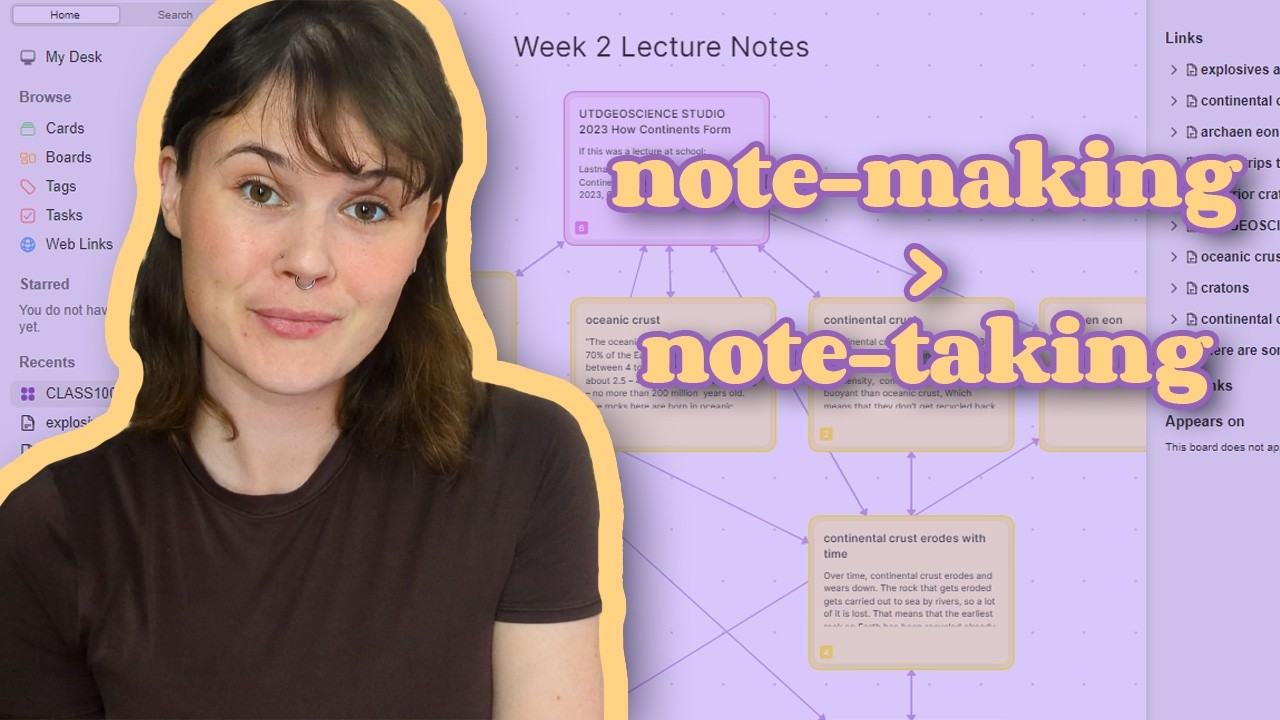
my scrl is a board and I have called this board class 100 Natural Science lectures uh just some generic pretend class name and if I was taking notes on lectures in scrol as opposed to obsidian this might be how I would do it I would create a board for the entire class and then I would create notes for the individual lectures so here is the note for the lecture that I was taking notes on this is just a lecture that I found on YouTube it was called how continents
form I figured I would literally use an example of rocks since Caro specifically mentioned rocks in their message to me and I'm here to tell you about how the oldest continents formed so if this was a lecture at school I would put my MLA formatting for the title of the lecture and its location and date and everything at the top of this card and cards are what scr calls notes and then because this was YouTube I literally copy and pasted the transcript from the YouTube video but if this was a class lecture then you might just be taking notes as
the professor speaks once my transcript was in this note I read back through it and tried to pull out points that I thought might be important if I was trying to regurgitate the information from this lecture later and for every piece of information I thought might be important I made a new card about it and I linked it to this main note so for instance my card on the continental crust I put a quote from the video on there I linked back to the video itself so there's that link and then in this
case I also started linking directly to other notes that specifically had to do with continental crusts um in this case the idea that the Continental cross erodes with time so I've made my lecture note and then I've made each of these kind of boring notes just about the literal information that was given to me by the lecturer and those are permanent notes because they link to the original lecture but to really make a note super permanent we have to form more connections to it so let's get to know these ideas and see where we can find some connection points between me and my
life and cratons or the continental crust since I've already brought up the continental crust let's go down into this idea that the continental crust erodes with time so I took this note writing that overtime continental crust and I've linked to continental crust erodes and wears down the rock that gets eroded gets carried out to sea by Rivers so a lot of it is lost that means the earliest rock on Earth has been recycled already and is inaccessible to us so we can't know much about the earliest cont of La Cross from Earth's first 2 billion
years okay so I'm not a geology student I'm not a geologist this is not a piece of information that I Morgan personally need to know and again I'm not a geologist so this information might not be entirely accurate but what I did find interesting about this that does link to things that I'm interested in is that it suggests our knowing is never finished and that there are some things in the world that we will never know and this note knowing is never finished is something that was already inside my subtle cast and it's been there for a
while and I got this idea from a totally different source so now I've built like quite a deep connection erosion of the continental crust is actually a really good example of this note that I already had about knowledge and then I also created a new note to try to like tie up some loose ends in my settle cast in between continental crust erosion and the idea that knowing is never finished so I created this note called there are some things we will never know and I wrote although knowing is never finished there are some things we will not and
cannot ever know because they've simply been lost and if I scroll down I can see that there's a backlink to Continental cruster roads with time but thinking about it now I actually maybe want to make that link more explicit so I'm going to type it out directly in the note to add a connection in a card in scrol you just type a plus sign and then start writing out the note you want to connect to or searching for something and this little scroll bar search comes up down here and I want to connect to continental crust AR with time so
there's my example for that note so that's a really basic version of how you form these deeper connections to the things that you're learning and you can use pretty much any topic like rocks as an example for the thing that you're really interested in I'm going to show you one other way I tried to make a creative connection between myself and my new found information about rocks so that I could better remember the notion of cratons Craton is not a term I had ever heard before listening to this YouTube lecture on cratons and I'm
pretty sure this lecture had been on a specific Katon in the United States but I'm in Ontario Canada so I was curious what is a Katon near me so of course I took the note on cratons I linked it to the idea that continental crust of roads with time and that there's some things I will never know and I linked it back to the original one and then this wasn't in the lecture but I started searching for a Caton near me so that I could make a personal connection to the idea of cratons and I found out about the Superior Katon so I'm going to click on
that note and I just pulled a quote from wikkipedia obviously you can do deeper research than Wikipedia but for the sake of example the superior Craton covers central Canada and occupies Northern and central part of Quebec extending through southern Ontario which is where I am so I actually have personal experience with this Katon I've seen this Katon because I used to do drives to Sudbury with my family and along the highway to Sudbury there would be these massive rocks on the side of the road which I always
thought was like so fascinating and beautiful and could never stop just staring out the window at these gorgeous rocks so I made a note that this reminds me of family trips to Sudbury and I created that connection so here is those rocks on the side of the road so anyway I wrote down my thought that growing up sometimes I drive to subury and I don't remember Sudbury but I do remember driving there because of these gorgeous rocks and I wrote you could see the drill holes didn't know
the term drill holes before I started learning about the superior Katon and the Rocks along the highway to Sudbury but they're called drill holes and it is evidence of where explosives were used to destroy rocks for highways and so I actually made a note about that because I find that so fascinating so here's what the drill holes look like these super straight semi-cylindrical lines down the rocks on the side of the highway and then even though the original lecture that I was watching didn't mention explosives or drill holes um I did quote from the original lecture
and I wrote that knowing now that Arc and cratons preserve an important record of crust formation and growth through Earth's history so here's the thing that I learned directly from the lecture just a piece of information that I'm trying to form a connection to it makes me sad to think that we blew up so much of the superior Craton for highways these things are like the oldest things on earth and we can use them to learn so much about our history and here we are just blowing them up so that we can form new history through them which is kind of poetic in itself but anyway I
continued to reflect on this in the moment and kept writing I wrote at some point someone saw that rock formation as getting in the way of human culture rather than being a necessary part of human's life on earth that is shared with so many other beings in the case of explosives used for highways the human desire for Mastery is destructive quite directly and I linked to a note that already existed in my ttle Casten on human desire for Mastery as destructive which was an idea I got from the book unthinking Mastery by Julieta Singh and connects to other things from lure Etc
and then I wrote I wonder if the highway Builders imagined that humans are part of the environment rather than the environment being an obstacle humans have to overcome would they have designed it differently so a little bit of a tangent here but there's a learning taxonomy called ice which stands for ideas connections extensions ideas is literally just what you learned from the lecture it's just that information it is these uh yellow pieces of information that haven't been formed connections to yet connections are what we're talking
about here I'm forming connections between the lecture and other knowledge that I have whether it's my memory or my past notes and experiences and uh readings that I've done but in the ice learning taxonomy there's this third level of learning called extensions and this is where you have these connections between existing things and you use those to springboard into coming up with your own ideas and your own critical thinking and questions about the world that you could then go on to answer and so that's where I ended up getting to in
this random uh note-taking session that I literally just did for the sake of this video because Caro mentioned rocks and I don't know anything about rocks but already because of this process of writing down the information and then forming connections between it I was able to get to that third level of learning that extension point where now I could write a pretty interesting creative non-fiction piece just about the concept of drill holes on my family trip to Sudbury and I have a better
understanding of the geological backdrop for those ideas because of this lecture that I watched so no I'm not interested in rocks necessarily but I am interested in the way that human culture thinks about the environment and that can be exemplified by using explosives to destroy these super old rocks to create highways and having an understanding of geology would definitely help me tell that story so I'm going to close these notes now and give you a little Zoom out so that you can see again with context
what my note taking session looked like I've got um a board which is where I'm storing all of my notes about the entire class I've got a lecture note in pink at the top uh and just the label that this is my week two lecture notes and then underneath the pink note I've got five yellow notes which are the literal pieces of information that I had to learn from this lecture but then down here all these white notes are ideas that respond from those lecture notes
that don't have to do directly with the lecture notes but the lecture notes helped me investigate and then of course each of these white notes also have like a bunch of links to things that aren't even on this board at all they're just in other parts of my ttle Caston so to go back to Cara's question then they asked do you have an idea of how to make working in a natural science he ttle Casten more fun I think that making personal connections to your lecture content does make that lecture content more fun to learn about obviously it
takes more time and it's maybe more difficult but learning should be challenging because if you aren't challenged then you probably aren't learning I hope Carol this gave you an example of how you can connect your notes with other ideas and with creativity and as a final suggestion I actually want to recommend that you read some creative non-fiction so not necessarily what your natural science professors are assigning you in school but stuff that other natural scientists have written for a popular audience and how they made connections between Natural Science and more creative or
philosophical or personal concepts for instance one of the best non-fiction books I've ever read is called braiding sweet grass by Robin mimer Robin mimer is a botanist by education but she uses her knowledge of Botany to try to form a deeper connection to her indigenous ancestry I also really loved the short and quiet book sounds of a wild snail eating by Elizabeth Tova Bailey in this book we do learn a lot about snails but Bailey also oo tries to connect her Newfound knowledge of the Natural
Sciences to her own medical condition to try to Grapple more deeply with that personal experience if anybody else has other creative non-fiction book recommendations where a specific academic field that one person might find boring has been connected to something more deeply personal and creative then please drop them in the comment section below because reading how others have made these deeply artistic and personal and philosophical and metaphorical connections to their super niche knowledges can be a good way
for you to prime your mind to make those connections within your own settle Casen anyway that's all for this video thank you so much to scrol for sponsoring if you liked the workflow that I demonstrated to you here then you can use my discount code in the description box below or the link to get 10% off of scrol personal Pro subscription keep sending me questions in the comments here and through Instagram and I'll see you in another video again soon bye everybody, You need a connection to your notes, YouTube, 01ka8mgp15n2eafmwtks0dr5pg.