YouTube Video 4xGywnoNCEI
## Metadata
- Author: [[YouTube]]
- Full Title: YouTube Video 4xGywnoNCEI
- Category: #articles
- Document Tags: [[productivity]] [[progress]] [[study]]
- Summary: YouTube Video 4xGywnoNCEI
- URL: https://www.youtube.com/watch?v=4xGywnoNCEI
Hi everyone, this is Tom and in thisvideo, I want to talk about how to turnyour studying, your revision, yourlearning for whatever kind ofcourse you’re doing into a game, andparticularly a kind of addictive gamethat makes you want to do more studying.This is something that I’ve managedto figure out even as far back as my Alevels and then implement it throughoutuniversity and my postgraduate exams.
It really helps me to staymotivated. Ultimately, studying can bequite boring, and if you’re just, youknow, passively going into the library,getting out some books, copying out somenotes, it’s very under-stimulating, andyou’ll probably find that your attentionis drifting. You’re losing interest inthings, and you don’t really feel thatmotivated to study. Whereas, if you cankind of gamify it and turn it into anaddictive game that makes you want tokeep going back and doing more studying,improving your skills, and seeing progress overtime, that can really make you excited to go and study.And that’s what this video is all about. So, how doI implement strategies to turn studyingHow do you turn studying into a game?
And I’ve had times over thecourse of my many years of studying forexams where I’ve not turned it into agame. I’ve tried different strategiesthat don’t have a gamelikeapproach to them, and I’ve done muchworse in those exams even if I’ve workedharder. Um, so having a gamelikestrategy really helps. So, I want tostart by just going through some basicbenefits of doing this, like approachingit as though it’s a game. And sometimesthere can be this feeling that if you’rehaving fun, if you’re enjoying it, itcan’t really be effective. You’re notsupposed to enjoy studying. You’re notsupposed to getkind of like a buzz and a reward, adopamine kind of reward from studying.
But that’s not true. In fact, um, it’sactually better to approach it this wayin terms of how much you learn, how muchyou recall, how well you do in yourexams. So, the first benefit is it’s fun andengaging.So if you implement these strategies,studying will become more fun.Ultimately, if something is more fun,you’ll do more of it. And that way, ifYou do more of something; if you just domore repetitions, more practice, you'llget better at it. So the more fun it is,and the more engaging it is, the moreyou'll do of it, and the more you get outof it. Secondly, these strategies are actuallymoreeffective. So when something is like agame, what happens is your brainswitches on and says, your brain kind ofsubconsciously says, "I need to payattention to this. I'm going to gettested. I'm going to get, you know, I'mgoing to, there's going to be some kindof challenge here. I need to reallyfocus. If you're just passively copyingout notes, your brain says, "Well, thisis a very low intensity activity.
There's no kind of test here. There's nochallenge here. There's no fun here. I'mgoing to switch off." So, by engagingyour brain and really challenging it,that makes learning way moreeffective. Thirdly, it's more efficient.So, the game-like strategies, whichwe'll go through, and I'll talk abouthow you turn things into a game, makesit more efficient. You don't want to bespending 12 hours a day studying in theLearning for your course, whatever kind ofcourse you’re doing, into a game, andparticularly a kind of addictive gamethat makes you want to do more studying.
And this is something that I’ve managedto figure out even as far back as my Alevels and then implement it throughoutuniversity and my post-graduate exams.It really helps me to staymotivated. Ultimately, studying can bequite boring. And if you’re just, youknow, passively going into the library,getting out some books, copying out somenotes, it’s very under-stimulating, andyou’ll probably find that your attentionis drifting. You’re losing interest inthings, and you don’t really feel thatmotivated to study. Whereas, if you cankind of gamify it and turn it into anaddictive game that makes you want to
keep going back and doing more studying,improving your skills and your scores, andseeing progress over time, that can really make you kind ofexcited to go and study. And that’swhat this video is all about. So, how doI implement strategies to turn studyinginto a game?There have been times over thecourse of my many years of studying forA non-strategic way that’s going to leavebig gaps in your knowledge. You’renot going to cover everything, and you’renot going to feel motivated along theway.
And finally, it’s morecomplete. So, by approaching it thisway, you’re going to wantto, you imagine this like a game. Saythis is Mario, and you want to collectall the coins. You want to kill all thebaddies. You want to, you know, tick offevery check, everything on yourchecklist. And that gives you a sense ofsatisfaction from completing everything.And if you approach it correctly, you’llmake sure you cover everything, and youdo it in a game-like way where youreally tick off all the boxes, and thenthat means you’ll much morelikely cover the whole syllabus, andthere won’t be big gaps in yourknowledge when it comes to theexams. So let’s look at theprinciples. We’ve gone through thebenefits. Now let’s look atexactly what we’re going to do and theprinciples that we’re going toimplement to make studying more like agame.
The amount ofchallenge. So when you sit down tostudy, it should be challenging. Itshould be difficult. You should besuspicious if it’s too easy. If you sitdown and you’re kind of getting boredand it’s not stimulating you enough, ifyou’re not kind of struggling, if youcan listen to music and hold aconversation at the same time, studyingis not challenging enough. Firstly,that’s less fun. And secondly, that’sway less effective. If you go into thelibrary and you’re with a group offriends and you’re kind of half texting,you’re half talking to your friends,you’re kind of eating at the same time,you’re listening to music, andyou’re supposedly studying at the sametime, this is not going to help youlearn. It's going to take up way moretime, and it’s not going to be asstimulating and rewarding as somethingchallenging.
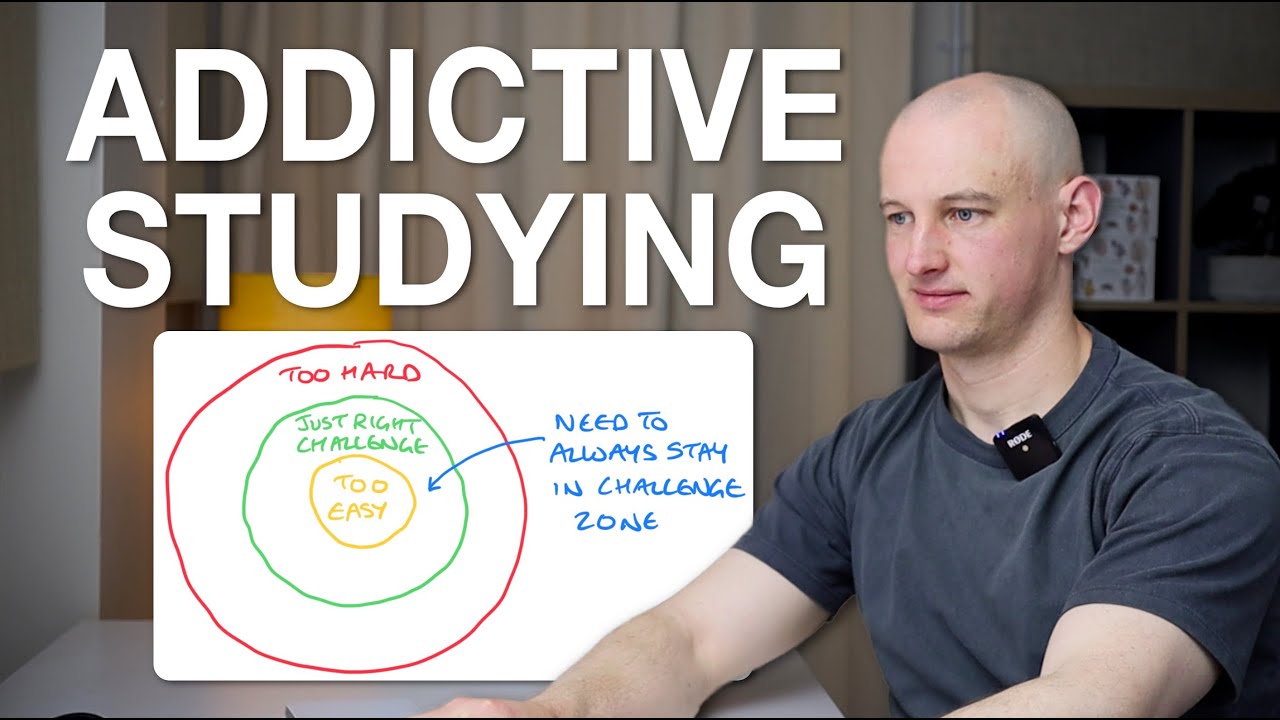
Every time I do a study session, I ampushing my brain to the point whereyou know I can’t do anything else. Ihave to just do that study session.There’s no chatting tofriends. There’s no texting because myThe brain is really being used to itsmaximumcapacity. So we can kind of illustratethis. Imagine this circle; you’re in themiddle of the circle, and you’restretching your capacity of your brainas you go further out from this circle.
In the middle is tooeasy. This is your comfortzone where you can sit down,chat, drink coffee, text people, scrollon social media, and do a bit ofstudying at the same time. Music's in.You can do this for like 12hours a day. This is not going to helpyou progress towards yourexams. The next circle ischallenging. This is the zone whereyou’re really making progress. You’rereally learning stuff. Youshould feelstimulated. You may have come acrossthis term, which is that you’re in astate of flow.
I was looking back at somepictures of me over the years. I wasjust with my wife looking at photosfrom years gone past, and there are quite afew photos that she’s taken of me.
When I’m studying, I look like I’m in acompletely different world. I’m kind ofreally focused on what I’m doing.And when I’m in that kind of zone,nothing in the outside world is going todistract me. You know, she struggledto get my attention. If you’re inthat zone and you get interrupted, itfeels painful. You get rippedout of that kind of state ofdeep work and flow, and then ittakes ages to get back into it. Ifyou’re able to just multitask, flippingback and forth between activities,conversations, and things, you’re not inthat zone. This is where it’s going
to be too easy. You’re not going to getthe same benefits in terms of thatreward system and that feeling of makingprogress, and your studying is justnot going to be aseffective. Of course, there’s anoutside zone which is toohard. If I were to say to go anddo a course on or try to read abook on rocket engineering orsomething, that would just be toohard. You’ve got to find the rightchallenging point that’s just theright amount of challenge and work.
At that level, you always want to behere when you're studying.If it's too easy or it's too hard, youneed to revisit the strategy and figuresomething out. It should be challengingto the point where you can only do, say, three or four hours a day maximumof this kind of work. That's where you get the most growth interms of your studying, but also themost reward and the feeling that you've had the right challenge. Youwouldn't want to play a video gamethat's just too easy or one that's justimpossibly hard. You want the rightamount of challenge. The secondprinciple is that you want constantfeedback. Ideally,immediatefeedback. I don't mean immediate as inwithin the next few seconds, but withinthat study session. You don't wantfeedback three weeks later on that studysession. You want feedback within thestudy session. So that looks like this.Youstudy. And by study, I don't just meanread, watch videos, or listen to podcasts.
Let's talk for a second about whatstudying means. You study, and thenyou getfeedback.So you learn; you get feedbackin terms of whether you actually learned thatthing. Have you retained thatinformation? Can youimpractice in a way that reflects yourexams? For me, in medicine, that wasoften multiple-choice question exams.When I did my psychology degree, thatwas essayexams. There could be otherthings, like if you've got math exams.
It could be solving mathproblems, like when I did my math Alevel.There could potentially be other types of exams aswell, and you want to get feedback on theway you would perform that exam, thatexam-specifictask. The same is true if you'relearning, say, guitar or a foreignlanguage.
The feedback you should implement should involveguitar practice with feedback on yourguitar practice or language practice.But I'm kind of getting ahead of myself.So you study, you get feedback, andthen you reflect on that.
Feedback and ideally record it as well.So you keep a kind ofscore, and then youlearn and you studyagain. So you've got this constant cycle.You're doing something, gettingfeedback, reflecting on it, learning,doing something, getting feedback. Andthis feedback cycle and this cycle ofkind of reflection and learning isreally how you make progress. It's alsovery rewarding because let’s say you'redoing anything that really gives you a lotof immediate feedback becomes quiteaddictive. So for me, practicingshooting basketball is very addictive.
I love going to a basketball court,shooting a basketball, watching it gothrough the net, watching it get a bitshort, a bit far, a bit to the left, a bit tothe right. Um, and that immediatefeedback of good shot, bad shot, badshot, good shot, and constantlyreflecting and getting better and doingthat over and over again becomes reallyaddictive. The same is true forstudying. You study through a topic, dosome questions, you feel theknowledge sinking into your brain andthrough the kind of feedback cycle.
You do the practice questions and getfeedback to say, "Yeah, it actually sunkin, and you did better on those scoresthan last time." It kind of becomesaddictive. So, I like to implementsomething called the testingsandwich for this.It gives you loads of feedback. So, thetesting sandwich starts. You sitdown for your study session, and I’vegot a whole video on the testingsandwich. You can watch me do it, butyou sit down for the study session, andthe first thing you do is short answerquestions. So, you’re going in cold. Sayyou’re studying cardiology. You’re goingin cold. You haven’t done any studyingtoday. This is the first thing you dowhen you sit down to study: a bunch ofshort answer questions. Immediately onthose short answer questions, you’regetting feedback. Immediate feedback.
You don’t know this, you don’t knowthis, you know this, you know this, youdon’t know this as you go through thosequestions. And that’s great. That makesyou immediately either excited about theones you’re getting right or excitedabout filling in those gaps in yourGettingwrong. Then you actually look at yourscores for the short answer question.
So you get a score from it, which tellsyou your current level of knowledge. Sothis could say your current level ofknowledge of cardiology is40%. That's great! You've got a score.You've got that feedback, and you've gotsomething to work on to try and improveit. If this is the second time you'regoing through cardiology, the first timeyou did it, your score might have been20%, and your score now is 60%. That'scool! You see your progress. You canactually see I went from 20% last time,and this is two weeks later. I'm doing
it again, and I've got 60% this time. I'mlearning stuff. I'm retaininginformation. And that feedback isexciting. And then you think, okay, inanother month, I'm going to dothese again, and I want to get80%. So, there's some incentive thatyou're building in. Your brain becomesexcited. There's a challenge here. Iwant to improve things. I can see someprogress. And so, that gets you kindof pumped up, and it's like doing aGame.
Then you do read andrecall. And you may have watched my fullvideo on read and recall. But again,this is like a game. So before you evenread through the topic, you're trying tofree recall everything you can rememberabout that topic without even looking atthe book. So you're sitting down andscribbling the stuff you can rememberfrom memory. And that's like a game.It's a challenge. It's forcing your brainto dig up what it already knows. Andit's quite rewarding if you can rememberstuff. It's exciting. If you can'tremember stuff, it's like a challenge.Okay, now I need to, when I go throughthis content, I know that I didn'tremember this. I need to remember it.And then as you're reading through, youread through and later on, you cover itback up and you try and recall what youjust read through from knowledge. Andthat could be details like, you know,say, drugdoses or numbers, um, or dates or wordsor people or names or whatever. Or itcould be concepts where you've got aconcept that you're trying toget your head around, say, how the bloodFlows through theheart, and you sit down and map outyou just scribble out that conceptas though you’re trying toexplain it to somebody. So you'rereading and you’re recalling, and eachtime you recall it, it’s like a test. It’slike a challenge. Um, and that challenge
kind of spurs you on. And then,if you make a mistake, youhave this kind of incentive to goback, find out the answer, then try anddo it again, and this time succeed. So,you’re always pushing yourself,pushing your boundaries, and trying togain moreinformation. Then,the final thing is thetesting sandwich. So, this is all in onestudy session as some kind of exampractice. So, you’ve done your shortanswer questions, you’ve done your readand recall, and now you’re going topractice putting that information intoan exam setting. So, this could be formedicine; it’s usually multiple choicequestions. So, you do some multiplechoice questions and you record yourscore for those multiple choiceInformation into practice. Again,recording your score is excitingbecause you have a score. You want toknow how well you’ve done during thatstudy session. You want to know whereyoustand. It could be a practice essay,or it could be like a math problem, aseries of math problems you need tosolve, or accounting problems, orengineering problems. If you’relearning a foreign language, youset yourself a challenge to puttogether some sentences, a vocabulary test.
If you’re learning an instrument, it could be toplay that song through. So, you’re doingsomething that replicates your exam andpracticing that, putting what you’vejust learned into action. Andimportantly, you record your score hereas well.
Okay. So onto the next thing. The nextaspect is you want to seeprogress, and this isrewarding. You need to track yourprogress over time. So you could thinkof this like you’re playing a video game.You’re doing levels, and you’re seeingall these levels get completed, and that’sIt’s very rewarding, and you’re seeing your characters level up, theirabilities improving, whatever kind ofthing you’re collecting. You’re seeingthat increase— the number of coins you’recollecting, the number of hearts, whatever that stat is. The sameidea needs to apply to studying. So youneed to be able to see your progress. Youwant to visualize the progress overtime. You want to see the work thatyou’ve
done. Traditionally, I think the waypeople tried to achieve this was bymaking a pretty set of notes. Theywould take a textbook, copy thattextbook into a pretty set of notes, andthen they’d have their notes to show forit. Having the notes to show for itmade them feel they’d made some sort ofprogress. They haven’t, because all thatthey’ve got now is a pretty set ofnotes. They don’t have it stored intheir brain. What matters for your examsis what’s stored in your brain. Thisway of tracking and gamifying it allows you to see progress. Youdon’t need to have an external set ofnotes to show your progress.
You see the progress of what's actuallyin your brain, not just what you'veproduced through some passivenote-taking. And you also want to seeyour scores goingup. So you want to see your scoresincreasing. So how do we trackthis? We have two options for this.One is a tracking table and you willhave seen videos that I've done whereI've talked about tracking tables, butessentially the tracking table lookslike this. On one side, you haveyourtopic, or you could call it yourmission. For example, this is what the topic is,for example, cardiology. But formaths, it could bealgebra, linear equations, things likethat. But for medicine, it would belike cardiology, endocrinology, renal, orit could be the anatomy of the heart,the anatomy of the muscular system, theanatomy of the nervous system, or itcould be the physiology of the heart,physiology of the liver, physiology ofthe GI system. So you break itdown into topics.
Cardiology,renal, gastro,etc. And then this is review one. This is review two, review three,and so on. So what you're doing here isyou're recording. Say you sit down for astudy session. Each box here is a studysession and inside that box you put thedate. You put how, um, how kind of, howwould you rate yourconfidence. So easy, medium, hard orsorry, um, low, medium, high confidence.
And then you rate, then you put yourshort answer question score from the testing sandwich, and thenyou do your exam practicescore. So for medicine that would beyour multiple choice question score. Ifyou're doing an essay, you would have tokind of self-assess that essay and giveyourself a score on the essay. Um, and soyou fill in the box. So this box wouldlook like that.So when you first go through a topic,you fill in that box, and then you dorenal, fill in that box. Gastro, fill inthat box. And these are like one dayafter the other. So Monday you might docardio, Tuesday you might do renal,Wednesday you might do gastro.
You work your way through all thetopics. When you’ve done the firstreview of all the topics, then you moveon to the second review and then thethird review, focusing on theweakest areas. What happens overtime as you go through the semester isyou see this tracking table fill in. Thisis like seeing a progress bar in avideo game where you’re seeing yourprogress. You’re seeing all the workthat you’ve done, and you’ll see thesescores start to go up. When youfirst start your first review, you mightsay, "Oh my gosh, I’m scoring 30% on theshort answer questions, 50% on thepractice multiple choice questions atthe end." You think, "Gosh, I’m sofar from my exam. I’m going to fail." Youknow, people have these doubts.
Whereas with this strategy, I would saythat’s kind of exciting because you seeall the progress that you can make,and then you become addicted to it. Yousay, "I really want to get back, doanother cardio session, and I want toimprove my scores." What happensis you see the scores improve witheach study session. So the second timeyour scores are like 30% higher.
That's exciting. Your confidence hasgone up, you're getting better atcardiology. Um, and then by the time youdo the third one, your exam scores arereally high. And then by the time you gointo your exam, you know, I have done somuch progress on this. I've got myscores really high. I've attacked all myweak areas. I've, you know, been throughso many feedback cycles. I'm going tosmash this exam. And then you do. Thenyou score really, really high inwhatever exam you're doing.
So by seeing your progress and gettingthat reward of the progression andseeing all the work you've done andfilling in this tracking table, itbecomes kind of addictive and you wantto do more study sessions. You want toimprove your scores, um, and you becomesort of very motivated about it. Okay,on to the next thing, which is pointnumber four: in order to make itmore like a game and more fun andactually more effective, you need to addsome timepressure. Andum, one of the problems if you have a lotof open time is that you never get theeffective stuff done.
Having some time pressure forces youinto taking action and doing the work.Anytime I've set aside aspecific block of time and known thatthat's the only time I have to getsomething done, it really forces me totake action and get the task done. If Iget up in the morning and think I've gota completely free open day to do loadsof stuff, what will happen?Nothing. If I get up and I have a veryspecific task I need to complete, and Ineed to get it done in this time period,it actually gets done. So they say, ifyou want to get something done, givethat job to a busy person because they'llactually ensure it gets completed. If yougive it to someone who is not busy,they've got so muchtime in the world that they neveractually get the task done. So, a fewthings to consider:set atime for your study sessions, or we couldcall them your missions. Let's say yourmission today is to do a study sessionon cardiology. Set a specific time for that.
It's like, okay, I'm going to getstraight to the library immediately, getstarted, and I'm going to block offIt takes three hours to get that done and setsome kind of alarmto endit. So, your goal is to completethis mission within this set period oftime. You don’t want to go over that time,because that kind of gives you a way ofrelaxing. It gives you a way of kind ofprocrastinating. You need that timepressure to really focus your mind. Andactually, there’s something fun aboutalmost like speed runningyour study sessions, forcingyourself to get it done. It’s moremotivating. There’s something calledParkinson’s law.
This states that work will expand tofill the time that’s allotted to it. So,if you set yourself three hours to do atask, you’ll get it done in three hours. Ifyou set yourself three weeks, that sametask will take you three weeks to getdone. So, you need to set yourself aspecific time. The way I do that and thething that’s the one productivityapp that I would recommend and that hascompletely changed my working issomething called Forest. Every time Isit down to do some work.
With this recording, this video, I've set myself a specific timeand a specific goal on the Forest appand pushed myself to actually get it all done within that time.That app actually records how much timeyou spend over the course of a day, aweek, a month. And so what you can do istry to increase the number of hoursthat you're setting asidefor working or studying and try toimprove that number over time. So again,that's like a game to try to get you todo more work. I'll make a whole videoabout that app at some point, but itreally has made a big change.
This time pressure really keeps you focused.What you can actually do is record the timeit takes you to go through that topicand try to improve that time overtime. This also stops you from gettingstuck. So if you are going throughsomething for the first or second time,there may be some concepts that youdon't quite click straight away,and you could spend hoursjust going around in circles on theseconcepts. And actually, what's better todo is try your best to understand them.
Improving your skills, improving your scores, and seeing progress over time can really make you kind of excited to go and study.And that's what this video is all about.So, how do I implement strategies to turn studying into a game?There have been times over my many years of studying for exams where I haven't turned it into a game.I've tried different strategies that don't have a gamelike approach, and I've done much worse in those exams even if I've worked harder.So having a gamelike strategy really helps.
I want to start by just going through some basic benefits to doing this, like approaching it as though it's a game.Sometimes, there can be this feeling that if you're having fun, if you're enjoying it, it can't really be effective.You're not supposed to enjoy studying.
You're not supposed to get a buzz, a reward, or a dopamine kind of reward from studying.But that's not true.In fact, it's actually better to approach it this way in terms of how much you learn, how much you recall, and how well you do in your exams.
The database, uh, the resources you use, sayyou’re all using the Zero to Finalstextbook, you’re all using the Zero toFinals question bank. Um, that way you’rematching, and then you have the same kindof tracking table. So you wouldmatch your trackingtable, and you can, uh, you can use theZero to Finals member site for a reallycool tracking resource that does thesame thing as well. But say you’rematching your trackingresource, you can compare trackingresources and become a bit competitiveabout it. So, say I want to boost myscores beyond like my friend Steve, for
example. I want to complete morerepetitions than that person. And thatkind of friendly competition pushes youto do more than you would otherwisedo if you were just on your own. Andthat’s very much harmless, and kind of itwill only serve to help everybodybecause you’ll both be competing. Thatwill raise the bar for everybody.Everybody will be working harder. It’llbe more fun, more exciting. You get somebragging rights. There’s kind of ascoreboard or a leaderboard. And, um, soit’s a win-win-win forEverything.
Um, numbersix is just really the final thing— really, it is to just shiftyour mindset. Let's start again.Shift yourmindset to a gamemindset.So really, this is just taking a wholemindset shift away from, you know,this is some kind of big exam. Um, and Ihave to do this boring study stuff. Idon't, I shouldn't be enjoying it. Itshould be a bit of a chore. Um, and, uh,you know, studying is more boring thanplaying video games or watching movies,or going out with friends or playingsports. And shifting your mindset to how
can I turn this studying into a gamewhere I get feedback, I have challenge,I see progress over time. There's somefriendlycompetition, and looking for the ways inwhich you can turn this into a game andchallenge yourself and, um, look for waysto make it more kind of addictive,exciting and make yourself want tostudy. So, I hope this video has beenhelpful. That's the end of the video. Ifyou want these kind of notes that I'veI've been making a really nice set ofnotes that you can refer back to if youdon't want to watch this 30 or 40-minutevideo again. You can find them.
There's a link in the description.You'll need a Patreon membership.That Patreon membership also gives youaccessto these videos a bit early, plus thefull members site. And if you'restudying medicine, this is theperfect resource for turning yourstudying of medicine into a game whereyou've got questions, a fact trainertool, which is a bit like Anki, andan OSI practice tool, and a trackingtool so that you can see your progressand track your progress over time.I'll see you in the next video, whichwill be tomorrow., YouTube Video 4xGywnoNCEI, YouTube, 01kac2rhqpkdhhg7rm6h3bpk8b.